Saturday of the Thirty-fourth Week in Ordinary Time – Lectionary: 508
Awake in a World That Wants You Asleep
Some days the world feels noisy, unstable, and quietly exhausting, and the temptation grows to just spiritually check out and coast. Today’s readings refuse to let that happen. They pull back the curtain on history, expose the spiritual battle underneath the headlines, and invite every baptized soul to stand awake, sober, and hopeful under the kingship of God.
In Daniel 7, the prophet is shaken by nightmarish visions of beasts and arrogant rulers that seem to dominate the earth. This is classic apocalyptic imagery from a time when God’s people lived under violent empires and needed assurance that evil would not have the final say. The message is not a coded puzzle for conspiracy charts. It is a revelation that behind every human kingdom stands a higher court, and that in the end “the kingship and dominion and majesty of all the kingdoms under the heavens shall be given to the people of the holy ones of the Most High”. The kingdoms of this world rise and fall, but the reign of God, fulfilled in Christ the King, is everlasting. CCC 668–672 teaches that Christ already reigns, even if the full manifestation of His Kingdom is still to come.
The responsorial canticle from Daniel 3 responds to that revelation with pure praise. The call goes out to “all you mortals”, to “spirits and souls of the just”, and to the “holy and humble of heart” to bless the Lord and “praise and exalt him above all forever”. This is the worship of people who trust God in the furnace, not only when life feels safe and predictable. Historically, this song is placed on the lips of the three young men in the fiery furnace, a reminder that the praise of God in suffering is one of the most powerful acts of spiritual resistance.
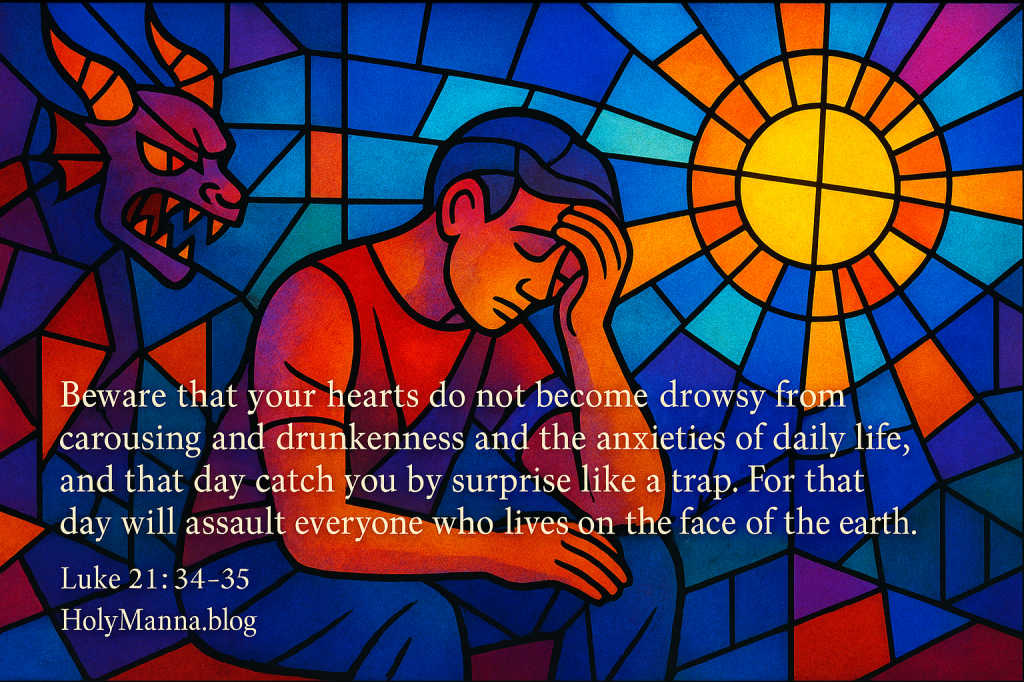
Then The Gospel of Luke brings all of this straight into daily life. Jesus gives a sober warning: “Beware that your hearts do not become drowsy from carousing and drunkenness and the anxieties of daily life”. The Lord is not only talking about end times in some distant future. He is talking about spiritual drowsiness right now. The same Christ who will return in glory as judge and king calls every disciple to “be vigilant at all times and pray that you have the strength… to stand before the Son of Man”. CCC 2730 speaks about vigilance of heart as part of the battle of prayer, a real struggle against distraction, discouragement, and sin.
Taken together, these readings form a single call: do not be fooled by the roar of earthly powers or the numbing comfort of distractions. The beasts of history do not get the last word. The anxieties of life do not define destiny. The everlasting kingship belongs to God, given to the holy ones, and the Church is invited to live already as citizens of that Kingdom. What needs to change so that your heart can stay awake, vigilant, and full of praise when the world feels overwhelming?
First Reading – Daniel 7:15-27
Holy Ones under Fire, Holy Ones Who Reign
The first reading from Daniel 7 drops the listener right into the heart of apocalyptic vision. Daniel, a Jew living under foreign rule, receives a terrifying revelation about beastly kingdoms that rise, devour, and oppress the people of God. Apocalyptic writing in Daniel emerged in a time when Israel had endured exile, pagan empires, and, according to many scholars, intense persecution under rulers who tried to erase their faith and identity. This style of writing uses vivid symbols and dramatic images to reveal the deeper spiritual reality behind political events. It shows that history is not random and that the apparent victory of evil is always temporary.
In this passage, the focus narrows from the general vision of beasts to the final arrogant power that wages war against the holy ones. Daniel is shaken and seeks understanding. What he is given is not a detailed political roadmap, but a theological anchor. The beasts represent kingdoms that pass. The horn symbolizes a ruler who opposes God and oppresses the faithful. Yet above them stands the Ancient of Days, the eternal God, who judges and hands over an everlasting kingship to the holy ones. Today’s theme of vigilant hope fits perfectly here. Even when evil seems to dominate, the true ending of the story is not written by the beasts but by God. The Kingdom will be given to the saints.
The Catechism of the Catholic Church teaches that Christ is already Lord of history. CCC 668 states: “Christ is Lord of the cosmos and of history. In him human history and indeed all creation are ‘set forth’ and transcendently fulfilled.” This reading from Daniel points forward to that truth. The powers of the world roar for a time, but the kingship and dominion belong to God and to those united to Him. This lays the foundation for the call in The Gospel of Luke to stay awake, pray, and live as citizens of a Kingdom that cannot be shaken, even while earthly kingdoms rise and fall.
Daniel 7:15-27
New American Bible (Revised Edition)
15 Because of this, my spirit was anguished and I, Daniel, was terrified by my visions. 16 I approached one of those present and asked him the truth of all this; in answer, he made known to me its meaning: 17 “These four great beasts stand for four kings which shall arise on the earth. 18 But the holy ones of the Most High shall receive the kingship, to possess it forever and ever.”
19 Then I wished to make certain about the fourth beast, so very terrible and different from the others, devouring and crushing with its iron teeth and bronze claws, and trampling with its feet what was left; 20 and about the ten horns on its head, and the other one that sprang up, before which three horns fell; and about the horn with the eyes and the mouth that spoke arrogantly, which appeared greater than its fellows. 21 For, as I watched, that horn made war against the holy ones and was victorious 22 until the Ancient of Days came, and judgment was pronounced in favor of the holy ones of the Most High, and the time arrived for the holy ones to possess the kingship. 23 He answered me thus:
“The fourth beast shall be a fourth kingdom on earth,
different from all the others;
The whole earth it shall devour,
trample down and crush.
24 The ten horns shall be ten kings
rising out of that kingdom;
another shall rise up after them,
Different from those before him,
who shall lay low three kings.
25 He shall speak against the Most High
and wear down the holy ones of the Most High,
intending to change the feast days and the law.
They shall be handed over to him
for a time, two times, and half a time.
26 But when the court is convened,
and his dominion is taken away
to be abolished and completely destroyed,
27 Then the kingship and dominion and majesty
of all the kingdoms under the heavens
shall be given to the people of the holy ones of the Most High,
Whose kingship shall be an everlasting kingship,
whom all dominions shall serve and obey.”
Detailed Exegesis
Verse 15 – “Because of this, my spirit was anguished and I, Daniel, was terrified by my visions.”
Daniel does not experience these revelations as a cool detached observer. His spirit is anguished and terrified. Authentic encounters with the mystery of God and the reality of evil often unsettle human comfort. This verse shows that even a holy prophet can feel deeply disturbed when confronted with the gravity of salvation history. It also reveals that God does not hide the hard truth about the presence of evil. Instead, He allows His servants to see it clearly so that they can cling more firmly to Him.
Verse 16 – “I approached one of those present and asked him the truth of all this; in answer, he made known to me its meaning.”
Daniel does not stay frozen in fear. He approaches one of the heavenly beings and asks for the truth. There is humility here. He does not assume he understands. The heavenly interpreter symbolizes how God provides help, through angels, prophets, and ultimately through Christ and His Church, to understand what He reveals. This reflects the Catholic understanding that Scripture needs authentic interpretation. CCC 113 says that Scripture must be read in the living Tradition of the whole Church. Daniel seeking an interpreter foreshadows the Church’s role in guiding believers through complex spiritual realities.
Verse 17 – “These four great beasts stand for four kings which shall arise on the earth.”
The beasts symbolize earthly kingdoms or empires. In biblical symbolism, beasts often represent political powers that act in brutal, inhuman ways when they cut themselves off from God. The vision is not random fantasy. It is a spiritual diagnosis of human politics when it is driven by pride, violence, and idolatry. These powers come and go, but the text prepares the listener to see them as temporary and ultimately subject to God’s judgment.
Verse 18 – “But the holy ones of the Most High shall receive the kingship, to possess it forever and ever.”
This is the heart of hope. In contrast to the passing power of the beasts, the holy ones of the Most High are promised a kingship that lasts forever. The phrase “holy ones” can refer both to the angels and to the faithful people of God who remain steadfast in the covenant. For Christians, this points toward the saints who share in the reign of Christ. CCC 1024 describes heaven as “the blessed community of all who are perfectly incorporated into Christ.” Their participation in His kingship is not symbolic only. It is a real sharing in His victory and glory.
Verse 19 – “Then I wished to make certain about the fourth beast, so very terrible and different from the others, devouring and crushing with its iron teeth and bronze claws, and trampling with its feet what was left;”
Daniel is especially concerned about the fourth beast. It is described as uniquely terrifying, devouring and crushing with iron teeth and bronze claws. This imagery highlights how some regimes seem more brutal and destructive than others. It evokes totalitarian power that not only opposes God but seeks to destroy everything in its path. The desire of Daniel to understand this beast reflects the human longing to make sense of the worst evils in history.
Verse 20 – “and about the ten horns on its head, and the other one that sprang up, before which three horns fell; and about the horn with the eyes and the mouth that spoke arrogantly, which appeared greater than its fellows.”
Horns in Scripture often represent power and authority. Ten horns suggest a fullness of rulers or powers emerging from this kingdom. The little horn that rises and displaces three others, with eyes and an arrogant mouth, represents a particularly blasphemous and prideful ruler. The detail of the eyes and the mouth suggests intelligence and intentional defiance of God. Church tradition has often seen in such figures foreshadowings of the Antichrist spirit, which rebels against God and persecutes the faithful.
Verse 21 – “For, as I watched, that horn made war against the holy ones and was victorious”
This verse is brutally honest. The arrogant power is permitted, for a time, to appear victorious against the holy ones. Persecution and apparent defeat are not signs that God has abandoned His people. Rather, they are part of the mysterious allowance of evil within history. Many Christians through the centuries, including martyrs and confessors, have lived this reality. Their apparent defeat in the eyes of the world is not the final chapter.
Verse 22 – “until the Ancient of Days came, and judgment was pronounced in favor of the holy ones of the Most High, and the time arrived for the holy ones to possess the kingship.”
The turning point arrives with the coming of the Ancient of Days, God Himself. He convenes judgment and rules in favor of the holy ones. The apparent victory of the persecutor is overturned. The holy ones not only survive. They receive kingship. This anticipates the final judgment and the vindication of the saints described in The Gospel of Matthew and the Book of Revelation. CCC 1038 speaks about the last judgment when “the truth will come to light” and every person will receive according to their works and their openness to grace.
Verse 23 – “He answered me thus: ‘The fourth beast shall be a fourth kingdom on earth, different from all the others; The whole earth it shall devour, trample down and crush.’”
The interpreter confirms that the fourth beast is a kingdom unlike the others, with a global reach that devours and crushes. This speaks to the frightening scale of some empires. Yet even here the text insists that this terrifying power is still only a beast under the authority of God. Nothing escapes God’s ultimate sovereignty.
Verse 24 – “The ten horns shall be ten kings rising out of that kingdom; another shall rise up after them, different from those before him, who shall lay low three kings.”
The prophecy continues with more detail about succession and conflict among the rulers. The ten kings and the one who rises afterward show that worldly power is often unstable, marked by rivalry and upheaval. The one who lays low three kings displays aggressive consolidation of power. This sets the stage for his open rebellion against God in the next verse.
Verse 25 – “He shall speak against the Most High and wear down the holy ones of the Most High, intending to change the feast days and the law. They shall be handed over to him for a time, two times, and half a time.”
This ruler does not simply oppress politically. He speaks against the Most High and tries to change the feast days and the law. This hints at an attempt to erase the worship and identity of God’s people by tampering with their liturgical life and moral law. Historically, this recalls rulers who outlawed Jewish practices like Sabbath, circumcision, and temple worship. Spiritually, it resonates with any regime or cultural pressure that tries to redefine truth, morality, and worship. The phrase “a time, two times, and half a time” signals a limited but intense period of trial. The suffering is real, but it is not endless. God sets the boundaries.
Verse 26 – “But when the court is convened, and his dominion is taken away to be abolished and completely destroyed,”
Here comes the decisive reversal. The heavenly court convenes, and the dominion of the blasphemous ruler is stripped away and destroyed. No matter how absolute earthly power seems, it is fragile before the judgment of God. This gives courage to believers facing powerful opposition. Earthly courts may condemn the faithful, but the final court belongs to God.
Verse 27 – “Then the kingship and dominion and majesty of all the kingdoms under the heavens shall be given to the people of the holy ones of the Most High, Whose kingship shall be an everlasting kingship, whom all dominions shall serve and obey.”
The conclusion is breathtaking. Kingship, dominion, and majesty are handed over to the people of the holy ones of the Most High. Yet the text immediately clarifies that this is ultimately the kingship of God, whose reign is everlasting and before whom all dominions serve and obey. The saints share in His rule, not as independent rulers, but as those united to Him. For Christians, this points clearly to Christ the King and the saints who reign with Him.
Teachings: The Reign of Christ and the Courage of the Saints
This reading lays out a profound vision of history that aligns with Catholic teaching on the Kingship of Christ and the perseverance of the saints. The Catechism of the Catholic Church in CCC 669 says: “As Lord, Christ is also head of the Church, which is his Body. Taken up to heaven and glorified after he had thus fully accomplished his mission, Christ dwells on earth in his Church.” This means that even in a world marked by beastly kingdoms, Christ is already reigning, especially through His Body, the Church.
At the same time, CCC 672 explains why evil still appears so strong: “According to the Lord, the present time is the time of the Spirit and of witness, but also a time still marked by ‘distress’ and the trial of evil which does not spare the Church.” The struggle described in Daniel 7 is not just ancient history. It describes the ongoing experience of the Church until the return of Christ.
The promise that the holy ones will receive the kingship connects with the Church’s teaching on the communion of saints. CCC 1029 says: “In the glory of heaven the blessed continue joyfully to fulfill God’s will in relation to other men and to all creation.” The saints share in Christ’s royal mission, interceding and working for the coming of the Kingdom.
Among the saints, many martyrs lived out exactly what Daniel saw. Saint Polycarp, for example, stood before a pagan Roman authority who had earthly power to kill him. Instead of collapsing in fear, he said, according to the Martyrdom of Polycarp: “For eighty six years I have served him and he has done me no wrong. How can I blaspheme my King and Savior?” That is a real life example of a holy one who seemed to be defeated yet truly shared in the kingship of Christ.
Saint Augustine, reflecting on the rise and fall of earthly empires in The City of God, taught that the City of God and the city of man are intertwined in history, but only the City of God endures. In one passage he writes that earthly kingdoms without justice are “great robberies” and that true peace is found only in submission to God. Daniel’s beasts portray these unjust kingdoms, while the holy ones belong to the enduring City of God.
This reading also supports the Church’s insistence on fidelity to liturgy and moral law, even under pressure. When the arrogant ruler tries to change the feast days and the law, it mirrors any attempt to reshape worship or morality away from God’s commands. The Church insists that genuine worship and true moral teaching come from God, not from passing cultural or political trends.
Reflection: Living Awake under the True King
This reading from Daniel 7 can feel intense, but it speaks directly into the world of constant news alerts, cultural chaos, and anxiety. It reminds every baptized person that behind every headline stands the Ancient of Days. No political system, ideology, or ruler is ultimate. The only everlasting kingship belongs to God, and that kingship will be shared with the holy ones.
In daily life, this means that faithfulness matters even when it feels small. Choosing to stay faithful to Sunday Mass, to daily prayer, to moral truth, and to acts of charity is not useless resistance. It is participation in the Kingdom that outlasts every beastly power. When a culture pressures believers to compromise on worship or moral law, this passage encourages a quiet but firm courage. God sees. God judges. God vindicates.
It also speaks into spiritual discouragement. There are times when evil seems to win, whether in global events or in personal battles with sin and temptation. The verse that says the horn “was victorious” for a time can feel painfully familiar. Yet the reading does not end there. The court convenes. Judgment is given in favor of the holy ones. The time arrives for them to possess the kingship. The apparent victory of evil is always temporary.
Practically, this calls for a few concrete responses. Stay close to the sacraments, because that is where the grace of the true King flows into hearts. Stay grounded in Scripture and in The Catechism of the Catholic Church, because that is how believers receive solid truth instead of being swept away by the latest narrative. Stay united to the Church, because the holy ones are not isolated heroes but members of one people.
Where is there a temptation to give in to fear when looking at the state of the world or the Church?
What “beasts” seem to dominate personal life right now, and how might God be inviting a deeper trust in His hidden kingship?
What small concrete act of fidelity today can be offered as a quiet declaration that Christ, not the powers of this age, is the true King?
Responsorial Psalm – Daniel 3:82-87
Praise That Stays Awake in the Fire
The responsorial psalm today comes from Daniel 3, from the great canticle often called the Song of the Three Young Men. In the original story, Shadrach, Meshach, and Abednego are thrown into a fiery furnace by a pagan king because they refuse to worship a false god. Instead of being consumed, they are preserved by God, and in the midst of the flames they burst into a long hymn of blessing and praise. These verses, addressed to “all you mortals” and especially to “the spirits and souls of the just” and “the holy and humble of heart,” form part of that hymn.
Historically and culturally, this song would have strengthened Jews living under foreign domination, especially during persecutions when rulers tried to force them to abandon their worship. Religiously, it reveals the heart of biblical praise. The point is not that life is comfortable, but that God is worthy of blessing in every circumstance. In the context of today’s theme of vigilant hope under the everlasting kingship of God, this canticle shows what a spiritually awake heart sounds like. While Daniel 7 reveals the beasts and the coming judgment and The Gospel of Luke warns against spiritual drowsiness, Daniel 3 teaches the response of the holy ones: unshaken praise that exalts the Lord “above all forever.”
Daniel 3:82-87
New American Bible (Revised Edition)
82 All you mortals, bless the Lord;
praise and exalt him above all forever.
83 O Israel, bless the Lord;
praise and exalt him above all forever.
84 Priests of the Lord, bless the Lord;
praise and exalt him above all forever.
85 Servants of the Lord, bless the Lord;
praise and exalt him above all forever.
86 Spirits and souls of the just, bless the Lord;
praise and exalt him above all forever.
87 Holy and humble of heart, bless the Lord;
praise and exalt him above all forever.
Detailed Exegesis
Verse 82 – “All you mortals, bless the Lord; praise and exalt him above all forever.”
This verse opens wide the call to praise. It is not limited to Israel or to a small group of the spiritually advanced. “All you mortals” means every human being. The language of “bless the Lord” does not mean adding something to God, but acknowledging His greatness with love and reverence. To “praise and exalt him above all forever” points to the proper ordering of life. God is above every created good, every attachment, every fear, and every earthly power. This verse fits today’s theme by reminding the reader that in a world of shifting kingdoms and constant anxieties, the first and deepest response is to place God above all in worship. CCC 2639 describes praise this way: “Praise is the form of prayer which recognizes most immediately that God is God. It lauds God for his own sake, gives him glory for who he is, not primarily for what he does.” That is exactly what this verse trains the heart to do.
Verse 83 – “O Israel, bless the Lord; praise and exalt him above all forever.”
The focus now narrows to Israel, the chosen people. The universal call to praise becomes particular. God’s people, who have received the covenant, are especially responsible for leading the way in blessing the Lord. In times of trial, when empires threaten their identity, Israel’s vocation is not just to survive but to worship. This line speaks strongly to the Church today. The new Israel, the People of God in Christ, is called to witness to the true God through public and personal worship, especially when the culture drifts away from Him. CCC 781 describes the Church as “a people made one with the unity of the Father, the Son and the Holy Spirit.” As Israel was called to praise in the midst of pagan nations, the Church is called to praise in the midst of secular societies.
Verse 84 – “Priests of the Lord, bless the Lord; praise and exalt him above all forever.”
Here the canticle addresses the priests directly. They are commissioned to offer sacrifice and lead the people in worship. In the Old Covenant, this referred to the sons of Aaron and the Levitical priesthood. In the light of Christ, this verse also resonates with the ministerial priesthood of the New Covenant and, in a broader way, with the baptismal priesthood of all the faithful. CCC 1547 teaches: “The ministerial or hierarchical priesthood of bishops and priests, and the common priesthood of all the faithful participate, ‘each in its own proper way,’ in the one priesthood of Christ.” Priests of the Lord, in both senses, are meant to lead the way in blessing God, especially through the Holy Mass and the Liturgy of the Hours. In a world where the beasts of power and distraction roar, faithful priests and faithful lay people who live their priestly identity by offering their lives as spiritual sacrifices keep the flame of praise burning.
Verse 85 – “Servants of the Lord, bless the Lord; praise and exalt him above all forever.”
This verse widens the circle again to “servants of the Lord.” This title can refer to all who belong to God and live in obedience to Him. In Scripture, some figures are specifically called “servants of the Lord,” like Moses, David, and the prophets. In Christ, every disciple called to follow Him is invited into this identity. To be a servant of the Lord is not slavery in a degrading sense, but a free and loving surrender to the One who is truth and love. CCC 306 reminds that God invites humans to cooperate freely with His plan: “God is the sovereign master of his plan. But to carry it out he also makes use of his creatures’ cooperation.” Servants bless the Lord not only with words, but by offering their daily work, decisions, and sacrifices as cooperation with His will.
Verse 86 – “Spirits and souls of the just, bless the Lord; praise and exalt him above all forever.”
Here the psalmist speaks directly to “the spirits and souls of the just.” This phrase turns attention to the interior life and to the communion of the saints. The just are those who live in right relationship with God, both on earth and in heaven. This line hints at the mysterious unity between the Church on earth, the souls in purgatory, and the saints in glory. All are called to bless the Lord. CCC 955 says: “So it is that the union of the wayfarers with the brethren who sleep in the peace of Christ is in no way interrupted.” When the psalm is prayed at Mass, the congregation is not praising alone. The souls of the just join in that blessing, especially in the liturgy, making the praise truly cosmic and eternal.
Verse 87 – “Holy and humble of heart, bless the Lord; praise and exalt him above all forever.”
The final verse of today’s selection reaches the core of what God desires. Holiness and humility of heart. Not flashy power, not loud self display, but quiet hearts that know their dependence on God and trust Him completely. The holy and humble of heart bless the Lord not as a performance, but as the overflow of love and awe. CCC 2546 connects humility with beatitude: “The Lord delights in his poor, for ‘the kingdom of heaven belongs to them.’” Holiness and humility keep the heart awake. They protect against the spiritual drowsiness that Jesus warns about in The Gospel of Luke, because a humble heart knows that everything depends on God and therefore turns to Him constantly in praise.
Teachings: The Praise That Fights Spiritual Drowsiness
This short canticle from Daniel 3 embodies the Church’s teaching on praise as a powerful and necessary part of the spiritual life. CCC 2639 offers a key definition: “Praise is the form of prayer which recognizes most immediately that God is God.” In other words, praise is not a spiritual extra for especially emotional believers. It is a basic act of truth. When God is praised, hearts are aligned with reality.
Praise is also deeply connected to the liturgy. CCC 2643 teaches: “The Eucharist contains and expresses all forms of prayer: it is ‘the pure offering’ of the whole Body of Christ to the glory of God’s name.” The language in Daniel 3 of blessing and exalting the Lord “forever” finds its fullest expression in the Holy Mass, where the Church on earth joins with the angels and saints in worship. That is why this canticle appears so often in the Liturgy of the Hours. The Church wants this way of speaking and thinking to soak into believers.
The repeated structure of the canticle, calling different groups to bless the Lord, also teaches about the universality of worship. Everyone is summoned. Israel, priests, servants, the just, the holy and humble of heart. This reflects the Church’s teaching that all are called to holiness. CCC 2013 states: “All Christians in any state or walk of life are called to the fullness of Christian life and to the perfection of charity.” The call to bless the Lord in Daniel 3 is not aimed at a spiritual elite. It is meant for every baptized person, whatever their state in life.
There is also a clear connection between praise and perseverance. The young men sang this hymn inside a furnace. Their praise did not deny the existence of fire. It proclaimed the greater reality of God’s presence. The martyrs throughout history echoed this same spirit, singing hymns or praying psalms on the way to execution. Saint Cyprian of Carthage wrote about persecuted Christians: “How gloriously does the Church shine forth, when she is acknowledged to be worthy of having such people in her bosom.” Their praise in suffering proved their trust in the God who saves.
In the context of today’s readings, this psalm acts like the soundtrack of the holy ones in Daniel 7 and the vigilant disciples Jesus describes in The Gospel of Luke. While beasts rage and temptations to spiritual sleep creep in, the holy and humble of heart stay awake by blessing and exalting the Lord above all forever.
Reflection: Learning to Bless the Lord in Every Season
This responsorial psalm gently but firmly confronts a tendency in modern life to praise God only when things feel good. The three young men, whose song these verses come from, praise in a furnace. That reality can be uncomfortable to think about, but it is incredibly freeing. It means that praise does not depend on mood, convenience, or visible success. Praise depends on who God is. He is always worthy.
In daily life, this can look very simple. Beginning the day with a short prayer of blessing, such as “Blessed are you, Lord God, for this new day,” reframes the entire morning. Choosing to quietly praise God in the middle of stress at work or family tension keeps the heart from sinking into bitterness or despair. Singing or praying with worshipful attention at Mass instead of going on autopilot turns the liturgy into real participation in the praise of heaven.
This psalm also invites examination of humility. The final verse highlights the “holy and humble of heart.” Pride blocks praise. When a person is absorbed in self, praise feels forced or unnecessary. Humility, which knows that everything is received from God, opens the mouth and the heart in gratitude. Asking for the grace of humility is one of the most practical ways to grow in authentic praise.
At a deeper level, this canticle trains believers for the moments of fire. When a serious illness hits, when relationships are strained, when the Church suffers scandals, praise can feel impossible. Yet if hearts have been practicing blessing God in small daily things, then praise in the furnace, while still hard, becomes more real. It becomes a choice to cling to God’s goodness when nothing else makes sense.
Where is there an invitation right now to bless the Lord in the middle of something that feels like a furnace rather than a comfort zone?
How might daily life change if every task, from work to family responsibilities to quiet moments, began with a simple act of praise directed to God?
What concrete step can be taken this week to grow in humility, so that the heart becomes more ready to join the “holy and humble of heart” who bless and exalt the Lord above all forever?
Holy Gospel – Luke 21:34-36
Staying Spiritually Awake When the World Feels Overwhelming
In The Gospel of Luke, these verses come near the end of Jesus’ public ministry, as He speaks about the destruction of Jerusalem and the coming of the Son of Man. The disciples are standing in the temple area, surrounded by religious ritual, national pride, and ordinary human concerns. Culturally and historically, many Jews expected a dramatic intervention of God, but often imagined it in political terms. Jesus, however, goes deeper. He warns not only about external events, but about what those events can do to the human heart.
The focus in this short passage is not on decoding timelines, but on interior vigilance. While Daniel 7 shows oppressive kingdoms and the final victory of God, and Daniel 3 leads the faithful into praise in the fire, The Gospel of Luke turns the spotlight on the day to day choices that either wake the heart up or lull it to sleep. Jesus names two big threats: disordered pleasures and crushing anxieties. Both can make a heart drowsy. In light of today’s theme, this Gospel shows how to live as a holy one of the Most High in real life: by guarding the heart, resisting spiritual numbness, and clinging to prayer so that there is strength to stand before the Son of Man.
Luke 21:34-36
New American Bible (Revised Edition)
Exhortation to Be Vigilant. 34 “Beware that your hearts do not become drowsy from carousing and drunkenness and the anxieties of daily life, and that day catch you by surprise 35 like a trap. For that day will assault everyone who lives on the face of the earth. 36 Be vigilant at all times and pray that you have the strength to escape the tribulations that are imminent and to stand before the Son of Man.”
Detailed Exegesis
Verse 34 – “Beware that your hearts do not become drowsy from carousing and drunkenness and the anxieties of daily life, and that day catch you by surprise”
Jesus begins with a warning: “beware.” This is not meant as a paranoid fear, but as a loving alertness. The danger is not first outside but inside. The heart can become “drowsy.” The image suggests someone who slowly nods off without noticing it happening. Spiritually, that looks like losing sensitivity to God’s presence, becoming numb to sin, and drifting into autopilot.
He names three causes. “Carousing” points to a lifestyle of constant entertainment, parties, and distraction that never allows silence or depth. “Drunkenness” points to literal abuse of alcohol, but also to any form of self-medicating that dulls the soul. “The anxieties of daily life” touches something that feels very familiar. Jesus is not condemning responsible concern, but warning about a kind of worry that dominates thoughts and pushes God to the margins.
If these forces take over, “that day” will catch the person by surprise. “That day” refers to the day of the Lord, which includes both any decisive moment of judgment in history and the ultimate coming of Christ. The idea is not that God is trying to trick anyone, but that a distracted heart will simply not be ready. CCC 2730 speaks of vigilance in prayer and says: “The battle against the possessive and dominating self requires vigilance, sobriety of heart.” That is exactly what Jesus is calling for here.
Verse 35 – “For that day will assault everyone who lives on the face of the earth.”
This verse underlines the universal scope of the coming day. It will “assault everyone who lives on the face of the earth.” No one is outside the reach of God’s final judgment. There is no neutral zone, no escape into private spirituality that pretends history does not matter. The language of “assault” does not mean that God is violent or cruel. It emphasizes that the day of the Lord will be sudden, inescapable, and deeply revealing.
In the context of Daniel 7, this connects to the convening of the heavenly court when the dominion of the arrogant ruler is removed and the kingship given to the holy ones. The same divine judgment that shatters beastly kingdoms will also evaluate each individual heart. CCC 678 teaches: “Following in the steps of the prophets and John the Baptist, Jesus announced the judgment of the Last Day in his preaching.” The point is not to terrify, but to move people to conversion and vigilance.
Verse 36 – “Be vigilant at all times and pray that you have the strength to escape the tribulations that are imminent and to stand before the Son of Man.”
Here Jesus shifts from warning to instruction. “Be vigilant at all times” sets the tone. Vigilance is not nervous hyperactivity. It is a steady, loving awareness that life is lived before the face of God. The command “pray” shows the main way to stay awake. Vigilance without prayer turns into anxious self-reliance. Prayer without vigilance drifts into empty words. Jesus links the two.
He tells the disciples to pray specifically for “strength to escape the tribulations that are imminent and to stand before the Son of Man.” “Escape” does not necessarily mean avoiding all suffering. Often it means escaping spiritual collapse in the middle of it. The real goal is to “stand before the Son of Man.” That phrase echoes Daniel 7, where the Son of Man comes before the Ancient of Days and receives the everlasting kingdom. To stand before the Son of Man is to be found faithful, upright, and fully belonging to Him when He comes.
CCC 2612 describes this kind of prayer in relation to Jesus’ teaching about vigilance: “In Jesus ‘the Kingdom of God is at hand.’ He calls his hearers to conversion and faith, but also to watchfulness.” The Gospel here shows that watchfulness is not just about noticing external signs, but about cultivating a praying heart that can endure tribulation and remain standing in grace.
Teachings: Vigilance, Prayer, and the Battle for the Heart
The Church reads this Gospel in the light of the whole mystery of Christ and the reality of the last things. The Catechism of the Catholic Church gathers Jesus’ words on vigilance into a clear teaching. CCC 2729 notes a common struggle in prayer: “The habitual difficulty in prayer is distraction. It can affect words and their meaning in vocal prayer; it can concern, more profoundly, him to whom one is praying.” Distraction is one of the ways hearts grow drowsy. Jesus’ warning about anxieties and pleasures overwhelming the heart fits this diagnosis.
CCC 2730 goes further and states: “In the battle of prayer, we must face in ourselves and around us erroneous notions of prayer. Some see prayer as a simple psychological activity, others as an effort of concentration to reach a mental void.” In contrast, the vigilance Jesus calls for is rooted in a living relationship with Him. It is alert love, not anxious self help.
The Church also teaches that Christian life in this age is marked by watchful waiting for the Lord’s return. CCC 672 explains: “According to the Lord, the present time is the time of the Spirit and of witness, but also a time still marked by ‘distress’ and the trial of evil which does not spare the Church.” That is why the instruction to “be vigilant at all times and pray” is not only for the apostles in the first century. It remains for every disciple in every age.
Saint Augustine preached often about vigilance. In one homily he said that believers should live in such a way that if the Lord were to come today, they would not be ashamed to meet Him. While the exact wording of his many sermons varies, the core message is clear. The Christian should not delay conversion, assuming there will be more time later. The Gospel today echoes that urgency in a loving way.
Saint Thérèse of Lisieux, though living in a cloister, embodied this vigilance in what she called her “little way.” She wrote in Story of a Soul: “Jesus does not demand great actions from us but simply surrender and gratitude.” A heart that surrenders and gives thanks regularly is the opposite of a drowsy heart. It is awake to God in the smallest moments. That is the spirit of vigilance Jesus desires.
Finally, the phrase “stand before the Son of Man” touches on the Church’s teaching about judgment. CCC 1021 says: “Each man receives his eternal retribution in his immortal soul at the very moment of his death, in a particular judgment that refers his life to Christ.” The daily battle for vigilance has eternal weight. Every choice to resist spiritual drowsiness and turn to prayer prepares the soul to stand before Jesus with confidence and love.
Reflection: Guarding the Heart in a Distracted Age
These three short verses from The Gospel of Luke hit close to home. The world today is full of carousing in the sense of constant entertainment, endless scrolling, and restless consumption that never really satisfies. Drunkenness is not only about alcohol, but also about any way of numbing deeper questions with noise, busyness, or addictive habits. The anxieties of daily life can feel overwhelming, from finances to health to family struggles. In that environment, spiritual drowsiness can creep in quietly. Prayer gets pushed to the edges. Sin feels less serious. Hope starts to dim.
Jesus’ words are not a guilt trip. They are a wake up call. The Lord takes the heart seriously. He wants disciples who are truly alive inside. Living this Gospel can start with small, concrete steps. Setting aside a daily time of prayer, even ten or fifteen focused minutes, is a real act of vigilance. Turning off certain distractions for a period each day, such as unnecessary screen time, is another. Bringing specific anxieties to Jesus in prayer instead of endlessly replaying them in the mind is a practical way to obey His warning about the “anxieties of daily life.”
Vigilance also involves examining what “carousing” looks like in a particular life. It might be constant social events that leave no room for silence. It might be an attachment to entertainment that slowly dulls the hunger for God. Choosing simplicity, even in small ways, helps the heart stay more alert.
The Gospel’s final line about praying for strength to stand before the Son of Man gives a beautiful focus. The goal is not simply to escape pain. The goal is to be able to stand in the presence of Jesus with a heart that recognizes Him and loves Him. Every moment of prayer, every act of faithfulness in temptation, every decision to choose virtue over vice is a way of preparing for that encounter.
What habits right now are quietly making the heart spiritually drowsy, even if they seem harmless on the surface?
How might a regular rhythm of daily prayer begin to shift the way anxieties are carried, so that they are laid before Christ instead of pulling the heart away from Him?
If the Son of Man were to appear today, what would need to change so that the heart could stand before Him with peace and honest love rather than panic or regret?
Staying Awake under the Everlasting King
Today’s readings trace a powerful arc. Daniel 7 reveals a world where beastly kingdoms rise, persecute, and seem to win for a time, yet the final word belongs to God, who hands the kingship to the holy ones of the Most High. Daniel 3 places a song of praise in the middle of the furnace and calls “all you mortals”, especially the “holy and humble of heart”, to “praise and exalt him above all forever”. The Gospel of Luke then steps straight into ordinary life, where carousing, drunkenness, and the anxieties of daily life threaten to make hearts spiritually drowsy, and Christ lovingly commands: “Be vigilant at all times and pray that you have the strength… to stand before the Son of Man.”
Together, these passages teach that history is not random and that evil never has the final claim. The beasts of this world, whether they are political systems, cultural pressures, or personal sins, are terrifying but temporary. The everlasting kingship belongs to God and is shared with the saints. The holy and humble of heart do not respond to chaos with panic or numbness. They respond with worship, fidelity, and a watchful, praying spirit. The Catechism reminds that Christ already reigns, and yet the present time is still marked by trial. That is exactly where these readings meet the soul: in the tension between a Kingdom that is already present and a world that still shakes.
This means that the call today is very concrete. Hearts are invited to bless the Lord in every circumstance, like the three young men in Daniel 3. Minds are invited to remember that every earthly power is accountable before the Ancient of Days in Daniel 7. Daily choices are invited to line up with Jesus’ warning in The Gospel of Luke, resisting the numbing pull of distraction and fear through a steady life of prayer. Vigilance is not frantic paranoia. It is a clear eyed, hopeful way of living that knows Christ will come and that every moment is preparation to stand joyfully in His presence.
So the invitation is simple and demanding at the same time. Let today be a day to wake up spiritually. Turn away from whatever dulls the soul or pulls it toward compromise. Choose even one concrete act of fidelity, whether that is time in silent prayer, a more attentive participation at Mass, or a deliberate choice to praise God in the middle of a personal furnace. The Ancient of Days has not abandoned the story. The Son of Man will be met face to face.
What needs to be surrendered so that the heart can stay awake instead of drifting into spiritual sleep?
How might regular praise, even in small whispered prayers, begin to change the way trials are faced?
If the everlasting Kingdom truly belongs to Christ and His holy ones, what step today can express real trust in that Kingdom rather than fear of the beasts that pass away?
Engage with Us!
You are warmly invited to share your thoughts, insights, and personal experiences in the comments below so that everyone can grow together in faith as one family in Christ.
- First Reading – Daniel 7:15-27: When looking at the vision of the beasts and the final victory of the holy ones, where do you see similar “beastly” forces at work in the world or in your own life right now? How does the promise that the kingship will be given to the holy ones of the Most High change the way you look at political chaos, cultural pressure, or personal trials today? What is one concrete act of fidelity you feel called to take in response to this reading?
- Responsorial Psalm – Daniel 3:82-87: What does it mean for you personally to “bless the Lord” in the middle of stress, suffering, or confusion? Which group named in this canticle speaks most to your heart right now, whether it is Israel, priests of the Lord, servants of the Lord, or the holy and humble of heart, and why? How could you build a simple daily habit of praise that keeps your heart awake to God’s presence?
- Holy Gospel – Luke 21:34-36: Where do you notice the “anxieties of daily life,” distractions, or habits of escape slowly making your heart spiritually drowsy? What small but real change can you make this week in your prayer life in order to live Jesus’ command to be vigilant and to pray for strength? If you imagine standing before the Son of Man today, what part of your life brings you peace, and what part feels like it still needs conversion and healing?
May these questions move hearts to deeper conversation with God and with one another. Let every reader be encouraged to live a life of faith that is fully awake, grounded in hope, and marked by concrete acts of love. In every thought, word, and action, may everything be done with the love and mercy that Jesus has taught and poured out for the world.
Sacred Heart of Jesus, we trust in You!
Immaculate Heart of Mary, pray for us!
Saint Michael the Archangel, defend us in battle!
Follow us on Instagram and Facebook for more insights and reflections on living a faith-filled life.

 Holy Manna!
Leave a comment