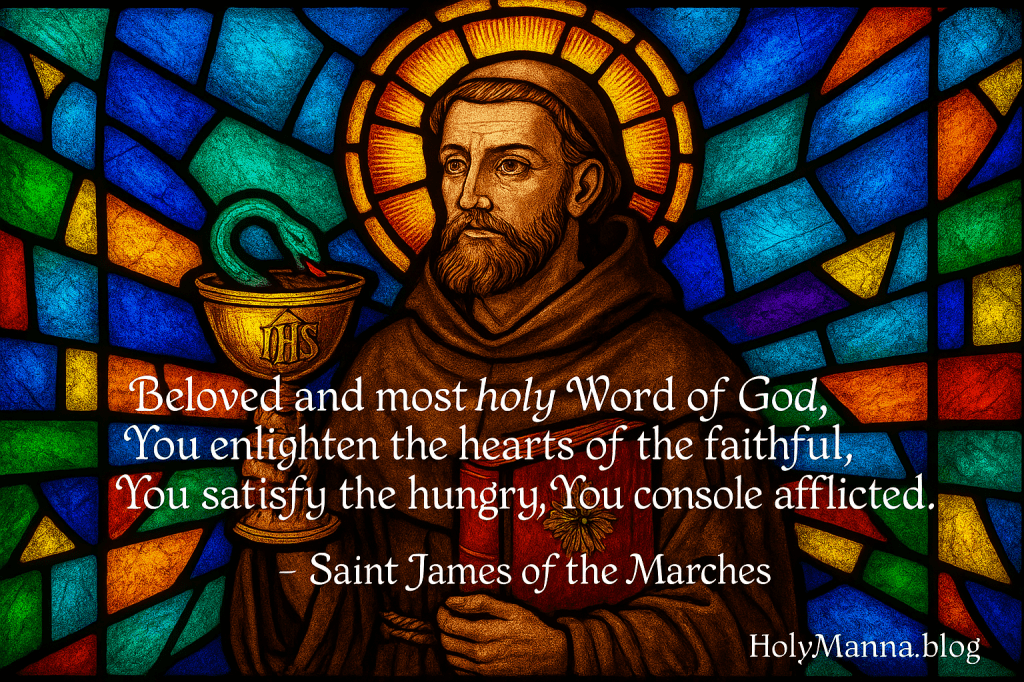
The Fiery Herald of the Holy Name
Saint James of the Marches stands as one of the great but often hidden reformers of the Franciscan tradition. Rising from the hills of eastern Italy, he became a brilliant scholar, a powerful preacher of the Holy Name of Jesus, a defender of the faith across Europe, and a miracle worker whose life still inspires Christians today. Through his missionary zeal, powerful sermons, and intense devotion to Christ, he helped rekindle Catholic life during a time of division, confusion, and spiritual coldness. His name may not be widely known, but his impact on the Church shines brightly for those who look for it.
From Shepherd Boy to Friar of the Holy Name
Saint James was born Dominic Gangala in the small town of Monteprandone, in the region known as the March of Ancona. Although his family lived in poverty, they passed on a deep work ethic and a simplicity of heart. As a boy he tended sheep, but his uncle, a priest, noticed the child’s intelligence and brought him to Offida and Ascoli for studies. His gifted mind led him to the University of Perugia, where he earned the highest degrees in both civil and canon law. For a time he served as a tutor to a noble family and even acted as a judge in cases dealing with sorcery.
Despite this worldly success, Dominic felt an inner stirring toward something higher. Encounters with the Franciscans, especially the friars near La Verna, placed the Crucified Christ before his eyes in a new and powerful way. The prestige of law no longer satisfied his heart. In 1416 he entered the Order of Friars Minor at the Portiuncula in Assisi and received the religious name James. He completed his novitiate at the hermitage of the Carceri and continued studies under two future saints: Bernardine of Siena and John of Capistrano. Their holiness, especially Bernardine’s devotion to the Holy Name of Jesus, shaped James profoundly. Although he practiced extreme penance, Bernardine commanded him to moderate his fasting for the sake of his health. Even in this, James showed deep obedience and humility.
The Catechism teaches that conversion is a lifelong work of grace. It says, “This endeavor of conversion is not just a human work. It is the movement of a contrite heart, drawn and moved by grace.” (CCC 1428). Saint James allowed this grace to redirect the entire course of his life.
Fire in His Preaching and Power in His Miracles
After his ordination in 1420, Saint James began the mission that would consume more than fifty years of his life. He preached almost daily throughout Italy, Germany, Austria, Bohemia, Poland, Hungary, Bosnia, and even as far as Scandinavia. His sermons carried the same fire as his teacher Saint Bernardine. He urged repentance, encouraged devotion to the Holy Name of Jesus, defended the truths of the faith, and brought countless souls back to confession and the sacraments.
His love for the Holy Name echoes The Catechism, which teaches that “The name ‘Jesus’ contains all: God and man and the whole economy of creation and salvation.” (CCC 435). Saint James did not preach the Holy Name as a concept. He preached it as a living reality that could drive out darkness, heal wounds, and bring peace to restless hearts.
Miracles accompanied his preaching. Many accounts tell of healings, conversions, and deliverance from spiritual oppression. People flocked to his missions not only because he spoke with conviction but because God confirmed his words with visible signs. He reconciled feuding cities and families and brought peace to areas torn by division. He also helped found the montes pietatis, charitable loan institutions that allowed the poor to borrow money at low interest rather than fall into the hands of ruthless lenders. This practical mercy reflected Catholic teaching that economic life must serve the dignity of every human person.
Hardship, Accusation, and the Weight of Truth
Saint James lived in extremely turbulent times, and his mission often put him in dangerous situations. Sent by the pope as a legate and inquisitor in several regions, he worked to bring heretical groups back to the Catholic faith. In Bosnia he angered local rulers who resisted Catholic reform, and tradition holds that Queen Dorothea even attempted to poison him. Because of this, he is often depicted with a chalice and a serpent emerging from it, symbolizing both the physical danger he faced and the spiritual poison he fought to protect the Church from.
James also played roles in significant Church events. He attended the Council of Florence and the Council of Mantua, contributing to discussions on unity and responding to the growing threats against Christendom. He was even offered the archbishopric of Milan, one of the most prestigious posts in Italy, but declined the honor in order to remain a humble Franciscan preacher.
One of his greatest sufferings came not from enemies but from a brother priest. On Easter Monday of 1462 in Brescia, he repeated a theological opinion about the Precious Blood of Christ that sparked intense controversy. A Dominican inquisitor accused him of heresy. The case reached Rome, where Pope Pius II and the cardinals examined the matter. Although the dispute caused him great pain, no condemnation was issued, and in time the matter faded. His later canonization is evidence of his enduring fidelity to the Church.
The Catechism reminds the faithful that saints are real people who struggle, learn, and persevere in grace. It says, “By canonizing some of the faithful, the Church…proposes them to the faithful as examples and intercessors.” (CCC 828). The trials of Saint James invite believers to hold firmly to truth even when misunderstood or falsely accused.
Signs and Wonders After His Death
Saint James died on November 28, 1476, in Naples, where he had been sent to help the suffering king. His funeral drew huge crowds, and devotion to him began almost immediately. Numerous miracles were reported at his tomb in the Franciscan church of Santa Maria la Nova, especially healings and extraordinary favors granted through his intercession. His incorrupt body, preserved for centuries in Naples and later transferred to his hometown of Monteprandone, continues to draw pilgrims today.
His incorruption is not a guarantee of universal holiness, nor is it a required sign of sainthood, but it stands as a visible reminder that God sometimes marks His faithful servants in extraordinary ways. The Catechism teaches that the saints in heaven do not cease praying for the Church on earth. It says, “Their intercession is their most exalted service to God’s plan.” (CCC 956). The miracles surrounding Saint James’s tomb are a concrete expression of that beautiful truth.
Walking the Path Inspired by Saint James
Saint James of the Marches speaks powerfully to Catholics today. The world praises comfort and self–promotion, yet he walked away from success to follow Christ with total commitment. The Name of Jesus shaped everything he did. His preaching was bold, his charity was concrete, and his love for truth remained firm even in the face of hostility.
His work with the montes pietatis challenges every Christian to consider how financial decisions affect the poor. His perseverance through accusations encourages anyone who has faced misunderstanding for holding to the faith. His burning love for Jesus reminds Catholics to anchor their prayer life in that holy and saving Name. One traditional prayer attributed to him addresses Christ with profound tenderness: “Beloved and most holy Word of God, You enlighten the hearts of the faithful, You satisfy the hungry, You console the afflicted.” Those words reveal a heart completely captivated by the Lord.
Saint James teaches that holiness begins with surrender. It grows through daily fidelity. It blossoms through love for the poor, devotion to the Holy Name, and unshakeable trust in Christ.
Engage With Us!
Your thoughts and reflections matter. Share in the comments below what part of Saint James’s life touched you, challenged you, or encouraged you.
- Where might God be calling for a deeper conversion of heart, similar to the moment Saint James left behind a successful legal career to follow Christ more radically?
- How present is the Holy Name of Jesus in daily life, and what new habit could help keep that Name consciously and lovingly on your lips?
- What does Saint James’s work with the poor reveal about the way financial choices should reflect mercy, justice, and dignity?
- Have there been moments of misunderstanding or pushback for standing with Catholic teaching, and how does Saint James’s perseverance offer courage in those moments?
- What specific intention can you bring to Saint James today, trusting in his intercession just as pilgrims have done for centuries?
May Saint James of the Marches help every reader grow in devotion to the Holy Name of Jesus. May his courage strengthen hearts, his charity inspire mercy, and his faith lead all closer to the love and compassion that Jesus taught.

 Holy Manna!
Leave a comment