A Silent Sister with a World Changing Mission
Saint Catherine Labouré is a quiet but towering presence in the life of the Church. Born in 1806 in rural France and later becoming a Daughter of Charity of Saint Vincent de Paul, she is the Marian visionary through whom Our Lady entrusted the Miraculous Medal to the world. Through this humble young sister, Catholics around the globe received a powerful sacramental associated with conversions, healings, and renewed love for the Immaculate Conception. Canonized in 1947, she remains a radiant example of hidden holiness, and her incorrupt body rests today in the Chapel of Our Lady of the Miraculous Medal in Paris. Her life reminds Christians that God often works most powerfully through those who choose humility over visibility.
From Zoe of Burgundy to Daughter of Charity
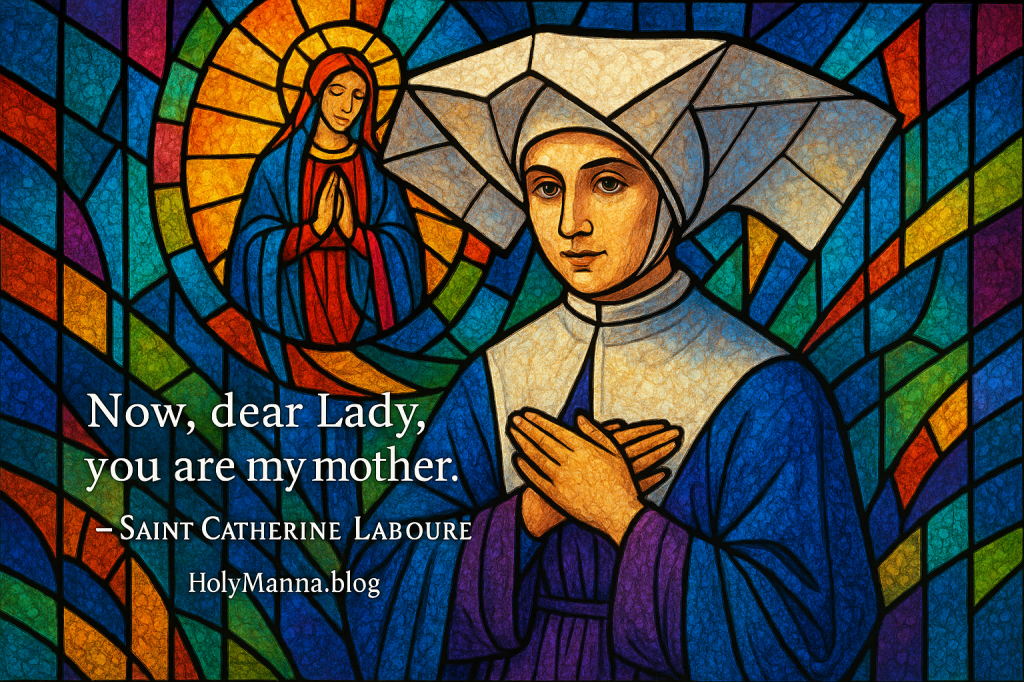
Before she was known as Catherine, she was Zoe Labouré, born on May 2, 1806, in the small village of Fain lès Moutiers in Burgundy. She was the ninth of eleven children in a hardworking farming family. Sorrow struck early when her mother died, and at the funeral the nine year old girl reportedly went to a statue of the Blessed Virgin, kissed it, and said, “Now, dear Lady, you are my mother.” That simple act of trust would define her spiritual life.
Not long after, Catherine experienced a dream in which an aged priest appeared to her and said, “My daughter, it is good to care for the sick. For now you flee from me, but one day you will be glad to come to me. God has plans for you. Do not forget it.” Years later she recognized the priest in a portrait of Saint Vincent de Paul when she visited a convent of the Daughters of Charity. The recognition confirmed her inner call to serve Christ in the poor.
Her father, however, did not approve of her desire for religious life. He attempted to prevent her vocation by sending her to Paris to work in an eating house for poor laborers. Instead of extinguishing her call, this period strengthened her compassion and deepened her love for the poor. Eventually her father relented, and Catherine entered the Daughters of Charity at Rue du Bac in Paris on April 21, 1830. On January 30, 1831, she received the habit. She served faithfully in the community for nearly fifty years, known not for public ministry but for being the chosen vessel through whom Our Lady would give the Miraculous Medal.
Visions of Fire, a Mother, and a Medal
Catherine’s time at Rue du Bac was marked by extraordinary graces. She experienced visions related to Saint Vincent de Paul during times of political upheaval in France and sensed from them the spiritual trials that would shake both Church and nation. Yet the most important moments came through the apparitions of the Blessed Virgin Mary.
On the night of July 18–19, 1830, a shining child awakened her and led her to the chapel. There she found the Blessed Mother waiting. Mary spoke with her intimately, saying, “God wishes to charge you with a mission. You will be contradicted, but do not fear. You will have the grace to do what is necessary. Times are evil in France and in the world.” Catherine carried these words in her heart with humility and obedience.
On November 27, 1830, during evening meditation, the Blessed Mother appeared again. Catherine saw Mary standing upon a globe, crushing a serpent, with rays of light streaming from jeweled rings on her hands. Surrounding her were the words: “O Mary, conceived without sin, pray for us who have recourse to thee.” Catherine noticed some rings emitted no rays. Mary explained, “These rays symbolize the graces I shed upon those who ask for them. The gems from which rays do not fall are the graces for which souls forget to ask.”
The vision then revealed the design for the reverse side of the medal: a large letter M supporting a small cross above it, encircled by twelve stars, and beneath the M the Sacred Heart of Jesus crowned with thorns beside the Immaculate Heart of Mary pierced with a sword. Mary asked that this image be struck as a medal and said, “All who wear it will receive great graces.” Catherine obeyed and communicated everything only to her confessor. The first medals were produced in 1832 and quickly became associated with remarkable healings and conversions. The faithful soon called it the “Miraculous Medal.”
Catherine’s simple spirituality can be summed up in one of her most profound sayings: “One must see God in everyone.” She also taught, “If you listen, God will also speak to you. For with the good Lord you have to both speak and listen. God always speaks to you when you approach him plainly and simply.”
Hidden Sacrifice and a Life Given in Love
Catherine did not face martyrdom in the violent sense, yet she lived a real martyrdom of daily self gift. Losing her mother at a young age shaped her early years with sorrow and responsibility. Her father’s resistance to her vocation forced her to wait and trust God’s timing. Even after the apparitions, she remained unknown and unrecognized. Only her confessor knew she had been the visionary of the Miraculous Medal, and she spent the rest of her life in quiet service.
After professing vows, Catherine was assigned to the Hospice d’Enghien in Reuilly near Paris. There she spent about forty years caring for elderly men, tending livestock, managing the convent’s kitchen and garden, and performing the most ordinary manual labor. She assisted the poor during the cholera epidemic of 1832, working long hours in the face of real danger. Despite the supernatural graces she received, she never rose above her humble tasks nor sought special treatment. She lived hidden, ordinary holiness, offering her sacrifices quietly to God.
Graces That Continue to Flow
Saint Catherine died peacefully on December 31, 1876, at the hospice in Reuilly. When her body was exhumed in 1933 during the beatification process, it was found incorrupt. Her body was placed in a glass reliquary beneath the altar of the chapel at Rue du Bac, where countless pilgrims still come to pray.
Miracles attributed to her intercession helped lead to her beatification in 1933 and canonization in 1947. Even more widespread are the graces associated with the Miraculous Medal. Reports of healings and rapid conversions began immediately after the medals were first distributed. One of the most famous was the 1842 conversion of Alphonse Ratisbonne, a Jewish banker who reluctantly wore the medal at the request of a friend. While standing in a church in Rome, he experienced an apparition of the Blessed Mother and underwent an instantaneous, radical conversion. His story became one of the most widely known miracles linked to the Miraculous Medal.
Through such miracles, God shows His desire to reach His children through simple, concrete signs. The Miraculous Medal, like all sacramentals described in The Catechism, is meant to draw the faithful closer to Christ by preparing hearts for grace and helping believers cooperate with the Holy Spirit. Marian devotion is always meant to honor Mary in a way that leads more deeply to Jesus. Saint Catherine’s mission perfectly reflects this truth.
Living the Message of the Miraculous Medal Today
Saint Catherine Labouré’s life is both challenging and consoling. It challenges Christians to embrace hidden holiness, patient charity, and Marian trust. At the same time, it consoles anyone who feels unseen, overworked, or overlooked. Catherine was not a public figure, preacher, or scholar. She was simply faithful, obedient, and receptive to God’s voice.
Her words, “One must see God in everyone,” provide a clear and demanding invitation. This means seeing Christ in elderly parents, in difficult coworkers, in the poor, and in those who test our patience. It means allowing everyday duties to become the path to sanctification instead of obstacles to it.
The message of the Miraculous Medal also offers practical guidance for daily life. Wearing a blessed Miraculous Medal can be a quiet act of devotion that reminds the heart to stay close to Jesus through Mary. The inscription “O Mary, conceived without sin, pray for us who have recourse to thee” is a simple but profound prayer of trust. Every time the medal is touched, it offers an opportunity to turn back to God.
Catherine’s example invites believers to ask boldly for grace, remembering that the rays that do not reach the earth symbolize the graces we forget to ask for. It also encourages embracing the sacraments, especially Confession and the Eucharist, since sacramentals like the Miraculous Medal prepare the soul to receive God’s life with greater openness.
Engage with Us!
Share your thoughts and reflections in the comments below.
- Where is God inviting you to “see Him in everyone,” especially in people who are difficult, forgotten, or overlooked?
- How has devotion to Mary helped you grow closer to Jesus, and what role does the Miraculous Medal play in your spiritual life?
- If you already wear a Miraculous Medal, how might you renew your devotion so that it becomes a true sacramental and not just a familiar object?
- Which hidden, everyday duties in your life might God be using as a path to deeper holiness, just as He used Catherine’s humble tasks?
- Which grace do you need most right now, and how can you ask Mary today to intercede for you with confidence and trust?
May Saint Catherine Labouré inspire all of us to live with deeper faith, to welcome Mary into our daily walk with Christ, and to offer every action with the love and mercy that Jesus has taught in the Gospel.
Saint Catherine Labouré, pray for us!
Follow us on Instagram and Facebook for more insights and reflections on living a faith-filled life.

 Holy Manna!
Leave a comment