Friday of the Thirty-fourth Week in Ordinary Time – Lectionary: 507
Thrones, Beasts, and Fig Trees
Some days the readings feel like a gentle breeze, and other days they hit like a storm. Today’s readings sit firmly in that second category, filled with strange beasts, fiery thrones, and a simple fig tree that quietly announces the nearness of something far bigger than itself. These passages invite hearts to face a tough but freeing truth: every kingdom, every power, every comfort in this world will eventually fall, but the Kingdom of God in Christ will never pass away.
Daniel 7 drops the reader right into classic apocalyptic imagery. Written during intense persecution of the Jewish people, this vision uses symbolic beasts rising from the chaotic sea to represent violent empires that crush and devour. Yet the scene does not end in terror. The spotlight shifts to the Ancient of Days seated in majesty, as “the court was convened, and the books were opened” and then to “one like a son of man” who receives “dominion, splendor, and kingship” that will never be destroyed. In other words, brutal regimes are temporary. The reign of God is not. Christian tradition sees this “son of man” fulfilled perfectly in Jesus Christ, as taught in The Gospel of Matthew and echoed in CCC 664 and CCC 668, where Christ’s exaltation and kingship over history are proclaimed.
The responsorial canticle from Daniel 3 provides the right response to that vision. Instead of focusing on the beasts, it calls mountains, rivers, birds, and beasts to bless the Lord. Creation itself becomes a choir reminding believers that God’s dominion is not fragile or limited to human power structures. Every corner of the world, from the highest hills to the depths of the sea, already belongs to the Lord and silently announces His glory. This praise in the furnace narrative of Daniel 3 was originally sung by faithful Israelites under trial, and it still trains hearts today to worship God even when earthly powers seem terrifying.
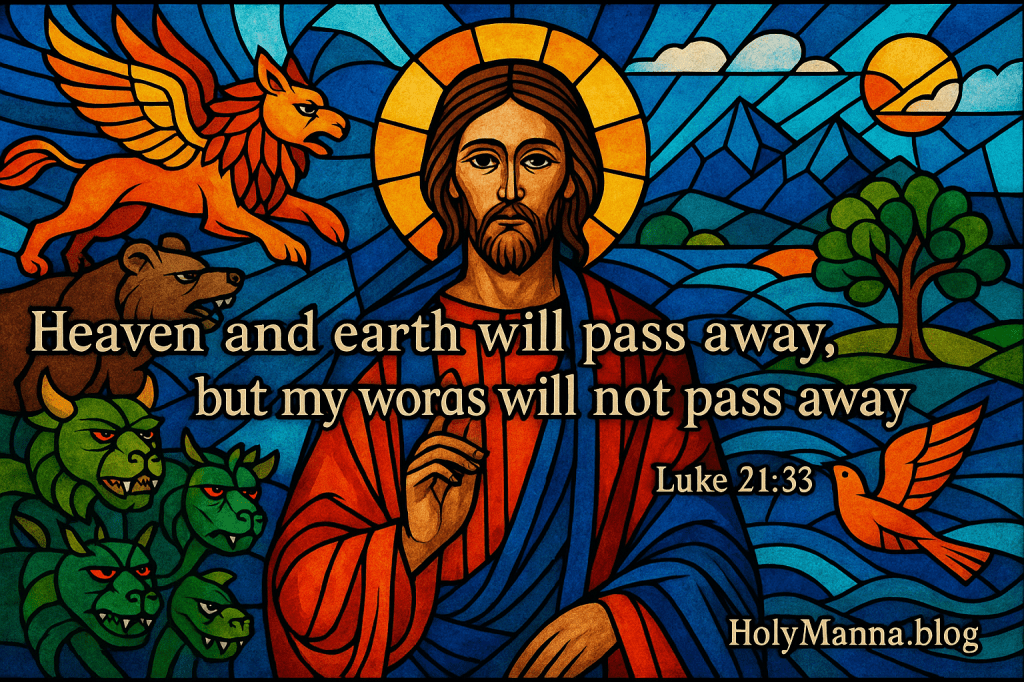
Then The Gospel of Luke steps in with a surprising shift in tone. Instead of beasts and thrones, Luke 21:29-33 offers a fig tree and the changing of the seasons. Jesus tells the disciples to notice how budding trees reveal that summer is near, and then applies that image to the unfolding events of history. When turmoil and shaking come, the response is not panic but spiritual alertness, because “when you see these things happening, know that the kingdom of God is near”. Empires, institutions, and even the visible form of creation are passing realities. Christ plainly declares, “Heaven and earth will pass away, but my words will not pass away”.
Together, these readings form a sober but hope filled wake up call. The beasts of Daniel 7 remind believers that worldly power can be terrifying but temporary. The cosmic praise of Daniel 3 teaches that all creation already belongs to God and exists to bless Him. The fig tree in The Gospel of Luke shows how to read the signs of the times through the lens of Christ’s unshakable word. The Church, guided by The Catechism of the Catholic Church, insists that history is not random chaos but a story moving toward the full manifestation of Christ’s reign in glory (CCC 668-672).
Where is the heart still clinging to passing kingdoms, and where is it learning to trust the King whose dominion shall not pass away?
First Reading – Daniel 7:2-14
When Empires Roar and God Still Reigns
This reading from Daniel 7 drops the soul right into the heart of apocalyptic imagery. The Book of Daniel was written for a people under pressure, most likely during the persecution under the Seleucid king Antiochus IV Epiphanes, whose brutal rule tried to crush Jewish faith and identity. The strange beasts rising from the sea are not random monsters. They represent a succession of pagan empires that dominate, oppress, and terrify. Yet the point of the vision is not to glorify the beasts. The point is to reveal that above every empire, every regime, and every historical crisis, God sits as Judge, and He entrusts everlasting kingship to “one like a son of man”.
Today’s theme focuses on the clash between passing kingdoms and the everlasting Kingdom of God. This reading fits that theme perfectly. The beasts show the chaos and violence of human power. The “Ancient of Days” seated on a fiery throne reveals the unshakable holiness and authority of God. The Son of Man receiving eternal dominion foreshadows Christ, who calls Himself the Son of Man repeatedly in The Gospel of Matthew and The Gospel of Luke. This scene anticipates the moment when the Father hands all things to the Son, a reality that The Catechism of the Catholic Church describes when it teaches that “Christ is Lord of the cosmos and of history” (CCC 668).
This vision prepares the heart to read Luke’s fig tree and the signs of the times in the right light. History can feel like a swirling sea of conflict and confusion. Yet this passage reveals that there is a divine court, real books, real judgment, and a real King whose dominion will never pass away.
Daniel 7:2-14
New American Bible (Revised Edition)
2 In the vision I saw during the night, suddenly the four winds of heaven stirred up the great sea, 3 from which emerged four immense beasts, each different from the others. 4 The first was like a lion, but with eagle’s wings. While I watched, the wings were plucked; it was raised from the ground to stand on two feet like a human being, and given a human mind. 5 The second beast was like a bear; it was raised up on one side, and among the teeth in its mouth were three tusks. It was given the order, “Arise, devour much flesh.” 6 After this I looked and saw another beast, like a leopard; on its back were four wings like those of a bird, and it had four heads. To this beast dominion was given. 7 After this, in the visions of the night I saw a fourth beast, terrifying, horrible, and of extraordinary strength; it had great iron teeth with which it devoured and crushed, and it trampled with its feet what was left. It differed from the beasts that preceded it. It had ten horns. 8 I was considering the ten horns it had, when suddenly another, a little horn, sprang out of their midst, and three of the previous horns were torn away to make room for it. This horn had eyes like human eyes, and a mouth that spoke arrogantly. 9 As I watched,
Thrones were set up
and the Ancient of Days took his throne.
His clothing was white as snow,
the hair on his head like pure wool;
His throne was flames of fire,
with wheels of burning fire.
10 A river of fire surged forth,
flowing from where he sat;
Thousands upon thousands were ministering to him,
and myriads upon myriads stood before him.
The court was convened, and the books were opened. 11 I watched, then, from the first of the arrogant words which the horn spoke, until the beast was slain and its body destroyed and thrown into the burning fire. 12 As for the other beasts, their dominion was taken away, but they were granted a prolongation of life for a time and a season. 13 As the visions during the night continued, I saw coming with the clouds of heaven
One like a son of man.
When he reached the Ancient of Days
and was presented before him,
14 He received dominion, splendor, and kingship;
all nations, peoples and tongues will serve him.
His dominion is an everlasting dominion
that shall not pass away,
his kingship, one that shall not be destroyed.
Detailed Exegesis
Verse 2 – “In the vision I saw during the night, suddenly the four winds of heaven stirred up the great sea.”
The “night” sets a mood of mystery and trial. In biblical symbolism, the sea often represents chaos, danger, and the forces opposed to God. The four winds of heaven suggest that what is happening has a global scale. All directions are involved, and the entire world is affected. The vision is not a private psychological dream. It is a revelation about how God sees history.
Verse 3 – “From which emerged four immense beasts, each different from the others.”
The four beasts stand for a series of kingdoms, usually understood as the great pagan empires that dominated God’s people. Their differences show that each empire has its own character, yet they are all beastly. They are powerful, but they are less than human in the way they exercise power. This reveals how sin and pride distort political power when it is detached from God.
Verse 4 – “The first was like a lion, but with eagle’s wings. While I watched, the wings were plucked; it was raised from the ground to stand on two feet like a human being, and given a human mind.”
The lion with eagle’s wings suggests a majestic, swift, fearsome kingdom, often linked with Babylon. The plucking of the wings shows that even mighty empires can be humbled. Being set on two feet and given a human mind suggests a kind of partial humanization or conversion. Power that once acted like a predator is tamed and limited. God can humble and reform rulers, but their power remains under His authority.
Verse 5 – “The second beast was like a bear; it was raised up on one side, and among the teeth in its mouth were three tusks. It was given the order, ‘Arise, devour much flesh.’”
The bear is heavy, powerful, and brutal. Raised on one side, it might suggest imbalance or partial dominance. The three tusks hint at conquests already achieved or regions devoured. The chilling part is the command it receives. “Arise, devour much flesh” shows that God allows even ruthless empires a certain space in history. That permission, however, is limited and under judgment. Earthly power does not move outside of God’s ultimate sovereignty.
Verse 6 – “After this I looked and saw another beast, like a leopard; on its back were four wings like those of a bird, and it had four heads. To this beast dominion was given.”
The leopard is fast and agile. The four wings and four heads emphasize speed and reach. This suggests a kingdom that spreads rapidly, often associated with the Greek empire and its fragmentation. Yet the crucial phrase is that “dominion was given.” Even when an empire seems unstoppable, its authority is still permitted, not self generated. God remains the true source and limit of power.
Verse 7 – “After this, in the visions of the night I saw a fourth beast, terrifying, horrible, and of extraordinary strength; it had great iron teeth with which it devoured and crushed, and it trampled with its feet what was left. It differed from the beasts that preceded it. It had ten horns.”
The fourth beast is so monstrous that it defies comparison with real animals. It is the climax of political brutality. Iron teeth symbolize ruthless, industrial scale destruction. It devours, crushes, and then tramples what remains. The ten horns represent a fullness of power, perhaps multiple kings or rulers. This is a picture of empire at its most inhuman. Yet even this horror is not the end of the story. Apocalyptic literature strips away illusions about worldly power and exposes what sin does when it dominates structures.
Verse 8 – “I was considering the ten horns it had, when suddenly another, a little horn, sprang out of their midst, and three of the previous horns were torn away to make room for it. This horn had eyes like human eyes, and a mouth that spoke arrogantly.”
The “little horn” represents a particular arrogant ruler, often connected to Antiochus IV in the historical background, and in a broader sense to any antichrist figure who exalts himself against God. The human eyes suggest intelligence and cunning. The arrogant mouth points to blasphemy and persecution. Evil often appears in a seemingly small, clever, and bold figure who rises quickly, tears down others, and mocks God. The Church sees this pattern as present in many ages and ultimately culminating in the final opposition to Christ, as discussed in CCC 675 which speaks of a final trial involving a religious deception.
Verse 9 – “As I watched, Thrones were set up and the Ancient of Days took his throne. His clothing was white as snow, the hair on his head like pure wool; His throne was flames of fire, with wheels of burning fire.”
The scene suddenly shifts from the chaos of beasts to the calm majesty of the divine courtroom. The “Ancient of Days” is a title for God, highlighting eternal existence and absolute authority. White clothing and pure wool hair symbolize holiness and wisdom. Flames of fire and wheels of burning fire show a throne that is both pure and active. God’s judgment is not cold or distant. It is holy fire that purifies and consumes evil. The thrones being set up hint that there is a council or heavenly court. The universe is not run by beasts but judged by God.
Verse 10 – “A river of fire surged forth, flowing from where he sat; Thousands upon thousands were ministering to him, and myriads upon myriads stood before him. The court was convened, and the books were opened.”
The river of fire suggests both judgment and the outflow of divine holiness. The countless ministers and those who stand before Him show the grandeur of heaven. The books being opened signal that history is being reviewed. Nothing is forgotten. Every act of injustice and every act of fidelity has been recorded. This anticipates the Last Judgment as described in The Gospel of Matthew and in CCC 1038, which speaks of the resurrection of all and the final judgment before Christ.
Verse 11 – “I watched, then, from the first of the arrogant words which the horn spoke, until the beast was slain and its body destroyed and thrown into the burning fire.”
The arrogant horn may seem unstoppable for a time, but it has an expiration date. The focus on its arrogant words shows that pride and blasphemy are at the core of its downfall. The beast is slain, destroyed, and cast into fire. This is a definitive judgment, not a temporary setback. God’s patience does not mean indifference. When the time comes, evil that refuses to repent is removed.
Verse 12 – “As for the other beasts, their dominion was taken away, but they were granted a prolongation of life for a time and a season.”
The other beasts lose their authority but remain alive for a while. This suggests that even after their political power collapses, their cultural or spiritual influence might linger. Old ideologies and sins can survive the fall of external regimes. God allows a “time and season” but their fate is sealed. Dominion belongs elsewhere now.
Verse 13 – “As the visions during the night continued, I saw coming with the clouds of heaven One like a son of man. When he reached the Ancient of Days and was presented before him.”
This is the turning point of the vision. The “Son of Man” is a human like figure, yet associated with the clouds of heaven, which is a divine attribute. This mysterious figure is both closely linked to humanity and to God. Christian faith sees here a prophetic glimpse of Christ, true God and true man, who ascends to the Father and is glorified. Jesus uses this title for Himself often, clearly echoing this passage, especially before the high priest in The Gospel of Matthew 26:64 where He speaks of the Son of Man coming on the clouds of heaven.
Verse 14 – “He received dominion, splendor, and kingship; all nations, peoples and tongues will serve him. His dominion is an everlasting dominion that shall not pass away, his kingship, one that shall not be destroyed.”
Here the contrast with the beasts becomes complete. Their power is brutal, limited, and temporary. His power is glorious, universal, and eternal. All nations, peoples, and tongues serve Him. This anticipates the universal mission of the Church and the vision of every tribe and tongue worshiping the Lamb in The Book of Revelation. The everlasting dominion and indestructible kingship point to the Kingdom of God fully revealed in Christ. This verse grounds the hope that no matter how chaotic or dark history becomes, Christ’s reign is the final word.
Teachings: Christ the Son of Man and Lord of History
This reading has always been central for Christian understanding of Jesus as the Son of Man. The Church teaches in The Catechism of the Catholic Church that “Christ is Lord of the cosmos and of history” and that “in him human history and indeed all creation are ‘set forth’ and transcendently fulfilled” (CCC 668). This means that all the beasts of history, every empire and ideology, find their limit and their judgment in Him.
The Catechism connects the exaltation of Christ with this kind of imagery when it says that after the Resurrection, “Jesus’ final apparition ends with the irreversible entry of his humanity into divine glory” and that He is seated at the right hand of the Father (CCC 659). This echoes the Son of Man being presented before the Ancient of Days and receiving dominion and glory.
The Church also teaches that the Kingdom of God is already present in mystery but not yet fully manifested. CCC 669 explains that Christ already reigns, yet the Kingdom is still under attack by the evil powers, even though they have been defeated at their root. This matches the picture in Daniel 7 where beasts still exist for a time and a season, but their dominion has been stripped and the Son of Man has received everlasting kingship.
Saint Augustine, reflecting on worldly empires in The City of God, highlights that earthly kingdoms rise and fall, but the City of God endures. Without quoting every line, the core idea is that when people place their deepest trust in earthly power, they build on sand. The real security lies in belonging to the Kingdom of Christ that does not pass away.
The Church’s teaching on the final trial of the Church in CCC 675 also resonates deeply with the image of the arrogant horn. It says that before Christ’s second coming the Church must pass through a final trial that will shake the faith of many and involve a religious deception offering apparent solutions at the price of apostasy. The arrogant, blasphemous horn that exalts itself over God is a kind of prototype of that final deception.
Reflection: Letting Go of Beasts and Clinging to the King
This vision can feel intense and far removed from daily life, yet it actually describes the inner spiritual battle that plays out in every generation and in every heart. The beasts are not just ancient empires. They can symbolize anything that becomes beastly in the soul or in society, whether that is an addiction, a political ideology, a cultural trend, or a personal drive for control that devours others.
Daniel’s vision invites a serious examination of what kind of power is admired and trusted. It presses a question that does not let go easily: Where is the heart placing its security, in fragile human structures or in the everlasting kingship of Christ? When news cycles roar and social media feels like a stormy sea, it is easy to forget that there is an Ancient of Days on the throne and that the court is real and the books are open.
Practically, this reading encourages several concrete responses. First, it calls for deeper confidence in Christ as the true King. That might look like prioritizing time with Scripture and the sacraments over constant consumption of political commentary. Second, it invites a shift from fear to worship. The beasts are loud, but in Daniel 3 the mountains, seas, and animals all bless the Lord. Choosing to praise God daily, especially through the liturgy and personal prayer, is a quiet but powerful way to live under the reign of the Son of Man. Third, it challenges believers to refuse beastlike behavior in their own lives. Whenever anger, pride, or contempt begin to drive choices, this vision reminds that such paths do not belong to the Kingdom that will last.
What “beasts” seem to dominate the landscape of personal life right now, and how can they be brought under the judgment and mercy of the Ancient of Days?
What would it look like today to live with the steady confidence that Christ’s dominion is an everlasting dominion that shall not pass away?
Where might the Holy Spirit be inviting a shift from anxiety about the future to active trust in the King whose words will never be destroyed?
Responsorial Psalm – Daniel 3:75-81
When Creation Preaches the Kingship of God
This responsorial canticle from Daniel 3 comes from the famous story of the three young men in the fiery furnace. Israel is in exile under pagan rule, and faithful Jews are pressured to worship an earthly king as if he were a god. Instead of bowing to the statue, Shadrach, Meshach, and Abednego entrust their lives to the Lord and are thrown into the flames. In the midst of that furnace, they break into this litany of praise, calling every part of creation to bless the Lord.
Against the backdrop of today’s readings, this canticle becomes a powerful counterpoint to the beasts of Daniel 7 and the shaking of history described in The Gospel of Luke. While empires roar and crumble, creation quietly and constantly proclaims the glory of the true King. Mountains, seas, rivers, birds, and beasts all “preach” a message. They all belong to God and reflect His beauty. In a world where human kingdoms rise and fall, this song anchors hearts in the unchanging reality that the Lord is the Creator and Sovereign of all things.
The response that usually accompanies this passage in the liturgy echoes that spirit of trust and worship. Even when the world feels like a furnace and the future is unclear, this canticle teaches that praise is not optional decoration. It is spiritual warfare. It is a confession that the Kingdom of God is near and that His dominion is everlasting, just as Daniel 7 reveals.
Daniel 3:75-81
New American Bible (Revised Edition)
75 Mountains and hills, bless the Lord;
praise and exalt him above all forever.
76 Everything growing on earth, bless the Lord;
praise and exalt him above all forever.
77 You springs, bless the Lord;
praise and exalt him above all forever.
78 Seas and rivers, bless the Lord;
praise and exalt him above all forever.
79 You sea monsters and all water creatures, bless the Lord;
praise and exalt him above all forever.
80 All you birds of the air, bless the Lord;
praise and exalt him above all forever.
81 All you beasts, wild and tame, bless the Lord;
praise and exalt him above all forever.
Detailed Exegesis
Verse 75 – “Mountains and hills, bless the Lord; praise and exalt him above all forever.”
The invocation of mountains and hills immediately lifts the imagination to what feels solid and ancient. Mountains have watched empires come and go. They stand firm while kingdoms rise and collapse. Calling mountains and hills to bless the Lord is a poetic way of saying that the most stable and majestic parts of the visible world exist to glorify God. Their height and strength are meant to direct hearts upward. When believers see mountains or even small hills, this verse suggests that they remember the Lord’s unshakable majesty. The stability of the landscape points to the far greater stability of God’s reign.
Verse 76 – “Everything growing on earth, bless the Lord; praise and exalt him above all forever.”
Here the focus moves to plants, fields, forests, and every living thing that sprouts and grows. Everything that grows is fragile and dependent on light, water, and soil. This verse quietly reminds hearts that life is received, not self generated. Grass, flowers, crops, and trees all depend on the Creator. When believers see things grow, they are given a living parable of dependence and generosity. God gives growth, and all creation responds by simply being what it is. In a world obsessed with control, this verse sings a different song: true fruitfulness comes from abiding in the will of God, just as Jesus later teaches in The Gospel of John 15 about the vine and the branches.
Verse 77 – “You springs, bless the Lord; praise and exalt him above all forever.”
Springs represent fresh, life giving water. In a dry climate like the ancient Near East, springs were precious, sometimes the difference between life and death. By calling springs to bless the Lord, the canticle highlights God as the source of refreshment and renewal. Spiritually, this echoes the repeated biblical theme of God as living water. This verse prepares hearts to hear Christ’s words when He says in The Gospel of John 7:37 that those who are thirsty should come to Him and drink. Every spring in the natural world becomes a tiny prophetic sign of the fountains of grace that flow from God.
Verse 78 – “Seas and rivers, bless the Lord; praise and exalt him above all forever.”
Seas and rivers are powerful, unpredictable realities. Seas can symbolize chaos and danger, while rivers often symbolize life and direction. Bringing both under the command to bless the Lord shows that even what seems wild or threatening is still under God’s sovereignty. The same God who reigns over the roaring sea also guides the peaceful river. For believers, this verse can reframe experiences of chaos and calm. Both the storms and the steady currents of life are ultimately under the authority of the Lord who made them.
Verse 79 – “You sea monsters and all water creatures, bless the Lord; praise and exalt him above all forever.”
In the ancient world, “sea monsters” conjured images of mysterious and terrifying creatures that symbolized forces beyond human control. By summoning even these to bless the Lord, the canticle boldly declares that no creature and no force, however frightening, lies outside God’s dominion. All water creatures, from the tiniest fish to the most intimidating sea beast, belong to Him. Spiritually, this verse echoes the message of Daniel 7, where even monstrous beasts cannot escape the judgment and authority of the Ancient of Days. Here, instead of beasts resisting God, they are invited into praise. The final word over creation is not terror but worship.
Verse 80 – “All you birds of the air, bless the Lord; praise and exalt him above all forever.”
Birds have always captured human imagination with their freedom and perspective. They see from above what humans experience from the ground. Calling birds to bless the Lord invites believers to lift their gaze and remember heavenly realities. Jesus later speaks of the birds of the air in The Gospel of Matthew 6:26, pointing to them as examples of trust in God’s providence. Birds do not store up barns, yet the Father feeds them. This verse, read alongside Christ’s teaching, becomes a call to trust in God’s care rather than in anxious self reliance.
Verse 81 – “All you beasts, wild and tame, bless the Lord; praise and exalt him above all forever.”
The final verse gathers all land animals, both wild and domesticated. Wild beasts represent the untamed, sometimes threatening aspects of creation. Tame beasts are part of daily work and survival. The canticle brings both into a single chorus of praise. This is especially striking in light of Daniel 7, where beasts symbolize violent empires. Here, beasts are not images of oppressive power but of creation fulfilling its purpose in giving glory to God. The same symbol of “beast” can show either rebellion or worship, depending on whether it stands against God or under Him. This verse hints that the ultimate destiny of creation is not rebellion but harmony under the reign of the true King.
Teachings: Creation, Praise, and the Kingdom of God
This canticle from Daniel 3 reveals a deeply biblical worldview that The Catechism of the Catholic Church takes very seriously. Creation is not neutral background scenery. It is a gift, a sign, and a participant in God’s praise. The Catechism teaches: “Because creation comes forth from God’s goodness, it shares in that goodness ‘and God saw that it was good’ ‘very good’” (CCC 299). Mountains, rivers, animals, and plants are not just resources to be used but reflections of God’s goodness.
The Catechism also insists that creation is ordered to God’s glory. It states: “The ultimate purpose of creation is that God ‘who is the creator of all things may at last become ‘all in all’, thus simultaneously assuring his own glory and our beatitude” (CCC 294). When this canticle calls all creation to bless the Lord, it is expressing that ultimate purpose out loud. Everything exists for God’s glory and for the happiness of creatures who live in union with Him.
Saint Francis of Assisi famously reflected this biblical spirit in his Canticle of the Creatures, where he praised God through “Brother Sun” and “Sister Moon.” While using different language, he follows the same pattern as Daniel 3. He recognizes that creation speaks and sings of God. Saints and mystics through the centuries have seen in nature a path to contemplation. Yet they never worship creation itself. They recognize that creation is a sign pointing beyond itself to the Creator.
In the context of Christ’s kingship, this canticle also shows that the Kingdom of God is cosmic in scope. It is not limited to human souls. CCC 1046 teaches: “For the cosmos, Revelation affirms the profound common destiny of the material world and man: ‘For the creation waits with eager longing for the revealing of the sons of God’”. The praise of mountains, seas, and beasts anticipates that future renewal where creation will be set free from corruption and share in the glory of the children of God, as Romans 8 describes.
This responsorial psalm, prayed within the Mass, draws believers into that cosmic praise. The Church’s liturgy unites the voices of the faithful with the silent hymn of creation. Even when human history feels chaotic, this song reminds hearts that the deeper, truer rhythm of reality is praise.
Reflection: Learning to Hear Creation Bless the Lord
In daily life, it is easy to rush past creation without really noticing it. Screens, noise, and constant hurry can drown out the subtle hymn that Daniel 3 describes. Yet this canticle gently teaches that every part of the created world is already oriented toward the praise of God. Mountains, trees, rivers, birds, and animals all reveal something of His beauty, strength, and tenderness.
Practically, this reading encourages a slower, more contemplative way of living. Taking a moment to notice the sky, to feel the wind, to listen to birds, or to look at a tree can become a simple form of prayer. The heart can silently repeat, “Bless the Lord”, in union with the mountains and rivers mentioned in this passage. This is not sentimentalism. It is a concrete way of aligning the soul with the truth that God is Creator and King over all.
This canticle also challenges the habit of placing ultimate trust in human structures and achievements. The beasts in Daniel 7 look powerful but crumble under judgment. The creatures in Daniel 3 look small but endure as part of God’s good creation. The more a person learns to hear creation blessing the Lord, the less impressive the arrogance of passing empires begins to seem. Praise becomes a way of resisting fear and despair.
This passage can also shape how believers care for the environment. If creation blesses the Lord, then caring for it is not just a political issue but a spiritual one. Protecting the beauty and integrity of the natural world honors the God who made it. It reflects the Church’s teaching that the earth has been entrusted to humanity as stewards, not as tyrants.
Where in daily life is there an opportunity to pause and join creation in blessing the Lord, instead of staying buried in distraction and anxiety?
How might paying attention to mountains, skies, trees, or animals help the heart remember that God’s Kingdom is bigger and more enduring than any human crisis or headline?
What practical choices can be made this week to treat creation not as a disposable product but as a gift that reflects the goodness and glory of the Creator?
Holy Gospel – Luke 21:29-33
Reading the Seasons of History through the Word That Never Fades
This passage from The Gospel of Luke comes near the end of Jesus’ public ministry, right after He has spoken about the destruction of Jerusalem and the trials that will shake His followers. The setting is charged. The disciples are trying to understand how to live in a world where both the Temple and their expectations about history are about to be shattered. Into that tension, Jesus does something beautiful and disarming. He points to something as simple and familiar as a fig tree.
In Jewish culture, the fig tree often symbolized Israel and also everyday life in the land. People knew the rhythm of the seasons. They could tell when summer was near just by looking at the buds on the trees. Jesus uses this simple image to teach that the signs of the times are just as readable for a heart that stays awake. When believers see turmoil, persecution, or the collapse of things that once seemed unshakable, that does not mean God has lost control. Instead, He says that “when you see these things happening, know that the kingdom of God is near”.
This fits perfectly with today’s theme. Daniel 7 shows empires as beasts that rise from the sea and then fall under the judgment of the Ancient of Days. Daniel 3 calls all creation to bless the Lord. Now Luke 21 teaches disciples how to live in the middle of that story. Heaven and earth will pass away. Human structures and even the visible shape of the world are temporary. Yet Christ’s words, His promises, and His Kingdom are not. “Heaven and earth will pass away, but my words will not pass away” is the Lord’s way of saying that His voice is more solid than the ground under our feet.
Luke 21:29-33
New American Bible (Revised Edition)
29 He taught them a lesson. “Consider the fig tree and all the other trees. 30 When their buds burst open, you see for yourselves and know that summer is now near; 31 in the same way, when you see these things happening, know that the kingdom of God is near. 32 Amen, I say to you, this generation will not pass away until all these things have taken place. 33 Heaven and earth will pass away, but my words will not pass away.
Detailed Exegesis
Verse 29 – “He taught them a lesson. ‘Consider the fig tree and all the other trees.’”
Jesus begins with a very down to earth example. He is not giving an abstract lecture about the end times. He is “teaching a lesson” using creation as a parable. The invitation to “consider the fig tree and all the other trees” is a call to pay attention. God often speaks through simple, ordinary things. The fig tree is something the disciples know well. By including “all the other trees,” Jesus shows that the point is not tied to just one symbol. Any tree, any sign of seasonal change, can become a lesson about the Kingdom for a heart that listens.
Verse 30 – “‘When their buds burst open, you see for yourselves and know that summer is now near’”
Here Jesus appeals to common sense and everyday observation. No one needs a theology degree to know that when a tree starts to bud, summer is coming. “You see for yourselves and know” highlights that this is obvious. The disciples already use signs in nature to interpret what is coming next. Jesus is building on this natural skill to talk about spiritual discernment. The bursting buds signal a change of season. In the same way, the events Jesus has described earlier in the chapter, such as persecution, upheaval, and signs in the heavens, are not meaningless chaos. They signal that God is doing something and that His Kingdom is drawing near in a new way.
Verse 31 – “‘In the same way, when you see these things happening, know that the kingdom of God is near.’”
This is the heart of the comparison. “These things” refer to the signs Jesus has just described in the previous verses. Some point to the destruction of Jerusalem in the first century. Others anticipate the trials before His second coming. The key is that believers are meant to “know” not only that something bad is happening but that “the kingdom of God is near.” That phrase does not necessarily mean that the final end of the world is immediate. It means that God’s reign is breaking in more clearly through judgment, purification, and the collapse of false securities. When worldly supports crumble, the Kingdom that cannot be shaken often becomes more visible to those who trust in Christ.
Verse 32 – “‘Amen, I say to you, this generation will not pass away until all these things have taken place.’”
This verse has challenged readers for centuries. The phrase “this generation” can refer to the people living at that time, and indeed many of the things Jesus predicted did happen within a generation, especially the destruction of Jerusalem in the year 70. It can also carry a deeper sense of “this type of people,” meaning the rebellious and unbelieving mindset that resists God, which continues until the end. Either way, Jesus uses the solemn formula “Amen, I say to you” to underline the certainty of His words. Some elements of His prophecy were fulfilled very quickly in history. Others will be fulfilled finally at His return. The point is that His word is trustworthy, even if the timing and full meaning unfold in layers.
Verse 33 – “‘Heaven and earth will pass away, but my words will not pass away.’”
This is one of the most powerful lines in all of Scripture. Jesus speaks with a divine authority that no prophet ever claimed. The phrase “heaven and earth” is a way of saying “the entire visible universe.” Everything that seems permanent, from the stars in the sky to the ground underfoot, will eventually pass. In contrast, His words will not. That is an astonishing statement. Only God’s word has that kind of permanence. This is a direct claim to divinity and to absolute reliability. For disciples living in a world where kingdoms, cultures, and even personal circumstances constantly shift, this verse reveals the one solid anchor. Clinging to the words of Christ is not a pious hobby. It is the only way to build a life that will outlast the collapse of everything temporary.
Teachings: Christ’s Word, the Kingdom, and Reading the Signs of the Times
The Church sees this passage as part of Jesus’ eschatological teaching, that is, His teaching about the end times and the full coming of the Kingdom. The Catechism of the Catholic Church explains that after the Ascension, Christ’s coming in glory could happen at any time and that the history of the world is now in the “last hour” in a spiritual sense. It states that Christ already reigns, yet His Kingdom has not yet been brought to full perfection in power and glory. The exact times and details of His coming remain hidden in the Father’s plan, but the faithful are called to watchfulness and trust.
The permanence of Jesus’ word is central to the Church’s understanding of Revelation. Scripture and Tradition transmit Christ’s teaching in a way that remains living and effective in every age. The Church insists that divine Revelation ended with the death of the last apostle, but the understanding of it grows over time. The words of Christ do not change. Instead, they continue to shine new light on changing situations.
Saint Augustine spoke often of the instability of worldly things compared with God’s eternal truth. One of his most famous lines, from The Confessions, captures the human hunger that this Gospel verse answers. He writes to God: “You have made us for yourself, and our heart is restless until it rests in you.” That rest is found above all in Christ’s living word, which does not pass away.
This passage also connects with the Church’s call to “read the signs of the times,” a phrase used especially in the teaching of the Second Vatican Council. The idea is not to obsess over predictions or to decode every event as a secret riddle. Instead, it is to look at the world with a discerning heart and ask how God is calling His people to respond here and now. The budding fig tree is a concrete example of how to do that. Just as people read the season through the tree, Christians are meant to read the spiritual season through prayerful attention to events in light of the Gospel.
Reflection: Standing Firm When Everything Else Shakes
This Gospel speaks directly into an age of anxiety, constant headlines, and rapid change. Many people feel like the ground under their feet is always moving. Institutions that once seemed solid are questioned. Technology changes the way people work, think, and relate. Cultural values shift fast. In that kind of atmosphere, Jesus’ words are a lifeline. “Heaven and earth will pass away, but my words will not pass away” is not just a poetic phrase. It is an invitation to build everything on Him.
Practically, this can shape daily life in several ways. First, it calls for a real relationship with Scripture. If Christ’s words are the one thing that will not pass away, then soaking in those words daily makes deep sense. Praying with the Gospels, listening attentively at Mass, and maybe even memorizing key verses can help the heart stay rooted when circumstances change.
Second, this passage encourages a shift from panic to discernment. When disturbing events hit, whether in the world, the Church, or personal life, the instinct might be to fear or to spiral. Jesus points to a different response. When you see these things happening, know that the kingdom of God is near. That does not mean ignoring suffering. It means asking in prayer, Lord, how are you drawing closer through this, and how are you calling your people to respond?
Third, this Gospel invites a sober but hopeful realism. No earthly project, no nation, no job, and no relationship will last forever in its current form. Instead of clinging desperately to passing things, believers can love them wisely and freely, while keeping their deepest hope anchored in Christ. The more a person trusts His word, the less terrifying change becomes.
Where in life right now does it feel like “heaven and earth” are shaking, and how might Christ be inviting a deeper trust in His word that will not pass away?
What concrete habit could be added or strengthened this week to stay closer to the words of Jesus, for example through daily Gospel reading or a few minutes of quiet reflection after Mass?
When confusing or troubling events happen in the world or in the Church, how can this teaching about the fig tree and the nearness of the Kingdom reshape the way the heart responds?
Standing Firm While the World Shifts
Today’s readings paint a powerful picture of reality that goes deeper than any headline or trend. Daniel 7 pulls back the curtain on history and shows that every arrogant “beast” of human power eventually faces judgment before the Ancient of Days, while “one like a son of man” receives a kingdom that will not pass away. Daniel 3 invites mountains, rivers, birds, and beasts into a chorus of praise, quietly preaching that creation already belongs to God and already moves to the rhythm of His glory. The Gospel of Luke then brings everything home with the image of the fig tree, teaching that when life begins to shake and familiar structures crack, “the kingdom of God is near” and that “Heaven and earth will pass away, but my words will not pass away”.
Together, these passages call the heart to stop making treaties with passing kingdoms. Beasts may roar loudly for a time, whether those beasts are political powers, cultural pressures, personal idols, or inner sins that try to dominate thoughts and choices. Yet their dominion is temporary. Christ, the Son of Man, already reigns, and His word stands when everything else falls. Creation itself, from the smallest bud on a fig tree to the largest mountain range, quietly sides with Christ and blesses the Lord.
The invitation is simple and demanding. Let the gaze shift from the beasts to the throne, from the furnace to the song, from the shaking earth to the word that does not fade. That can look very concrete. It can mean carving out daily time with The Gospel of Luke or another part of Scripture so that the mind is shaped more by Christ’s voice than by fear or anger. It can mean choosing praise in prayer, even on days when life feels like a furnace, echoing the spirit of Daniel 3. It can mean asking hard questions about what really rules the heart and bringing those “beasts” under the judgment and mercy of God.
Christ is not asking for a vague optimism. He is offering something stronger than optimism. He is offering Himself as the unshakable center, the King whose dominion is everlasting. The more a soul leans into that truth, the freer it becomes to love boldly, to suffer with hope, and to walk through uncertain times without losing peace.
What concrete step can be taken this week to cling more tightly to the words of Jesus rather than to the passing security of this world?
Where might the Holy Spirit be inviting a shift from fear of crumbling kingdoms to confident praise of the King whose reign shall not be destroyed?
Engage with Us!
Share your thoughts and prayers in the comments below so that this reflection can become a real conversation and not just words on a screen. The Lord is speaking through Daniel 7, Daniel 3, and The Gospel of Luke 21:29-33 in powerful ways today, and your perspective might be exactly what someone else needs to read.
- First Reading – Daniel 7:2-14: Which “beasts” in life right now feel loud or intimidating, and how does the vision of the Ancient of Days and “one like a son of man” receiving everlasting dominion help you see those fears in a new light?
- Responsorial Psalm – Daniel 3:75-81: Which part of creation helps your heart bless the Lord most easily, and how can you intentionally let mountains, rivers, birds, or beasts remind you that God is King over every passing kingdom?
- Holy Gospel – Luke 21:29-33: Where do the words of Jesus, especially “Heaven and earth will pass away, but my words will not pass away”, invite you to shift your trust from temporary security to His unshakable promises this week?
Let these questions stay with you as you move through your day. Keep choosing faith over fear, praise over panic, and trust over control. In every conversation, decision, and hidden moment, try to act with the love and mercy that Jesus taught, so that His Kingdom becomes a little more visible through the way you live.
Sacred Heart of Jesus, we trust in You!
Immaculate Heart of Mary, pray for us!
Saint Michael the Archangel, defend us in battle!
Follow us on Instagram and Facebook for more insights and reflections on living a faith-filled life.

 Holy Manna!
Leave a comment