Thursday of the Thirty-fourth Week in Ordinary Time – Lectionary: 506
Standing Tall When The World Shakes
There are days when life feels like a pressure cooker and it seems like everything is closing in. Deadlines, anxiety, sin patterns, and a culture that often mocks faith can make a soul feel cornered. Today’s readings speak right into that space, not with empty comfort, but with the solid promise of a God who saves in real history, in real danger, and in the face of real judgment.
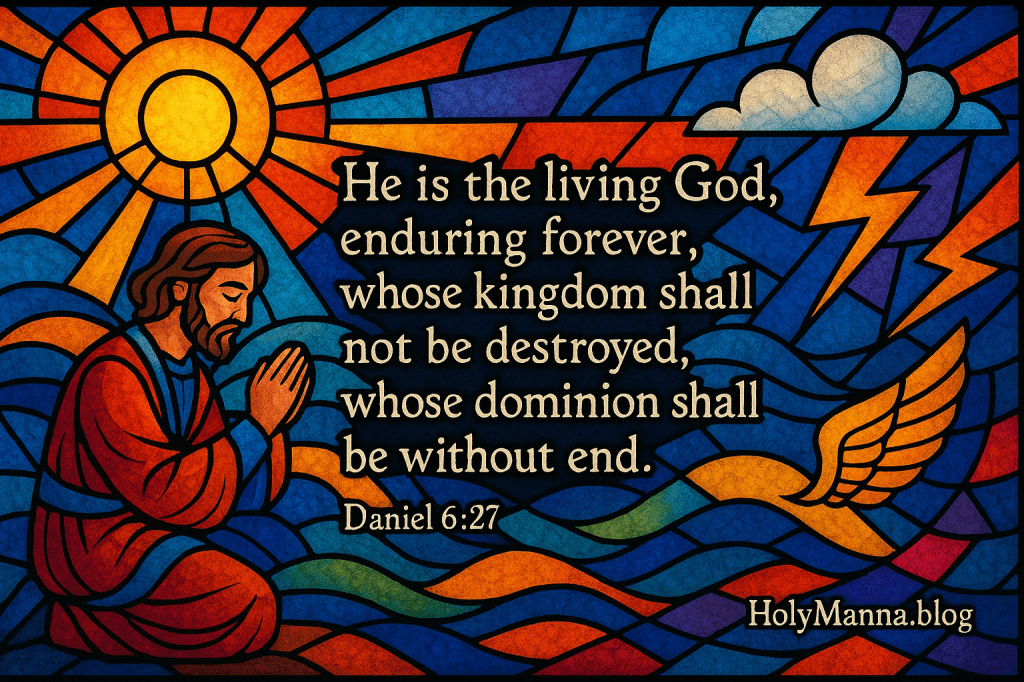
In the first reading from Daniel 6:12-28, Daniel lives in exile under pagan rule. The Medes and Persians dominate the scene, and their law is considered unchangeable. Political rivals manipulate King Darius and weaponize the law in order to destroy a faithful servant of God. Daniel does not protest, scheme, or compromise. He simply keeps doing what he has always done. He prays three times a day toward Jerusalem. His fidelity leads him straight into the lions’ den, yet God sends an angel and shuts the mouths of the beasts. The pagan king who signed the deadly decree ends up proclaiming to the world that the God of Israel is “the living God, enduring forever, whose kingdom shall not be destroyed” in Daniel 6:27. The message is clear. Earthly powers rise and fall, but the kingdom of God is not fragile.
The responsorial canticle from Daniel 3:68-74 widens the lens. All of creation is summoned to praise. “Dew and rain, bless the Lord”, “nights and days, bless the Lord”, “lightnings and clouds, bless the Lord”. The elements that can feel harsh or frightening, like frost, chill, and storm, are all invited to glorify God. This is not naive optimism. It is the eyes of faith recognizing that even in the cold, the dark, and the storm, God is still Lord, and creation itself is ordered toward His praise. Is the heart willing to bless the Lord not only in sunshine but also in icy seasons and cloudy days?
Then the Holy Gospel from Luke 21:20-28 takes things to a cosmic level. Jesus speaks of the destruction of Jerusalem, a real historical event that would shatter the Jewish world, and also of the final coming of the Son of Man. Armies surround the holy city, people flee, captives are taken, and the nations tremble. There are “signs in the sun, the moon, and the stars”, and “on earth nations will be in dismay” in Luke 21:25. People are dying of fear as the powers of the heavens are shaken. In the middle of that chaos, Jesus does not tell His disciples to hide or to collapse in panic. He commands them: “Stand erect and raise your heads because your redemption is at hand” in Luke 21:28. The same God who shut the lions’ mouths stands at the center of history, and the shaking of the world is not proof that He has abandoned His people. It is the stage on which His glory is revealed.
A central theme runs through all of this like a strong, unbroken thread. The living God reigns in the middle of trial, judgment, and apparent disaster, and the right response is steadfast trust and praise. Daniel stands firm in prayer despite deadly opposition. Creation blesses the Lord in all seasons, not only in gentle weather. The disciples are told to stand tall and lift their heads even when the world is falling apart. These readings invite hearts to move from fear to faith, from panic to praise, and from staring at the lions or the shaking skies to fixing their gaze on the coming Son of Man. Where is God inviting a soul today to stand firm, to keep praying, and to raise its head because redemption is closer than it feels?
First Reading – Daniel 6:12-28
Faith That Does Not Flinch In The Lions’ Den
The scene in Daniel 6:12-28 unfolds in the Medo Persian empire, after the fall of Babylon. Daniel is an elderly exile, a Jewish believer who has spent decades serving pagan kings with integrity while remaining completely faithful to the God of Israel. Under King Darius, Daniel has risen to such prominence that jealous officials conspire to destroy him. They use the very structure of Persian law against him, since royal decrees are considered irrevocable. The trap is simple and cruel. For thirty days, no one may pray to any god or human except the king. The punishment is execution in a den of lions.
In this context, Daniel’s quiet fidelity becomes explosive. He refuses to adjust his prayer life to fit a godless law. He continues to pray three times a day, facing Jerusalem, as he has always done. The cost is real. There is no guarantee of a miraculous rescue on the front end. Yet the God who seemed defeated when His people were exiled shows Himself again as “the living God, enduring forever, whose kingdom shall not be destroyed” in Daniel 6:27. Today’s theme comes into sharp focus here. Earthly powers may dominate the headlines, but the believer is called to trust and worship the living God even when obedience places them in the lions’ den. Daniel’s story prepares hearts to hear Jesus in Luke 21 say “stand erect and raise your heads because your redemption is at hand”, and it resonates with the cosmic praise of creation in Daniel 3, where every part of creation blesses the Lord in every season.
Daniel 6:12-28
New American Bible (Revised Edition)
12 So these men stormed in and found Daniel praying and pleading before his God. 13 Then they went to remind the king about the prohibition: “Did you not sign a decree, O king, that for thirty days, whoever makes a petition to anyone, divine or human, except to you, O king, shall be cast into a den of lions?” The king answered them, “The decree is absolute, irrevocable under the law of the Medes and Persians.” 14 To this they replied, “Daniel, one of the Jewish exiles, has paid no attention to you, O king, or to the prohibition you signed; three times a day he offers his prayer.” 15 The king was deeply grieved at this news and he made up his mind to save Daniel; he worked till sunset to rescue him. 16 But these men pressed the king. “Keep in mind, O king,” they said, “that under the law of the Medes and Persians every royal prohibition or decree is irrevocable.” 17 So the king ordered Daniel to be brought and cast into the lions’ den. To Daniel he said, “Your God, whom you serve so constantly, must save you.” 18 To forestall any tampering, the king sealed with his own ring and the rings of the lords the stone that had been brought to block the opening of the den.
19 Then the king returned to his palace for the night; he refused to eat and he dismissed the entertainers. Since sleep was impossible for him, 20 the king rose very early the next morning and hastened to the lions’ den. 21 As he drew near, he cried out to Daniel sorrowfully, “Daniel, servant of the living God, has your God whom you serve so constantly been able to save you from the lions?” 22 Daniel answered the king: “O king, live forever! 23 My God sent his angel and closed the lions’ mouths so that they have not hurt me. For I have been found innocent before him; neither have I done you any harm, O king!” 24 This gave the king great joy. At his order Daniel was brought up from the den; he was found to be unharmed because he trusted in his God. 25 The king then ordered the men who had accused Daniel, along with their children and their wives, to be cast into the lions’ den. Before they reached the bottom of the den, the lions overpowered them and crushed all their bones.
26 Then King Darius wrote to the nations and peoples of every language, wherever they dwell on the earth: “May your peace abound! 27 I decree that throughout my royal domain the God of Daniel is to be reverenced and feared:
“For he is the living God, enduring forever,
whose kingdom shall not be destroyed,
whose dominion shall be without end,
28 A savior and deliverer,
working signs and wonders in heaven and on earth,
who saved Daniel from the lions’ power.”
Detailed Exegesis
Verse 12 – “So these men stormed in and found Daniel praying and pleading before his God.”
The enemies of Daniel do not catch him plotting rebellion or stirring up violence. They find him doing the most faithful and vulnerable thing a believer can do. He is praying and pleading before God. The verb suggests an intense, persevering prayer, not a quick, casual moment. The very thing that marks Daniel’s loyalty to God becomes the evidence used against him. This shows how spiritual fidelity often becomes the point of attack in a hostile culture. Prayer is not a neutral act. It declares that someone other than the state, the boss, or popular opinion is Lord.
Verse 13 – “Then they went to remind the king about the prohibition: ‘Did you not sign a decree, O king, that for thirty days, whoever makes a petition to anyone, divine or human, except to you, O king, shall be cast into a den of lions?’ The king answered them, ‘The decree is absolute, irrevocable under the law of the Medes and Persians.’”
The officials manipulate the king with his own vanity and legal system. They emphasize the flattery embedded in the law, which treats the king as the sole mediator of petitions. The phrase about irrevocable law underlines the rigidity of human systems when they are absolutized. It is a warning against any earthly authority that tries to occupy the place of God in the heart. The king unknowingly binds himself to a deadly injustice, which reveals how sin can weaponize even good order when pride and fear drive decisions.
Verse 14 – “To this they replied, ‘Daniel, one of the Jewish exiles, has paid no attention to you, O king, or to the prohibition you signed; three times a day he offers his prayer.’”
Notice how they highlight Daniel’s identity as “one of the Jewish exiles”. The goal is to paint him as an outsider and a threat. Faithful believers often experience this kind of labeling. The accusation that Daniel has “paid no attention to you” twists his loyalty. Daniel has served the king faithfully, but his ultimate allegiance is to God. The reference to three times a day shows his disciplined, covenantal prayer life. Fidelity is not a mood but a habit.
Verse 15 – “The king was deeply grieved at this news and he made up his mind to save Daniel; he worked till sunset to rescue him.”
Darius realizes he has been tricked and feels real affection and respect for Daniel. Yet he is trapped in his own system. His grief shows the tension between human goodwill and structural injustice. He tries to save Daniel, but his efforts within the same broken framework cannot undo the damage. This exposes the limits of earthly power when it is not rooted in God’s wisdom. Even the most powerful ruler finds himself powerless.
Verse 16 – “But these men pressed the king. ‘Keep in mind, O king,’ they said, ‘that under the law of the Medes and Persians every royal prohibition or decree is irrevocable.’”
The conspirators pressure the king, using the law as a weapon instead of a tool for justice. They cling to the principle of irrevocability more tightly than to the value of human life. This reflects the danger of legalism when law is detached from truth and mercy. It also contrasts sharply with God’s law, which reflects His justice, goodness, and love. Here, the law of the Medes and Persians becomes a cage, not a safeguard.
Verse 17 – “So the king ordered Daniel to be brought and cast into the lions’ den. To Daniel he said, ‘Your God, whom you serve so constantly, must save you.’ Then the king sealed with his own ring and the rings of the lords the stone that had been brought to block the opening of the den.”
Darius speaks with a mixture of hope and resignation. He recognizes Daniel’s constant service to God and implicitly acknowledges that only God can undo this situation. The sealing of the stone confirms that no human tampering will occur. It becomes a stage for pure divine action. There is an echo here of sealed tomb imagery, which will later appear in the burial of Christ. Human power thinks it has the final word, but God is free to act beyond sealed stones.
Verse 18 – “Then the king returned to his palace for the night; he refused to eat and he dismissed the entertainers. Since sleep was impossible for him,”
Darius spends a sleepless night, fasting and restless. The one who is supposed to be in control is tormented by his own impotence. The contrast between the anxious king and the trusting Daniel is striking. Daniel is at peace in a den of lions, while Darius is in turmoil in a palace. This reveals that true security is not found in comfort, power, or luxury, but in faithfulness to God.
Verse 19 – “the king rose very early the next morning and hastened to the lions’ den.”
The urgency of the king’s actions shows the depth of his concern. He rushes to the place of death because something in him still hopes for a miracle. He may not fully know the God of Israel, but he senses that this God is not powerless. The human heart, even when entangled in sin or confusion, is drawn toward hope when it encounters authentic holiness.
Verse 20 – “As he drew near, he cried out to Daniel sorrowfully, ‘Daniel, servant of the living God, has your God whom you serve so constantly been able to save you from the lions?’”
Darius calls Daniel “servant of the living God”, which is a significant confession. Surrounded by idols and political power, he acknowledges a God who is alive and active. He connects Daniel’s constant service with the possibility of divine rescue. This is a deep insight. Fidelity to God is not a private hobby. It is a living relationship with the God who saves. The sorrow in his voice shows his fear that it might be too late, yet he still calls out.
Verse 21 – “Daniel answered the king: ‘O king, live forever!’”
Daniel’s first words are respectful and ordered. Even after injustice, he addresses the king with honor. Holiness does not turn into bitterness. His greeting reassures the king and demonstrates that faith does not cancel legitimate respect for authority. It reflects the kind of witness that can soften hardened hearts.
Verse 22 – “‘My God sent his angel and closed the lions’ mouths so that they have not hurt me. For I have been found innocent before him; neither have I done you any harm, O king!’”
Daniel attributes his deliverance entirely to God. He does not boast in his courage or his cleverness. He recognizes a specific divine intervention through an angel who shuts the mouths of the lions. His innocence before God is linked with his innocence before the king. This shows the integrity of a rightly formed conscience. Daniel’s loyalty to God has not made him a rebel against legitimate authority. Instead, it has made him the most trustworthy servant in the kingdom.
Verse 23 – “This gave the king great joy. At his order Daniel was brought up from the den; he was found to be unharmed because he trusted in his God.”
The text gives the reason for Daniel’s safety very clearly. He was unharmed “because he trusted in his God”. Trust is not a vague feeling. It is a concrete choice to place one’s destiny in God’s hands, even at great cost. The king’s joy shows how the faith of one believer can become a source of hope for others. Daniel’s trust becomes evangelizing.
Verse 24 – “The king then ordered the men who had accused Daniel, along with their children and their wives, to be cast into the lions’ den. Before they reached the bottom of the den, the lions overpowered them and crushed all their bones.”
This verse is sobering and difficult. It reflects the harsh judicial customs of the ancient Near East, where families could suffer together with the guilty. The inspired text does not endorse every detail as a moral model, but it does show the radical difference between Daniel’s protection and the fate of his enemies. The fact that the lions immediately overpower them confirms that Daniel’s deliverance was not due to tame animals, but to God’s intervention. It also warns that evil plots often backfire, and that unjust violence eventually returns upon the heads of the wicked.
Verse 25 – “Then King Darius wrote to the nations and peoples of every language, wherever they dwell on the earth: ‘May your peace abound!’”
Darius now shifts from being a hesitant admirer of Daniel to a public proclaimer of the God of Israel. He addresses all peoples and nations and wishes them peace. This prefigures the universal mission of the Gospel. When pagan rulers witness true holiness and divine power, they are capable of bearing witness to the true God, even if imperfectly. The God of Daniel is not a tribal deity but Lord of all.
Verse 26 – “‘I decree that throughout my royal domain the God of Daniel is to be reverenced and feared:”
The king issues a new decree that points in the right direction. The God of Daniel is to be reverenced and feared. This is not yet the fullness of revealed religion, but it marks a decisive step away from idolatry. Fear of the Lord in this context means awe, reverence, and recognition of God’s supremacy over every other power.
Verse 27 – “‘For he is the living God, enduring forever, whose kingdom shall not be destroyed, whose dominion shall be without end,”
This confession is powerful. It echoes language that will later be used of Christ and His kingdom in the New Testament. The king recognizes God as living, eternal, and sovereign. Unlike the fragile empires of history, God’s kingdom is indestructible. This is exactly the hope that Jesus offers in Luke 21, where the shaking of the world does not threaten God’s reign. Believers today are invited to root their identity in this unshakable kingdom.
Verse 28 – “‘A savior and deliverer, working signs and wonders in heaven and on earth, who saved Daniel from the lions’ power.’”
Darius concludes by proclaiming God as savior and deliverer, the worker of signs and wonders. Daniel’s personal rescue becomes a revelation of God’s character. This prepares the way for the fullness of salvation in Christ, who will overcome not just lions but sin and death themselves. The God who saved Daniel is the same God who raises Jesus from the dead and promises redemption to all who trust in Him.
Teachings
The story of Daniel in the lions’ den stands at a crossroads of themes that run through the entire Bible and the life of the Church. It speaks about persevering prayer, courageous witness in a hostile culture, and the absolute sovereignty of God’s kingdom.
The Catechism of the Catholic Church teaches that regular, chosen times of prayer shape the heart for constant communion with God. In CCC 2742 it says: “We cannot pray at all times if we do not pray at specific times, consciously willing it.” Daniel’s habit of praying three times a day shows exactly this kind of intentional rhythm. His fidelity in ordinary days prepares him for extraordinary trials. Prayer is not a last minute escape plan. It is the daily training of trust.
The Catechism also speaks about the duty to witness to the faith even when it is costly. In CCC 1816 it teaches: “The disciple of Christ must not only keep the faith and live on it, but also profess it, confidently bear witness to it, and spread it.” Daniel lives this out in a pre Christian context. He does not stage a protest, but he refuses to hide his worship. His open fidelity is his profession of faith.
Regarding persecution and even the threat of death, CCC 2473 describes martyrdom as “the supreme witness given to the truth of the faith: it means bearing witness even unto death.” Daniel is not killed, but he is ready to lose his life. His willingness to suffer for obedience places him among the great cloud of witnesses who show that life with God is more precious than physical survival.
The Church Fathers often reflect on the power of prayer in situations like Daniel’s. Saint John Chrysostom famously wrote about the strength of prayer: “Nothing is equal to prayer; for what is impossible, it makes possible, what is difficult, easy.” Daniel’s night in the lions’ den illustrates this truth dramatically. What seemed impossible within the limits of Persian law becomes possible through divine intervention.
The sovereignty of God over empires is another key theme. CCC 268 reminds believers: “Of all the divine attributes, only God’s omnipotence is named in the Creed: to confess this power has great bearing on our lives.” When Darius proclaims that God’s kingdom cannot be destroyed, he is touching the edge of this doctrine. Human systems, even massive empires, are temporary. God’s reign is eternal. That is why Jesus can speak of world shaking events in Luke 21 without any hint of panic.
Historically, the Church has often read Daniel 6 alongside times of persecution, whether under pagan Rome, anti Christian regimes, or more subtle cultural hostility. The story of Daniel reminds every generation that laws and customs that contradict God’s commands do not have the final word. The early martyrs, like Saint Polycarp and Saint Ignatius of Antioch, read stories like Daniel’s as encouragement to remain faithful under threat. Their courage flowed from the same conviction that animated Daniel, namely that God is able to save, and that even if He permits suffering, His kingdom remains unshaken.
Reflection
Daniel’s story is not just an inspiring tale from ancient history. It is a mirror held up to modern disciples. Every believer today faces their own version of a lions’ den. Sometimes the lions look like social pressure to hide faith, a workplace culture that mocks prayer and purity, or friendships where sin is normalized and holiness seems strange. At other times the lions are interior, such as addictions, fears, or patterns of sin that feel ready to devour peace and hope.
One of the most striking details in Daniel 6 is that Daniel does not start praying when the crisis hits. He continues what he has always done. A heart can take this as a concrete invitation. Set fixed times of daily prayer and guard them. Morning, midday, and evening moments of turning toward God, whether through Scripture, the Rosary, or silent adoration, form a kind of interior Jerusalem where the soul faces God no matter what decrees the world passes.
Another practical step is to cultivate integrity in both spiritual and secular responsibilities. Daniel is not only holy. He is also excellent in his work, which is why his enemies envy him. Holiness that is lazy or dishonest in ordinary duties sends a mixed message. Holiness that is competent, honest, and generous shines with credibility. It becomes easier for others to see that the God of Daniel truly is living and powerful when His servants reflect His goodness in daily life.
There is also a call to examine the subtle ways fear of human opinion may be influencing choices. Is there a place where God’s will is clear, but fear of what others might say or do keeps the heart from full obedience? Is there a situation where prayer, worship, or moral truth are being quietly adjusted to fit in with a crowd or a company culture? Daniel’s example challenges believers to gently but firmly realign their priorities so that God’s law and God’s love sit at the center.
Finally, Daniel’s story can be a source of consolation for those who feel trapped by situations beyond their control. The sealed stone over the lions’ den looked like the end. Yet in that hidden darkness, God was at work. Is there a “sealed den” in life right now, a situation that feels finished, hopeless, or beyond rescue? This reading invites the heart to place that situation explicitly in God’s hands and to ask for the courage to trust Him before the miracle, not only after.
Daniel walked out of the den without a scratch, but the real victory was won the moment he chose to keep praying when the decree was signed. In the same way, every act of fidelity, every quiet yes to God in the middle of pressure, participates in the victory of the kingdom that will never be destroyed.
Responsorial Psalm – Daniel 3:68-74
When All Of Creation Becomes A Choir Of Trust
The responsorial canticle from Daniel 3:68-74 comes from the famous hymn often called the Canticle of the Three Young Men. In the Book of Daniel, this song rises from the hearts of three Jewish youths who have been thrown into a blazing furnace by King Nebuchadnezzar for refusing to worship a golden statue. Humanly speaking, their story should end in smoke and ashes. Instead, God sends an angel to protect them, and in the middle of the flames they burst into praise. This context matters because it shows that this is not soft, comfortable worship. It is praise in the fire, trust in the midst of persecution, and joy in the heart of danger.
In today’s liturgy, this canticle responds to the story of Daniel in the lions’ den in Daniel 6:12-28. Once again, a faithful servant of God is under deadly pressure from a pagan empire. Once again, God sends an angel and preserves His servant. The canticle calls all creation to bless the Lord. Dew and rain, frost and chill, nights and days, light and darkness, lightnings and clouds, and finally the whole earth are summoned into a cosmic liturgy. This fits perfectly with the theme of trusting and praising the living God when the world feels hostile or unstable. While Daniel stands firm in the lions’ den and Jesus speaks in Luke 21:20-28 about nations in distress and signs in the heavens, this psalm reminds believers that all of creation is ultimately ordered toward the praise of God. Even harsh conditions, like frost, chill, and storm, become instruments in the symphony of divine glory. Can hearts learn to praise God not only in gentle breezes and warm sunlight, but also when life feels icy, dark, and shaken by thunder?
Daniel 3:68-74
New American Bible (Revised Edition)
68 Dew and rain, bless the Lord;
praise and exalt him above all forever.
69 Frost and chill, bless the Lord;
praise and exalt him above all forever.
70 Hoarfrost and snow, bless the Lord;
praise and exalt him above all forever.
71 Nights and days, bless the Lord;
praise and exalt him above all forever.
72 Light and darkness, bless the Lord;
praise and exalt him above all forever.
73 Lightnings and clouds, bless the Lord;
praise and exalt him above all forever.
74 Let the earth bless the Lord,
praise and exalt him above all forever.
Detailed Exegesis
Verse 68 – “Dew and rain, bless the Lord; praise and exalt him above all forever.”
The first verse calls dew and rain to bless the Lord. Dew is gentle and quiet, the kind of moisture that nourishes the earth in the stillness of dawn. Rain is more obvious and sometimes disruptive, but absolutely essential for life. Together they represent all the ways God sustains creation, both softly and powerfully. Spiritually, dew can symbolize the quiet action of grace in the soul, while rain evokes the generous outpouring of God’s gifts. This line invites every believer to recognize both subtle and dramatic blessings as reasons to praise God. The command to “praise and exalt him above all forever” reminds the heart that God must be placed above every created good. Even when the rain pattern in life feels inconvenient, the believer is called to see God’s hand at work and respond with trust instead of resentment.
Verse 69 – “Frost and chill, bless the Lord; praise and exalt him above all forever.”
Here the tone shifts from the gentleness of dew and life giving rain to the bite of frost and the discomfort of chill. These are not cozy images. Frost can damage crops, and cold can make life harsh. Yet they are still commanded to bless the Lord. This verse pushes against the instinct to praise only when things feel warm and easy. Spiritually, frost and chill can symbolize seasons of dryness, emotional desolation, or hardship. The Church teaches that such times are not signs that God has abandoned the soul, but often moments when faith is purified. The call for frost and chill to bless the Lord is an invitation to trust that even difficult seasons are under God’s providence and can bear fruit. The heart is challenged to say, in the spirit of this verse, that God is still worthy of praise when feelings are numb and circumstances are rough.
Verse 70 – “Hoarfrost and snow, bless the Lord; praise and exalt him above all forever.”
Hoarfrost and snow paint a picture of a world that looks frozen and still. Yet snow also has a strange beauty and a quiet that feels almost sacred. This line suggests that God’s glory shines not only in the green of spring and the heat of summer, but also in the stark white of winter. Spiritually, snow can point to purity and cleansing. The Bible often connects whiteness with forgiveness and renewal. Even when life feels like a frozen landscape, God may be covering what is old and broken and preparing for a new season of growth. This verse encourages believers to see beauty in seasons that seem lifeless. The repetition of “praise and exalt him above all forever” reinforces that praise is not seasonal, but constant.
Verse 71 – “Nights and days, bless the Lord; praise and exalt him above all forever.”
Nights and days sum up the basic rhythm of time. Every twenty-four-hour cycle contains both light and darkness. The verse declares that the whole flow of time is called to bless the Lord. Daytime usually represents clarity, work, and visibility. Night often symbolizes mystery, rest, and sometimes fear. Both are under God’s rule. The Church reminds the faithful that all time belongs to God and is a path to holiness. By inviting nights and days to bless the Lord, the text teaches that God is present at every hour, whether the soul feels awake and sharp or exhausted and confused. This calls believers to sanctify time through prayer in the morning and evening, and to remember that God is God in both bright seasons and dark ones.
Verse 72 – “Light and darkness, bless the Lord; praise and exalt him above all forever.”
This verse goes even deeper into the mystery. Light and darkness themselves are told to bless the Lord. Light clearly points to truth, revelation, and the presence of God, since Scripture says in 1 John 1:5 that “God is light, and in him there is no darkness at all.” Yet darkness in Scripture can represent both the absence of God and the hiddenness of God. Here, even darkness is included in the call to praise. This does not mean evil is good. Rather, it means that even experiences of darkness in the spiritual life can become occasions for deeper faith when they are lived in trust. The contrast between light and darkness also fits the theme of Luke 21, where cosmic signs and frightening events are not signs that God has lost control, but part of a larger plan that ends with the Son of Man coming in glory. Light and darkness, in the end, serve the purposes of God.
Verse 73 – “Lightnings and clouds, bless the Lord; praise and exalt him above all forever.”
Lightning and clouds evoke awe and sometimes fear. Storms can be terrifying and yet strangely beautiful. In Scripture, God often appears in cloud and storm, such as on Mount Sinai or during the Exodus. Lightning points to the sudden, powerful actions of God that break into human history. Clouds can hide God’s face while still signaling His presence. This verse encourages hearts to see God’s hand even in events that feel stormy. Spiritually, there are seasons when God’s action is sudden and disruptive, and other times when His presence is veiled. Both are moments to bless the Lord. The repeated call to “praise and exalt him above all forever” keeps the focus on God’s greatness rather than on the fear that storms may provoke.
Verse 74 – “Let the earth bless the Lord, praise and exalt him above all forever.”
The final verse in this section zooms out to the entire earth. All creation, from weather patterns to the soil beneath our feet, is summoned into worship. This line brings together the whole list of elements and reveals their purpose. Creation is not random or meaningless. It exists to glorify God. The earth’s blessing of the Lord also hints at humanity’s role, since human beings are the voice of conscious creation. When people praise God, work the land with justice, and care for the environment responsibly, the earth’s blessing of the Lord becomes audible. This verse ties directly into today’s theme. While kingdoms rise and fall and while Daniel faces lions and Jesus speaks of shaking skies, the earth remains called to praise. Believers are invited to join that cosmic chorus, confident that God’s kingdom endures.
Teachings
The Canticle of the Three Young Men has a special place in the Church’s liturgy. In the Liturgy of the Hours, this song is prayed in morning prayer on certain days, inviting the faithful to join the praise of creation as a new day begins. This is not just poetic. It reflects deep Catholic teaching about the goodness of creation and its orientation toward God.
The Catechism of the Catholic Church teaches that the world was created for the glory of God. In CCC 293 it says: “Scripture and Tradition never cease to teach and celebrate this fundamental truth: ‘The world was made for the glory of God.’” That glory is not God’s ego, but the radiance of His goodness poured out so that creatures might share in His life. The Canticle of Daniel sings this truth. Every created reality, from dew and rain to lightning and clouds, finds its true meaning when it blesses the Lord.
The Catechism also emphasizes that each creature has its own goodness and purpose in the divine plan. In CCC 339 it teaches: “Each creature possesses its own particular goodness and perfection. For each one of the works of the ‘six days’ it is said: ‘And God saw that it was good.’ ‘By the very nature of creation, material being is endowed with its own stability, truth, and excellence, its own order and laws.’” When the Church prays, “Dew and rain, bless the Lord”, it is recognizing that the natural processes of creation are good and reveal something of their Creator.
Saint Francis of Assisi famously echoed the spirit of this canticle in his Canticle of the Creatures, where he calls Brother Sun, Sister Moon, and even Sister Death to praise God. He writes: “Praised be You, my Lord, with all Your creatures, especially Sir Brother Sun, who is the day and through whom You give us light.” This Franciscan spirituality recognizes the world as a kind of sacrament, not in the technical sense of the seven Sacraments, but as a sign that points to God. The Canticle in Daniel 3 is an earlier biblical expression of this same outlook.
The Catechism also links creation’s praise directly to liturgy. In CCC 1095 it notes how the Church reads and prays the Old Testament in the light of Christ and says: “The Church, as early as apostolic times, and then constantly in her Tradition, has illuminated the unity of the divine plan in the two Testaments through typology, which discloses the inexhaustible content of the Old Testament.” The three young men in the furnace prefigure Christians who praise God in the midst of persecution, and the Canticle they sing becomes part of the Church’s own prayer. This shows that the liturgy is not just about words, but about entering into the same trust that allowed them to sing in the fire.
Another key teaching is the call to continual praise. CCC 2639 describes praise as a distinct form of prayer: “Praise is the form of prayer which recognizes most immediately that God is God. It lauds God for his own sake and gives him glory, beyond what he does, but simply because HE IS.” The Canticle of Daniel is pure praise. It does not ask for anything. It simply recognizes that God is worthy of blessing and exaltation in every circumstance. This is exactly the posture that Daniel models in the lions’ den and that Jesus calls for in Luke 21, when He tells disciples to stand erect and lift their heads even when the world is in turmoil.
The Church also teaches that creation is groaning and awaiting redemption, but still participates in God’s plan. In CCC 1049 it says: “Far from diminishing our concern to develop this earth, the expectancy of a new earth should spur us on, for it is here that the body of a new human family grows, foreshadowing in some way the age which is to come.” When the earth is invited to bless the Lord, the faithful are reminded that their care for creation is not separate from their spiritual life. It is part of living in harmony with God’s design and anticipating the final renewal of all things when Christ returns.
Reflection
This responsorial psalm gently but firmly trains the heart to praise God in every season, both literally and spiritually. Most people love dew, rain after a drought, and soft spring mornings. Fewer people love frost, biting cold, and storms. Yet the canticle refuses to filter out the hard parts of nature. It teaches that God is Lord in gentle weather and in harsh climates, in bright daytime and in dark nights, in clouds and in clear skies.
Applied to daily life, this means choosing to bless the Lord not only when feelings cooperate, but also when they do not. Morning might come with energy and joy, or with heaviness and anxiety. Work may feel fulfilling or frustrating. Friendships may be in a season of warmth or a season of misunderstanding. In every case, this canticle invites believers to say, in some form, “Bless the Lord, praise and exalt him above all forever.” This does not mean pretending that pain or injustice are good. It means trusting that God is still present and still worthy of worship in the middle of them.
One concrete practice that flows from this reading is to offer a short prayer of praise in different “weathers” of the day. When a cool breeze or a sudden rainstorm appears, the heart can whisper praise. When the morning feels bright and full of hope, the soul can thank God for the light. When the evening feels heavy or confusing, the believer can still say that God is God and that His kingdom will not be destroyed. Over time, this habit forms a reflex of trust.
Another step is to examine how easy it is to complain about the “frost and chill” parts of life while forgetting that even these can draw the heart closer to God. Is there a difficult situation right now that could become part of a personal canticle of praise, offered not because the situation feels good, but because God is still faithful? Is there an area of life that feels like darkness, where God might be quietly present even if His face is hidden?
This psalm also invites a more reverent attitude toward creation itself. Instead of treating weather, seasons, and the natural world as background noise, the believer can start to see them as fellow worshippers. Dew, rain, snow, clouds, sun, and stars are not just scenery. They are part of a giant liturgical procession that leads everything back to God. How might prayer life change if the next walk outside is seen as stepping into a cathedral where the walls are sky and the choir is made of wind, rain, and sunlight?
Finally, this canticle anchors the heart for the more intense moments described in the other readings. When Jesus speaks of nations in dismay and signs in the heavens in Luke 21, the believer who has learned from Daniel 3 knows that even cosmic disturbances cannot dethrone God. When life feels like a lions’ den or a fiery furnace, praise may not feel natural. Yet from the perspective of heaven, those are exactly the moments when praise becomes most beautiful, because it is an act of pure faith.
Dew and rain, frost and snow, nights and days, light and darkness, storms and calm, all of them are being woven into a song that proclaims the greatness of God. The invitation today is simple and demanding at the same time. Let hearts join that song, especially when the weather of the soul is cold or stormy. In doing so, believers share in the unshakable confidence of Daniel and in the hope that hears Jesus say, “stand erect and raise your heads because your redemption is at hand.”
Holy Gospel – Luke 21:20-28
Heads Up, Not Down, When The World Shakes
The Holy Gospel from Luke 21:20-28 takes place in the days just before Jesus’ Passion. He is in Jerusalem, teaching in the Temple, surrounded by religious tensions and political pressure from Rome. The disciples admire the beauty of the Temple, but Jesus speaks bluntly about its coming destruction. Historically, these words point very clearly to the fall of Jerusalem in the year 70, when Roman armies surrounded the city, laid siege, and eventually destroyed the Temple. For the Jewish people, the Temple was the center of worship, identity, and sacrifice. Its destruction felt like the end of the world.
Jesus, however, does not only speak about that historical catastrophe. He also lifts the eyes of His disciples beyond 70 A.D. to the final coming of the Son of Man. The language of signs in the sun, moon, and stars, roaring seas, and shaken heavens echoes prophetic imagery from Daniel and other Old Testament books. It is apocalyptic language, meant to reveal God’s perspective on history. Nations shake, cities fall, and people are terrified, but the deeper truth is that God is still in control and His kingdom cannot be destroyed.
This fits perfectly with today’s theme. Daniel in the first reading stands firm in the lions’ den because he trusts the living God. The Canticle in Daniel 3 calls creation to praise in every season. Now Jesus tells His disciples that when world events feel like a total collapse, they must not crumble inside. He says that when these frightening signs begin to happen, they should “stand erect and raise your heads because your redemption is at hand” in Luke 21:28. The Gospel invites believers to live with a steady heart in a shaking world, rooted in the certainty that Christ is Lord of history and that judgment for the world can be redemption for the faithful.
Luke 21:20-28
New American Bible (Revised Edition)
20 “When you see Jerusalem surrounded by armies, know that its desolation is at hand. 21 Then those in Judea must flee to the mountains. Let those within the city escape from it, and let those in the countryside not enter the city, 22 for these days are the time of punishment when all the scriptures are fulfilled. 23 Woe to pregnant women and nursing mothers in those days, for a terrible calamity will come upon the earth and a wrathful judgment upon this people. 24 They will fall by the edge of the sword and be taken as captives to all the Gentiles; and Jerusalem will be trampled underfoot by the Gentiles until the times of the Gentiles are fulfilled.
The Coming of the Son of Man. 25 “There will be signs in the sun, the moon, and the stars, and on earth nations will be in dismay, perplexed by the roaring of the sea and the waves. 26 People will die of fright in anticipation of what is coming upon the world, for the powers of the heavens will be shaken. 27 And then they will see the Son of Man coming in a cloud with power and great glory. 28 But when these signs begin to happen, stand erect and raise your heads because your redemption is at hand.”
Detailed Exegesis
Verse 20 – “When you see Jerusalem surrounded by armies, know that its desolation is at hand.”
Jesus first gives a concrete sign. Jerusalem will be surrounded by armies. This is not just symbolic. It refers to a real siege, which took place under the Romans. The word “desolation” hints at Old Testament prophecies about abominations and judgment. The holy city that rejected the prophets and is about to reject the Messiah will face consequences. Spiritually, this is a sober reminder that sin and infidelity have real effects in history. God is patient but not indifferent. At the same time, Jesus is warning His followers so that they will not be caught by surprise. His foreknowledge shows that nothing escapes His gaze.
Verse 21 – “Then those in Judea must flee to the mountains. Let those within the city escape from it, and let those in the countryside not enter the city,”
Here Jesus gives very practical instructions. He does not tell His disciples to stay and fight. He tells them to flee. In the ancient world, a city under siege was where people ran for safety. Jesus reverses that instinct. The city that should have been a refuge will become a trap, so obedience to Jesus means going against normal human calculations. Historically, early Christian tradition suggests that many believers did in fact flee before the final destruction. Spiritually, this shows that following Christ sometimes requires leaving behind places or patterns that feel familiar but are spiritually dangerous. When the Lord says, “escape,” the wise heart responds.
Verse 22 – “for these days are the time of punishment when all the scriptures are fulfilled.”
Jesus calls this a time of punishment and fulfillment of Scripture. God’s judgment is not random anger. It is the unfolding of a long-announced plan. The prophets had warned repeatedly that infidelity, injustice, and rejection of God would lead to disaster. The destruction of Jerusalem becomes a kind of visible sign of what sin does. At the same time, it is part of the larger story of salvation. Scripture is fulfilled not only in comforting promises, but also in hard truths. The believer is called to hold both together. The justice of God and the mercy of God are not opposed. They meet in the Cross.
Verse 23 – “Woe to pregnant women and nursing mothers in those days, for a terrible calamity will come upon the earth and a wrathful judgment upon this people.”
This verse shows the deep human cost of judgment. Pregnant women and nursing mothers represent the most vulnerable, those who carry and care for new life. War and siege are especially cruel to the weak. Jesus is not detached. The word “woe” expresses sorrow and compassion. The phrase “this people” points to the responsibility of the generation that has resisted God’s call. There is a mysterious tension here. The innocent suffer because of the sins of others. This reality runs through human history. It is not presented as something good, but as something tragic that flows from the misuse of freedom. It should stir both sorrow for victims and a serious desire to repent of sin before it harms others.
Verse 24 – “They will fall by the edge of the sword and be taken as captives to all the Gentiles; and Jerusalem will be trampled underfoot by the Gentiles until the times of the Gentiles are fulfilled.”
Jesus continues with a clear description of defeat and exile. Many will die by the sword. Others will be taken away as captives. Jerusalem will be trampled. This matches what happened in 70 A.D. and in the following years. Yet there is a small phrase of hope: “until the times of the Gentiles are fulfilled.” This suggests that God is not finished. The fall of Jerusalem opens a new phase in salvation history, where the Gospel goes out to the nations. Saint Paul later reflects on this mystery in Romans 11, speaking of a partial hardening until the full number of the Gentiles comes in. The point is that even in painful events, God is still guiding history toward the inclusion of all peoples in His plan.
Verse 25 – “There will be signs in the sun, the moon, and the stars, and on earth nations will be in dismay, perplexed by the roaring of the sea and the waves.”
Now the perspective zooms out from one city to the whole cosmos. The language becomes clearly apocalyptic. Signs in the heavens and turmoil in the seas echo texts like Joel 2 and Daniel 7. Nations are in dismay and confusion. The “roaring of the sea and the waves” suggests chaos and instability. In biblical symbolism, the sea often represents forces that resist God’s order. Here, everything that seemed stable begins to shake. Spiritually, this shows that the final consummation of history will not be a gentle fadeout but a moment when God definitively confronts all opposition. The disciple does not need to decode every sign but is called to stay awake and rooted in faith.
Verse 26 – “People will die of fright in anticipation of what is coming upon the world, for the powers of the heavens will be shaken.”
This verse describes the reaction of those whose hope is anchored only in this world. When the foundations they trust begin to crumble, they are overwhelmed by terror. The phrase “powers of the heavens” can refer to spiritual forces or to the cosmic order itself. Either way, the message is that nothing created is ultimate. Everything that is not God can be shaken. This is frightening if the heart is clinging to created things as if they were absolute. It is liberating if the heart is attached to God, who cannot be shaken. This verse exposes where trust really lies.
Verse 27 – “And then they will see the Son of Man coming in a cloud with power and great glory.”
At the center of all this turmoil stands a Person. Jesus calls Himself the Son of Man, drawing directly from Daniel 7, where “one like a son of man” comes with the clouds of heaven and receives an everlasting kingdom. The cloud recalls the presence of God in the Old Testament, from the Exodus to the Temple. Power and great glory belong to Christ. This is not a hidden, gentle arrival like Bethlehem. This is the visible manifestation of the King at the end of history. The same Jesus who is about to be crucified and mocked is the One who will come in glory to judge the living and the dead.
Verse 28 – “But when these signs begin to happen, stand erect and raise your heads because your redemption is at hand.”
This is the heart of the Gospel. While others collapse in fear, disciples are told to stand upright and lift their heads. The difference is not that believers are immune to suffering. The difference is that they know what is really happening. For them, the shaking of the world is not the triumph of chaos but the approach of redemption. The word “redemption” points to liberation, like the Exodus, and to the final restoration of all things in Christ. This verse calls for a posture of hope in the face of frightening events. It invites the soul to live with spiritual backbone, confident that Christ’s kingdom is close.
Teachings
The Church reads this passage in the context of what it calls “Christian eschatology,” the teaching about the last things. The Catechism of the Catholic Church insists that Christ already reigns, even if His kingdom is not yet fully manifested. In CCC 668 it states that after His Ascension, “Christ is seated at the right hand of the Father” and that from this position He exercises kingship over all things. This means that the events described in Luke 21 are not random. They unfold under the authority of the risen Lord.
At the same time, the Church teaches that history is in a kind of tension between what is already accomplished and what is not yet complete. In CCC 671 it explains that though everything is subject to Christ, “the kingdom will be fulfilled… only after a final trial”. The shaking described in this Gospel is part of that final drama. Believers are warned not to expect an easy, conflict free path to glory.
The Catechism also speaks of a final trial that will test the faith of many. In CCC 675 it says that before Christ’s second coming, “the Church must pass through a final trial that will shake the faith of many believers”. While it does not identify exact timelines, it makes clear that deception, persecution, and confusion will intensify. This connects with Luke 21, where nations are in dismay and people die of fright. The Church is realistic. Faith will be tested, not flattered.
However, the Church never speaks of the end in a tone of despair. In CCC 1040 it teaches that the last judgment will reveal the ultimate meaning of all works and hearts and will show that God’s justice triumphs. It says that Christ will “pronounce the final word on all history”. The Gospel scene of the Son of Man coming in a cloud with glory corresponds to this moment. For those who love God, that final word is not condemnation but the joyful confirmation of their hope.
Regarding Jerusalem’s fall and the “times of the Gentiles,” the Church recognizes both the tragedy and the mystery. CCC 674 speaks of the Jewish people’s role in the plan of God and says that “the full inclusion of the Jews in the Messiah’s salvation” is linked to the final coming of Christ. This suggests that history has a rhythm known to God, in which the Gospel goes out to the nations and Israel remains mysteriously central to His plan.
Saint Augustine, reflecting on the end times, reminds believers not to obsess over dates or external signs, but to live always ready. He writes that the exact day is hidden so that every generation may be watching. His approach fits with Jesus’ call to stand ready when signs begin to happen. The focus is less on decoding every event and more on living in a state of faithful vigilance.
Saint John Paul II often spoke about not being afraid in the face of global upheaval. In his inaugural homily he urged the world: “Do not be afraid. Open wide the doors to Christ.” That same spirit resonates with Luke 21:28. Instead of closing in on themselves in fear, disciples are told to open their hearts in hope, knowing that Christ is drawing near.
Reflection
This Gospel speaks very directly into a culture that lives on a steady diet of crisis. News feeds, social media, and constant notifications often give the sense that everything is on the brink of collapse. Wars, economic instability, scandals in the Church, moral confusion, and natural disasters can easily make a soul feel like those people in Luke 21 who are “dying of fright.” Jesus does not mock that fear, but He does call His disciples to a different posture.
One concrete response to this Gospel is to become more intentional about where the heart roots its hope. If hope is placed mainly in political stability, financial security, health, or social approval, then any threat to those things will feel like the end of the world. If hope is anchored in Christ and His kingdom, then even very real losses, while painful, cannot destroy the deepest confidence. What currently feels like the “foundation” of life, and how would the heart react if that foundation shook? Does daily prayer reflect a trust in Christ as Lord of history, or does it remain mostly focused on short term comfort?
Another step is to limit the amount of time spent consuming fear driven content. The Gospel does not ask believers to be ignorant. It asks them not to be ruled by panic. It may be helpful to set specific times for checking news, and to pair that habit with prayer. Every time worrying headlines are read, a short act of trust can follow, such as a simple prayer acknowledging Christ’s kingship and asking for the grace to stand firm. Over time, this trains the soul to respond to bad news not with immediate despair, but with a reflex of intercession and hope.
This passage also encourages a serious approach to personal conversion. The destruction of Jerusalem shows that ignoring God’s calls has real consequences. Rather than using this text to judge others, a believer can ask quietly, Is there any area where God has been calling for change and that call is being ignored? Are there sins that are being minimized or excuses that are being made while grace is nudging toward repentance? Accepting Jesus’ warning personally is not about fear of punishment as much as it is about stepping out of paths that lead to destruction and onto paths that lead to life.
Finally, this Gospel invites a kind of daily “head lifting.” When anxiety about the future creeps in, when scandals shake trust, or when personal suffering feels overwhelming, Jesus’ words can be repeated almost like a mantra: “Stand erect and raise your heads because your redemption is at hand.” That does not magically erase problems, but it reorients the heart. Redemption is not just a distant idea. It is the living presence of Christ at work now and the promise of His final victory.
The world shook for Daniel in the lions’ den and for the three young men in the furnace. It shook for the early Christians when Jerusalem fell and when emperors persecuted them. It still shakes today in different ways. This Gospel does not promise a calm world. It promises a calm heart that belongs to a kingdom which cannot be destroyed. How might life look different if every moment of shaking became an invitation to stand a little straighter, lift the eyes a little higher, and trust that the Son of Man is closer than it seems?
Raise Your Head And Bless The Lord In Every Season
Today’s readings trace a powerful arc, from a lions’ den in Daniel 6, through the cosmic hymn of creation in Daniel 3:68-74, to the shaking of nations and skies in Luke 21:20-28. Together they deliver a single, clear message. God is not fragile. God is not distant. God is the living King whose kingdom cannot be destroyed, who saves in the furnace, in the den, and in the final upheaval of history. Daniel shows that trust in God is not theory. It looks like kneeling in prayer when it is illegal, choosing fidelity over safety, and discovering that “he is the living God, enduring forever, whose kingdom shall not be destroyed” in Daniel 6:27. The Canticle from Daniel 3 reminds every heart that all of creation, from dew and rain to frost, snow, lightning, and clouds, is already praising the Lord. The world is not a cold, empty machine. It is a temple. Every season of the soul, even the cold and stormy ones, can become part of a personal song of praise.
In the Holy Gospel from Luke 21:20-28, Jesus speaks into the deepest fears. Cities fall. Armies surround. Nations tremble. People “die of fright.” Yet to His disciples He says the opposite of what fear expects. He commands: “Stand erect and raise your heads because your redemption is at hand” in Luke 21:28. That is the heart of today. When the world shakes, when personal life feels like a den of lions or a city under siege, the believer is not called to collapse inside. The believer is called to stand. Not because things are easy, but because Christ is near.
This day invites a very concrete response. It calls for a Daniel like decision to build a regular rhythm of prayer that does not disappear when pressure rises. It urges a shift from complaining about the “frost and chill” seasons of life to quietly choosing to say, “Bless the Lord, praise and exalt him above all forever”, even when feelings lag behind. It pushes the heart to anchor its hope in Christ more than in news cycles, bank accounts, or human approval. Where is God asking for a step of courage, a recommitment to prayer, or a deeper trust in His providence right now?
The God who shut the mouths of lions and walked with three young men in the flames is the same God who will one day split the sky and come in a cloud with power and great glory. Until that day fully arrives, the invitation is simple and strong. Keep praying like Daniel. Keep blessing the Lord with all creation. Keep standing with a lifted head when fear says to fold. The living God endures forever, His kingdom will not be destroyed, and for those who trust Him, redemption is not far off. It is already drawing near.
Engage with Us!
Share your thoughts and reflections in the comments below, because this kind of Scripture is meant to be prayed together, wrestled with, and lived out in real life, not just read in passing. Let these questions help you sit with God’s Word and open your heart more fully to His voice today.
- First Reading – Daniel 6:12-28: Where do you most relate to Daniel right now? Is there an area of life where staying faithful to God feels risky, uncomfortable, or misunderstood, and what concrete step of trust can be taken this week to “keep praying” even when it costs something?
- Responsorial Psalm – Daniel 3:68-74: When you hear “Dew and rain, bless the Lord” and “frost and chill, bless the Lord”, which “weather” of your own soul comes to mind right now, and how can you begin to bless the Lord in that specific season instead of only waiting for things to feel warm and easy again?
- Holy Gospel – Luke 21:20-28: Jesus says, “Stand erect and raise your heads because your redemption is at hand” in Luke 21:28; in what situations do you feel most tempted to hunch over in fear, anxiety, or discouragement, and what would it look like, very practically, to “raise your head” in those moments and choose hope in Christ instead of panic?
As you carry these questions into your day, remember that faith is not about never feeling afraid. Faith is about choosing to trust the living God right in the middle of the lions, the frost, the storms, and the shaking of the world. Go forward with courage, do everything with the love and mercy Jesus taught, and let every moment become an opportunity to live as a true disciple whose life quietly says, “Bless the Lord, praise and exalt him above all forever.”
Sacred Heart of Jesus, we trust in You!
Immaculate Heart of Mary, pray for us!
Saint Michael the Archangel, defend us in battle!
Follow us on Instagram and Facebook for more insights and reflections on living a faith-filled life.

 Holy Manna!
Leave a comment