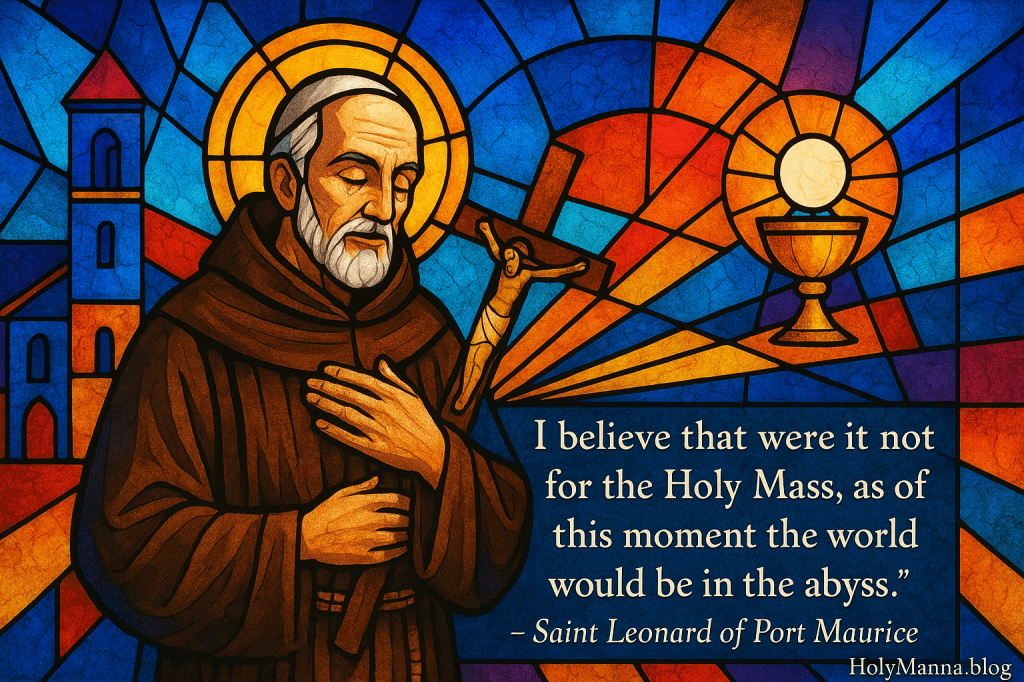
A Missionary Heart Set on Fire
Saint Leonard of Port Maurice is remembered as one of the greatest preachers of the eighteenth century, a Franciscan friar whose entire life burned with one passionate desire: to lead souls to Jesus through the Cross, the Holy Mass, and devotion to the Blessed Virgin Mary. His legacy shines most clearly in his deep love for the Eucharist and his tireless promotion of the Stations of the Cross, which he helped spread across Italy. He personally erected hundreds of sets of Stations, including the famous Via Crucis in the Roman Colosseum. His fiery preaching drew enormous crowds, sometimes so large that churches could not contain them, forcing him to preach outdoors.
Saint Leonard also composed the Divine Praises, recited at Benediction as an act of reparation and Eucharistic adoration. His profound love for the Holy Mass shines in his famous words: “I believe that were it not for the Holy Mass, as of this moment the world would be in the abyss.” This echoes the teaching of The Catechism, which proclaims that “The Eucharist is the source and summit of the Christian life.” (CCC 1324). Everything about Saint Leonard’s ministry flowed from this truth.
From Porto Maurizio to the Franciscan Habit
Saint Leonard was born Paul Jerome Casanova on December 20, 1676, in Porto Maurizio near Genoa, Italy. His father was a ship captain, and his mother was a devout Catholic woman whose influence deeply shaped the family. The Casanova household was richly blessed with vocations, and several of Leonard’s siblings entered religious life.
At thirteen, Leonard was sent to Rome to live with his uncle and study at the Jesuit Roman College. Brilliant and gifted in the sciences, he was expected to pursue a medical career. Yet God planted a deeper longing in his heart, calling him away from worldly ambition and toward religious life. Against his family’s expectations and his uncle’s wishes, he joined the Franciscan Reform of the Strict Observance in 1697 and took the name Leonard.
His early priesthood was marked by suffering. A severe bleeding ulcer shattered his dream of becoming a missionary in China and left him physically weakened for years. What appeared to be a setback became his purification. In this season of hidden suffering, God prepared Leonard for a different kind of mission, one that would renew the Catholic faith throughout Italy. When his health returned, he began preaching missions with such power and conviction that his reputation quickly spread. Saint Leonard became known as a living example of the deep interior conversion described in The Catechism, which calls every Christian to continual turning of the heart toward God (CCC 1435–1436).
Apostle of the Way of the Cross
Saint Leonard spent more than forty years traveling Italy on foot, preaching parish missions, hearing confessions for hours each day, and urging Catholics to return to the sacraments. His missions often lasted weeks, and people flocked to hear him speak. His preaching was marked by clarity, zeal, and fatherly love. He taught devotion to the Sacred Heart of Jesus, encouraged frequent Confession, and promoted tender love for the Blessed Virgin Mary.
Above all, he became known as the apostle of the Stations of the Cross. Over the course of his ministry, he erected more than five hundred sets of Stations, helping ordinary Catholics meditate on the Passion of Christ in a deeper and more personal way. The Catechism reminds us that such devotions flow from and lead back to the liturgy (cf. CCC 1674–1675), and Saint Leonard embodied this beautifully.
Saint Leonard also wrote extensively on the Holy Mass, especially in works like The Hidden Treasure. He insisted that the sacrifice of the Mass is the same sacrifice of Calvary, offered in an unbloody manner, and he constantly urged the faithful to attend Mass with devotion and gratitude. His words still stir hearts today: “What graces, gifts and virtues the Holy Mass calls down.” He also encouraged frequent spiritual communion, teaching that “If you practice the holy exercise of spiritual communion many times each day, within a month you will see yourself completely changed.”
While specific recorded miracles from his lifetime are less detailed, countless testimonies describe conversions, reconciliations, healings, and renewed parishes as direct fruits of his missions. His holiness and preaching bore unmistakable divine power.
A Life Poured Out in Sacrifice
Saint Leonard’s life was marked by constant sacrifice. His body remained fragile after his early illness, yet he undertook exhausting missionary journeys, preaching multiple times a day, walking long distances, and living with Franciscan austerity. His daily life resembled a form of white martyrdom, a total offering of himself for the salvation of souls.
He was once sent to Corsica on a difficult mission marked by political conflict and resistance. Despite discouragement and danger, he preached with courage and charity. Even when people rejected him or misunderstood his intentions, he continued offering himself entirely to God.
Though not martyred by violence, Saint Leonard died as a victim of love for Christ and His people. Completely worn out from his labors, he collapsed while preaching in Bologna and honored his promise to Pope Benedict XIV to return to Rome before dying. On November 26, 1751, surrounded by his Franciscan brothers in the monastery of Saint Bonaventure on the Palatine Hill, he surrendered his soul to God. His death was the final act of a life completely consumed for Christ.
Glory After the Grave
After Saint Leonard’s death, numerous miracles were reported through his intercession. These signs contributed to his beatification in 1796 by Pope Pius VI and his canonization in 1867 by Pope Pius IX. Later, Pope Pius XI declared him the patron saint of parish mission preachers, recognizing his unmatched zeal for evangelization.
His body, found to be partly incorrupt, rests beneath the high altar of the Church of Saint Bonaventure in Rome, where many pilgrims come to seek his intercession. Devotion to him spread beyond Italy as well. Italian immigrants in Boston named the first Roman Catholic Church in New England after him, honoring him as their patron and guide.
The Catechism beautifully explains why devotion to the saints matters: the saints, being united to Christ, intercede for us constantly (CCC 956). Saint Leonard continues his earthly mission from heaven, urging Catholics to love the Mass, embrace the Cross, and turn away from sin with courage and hope.
Walking the Way of the Cross Today
Saint Leonard’s message speaks strongly to our own time. He warned against spiritual laziness and the dangers of living without a sense of eternity. His serious tone was never rooted in fear but in love for souls and deep reverence for God. His exhortation still resonates: “Avoid sloth, bad company, dangerous conversations and games, remembering that time passes and never returns, that you have a soul, and that if you lose your soul, you lose all.”
His life invites every Christian to rediscover the central truth of the Faith: the Holy Mass is not a weekly obligation but the heart of our relationship with Jesus. The Eucharist is the real presence of Christ, the greatest treasure on earth, and the ultimate act of love.
Saint Leonard also reminds us that devotions like the Stations of the Cross are powerful tools for spiritual growth. When practiced in harmony with the liturgy, as The Catechism teaches, they lead us deeper into Christ’s love and strengthen our resolve to live holy lives.
His spirituality offers simple but transformative invitations. Attending Mass with intentional devotion, praying the Way of the Cross regularly, practicing spiritual communion throughout the day, and seeking the intercession of Our Lady all draw the soul closer to Jesus. In a culture often marked by distraction and indifference, Saint Leonard invites us to live with purpose, courage, and Eucharistic love.
Engage with Us!
The story of Saint Leonard of Port Maurice encourages the faithful to embrace the Cross and walk more closely with Jesus. Share your thoughts, struggles, and inspirations in the comments below. Your reflections may help someone else grow in faith.
- How can you make the Holy Mass more central in your daily life, and what is one step you can take this week to deepen your devotion to the Eucharist?
- When was the last time you prayed the Stations of the Cross with intention, and how might this devotion reshape your spiritual life?
- Is there an area of spiritual laziness or bad influence that God is calling you to confront with more courage?
- How could practicing spiritual communion throughout the day strengthen your relationship with Jesus?
- Where do you sense Jesus inviting you to a deeper daily offering of yourself, a kind of quiet “white martyrdom” lived in love?
May Saint Leonard of Port Maurice inspire you to live your faith boldly, to love Jesus in the Eucharist wholeheartedly, and to walk the way of the Cross with trust and courage. May his example lead you to do everything with the love and mercy that Jesus taught us.
Saint Leonard of Port Maurice, pray for us!
Follow us on Instagram and Facebook for more insights and reflections on living a faith-filled life.

 Holy Manna!
Leave a comment