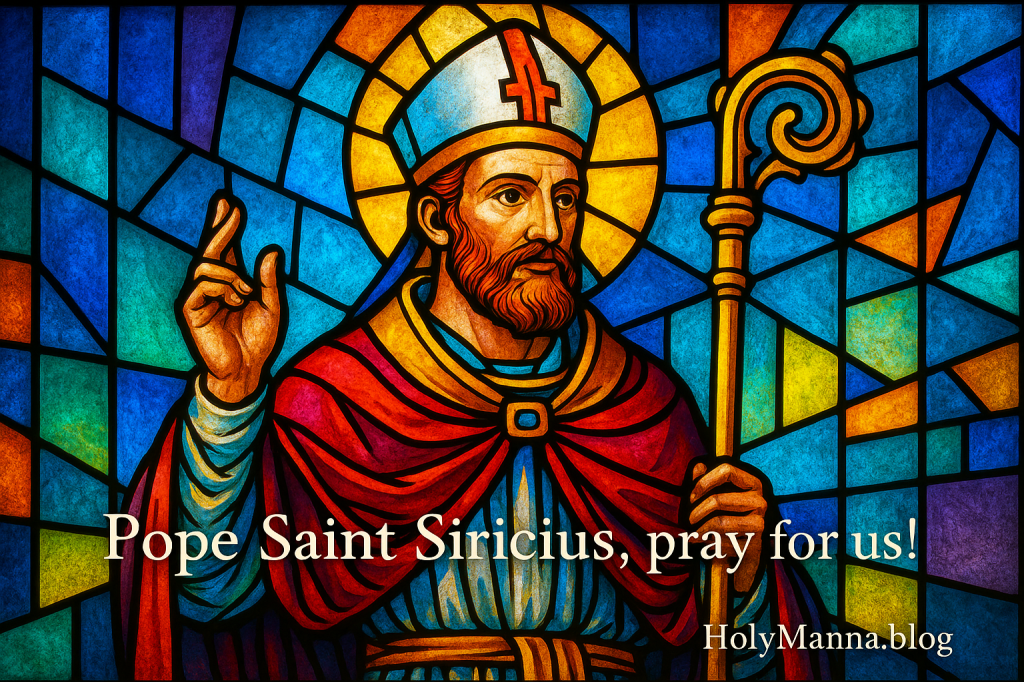
Shepherd of Discipline and Defender of Apostolic Unity
Pope Saint Siricius may not be the most widely known of the early popes, but his influence still shapes the Church today. Serving from 384 to 399, he stands as the first pope whose official letters, or decretals, survive in full. These writings reveal a man who understood the Petrine office as a living responsibility handed down from the Apostle Peter himself. He is remembered for strengthening clerical discipline, protecting sacramental integrity, and clarifying matters of doctrine at a time when the Church faced internal confusion and external pressure. In many ways, he laid the groundwork for how popes exercise pastoral governance even now.
He expressed his sense of apostolic duty powerfully in one of his preserved decretals: “We bear the burdens of all who are oppressed, or rather the blessed apostle Peter, who in all things protects and preserves us, the heirs, as we trust, of his administration, bears them in us.” This captures his understanding that the pope serves not by personal power, but by the authority Christ entrusted to Peter for the good of the whole Church, an authority taught clearly in The Catechism in CCC 882 and CCC 936 through CCC 937.
Formed in Rome and Called to the Chair of Peter
Siricius was born in Rome around 334, the son of a man named Tiburtius. From his youth he was immersed in the life of the Church. An inscription preserved from antiquity notes that he served first as a lector and later as a deacon under Pope Liberius. This early formation shaped his identity as a servant of the Word and giver of charity. As a lector he proclaimed Scripture. As a deacon he assisted at the altar and tended to the poor. There is no dramatic conversion story in his biography. Instead, his holiness grew through steady, faithful service to the Church.
When Pope Damasus I died in 384, Siricius was unanimously elected bishop of Rome by clergy and laity alike. His election was confirmed by Emperor Valentinian II, and he quickly began guiding the Church with a clear sense of responsibility. Siricius became known for three main contributions. He issued the earliest complete papal decretal, establishing a pattern by which future popes would address doctrinal and disciplinary questions. He strongly defended clerical continence and celibacy, grounding it in apostolic tradition. And he intervened in controversies throughout the Christian world, encouraging unity and fidelity to the teachings handed down from the apostles.
A Pope Who Clarified, Guided, and Strengthened the Church
Siricius’ most significant work is found in his decretal to Bishop Himerius of Tarragona, written in 385. In this letter he answered fifteen questions dealing with baptism, penance, the reception of converts, and clerical discipline. He instructed that baptism be celebrated at Easter or Pentecost unless urgent need required otherwise, reflecting ancient sacramental practice. He affirmed that former Arians should not be rebaptized but instead reconciled through the imposition of hands, emphasizing the unity and validity of baptism. He also upheld clerical continence and celibacy, presenting it as part of the apostolic tradition and as a way for clergy to imitate Christ with undivided hearts, a teaching echoed in CCC 1579.
In 386 he called a Roman synod of around eighty bishops. The council issued decisions concerning the ordination of bishops, clerical celibacy, and several matters of discipline. Siricius then circulated these decisions to other regions, insisting that they be observed throughout the Church. This helped shape the Church’s growing sense of universal discipline and unity under the successor of Peter.
Siricius also acted on specific pastoral issues. He wrote to bishops urging them to choose worthy candidates for ordination. He supported the rebuilding and dedication of the great basilica of Saint Paul Outside the Walls. He continued clarifying sacramental discipline and encouraging sound doctrine throughout his pontificate. Although no dramatic miracle stories are recorded from his lifetime, his “miracles” were the structural ones: a more disciplined clergy, clearer sacramental norms, and a stronger Church confident in its apostolic identity.
Defender of Truth in a Time of Conflict
Siricius did not die a martyr in the traditional sense, but he experienced what might be called the daily martyrdom of leadership. The controversies he faced demanded courage, firmness, and deep trust in God. He had to confront Jovinian, a monk in Rome who denied the higher value of virginity and ascetic life. Siricius convened a synod that condemned this teaching, defending the Church’s long-standing understanding of consecrated virginity and sacrificial offering.
He also opposed Bishop Bonosus of Sardica, who denied the perpetual virginity of Mary. Siricius and Saint Ambrose of Milan worked together to protect this truth, which The Catechism presents as an essential sign of Mary’s total consecration to God in CCC 499 and CCC 500.
In Spain, Siricius confronted the Priscillianist controversy. When the usurper emperor Maximus executed Priscillian and several followers on charges of heresy, Siricius firmly rejected the use of secular violence in resolving theological disputes. He later excommunicated Bishop Felix of Trier for supporting the harsh proceedings and wrote letters guiding the Spanish bishops on how to reconcile those who had fallen into error.
He also contributed to ending the long Meletian schism at Antioch, working with Eastern bishops such as Saint John Chrysostom to restore unity. Although not every contemporary agreed with all his decisions, Siricius ultimately acted as a shepherd determined to preserve fidelity and harmony within the Church.
Resting in Peace and Speaking Through the Ages
Pope Saint Siricius died on November 26, 399, and was buried in the cemetery of Priscilla on the Via Salaria. The inscription on his tomb honors his early service as lector and deacon and his lifelong dedication to the Church in Rome. His memory became linked to the basilica of Saint Paul Outside the Walls, which he helped dedicate during his pontificate. His name was later added to the Roman Martyrology, and the Church celebrates his feast on November 26.
There are no extensive collections of posthumous miracles attributed to him, but his legacy is found in something even more enduring: the structure, discipline, and sacramental clarity that he strengthened. Every time Catholics experience consistent sacramental practice or benefit from the authoritative guidance of the papacy, they touch the fruit of his quiet but monumental work.
Learning From Pope Saint Siricius Today
Pope Saint Siricius offers a timely message for today’s world, which often resists discipline and distrusts authority. His life shows that true authority in the Church is never about control. It is about service, unity, and fidelity to Christ. His words remind us that the burdens of the Church are carried with Peter and through the grace of Christ. “We bear the burdens of all who are oppressed… the blessed apostle Peter… bears them in us.”
Catholics today can draw several lessons from his example. First, there is value in respecting and praying for the pope and bishops, recognizing their teaching authority as described in CCC 888 through CCC 892. Second, his defense of clerical celibacy invites the faithful to support priests so that they can live their vocation with joy, purity, and dedication. Third, his careful treatment of sacraments encourages all Catholics to approach the sacraments with reverence and preparation, embracing them as channels of grace described in CCC 1116 and CCC 1129. Finally, his commitment to unity challenges modern Catholics to reject factions and cultivate peace within their parishes, families, and communities.
How is God inviting you to embrace the discipline of the Church as a path to deeper freedom rather than as a burden? What virtues of Pope Saint Siricius speak most clearly to your own walk of faith today?
Engage With Us!
Share your thoughts, insights, and reflections in the comments. Your perspective might be exactly what someone else needs to hear today.
- What part of Pope Saint Siricius’ life challenges or inspires you the most?
- How do you personally respond to the Church’s teaching authority as expressed through the pope and bishops?
- In what ways can you support priests and seminarians in living out their vocation wholeheartedly?
- Where do you struggle with Church discipline, and how might this be an invitation to deeper holiness?
- How can you help build unity within your parish and family, following the example of Pope Saint Siricius?
May Pope Saint Siricius intercede for all who seek purity of faith, strength in discipline, and unity in Christ. May God grant each of us the grace to live with the love, mercy, and steadfast devotion that Jesus calls every disciple to embrace.
Pope Saint Siricius, pray for us!
Follow us on Instagram and Facebook for more insights and reflections on living a faith-filled life.

 Holy Manna!
Leave a comment