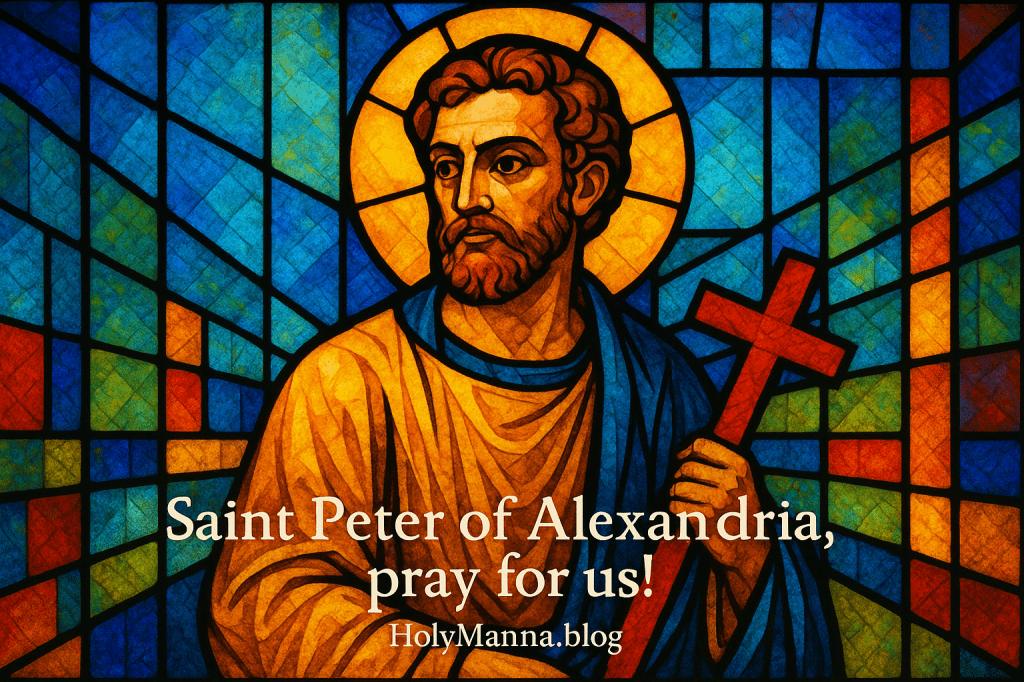
The Seal of the Martyrs
Saint Peter of Alexandria, honored for centuries as the “Seal of the Martyrs,” stands as one of the great patriarchs of the early Church. He shepherded the faithful of Egypt during the final and fiercest waves of Roman persecution, defended the truth against the earliest forms of Arianism, guided sinners with mercy and firmness, and sealed his witness with the shedding of his own blood. His life radiates the teaching of the Catechism, which tells us that martyrdom is the supreme testimony to Christ’s truth, offered freely out of love. Saint Peter of Alexandria lived this truth with courage, wisdom, and a fatherly heart for his flock.
A Child Formed for the Altar
Saint Peter was born in the great city of Alexandria, a place renowned for scholarship, trade, and profound Christian tradition. According to ancient accounts, his parents entrusted him to Bishop Theonas to be raised and formed for the service of the Church. From his youth, he was immersed in prayer, study, and the sacred liturgy. His natural gifts quickly became evident, and he was gradually entrusted with greater responsibilities, first as a lector, then as a deacon, and finally as a priest.
Peter became known for his deep understanding of Scripture and for his ability to teach the faith clearly. He eventually led the catechetical school of Alexandria, the most influential Christian teaching center of its time. After the death of Bishop Theonas, the clergy and faithful chose Peter as bishop. As the sixteenth successor of Saint Mark the Evangelist, he guided the Church of Alexandria with humble authority, pastoral wisdom, and a mind fully rooted in the apostolic faith.
A Shepherd in the Fire
Saint Peter became Patriarch of the Church of Alexandria at the dawn of the Great Persecution under Diocletian. Churches were destroyed and sacred texts were burned, yet Peter continued to encourage his flock through letters, homilies, and personal example. He is especially remembered for his balanced and compassionate approach to those who had renounced their faith under torture or threat. In his canonical writings, Peter insisted on sincere repentance but opened wide the doors of mercy to the brokenhearted. This harmony of truth and love reflects the heart of The Catechism, which teaches that the Church’s discipline aims at healing and reunion.
One striking moment in his life involved a prophetic vision. While imprisoned, Peter saw a radiant young boy whose tunic had been torn. When Peter asked who had done this, the boy answered that Arius was the one who tore it. This vision revealed the future wounds Arius would inflict on the unity of the Church. Because of this vision, Peter warned his successors never to restore Arius to communion. His discernment and courage helped prepare the Church to confront the Arian controversy that would shake Christianity in the decades to come.
Peter’s own writings show his deep reverence for the apostolic foundations of the Church. Meditating on the martyrdom of Saint Peter the Apostle, he wrote: “Peter, the first chosen of the Apostles, having been apprehended often and thrown into prison and treated with ignominy, at last was crucified in Rome.” His words demonstrate a profound continuity with the apostolic witness and reveal the spiritual strength that shaped his own ministry.
Trials Within and Without
The hardships that Saint Peter faced were immense. Persecution from the Roman Empire raged violently during his episcopate, forcing him at times to flee across various regions to protect the flock. Yet internal wounds within the Church tested him even more painfully. Meletius of Lycopolis created a schism by ordaining his own bishops and rejecting legitimate authority. Peter, for the sake of unity and truth, excommunicated Meletius and called the faithful to remain steadfast in communion.
Peter also confronted the early errors of Arius, whose pride and teaching threatened the heart of the Christian faith. After discerning Arius’s duplicity, Peter removed him from communion and warned that his doctrine would tear at the seamless garment of Christ. According to ancient testimony, Peter even spoke a prophetic sentence about Arius’s future: “He will always remain banished and separate from the glory of the Son of God, Jesus Christ our Lord.” His words proved tragically accurate as Arianism spread after his death.
Under Emperor Maximinus Daia, Peter was eventually arrested and imprisoned. The faithful gathered around the prison in sorrow and prayer, determined to protect their bishop. The authorities, fearing unrest, resorted to deception. They lured Peter away from the crowd, led him outside the city walls, and quietly beheaded him around the year 311. Because he was the final bishop of Alexandria to die for the faith during the Roman persecutions, Christian tradition honors him with the title “Seal of the Martyrs.”
An ancient account says that as a consecrated virgin prayed at the tomb of Saint Mark, she heard a heavenly voice proclaim: “Peter was the first of the Apostles. Peter is the last of the martyred bishops of Alexandria.” This beautiful testimony reveals the continuity of apostolic faith and the profound dignity of Saint Peter’s witness.
The Martyr Who Still Guides Us
Following his martyrdom, Saint Peter of Alexandria was immediately venerated across Egypt and the wider Christian world. Churches honored him as a steadfast defender of orthodoxy and a loving shepherd who laid down his life for his flock. His feast is celebrated in both the East and the West, and he remains especially beloved in the Coptic Church.
While specific miracle accounts tied to his relics are scarce in Western memory, the enduring strength of the Alexandrian Church is often seen as the fruit of the intercession of its early martyrs. The communion of saints reminds us that the grace given to one member of the Body of Christ strengthens the whole Church. The courage, fidelity, and prophetic clarity of Saint Peter continue to inspire generations of believers who face their own trials, temptations, and cultural pressures.
Learning from a Martyr Bishop
Saint Peter of Alexandria speaks powerfully to a world that often confuses tolerance with love and silence with peace. His life teaches that charity must walk hand in hand with truth, and that real mercy never ignores sin but calls the sinner to transformation. His firmness in correcting schism and heresy challenges every believer to hold fast to the teachings of the Church without fear or compromise.
His vision of the torn tunic reminds us that false teaching still threatens the unity of the Church. Catholics today face many pressures to soften or abandon the truths Christ has handed down, yet Saint Peter stands as a witness that authentic unity cannot exist without fidelity to doctrine.
His devotion to the Mother of God shines as a reminder that love for Mary always strengthens love for her Son. His writings show a bishop deeply rooted in Scripture and tradition, a man who guarded the deposit of faith with both humility and courage.
Most importantly, his martyrdom calls us to a deeper readiness to confess Christ in our own lives. While not everyone is called to shed blood, every Christian is called to the daily sacrifices of love, integrity, and steadfastness. The Cross appears in many forms, and Saint Peter teaches us how to embrace it with confidence in God’s grace.
Engage with Us!
Share your thoughts and reflections in the comments below. This is a space to support each other and grow together in faith as brothers and sisters in Christ.
- In what areas of your life do you most feel the pressure to blend in with the culture rather than stand firmly with Christ and His Church as Saint Peter of Alexandria did?
- How do you personally balance truth and mercy when helping someone return to the faith after serious sin?
- Are there moments when you have been tempted to soften or avoid a difficult Church teaching, and how does Saint Peter’s courage speak into that struggle?
- Which steps can you take this week to strengthen your spiritual life so that you will be ready to endure trials for the sake of the Gospel?
- How could a deeper devotion to Mary, the Mother of God, strengthen your commitment to Christ in the same way it strengthened Saint Peter of Alexandria?
May the witness of Saint Peter of Alexandria inspire every heart to live with courageous faith, steady hope, and generous charity. May we learn to love boldly, forgive generously, and do everything with the love and mercy that Jesus teaches in the Gospel.
Saint Peter of Alexandria, pray for us!
Follow us on Instagram and Facebook for more insights and reflections on living a faith-filled life.

 Holy Manna!
Leave a comment