A Royal Mind with a Martyr’s Heart
Saint Catherine of Alexandria stands in the Church’s memory as a brilliant young woman, a virgin martyr, and a fearless witness to Christ in a world that worshiped power and worldly wisdom. According to ancient tradition, she was a noblewoman from Alexandria in Egypt, celebrated for her beauty, extraordinary intelligence, and mastery of philosophy, rhetoric, poetry, mathematics, astronomy, and medicine. She is honored as one of the Fourteen Holy Helpers and is a powerful patroness of philosophers, scholars, students, and unmarried women. Her feast on November 25 continues to inspire countless Christians to love the Lord with both mind and heart.
A Princess Who Found Her True Bridegroom
Tradition says that Catherine was born into a wealthy and influential pagan family toward the end of the third century. She grew up surrounded by culture, privilege, and opportunity, receiving an education that few in the ancient world could ever dream of. Her intellectual gifts earned her a reputation as an exceptional scholar even in her teenage years.
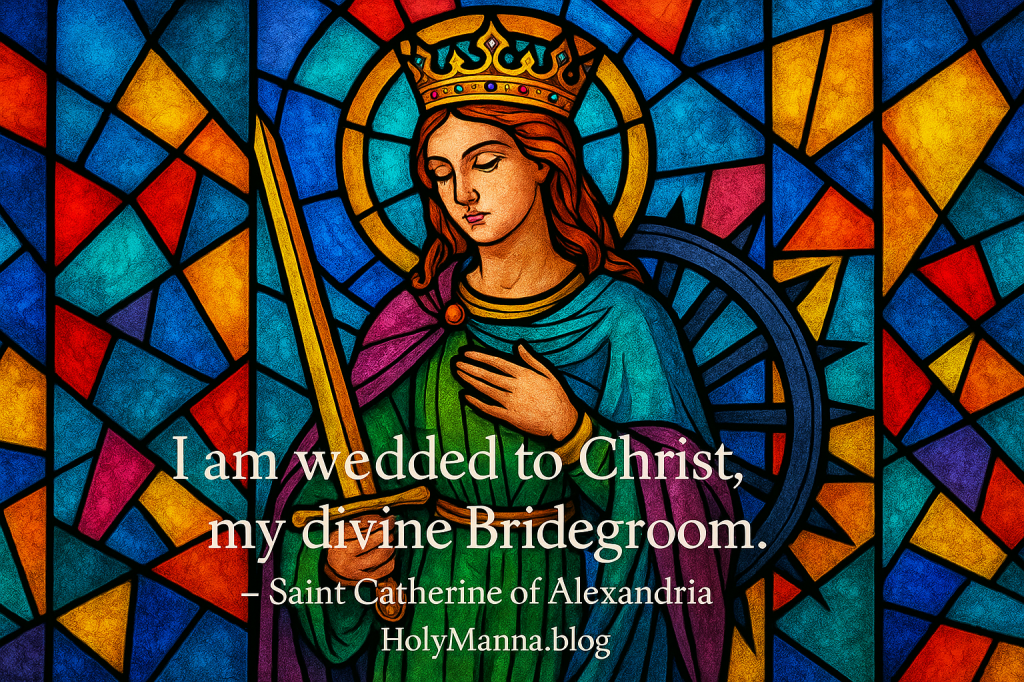
Despite her education and social status, Catherine sensed a deep emptiness in the pagan world around her. Ancient accounts tell of her encounter with a Christian hermit who explained the fullness of truth found in Jesus Christ. Moved by his teaching, she began to pray and search for the true God. In a mystical vision, the Blessed Virgin Mary appeared to her holding the Child Jesus. Christ placed a ring on Catherine’s finger, and she consecrated herself entirely to Him. This moment is one of the most famous aspects of her story, and her alleged words reflect her total dedication: “I am wedded to Christ, my divine Bridegroom.”
From that moment on, Catherine’s intellect became a tool for evangelization. Her heart and mind were fixed firmly on Christ, and she became known as a bold defender of the faith.
Scholar, Apologist, And Wonder Worker
During one of the last major persecutions of the early Church, Catherine stepped forward in courage when she witnessed Christians being killed for their faith. She confronted the emperor directly, rebuking him for his idolatry and cruelty. Her courage shocked the imperial court.
The emperor, fascinated by her intelligence, summoned fifty of the best philosophers and orators of the empire to debate her. According to tradition, Catherine spoke with such clarity and conviction that many of these philosophers embraced the Christian faith on the spot. They were immediately put to death, sealing their witness with their own blood. Catherine’s intellect, once shaped by pagan philosophy, was now fully illuminated by grace. Her legendary saying captures the heart of her mission: “If you are ruled by the mind you are king, if by the body you are a slave.”
Accounts describe her giving comfort to prisoners, converting guards, and strengthening Christians through her wisdom and unwavering peace. Even when her story blends history with legend, the Church has always treasured the truth at its core. Catherine shows what it means to allow the Holy Spirit to sanctify one’s gifts, personality, and intellect for the glory of God.
The Wheel That Shattered
When persuasion and debate failed, the emperor imprisoned Catherine. She was scourged, starved, and left chained in a dark cell. Despite this, tradition says she was miraculously sustained by the grace of Christ. Her wounds healed, and she remained filled with joy and peace. This inspired many who visited her, including soldiers and even the emperor’s wife, to embrace Christianity. These conversions only enraged the emperor further.
The emperor ordered her execution on a spiked breaking wheel designed to tear her apart. Yet, as soon as Catherine touched the device, the wheel shattered. The violent force of the explosion killed bystanders instead of harming her. This miraculous event made the “Catherine wheel” her most recognizable symbol in Christian art.
Finally, she was condemned to death by beheading. Before the sword fell, Catherine prayed a beautiful prayer of trust in Jesus Christ, asking Him to receive her soul, forgive her faults, and bless all who would honor her memory. Tradition says that instead of blood, a milk-like substance flowed from her neck, symbolizing purity and heavenly grace. Her martyrdom reflects what the Catechism of the Catholic Church describes as “the supreme witness given to the truth of the faith” and “an act of fortitude”.
A Saint Who Still Walks With Pilgrims
After her death, tradition holds that angels carried Catherine’s body to Mount Sinai. Centuries later, a monastery was built there by the Emperor Justinian. Today, Saint Catherine’s Monastery is one of the oldest continuously operating monasteries in the world, home to priceless Christian manuscripts and known for its deep spiritual heritage.
By the ninth century, stories spread of Catherine’s incorrupt body being discovered at Sinai. Her relics were said to exude a healing oil, and pilgrims from all corners of Christendom made the long journey through the desert to seek her intercession. The monks would often give visitors small rings marked with her monogram, symbolizing spiritual friendship with the saint.
Her memory has inspired countless works of art and literature. She became the patroness of students and scholars, and her intercession was cherished by saints like Joan of Arc, who testified that Catherine was one of the heavenly voices guiding her. The Catechism teaches that the saints, united with Christ in heaven, continue to intercede for the faithful on earth. Catherine stands among those powerful intercessors, offering help to all who seek wisdom, courage, purity of heart, and strength in trials.
Learning To Think And Love Like Saint Catherine
Saint Catherine of Alexandria speaks powerfully to our time. Many believers today face skepticism, indifference, or pressure to hide their faith. Catherine reminds us that intellect and faith are not enemies. The more a Christian studies truth, the more clearly Christ shines. Her life invites every believer to take study seriously, whether through reading Sacred Scripture, diving into The Catechism of the Catholic Church, or exploring the writings of the saints.
Her mystical marriage to Christ points us toward purity of heart and fidelity in our vocations. Whether one is single, married, or consecrated, each person is called to let Christ be the center of love.
Her boldness in defending the Gospel encourages believers to speak truth with humility, patience, and courage. This does not mean arguing online or picking unnecessary fights. It means being unafraid to share the faith, explain it clearly, and stand firm when challenged.
Finally, her martyrdom teaches that holiness requires sacrifice. The saints show that the cross is the road to life, and Catherine stands as a radiant example of what it means to follow Christ with an undivided heart.
Engage With Us!
Share your thoughts and reflections in the comments below.
- Where do you feel pressured to downplay your Catholic faith, and how does Saint Catherine’s boldness challenge you in those areas?
- How can you better unite your mind and your heart so that study and prayer help each other grow?
- What small sacrifices or “little martyrdoms” might God be asking of you today in order to grow in courage, purity, or honesty?
- How can you invite Saint Catherine’s intercession into your studies, work, or vocation so that Christ’s wisdom guides your decisions?
- What steps can you take this week to deepen your knowledge of the faith and let it shape the way you live?
May Saint Catherine of Alexandria intercede for all who desire wisdom, strength, and purity. May her example inspire you to live with courage, to embrace truth with confidence, and to do everything with the love and mercy that Jesus teaches and pours into every willing heart.
Saint Catherine of Alexandria, pray for us!
Follow us on Instagram and Facebook for more insights and reflections on living a faith-filled life.

 Holy Manna!
Leave a comment