Tuesday of the Thirty-fourth Week in Ordinary Time – Lectionary: 504
A Kingdom That Lasts Forever
Sometimes life feels like standing in front of something huge and impressive that looks unshakable, until a crack shows up and everything starts to wobble. Today’s readings press right on that fragile spot in the human heart that leans on things that will not last: empires, buildings, institutions, even religious structures that seem permanent from the outside.
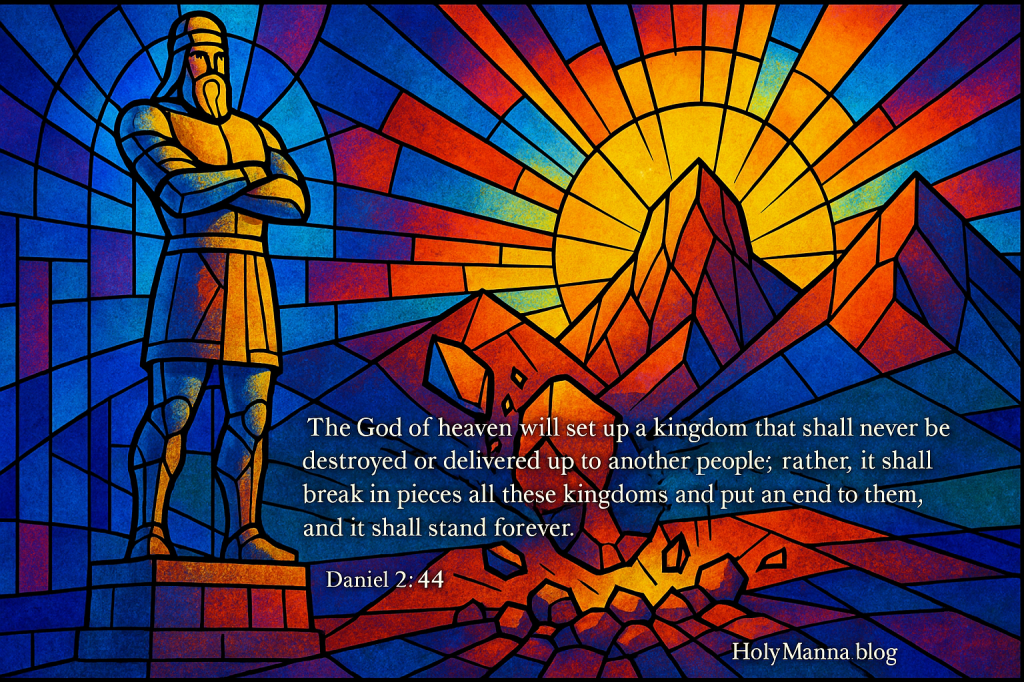
In the first reading from Daniel 2, King Nebuchadnezzar dreams of a massive statue made of gold, silver, bronze, iron, and clay. It looks glorious and terrifying, but it is built on weak feet. A mysterious stone, “hewn from the mountain without a hand being put to it” in Daniel 2:34, strikes the statue and brings the whole thing down. The message is clear. Human kingdoms rise and fall. Political power shifts. Cultures change. Yet the God of heaven will establish a kingdom that “shall stand forever” in Daniel 2:44. This is not just about ancient Babylon. It is about every age that thinks its power is untouchable.
The responsorial canticle from Daniel 3 zooms out even further. Instead of kings and empires, all creation is called into a cosmic litany of worship. Angels, heavens, waters, and all powers are summoned to bless and exalt the Lord. When everything human is shaken, creation itself still points to the One who made it. The Church’s use of this canticle in the liturgy reminds believers that the right response to shifting kingdoms is not panic but praise.
Then the Holy Gospel from Luke 21:5-11 brings this theme right into the heart of Israel’s religious life. Some people are marveling at how beautiful the temple is, with its costly stones and offerings. Jesus cuts right through the admiration with a shocking prophecy that “there will not be left a stone upon another stone that will not be thrown down” in Luke 21:6. For faithful Jews, the temple was not just a pretty building. It was the center of worship, sacrifice, and identity. Hearing that it would be destroyed would have felt like hearing that the world itself was ending.
Yet Jesus does not only predict destruction. He also warns about spiritual confusion. He tells the disciples that many will come claiming “I am he” or “The time has come” in Luke 21:8, and he says very clearly not to follow them. Wars, insurrections, earthquakes, famines, and plagues will come, but he tells them not to be terrified. The point is not to decode every headline but to cling to the true King when everything else looks unstable.
Historically, these readings sit in moments of deep upheaval. Daniel was written in the context of exile and persecution, where foreign powers seemed to control everything. Luke 21 looks ahead to the destruction of the temple in Jerusalem in the year 70, which would be a spiritual earthquake for the Jewish people and the early Christians. The Church places these passages near the end of the liturgical year as a reminder that every human project, even the most impressive, is temporary. Only the Kingdom of God, fully revealed in Jesus Christ, endures.
The central theme tying all of this together is the collapse of earthly security and the unshakable reality of God’s Kingdom. Empires crumble. Temples fall. History shakes. Yet Christ the King and his Kingdom are not built on iron and clay. They are rooted in the eternal faithfulness of God. Where does the heart tend to cling to passing structures instead of the King whose Kingdom will never be destroyed?
First Reading – Daniel 2:31-45
The Shattering Of Human Power
The scene in Daniel 2 takes place in the royal court of Babylon, one of the greatest empires of the ancient world. Israel is in exile. The people of God live under foreign rule, surrounded by a culture that worships power, wealth, and idols. King Nebuchadnezzar has a disturbing dream that none of his pagan wise men can interpret. God then reveals the dream and its meaning to Daniel, a young Jewish exile who remains faithful to the Lord in the middle of an aggressively pagan empire. This moment is not just a political drama. It is a spiritual showdown between earthly power and the sovereignty of the God of heaven.
The towering statue in the king’s dream symbolizes a series of kingdoms that look impressive and unstoppable from a human perspective. Yet the dream reveals that these empires are built on fragile foundations and destined to fall. The mysterious stone that strikes the statue, “hewn from the mountain without a hand being put to it” in Daniel 2:34, points to a kingdom that does not come from human strength or planning. It comes from God alone. This connects directly to today’s overall theme. Earthly kingdoms, institutions, and projects rise and fall, but the Kingdom of God is the only reality that truly lasts. While the Gospel shows Jesus predicting the fall of the temple, this reading from Daniel shows that the pattern has always been the same. Human power crumbles, and the Lord quietly builds a kingdom that will endure forever.
Daniel 2:31-45
New American Bible (Revised Edition)
31 “In your vision, O king, you saw a statue, very large and exceedingly bright, terrifying in appearance as it stood before you. 32 Its head was pure gold, its chest and arms were silver, its belly and thighs bronze, 33 its legs iron, its feet partly iron and partly clay. 34 While you watched, a stone was hewn from a mountain without a hand being put to it, and it struck its iron and clay feet, breaking them in pieces. 35 The iron, clay, bronze, silver, and gold all crumbled at once, fine as the chaff on the threshing floor in summer, and the wind blew them away without leaving a trace. But the stone that struck the statue became a great mountain and filled the whole earth.
36 “This was the dream; the interpretation we shall also give in the king’s presence. 37 You, O king, are the king of kings; to you the God of heaven has given dominion and strength, power and glory; 38 human beings, wild beasts, and birds of the air, wherever they may dwell, he has handed over to you, making you ruler over them all; you are the head of gold. 39 Another kingdom shall take your place, inferior to yours, then a third kingdom, of bronze, which shall rule over the whole earth. 40 There shall be a fourth kingdom, strong as iron; it shall break in pieces and subdue all these others, just as iron breaks in pieces and crushes everything else. 41 The feet and toes you saw, partly of clay and partly of iron, mean that it shall be a divided kingdom, but yet have some of the hardness of iron. As you saw the iron mixed with clay tile, 42 and the toes partly iron and partly clay, the kingdom shall be partly strong and partly fragile. 43 The iron mixed with clay means that they shall seal their alliances by intermarriage, but they shall not stay united, any more than iron mixes with clay. 44 In the lifetime of those kings the God of heaven will set up a kingdom that shall never be destroyed or delivered up to another people; rather, it shall break in pieces all these kingdoms and put an end to them, and it shall stand forever. 45 That is the meaning of the stone you saw hewn from the mountain without a hand being put to it, which broke in pieces the iron, bronze, clay, silver, and gold. The great God has revealed to the king what shall be in the future; this is exactly what you dreamed, and its meaning is sure.”
Detailed Exegesis
Verse 31 – “In your vision, O king, you saw a statue, very large and exceedingly bright, terrifying in appearance as it stood before you.”
The dream begins with a huge, dazzling statue that inspires fear. The brightness and terror show how earthly power looks from the outside. It can seem glorious, overwhelming, and almost godlike. The king is used to inspiring fear, and now he is the one who is afraid. Spiritually, this verse exposes how human hearts can be dazzled by what looks impressive. The vision already hints that what seems powerful is not as secure as it appears.
Verse 32 – “Its head was pure gold, its chest and arms were silver, its belly and thighs bronze,”
The statue’s body is divided into different metals, starting with the most precious. Gold, silver, and bronze represent a succession of kingdoms, beginning with Nebuchadnezzar’s own empire. Each metal is slightly less valuable, which shows that human history is not a straight line of progress. Even when kingdoms become stronger in some ways, they also become less noble. From a theological angle, this reminds believers that human greatness without God gradually loses its glory.
Verse 33 – “its legs iron, its feet partly iron and partly clay.”
Iron suggests strength and military power. Clay suggests weakness and instability. The statue’s legs are strong, but the feet are mixed, which creates a built-in flaw. The final kingdom in this sequence will look strong on top but will rest on a fragile base. This mirrors many periods in history when outward power hides internal division and moral decay. Theologically, it recalls how any society that rejects God will eventually reveal its cracks, no matter how strong its armies or economies look.
Verse 34 – “While you watched, a stone was hewn from a mountain without a hand being put to it, and it struck its iron and clay feet, breaking them in pieces.”
The stone is the key moment in the dream. It is not crafted by human hands. It comes from outside human effort and skill. It targets the weakest part of the statue, the feet of iron and clay, and shatters them. This stone is a powerful image of the Kingdom of God, which arises from God’s initiative, not from political or military might. Christians see in this an anticipation of Christ, the cornerstone rejected by men but chosen by God. The fact that it strikes the feet also shows that when God acts, He brings down entire systems that rest on compromised foundations.
Verse 35 – “The iron, clay, bronze, silver, and gold all crumbled at once, fine as the chaff on the threshing floor in summer, and the wind blew them away without leaving a trace. But the stone that struck the statue became a great mountain and filled the whole earth.”
The fall is total and sudden. Everything that looked solid disintegrates like chaff and blows away with the wind. Nothing remains of the statue. This shows how quickly human achievements can vanish when God decides the time has come. The stone, on the other hand, grows into a mountain that fills the whole earth. This is a picture of the universal reign of God. From a small, seemingly insignificant beginning, the Kingdom spreads everywhere. For Christians, this points toward the spread of the Gospel and the final reign of Christ over all creation.
Verse 36 – “This was the dream; the interpretation we shall also give in the king’s presence.”
Daniel calmly transitions from describing the dream to interpreting it. This verse highlights that Daniel does not rely on guesswork or human techniques. God has revealed both the dream and its meaning. The Church sees in this a model of true prophecy. Authentic interpretation depends on revelation, not on cleverness.
Verse 37 – “You, O king, are the king of kings; to you the God of heaven has given dominion and strength, power and glory;”
Daniel honors the king’s position but immediately roots that power in God. Nebuchadnezzar is called “king of kings” in a limited sense, yet every bit of his dominion is a gift. This verse corrects any illusion that rulers control their own destiny apart from God. Later Christian teaching reflects this same truth. Human authority is allowed by God and must answer to Him.
Verse 38 – “human beings, wild beasts, and birds of the air, wherever they may dwell, he has handed over to you, making you ruler over them all; you are the head of gold.”
The breadth of the king’s rule is vast. Yet Daniel reminds him that this rule is something God has “handed over.” The head of gold is Babylon’s empire at its peak. Gold shines, but it is still created and limited. This verse shows that even the greatest empires are under God’s sovereignty. Human greatness does not erase dependence on the Creator.
Verse 39 – “Another kingdom shall take your place, inferior to yours, then a third kingdom, of bronze, which shall rule over the whole earth.”
Here the dream moves beyond Babylon to other empires. Each kingdom replaces the previous one. Even when one seems unbeatable, the next rises in its place. This turns human history into a lesson in humility. No political order is final. This verse keeps believers from being scandalized when nations change and governments fall. It has always been this way.
Verse 40 – “There shall be a fourth kingdom, strong as iron; it shall break in pieces and subdue all these others, just as iron breaks in pieces and crushes everything else.”
The fourth kingdom is marked by sheer force. Iron crushes and subdues. Historically, many scholars see in this a reference to later empires, like the Greek and Roman powers, which shaped the world around the time of Christ. Theologically, the pattern holds in every age. Some powers dominate through military or economic strength, but they remain temporary. The crushing ability of iron does not make a kingdom eternal.
Verse 41 – “The feet and toes you saw, partly of clay and partly of iron, mean that it shall be a divided kingdom, but yet have some of the hardness of iron. As you saw the iron mixed with clay tile,”
Daniel explains the mixed feet. The kingdom that comes later has a strange mixture of strength and weakness. It has iron’s hardness but clay’s fragility. This divided quality points to internal conflict and lack of true unity. From a spiritual perspective, it mirrors any society that looks powerful externally but is morally or spiritually fractured.
Verse 42 – “and the toes partly iron and partly clay, the kingdom shall be partly strong and partly fragile.”
This verse makes it explicit. The kingdom is split between strength and fragility. No matter how advanced or sophisticated it looks, it can crack under pressure. Every human system that is not built on God’s law and truth will eventually show this same mix. It may be impressive in some areas and deeply unstable in others.
Verse 43 – “The iron mixed with clay means that they shall seal their alliances by intermarriage, but they shall not stay united, any more than iron mixes with clay.”
Political marriages and alliances attempt to hold the kingdom together. Still, the unity does not last. Iron and clay cannot truly bond. This is a powerful image of superficial unity. External agreements cannot overcome deep divisions of heart and belief. For the believer, it is a reminder that real unity must be rooted in God’s covenant, not just in human deals.
Verse 44 – “In the lifetime of those kings the God of heaven will set up a kingdom that shall never be destroyed or delivered up to another people; rather, it shall break in pieces all these kingdoms and put an end to them, and it shall stand forever.”
This is the heart of the passage. While human kingdoms rise and fall, God Himself will establish a kingdom that never ends. It will not be taken over or replaced. It will judge and outlast every other kingdom. For Christians, this clearly foreshadows the Kingdom of God revealed in Jesus Christ. The Church teaches that Christ inaugurated this Kingdom in His life, death, and resurrection, and it will reach its fullness at His return. This verse anchors today’s theme. Everything temporary will yield to what is eternal.
Verse 45 – “That is the meaning of the stone you saw hewn from the mountain without a hand being put to it, which broke in pieces the iron, bronze, clay, silver, and gold. The great God has revealed to the king what shall be in the future; this is exactly what you dreamed, and its meaning is sure.”
Daniel confirms the whole message. The stone from the mountain is the work of God, not man. It brings every metal crashing down. The interpretation comes with a guarantee. God Himself backs it. The dream is not a vague warning. It is a firm prophecy. The Lord is in charge of history. Empires are not. The final word in the verse, that its “meaning is sure,” invites trust. Even if the world appears unstable, God’s plan is not.
Teachings
The Church understands this passage as a powerful revelation of God’s sovereignty over history and a prophetic glimpse of the Kingdom fulfilled in Christ. The Catechism of the Catholic Church teaches in CCC 541: “To carry out the will of the Father Christ inaugurated the kingdom of heaven on earth. Now the Father’s will is ‘to raise up men to share in his own divine life.’ He does this by gathering men around his Son Jesus Christ. This gathering is the Church, ‘on earth the seed and the beginning of that kingdom.’” The stone in Daniel 2 that becomes a great mountain filling the earth connects beautifully with this teaching. The Kingdom begins small in Christ and His Church, but it is destined to fill all creation.
The Catechism also speaks about the ultimate destiny of this Kingdom in CCC 1042: “At the end of time, the Kingdom of God will come in its fullness. After the universal judgment, the righteous will reign forever with Christ, glorified in body and soul. The universe itself will be renewed…” The dream in Daniel looks ahead to that final stage when every earthly kingdom will have passed away and only the renewed creation under Christ’s reign will remain.
Saint Augustine, in The City of God, contrasts the earthly city built on love of self with the City of God built on love of God. He writes: “Two cities have been formed by two loves: the earthly by the love of self even to the contempt of God, the heavenly by the love of God even to the contempt of self.” The statue with its mixed metals vividly portrays the earthly city, powerful yet unstable, while the stone that becomes a mountain points to the City of God that cannot be shaken.
The Church Fathers often saw in the stone a symbol of Christ Himself. Christ is the stone rejected by the builders in Psalm 118:22 and applied to Jesus in the New Testament. This stone becomes the cornerstone. The statue’s destruction under the impact of the stone shows that the coming of Christ and His Kingdom relativizes every human power. None of them can claim the ultimate loyalty that belongs to God alone.
Historically, this passage gave courage to believers living under hostile regimes. Whether in Babylon, under Greek persecution, under Roman domination, or in later ages, Christians have looked to Daniel 2 to remember that God’s Kingdom is not a fragile clay foot. It is the stone from the mountain, sure, solid, and eternal.
Reflection
This reading presses a very personal question into the heart. Where does the heart quietly look for security in “statues” that seem bright and unshakable but are really built on clay? That statue might be a career, financial success, political identity, or even a religious structure that is treated more like an institution than a living relationship with God.
The dream in Daniel 2 calls believers to shift trust away from anything that can fall and toward the Kingdom that cannot be destroyed. One very concrete step is to begin each day by consciously entrusting that day to the reign of Christ. Instead of mentally bowing to fear of the future, worldly news, or personal anxieties, the heart can be offered to the King whose Kingdom stands forever.
Another step is to examine how decisions are made. Is the main concern to protect a personal “kingdom,” or to seek God’s will and the spread of Christ’s Kingdom? That might affect how time is spent, what kind of work is pursued, how money is used, and how relationships are handled.
The dream also encourages believers not to panic when the world feels unstable. Earthly kingdoms shake. Institutions change. News cycles can be intense. Yet in that shaking, God is not losing control. The stone from the mountain is still at work. The Kingdom is still growing, often in quiet and hidden ways, through prayer, sacraments, acts of charity, and faithful witness.
A helpful daily practice could be to end the day with a simple examination. Where did the heart cling today to “gold, silver, bronze, iron, and clay,” and where did it respond to the quiet call of the stone that becomes a mountain? The more the heart leans into the Kingdom that will never pass away, the more peace takes root, even when everything else looks fragile.
Responsorial Psalm – Daniel 3:57-61
When The World Shakes, Creation Keeps Praising
This canticle from Daniel 3 comes from the famous story of the three young men in the fiery furnace. Shadrach, Meshach, and Abednego have refused to bow to King Nebuchadnezzar’s golden statue, even under threat of death. They are thrown into the furnace for their fidelity to the Lord, yet instead of burning, they walk unharmed in the fire and sing a hymn of praise. These verses are part of that hymn. They are not sung from a place of comfort and safety. They rise from the heart of persecution and apparent defeat.
Culturally and historically, this is a prayer born in exile. The people of Israel live under a foreign empire that demands idolatrous worship. Human power looks overwhelming. Yet this song refuses to center the king or his furnace. Instead, it calls all creation, from angels to waters to powers, to bless the Lord. This is deeply connected to today’s theme. While earthly kingdoms rise and fall, and while institutions and even sacred buildings can crumble, the right response is not despair but worship. The canticle in Daniel 3 answers the vision of collapsing kingdoms in Daniel 2 and the warnings of Jesus in Luke 21 with a steady, unshakable chorus of praise. When the world feels unstable, this psalm reminds believers that all creation is already oriented toward the glory of God.
Daniel 3:57-61
New American Bible (Revised Edition)
57 Bless the Lord, all you works of the Lord,
praise and exalt him above all forever.
58 Angels of the Lord, bless the Lord,
praise and exalt him above all forever.
59 You heavens, bless the Lord,
praise and exalt him above all forever.
60 All you waters above the heavens, bless the Lord,
praise and exalt him above all forever.
61 All you powers, bless the Lord;
praise and exalt him above all forever.
Detailed Exegesis
Verse 57 – “Bless the Lord, all you works of the Lord, praise and exalt him above all forever.”
The prayer opens by summoning “all you works of the Lord” into praise. That phrase includes everything God has made. This is not just a private prayer. It is a call to cosmic worship. The three young men, standing in the furnace, are not focused on the flames or the king’s threats. They zoom out and see reality from God’s perspective. Earthly power is small. God’s work in creation is vast. The Church picks up this same spirit in the Liturgy of the Hours, especially in morning prayer, reminding believers that every day begins inside a universe that exists to glorify God.
Verse 58 – “Angels of the Lord, bless the Lord, praise and exalt him above all forever.”
Now the focus turns to the angels. These pure spiritual beings who worship in the presence of God are called to bless the Lord. Of course, the angels already do this, but naming them in prayer helps believers remember that worship is not limited to earth. There is a liturgy in heaven that never stops. This verse pulls the heart into that heavenly perspective. While empires and kingdoms fight for glory, angels quietly adore the true King. In the Mass, the Church joins their song, echoing their praise in the Sanctus.
Verse 59 – “You heavens, bless the Lord, praise and exalt him above all forever.”
Here the heavens themselves are called to bless the Lord. The sky, the stars, the vastness of space, all become part of the choir. This is very different from pagan cultures that worship the sun, moon, and stars as gods. Daniel 3 is crystal clear. The heavens are not divine. They are works of the Lord, and their purpose is to bless Him. This verse also helps believers remember that the visible universe, as huge as it is, is still just a created sign pointing to the Creator. No earthly structure, even something as impressive as the Jerusalem temple or a modern city skyline, compares with the grandeur of the heavens. Yet even that grandeur is meant to lead to praise.
Verse 60 – “All you waters above the heavens, bless the Lord, praise and exalt him above all forever.”
This line reaches back to the creation story in Genesis 1, where the waters above the firmament are separated from the waters below. In ancient imagery, these waters symbolize mystery and power. Water can be peaceful or terrifying. By calling these waters to bless the Lord, the canticle proclaims that even the most untamed parts of creation are under God’s authority. For someone in exile or in trial, this is good news. Nothing in creation is stronger than the Creator.
Verse 61 – “All you powers, bless the Lord; praise and exalt him above all forever.”
The word “powers” can point to created spiritual beings, like the angelic choirs, and also to the forces and structures present in creation. Whatever is mighty or influential is reminded of its true end. It exists to bless the Lord. This verse is especially striking in the context of Babylonian exile. The “powers” of that time appear to belong to kings and empires, but this prayer quietly insists that every power is ultimately accountable to God. For the Christian, it teaches that spiritual warfare is real, that invisible powers are at work, but that all of them are ultimately beneath the Lord who deserves eternal praise.
Teachings
The Responsorial Psalm today shows how praise is the proper posture in the face of God’s unshakable Kingdom. When earthly kingdoms feel unstable, the Church does not teach panic. The Church teaches worship. The Catechism of the Catholic Church explains the nature of praise in CCC 2639: “Praise is the form of prayer which recognizes most immediately that God is God. It lauds God for his own sake and gives him glory, quite beyond what he does, but simply because HE IS.” The three young men in Daniel 3 are doing exactly that. They praise God not because their circumstances are easy, but because He is worthy.
The Catechism also reminds believers why creation exists in the first place. In CCC 293 it teaches: “Scripture and Tradition never cease to teach and celebrate this fundamental truth: ‘The world was made for the glory of God.’” This canticle makes that truth sing. Angels, heavens, waters, and powers are all called to glorify the Lord. When this psalm is prayed at Mass, it is more than poetry. It is a direct participation in the purpose for which the world was created.
In CCC 294, the Church continues: “The glory of God consists in the realization of this manifestation and communication of his goodness, for which the world was created.” The praise of creation is not about boosting God’s ego. It is about the revelation of His goodness. When believers join creation in blessing the Lord, they enter into the deepest truth about who God is and who they are.
Saint Francis of Assisi expressed a similar spirit in his Canticle of the Creatures when he prayed: “Praised be You, my Lord, with all Your creatures.” His heart echoed Daniel 3, inviting sun, moon, wind, water, and fire into a chorus of praise. The saints remind the Church that true holiness always leads to praise, even in suffering.
Saint John Paul II spoke about the importance of praise in the life of the Church. In one of his catecheses on the psalms, he taught that the Church’s hymn of praise rises from both joy and trial. He noted that believers are called to sing even in the night, acknowledging the Lord’s presence in every season. That matches the situation of the three young men praising God in the furnace. They are not spared the trial, but they are sustained in it.
The Church’s liturgy places this canticle especially in morning prayer, symbolizing the new day of creation in Christ. As the end of the liturgical year approaches and the readings speak about the end of worldly structures, the Church answers with this steady refrain. Everything passes, but the praise of God remains.
Reflection
This psalm invites a very practical and challenging response. It teaches believers to praise God not only when life is calm, but especially when things feel unsteady. The three young men do not wait until they are out of the furnace to sing. They sing inside it. Is there a “furnace” right now where praise feels difficult or unnatural? That might be a stressful work situation, a family tension, a personal weakness, or a fear about the future of the world or the Church.
One concrete step is to begin or end the day with a short act of praise that goes beyond asking for things. It can be as simple as saying slowly and sincerely: “Bless the Lord, all you works of the Lord, praise and exalt him above all forever.” This shifts the focus from problems to the God who holds everything.
Another step is to let creation itself become a reminder to praise. When the sky is beautiful, when rain falls, when stars are visible, that moment can become a quiet, interior response echoing Daniel 3: You heavens, bless the Lord. All you waters, bless the Lord. This way, the heart joins the song that creation is already singing.
This psalm also pushes back against the temptation to think that earthly powers have the final word. Governments, economies, and institutions might feel overwhelming, but they are not the center of reality. All you powers, bless the Lord is a gentle way of remembering that every power, visible or invisible, is beneath God’s authority. Where might the heart have given too much fear or attention to earthly powers instead of lifting its eyes to the Lord who reigns above them all?
Over time, choosing praise forms the heart to live in the Kingdom that will not be shaken. Even when the world changes, the believer who learns to stand with the three young men in the furnace, praying with Daniel 3, begins to experience a deep inner stability. The storm may rage outside, but the soul learns to sing, Bless the Lord, all you works of the Lord, praise and exalt him above all forever.
Holy Gospel – Luke 21:5-11
When Even Sacred Stones Come Crashing Down
The Holy Gospel from Luke 21:5-11 takes place in Jerusalem, very close to the Passion. Jesus is in the temple, the beating heart of Israel’s religious life. The temple at this point is the Second Temple, renovated and expanded by Herod the Great. It was famous in the ancient world for its beauty. Massive white stones and glittering gold made it look like a mountain of light. For devout Jews, the temple was not just a building. It was the visible sign of God’s presence, the place of sacrifice, covenant, and identity.
So when Jesus looks at this glorious structure and foretells its destruction, the words hit like an earthquake. The prediction is fulfilled about forty years later, in the year 70, when the Romans destroy the temple. In Luke 21, Jesus is not only talking about that historical event. He is also teaching about the fragility of every earthly security and pointing hearts toward the only Kingdom that cannot be shaken. This fits perfectly with today’s theme. Daniel 2 shows the collapse of empires. Daniel 3 shows creation praising God in the midst of persecution. Luke 21 now brings the lesson into the very center of religious life and says, in effect, that even the most sacred human structure will not last forever. Only faith in Christ and His Kingdom endures.
Luke 21:5-11
New American Bible (Revised Edition)
5 While some people were speaking about how the temple was adorned with costly stones and votive offerings, he said, 6 “All that you see here—the days will come when there will not be left a stone upon another stone that will not be thrown down.”
The Signs of the End. 7 Then they asked him, “Teacher, when will this happen? And what sign will there be when all these things are about to happen?” 8 He answered, “See that you not be deceived, for many will come in my name, saying, ‘I am he,’ and ‘The time has come.’ Do not follow them! 9 When you hear of wars and insurrections, do not be terrified; for such things must happen first, but it will not immediately be the end.” 10 Then he said to them, “Nation will rise against nation, and kingdom against kingdom. 11 There will be powerful earthquakes, famines, and plagues from place to place; and awesome sights and mighty signs will come from the sky.
Detailed Exegesis
Verse 5 – “While some people were speaking about how the temple was adorned with costly stones and votive offerings, he said,”
The scene opens with admiration. People are talking about the temple’s beauty, its precious stones, and the offerings that decorate it. There is a kind of religious tourism happening. The focus is on exterior glory. This is not entirely wrong. Beauty in worship is good and fitting. The Church has always valued sacred art and architecture. But here the admiration hides a subtle danger. When hearts become too impressed with outward structures, even religious ones, they can forget the deeper reality: God Himself. Jesus is about to redirect their vision.
Verse 6 – “All that you see here, the days will come when there will not be left a stone upon another stone that will not be thrown down.”
These words would have sounded unthinkable. The temple represented God’s dwelling place, Israel’s identity, and a kind of spiritual security. To imagine it shattered was almost to imagine the end of the world. Jesus is warning that even the holiest visible realities can be taken away. He is not attacking the temple itself. He is confronting the temptation to treat any created thing as ultimate. In light of Daniel 2, this is another form of the same lesson. The statue looks powerful until it falls. The temple looks permanent until it collapses. The faith of the disciple must not be built on stone blocks, but on the living Christ.
Verse 7 – “Then they asked him, ‘Teacher, when will this happen? And what sign will there be when all these things are about to happen?’”
The disciples’ response is very human. When confronted with a frightening prophecy, they want details. They ask about timing and signs. This shows a natural desire for control. If they know when and how, they think they can be prepared. Jesus will answer, but not in the way they expect. Instead of giving specific dates, He gives warnings about deception and fear. The point is not to feed curiosity but to form faithful hearts.
Verse 8 – “He answered, ‘See that you not be deceived, for many will come in my name, saying, “I am he,” and “The time has come.” Do not follow them!’”
The first danger Jesus names is not war, not disaster, but deception. False messiahs and spiritual frauds will appear, claiming to be the answer or declaring that the end has arrived. Jesus commands, “Do not follow them!” That warning applies to every age. There are always voices, religious or secular, that promise salvation, safety, or a perfect future if people will just trust them completely. The Church teaches that Christ is the one and only Savior. No ideology, party, guru, movement, or leader can take His place. The disciple must stay rooted in Him, in Scripture, and in the teaching of the Church, so as not to be led astray.
Verse 9 – “When you hear of wars and insurrections, do not be terrified; for such things must happen first, but it will not immediately be the end.”
Now Jesus speaks of wars and revolutions, things that shake nations and terrify ordinary people. He does not pretend these things will not happen. He says they must happen first. In a fallen world, human sin leads to conflict. But then He adds something crucial: “do not be terrified” and “it will not immediately be the end.” He breaks the link between catastrophe and panic. Wars and unrest are serious, but they are not proof that God has lost control. They are not an excuse for despair or spiritual hysteria. For the believer, the presence of Christ is more real than the noise of conflict.
Verse 10 – “Then he said to them, ‘Nation will rise against nation, and kingdom against kingdom.’”
Jesus continues the description. Large-scale conflict will be part of history. This aligns with the vision in Daniel 2, where one kingdom replaces another. Human political structures are unstable. They rise, clash, and fall. The Church reads these words and remembers that no earthly nation, no matter how blessed, can claim to be the ultimate Kingdom of God. Loyalty to Christ must come before loyalty to any earthly kingdom.
Verse 11 – “There will be powerful earthquakes, famines, and plagues from place to place; and awesome sights and mighty signs will come from the sky.”
Jesus ends this section with images of natural and cosmic disturbance. Earthquakes, famines, plagues, and heavenly signs all point to a world that is groaning and unstable. These events can easily provoke fear and superstition. But the deeper message is that creation itself is involved in the drama of salvation history. The world is not static. It is moving toward a final fulfillment in God’s plan. The believer is called to live in this shaking world with a steady heart, not ignoring the suffering but also not losing hope. The Kingdom of God, like the stone in Daniel 2, remains firm while everything else is shaken.
Teachings
The Church offers rich teaching that helps make sense of this passage. The Catechism of the Catholic Church explains the meaning of Jesus’ words about the temple in CCC 585: “On the threshold of his Passion Jesus foretold the coming destruction of this splendid building, of which there would not remain ‘one stone upon another.’ By doing so, he announced a sign of the last days, which were to begin with his own Passover.” The destruction of the temple is linked to the Paschal Mystery. Christ’s death and resurrection mark the beginning of the last days, the final phase of God’s plan, even if the end of history is still to come.
The Catechism continues in CCC 586: “Far from having been hostile to the Temple, where he gave the essential part of his teaching, Jesus was willing to pay the temple tax, associating himself in this with Peter, whom he had just made the foundation of his future Church. He even identified himself with the Temple by presenting himself as God’s definitive dwelling-place among men.” Jesus is not rejecting the temple. He is revealing that He Himself is the true Temple, the definitive presence of God among His people. When the physical temple falls, the presence of God does not vanish. It is fully alive in Christ and, through Him, in His Body, the Church.
Regarding the signs of the times and the end, the Catechism teaches in CCC 672: “According to the Lord, the present time is the time of the Spirit and of witness, but also a time still marked by ‘distress’ and the trial of evil which does not spare the Church and ushers in the struggles of the last days. It is a time of waiting and watching.” This fits perfectly with Luke 21:5-11. Wars, earthquakes, and plagues are part of this age of trial, but they are also the setting for witness. The Church is called not to hide, but to shine.
The Catechism also warns strongly against false messianism in CCC 676: “The Antichrist’s deception already begins to take shape in the world every time the claim is made to realize within history that messianic hope which can only be realized beyond history through the eschatological judgment. The Church has rejected even modified forms of this falsification of the kingdom to come under the name of millenarianism, especially the ‘intrinsically perverse’ political form of a secular messianism.” This is a direct echo of Jesus’ warning that many will say, “I am he” or “The time has come.” Any attempt to build a perfect utopia on earth by replacing Christ with some human project or ideology is a dangerous counterfeit.
Saint Augustine famously wrote in The City of God about the two cities: “Thus the two cities were created by two kinds of love: the earthly city was created by self love reaching the point of contempt for God, the heavenly city by the love of God carried as far as contempt of self.” The temple, the nations, and all the visible structures of this world belong to the realm of what passes away. The heavenly city, the Kingdom of God, is what endures.
The Church reads this Gospel especially near the end of the liturgical year to remind believers that history has a direction. It is not a random cycle. Christ will return, and His Kingdom will be fully manifest. Until then, His words in Luke 21 form His disciples to live in a world of shaking stones with trust, vigilance, and hope.
Reflection
This Gospel speaks directly into a world that often feels unstable. News cycles are filled with conflict, disaster, and confusion. Institutions that once felt solid, even within the Church, can show cracks. The Lord’s words invite a deep examination of the heart. What has quietly become a “temple” in life, something that feels untouchable and necessary for security? That might be a job, a relationship, a status, a ministry, or even a particular style of Church life. Jesus gently but firmly says that all that you see here can pass away.
One concrete step is to renew trust in Christ as the true Temple and the unshakable center. Daily prayer before the Lord, especially in front of the Blessed Sacrament when possible, helps root the heart in His presence rather than in visible structures. Even a brief, sincere prayer during the day that says, in spirit, Jesus, be the center when everything else feels unstable, can begin to shift the focus.
Another step is to resist spiritual panic. When hearing of wars, cultural upheaval, or crises in the Church, the instinct might be to react with fear, anger, or endless doom scrolling. Jesus’ command, “do not be terrified”, is not a call to denial but to trust. A practical way to live this is to make sure that for every piece of alarming news, there is a conscious return to prayer. Instead of letting fear have the last word, the believer can choose to say, Lord, you are still King. Let your Kingdom come in this situation.
This Gospel also calls for discernment. Where are the false voices today that say “I am he” or “The time has come”? They might not use those exact words, but they show up in movements or ideologies that promise total salvation here and now if people give them ultimate loyalty. The antidote is to stay close to Scripture, the sacraments, and the authentic teaching of the Church, trusting that Christ guides His people through the Magisterium and the Holy Spirit.
Finally, this passage invites a peaceful readiness. The believer does not know when individual trials will come or when the final coming of Christ will happen. But living in a state of grace, going to Confession regularly, receiving the Eucharist with faith, and practicing charity each day is the best way to be prepared. If the Lord returned today, would the heart be found clinging to fragile stones, or standing on the solid rock of His Word and His love?
As this Gospel sinks in, it becomes clear that Jesus is not trying to scare His disciples. He is freeing them. He is loosening their grip on what will fall, so that they can hold fast to the Kingdom that will never be destroyed.
Building On Rock While The Statues Fall
The readings today trace a powerful arc that runs straight through the human heart. In Daniel 2, a towering statue made of gold, silver, bronze, iron, and clay collapses under the impact of a small stone “hewn from the mountain without a hand being put to it” in Daniel 2:34. Every kingdom that looks permanent turns out to be fragile. Yet the stone that shatters human empires becomes a great mountain and fills the whole earth. God’s Kingdom is not just one more regime in a long line of political experiments. It is the final, unshakable reality that stands when everything else has turned to dust.
In Daniel 3, the canticle from the furnace shows what the heart is supposed to do in a world of falling statues and crumbling thrones. The three young men stand in the fire and sing, “Bless the Lord, all you works of the Lord, praise and exalt him above all forever.” Surrounded by the power of an earthly king who wants their worship, they join the angels, heavens, waters, and all powers in a cosmic act of praise. The fire does not silence their song. Instead, their praise reveals what is actually solid. The empire that condemned them will pass. The worship that rises from their lips will echo into eternity.
Then the Holy Gospel in Luke 21:5-11 brings this same message all the way into the temple in Jerusalem. People admire “how the temple was adorned with costly stones and votive offerings”, and Jesus answers with the shocking prophecy that “there will not be left a stone upon another stone that will not be thrown down” in Luke 21:6. Even the most sacred human structure will not last forever. Wars, insurrections, earthquakes, famines, and plagues will come. False voices will claim “I am he” and “The time has come” in Luke 21:8. In the middle of all this, Christ says, “Do not be terrified.” His Kingdom does not depend on the survival of any particular building, nation, or system. His Kingdom is the stone that becomes the mountain.
Together, these readings invite a deep and honest look at where the heart is placing its trust. Is security resting on statues of success, approval, politics, or even certain religious structures, instead of on the living King who will never pass away? Is fear of wars, disasters, or cultural chaos drowning out the quiet voice of Jesus saying, “Do not be terrified”?
The call to action today is simple and demanding. Choose to live for the Kingdom that will not crumble. That can start very concretely. Begin and end the day with praise, even if emotions are flat or circumstances are heavy. Let creation itself become a reminder to bless the Lord, just like Daniel 3. When stories of conflict, disaster, or crisis show up, refuse to spiral into panic. Instead, lift a short, sincere prayer to Christ the King, asking Him to reign in that situation and in the heart. Stay close to the sacraments, to Scripture, and to the teaching of the Church, so that false saviors and spiritual noise do not pull the heart off-center.
Most of all, let this day stir a new desire to belong completely to the Kingdom that will stand forever. What would change if every decision, every plan, and every fear were laid at the feet of the King whose love outlasts every empire and whose mercy survives every collapse? The world may shake. Statues may fall. Temples of stone may crumble. But Christ is still on the throne, and His Kingdom is already growing like that hidden stone from the mountain, filling the earth and quietly claiming hearts that choose to trust Him above all.
Engage with Us!
Share your reflections in the comments below and let this be more than just a quick read. Let it become a real conversation about how God is speaking through these readings today.
- First Reading – Daniel 2:31-45: Where do “statues” of success, security, or power show up in life today, looking bright and intimidating but actually standing on feet of clay? How does the image of the stone “hewn from the mountain without a hand being put to it” challenge the way long term plans, ambitions, or fears about the future are viewed? What would it look like in a concrete way to entrust those areas more deeply to the Kingdom that “shall stand forever”?
- Responsorial Psalm – Daniel 3:57-61: What is one “furnace” moment right now where praise feels difficult or unnatural, and how might the example of the three young men inspire a different response in that situation? How can everyday encounters with creation, like the sky, the weather, or the quiet of the night, become little reminders to echo “Bless the Lord, all you works of the Lord, praise and exalt him above all forever” in the heart?
- Holy Gospel – Luke 21:5-11: Which “temples” in life feel untouchable, things that seem absolutely necessary for security and identity, and how might Jesus’ words “there will not be left a stone upon another stone” invite a deeper trust in Him rather than in those structures? When hearing about wars, disasters, or crises in the world or in the Church, what would it practically look like to live His command “do not be terrified” in thoughts, conversations, and daily choices?
As these questions sink in, let them move the heart toward a life rooted in faith, not fear, trusting in the Kingdom that cannot be shaken. May every thought, decision, and action be shaped by the love and mercy Jesus taught, so that His light shines through in all things and His peace steadies the heart in every storm.
Sacred Heart of Jesus, we trust in You!
Immaculate Heart of Mary, pray for us!
Saint Michael the Archangel, defend us in battle!
Follow us on Instagram and Facebook for more insights and reflections on living a faith-filled life.

 Holy Manna!
Leave a comment