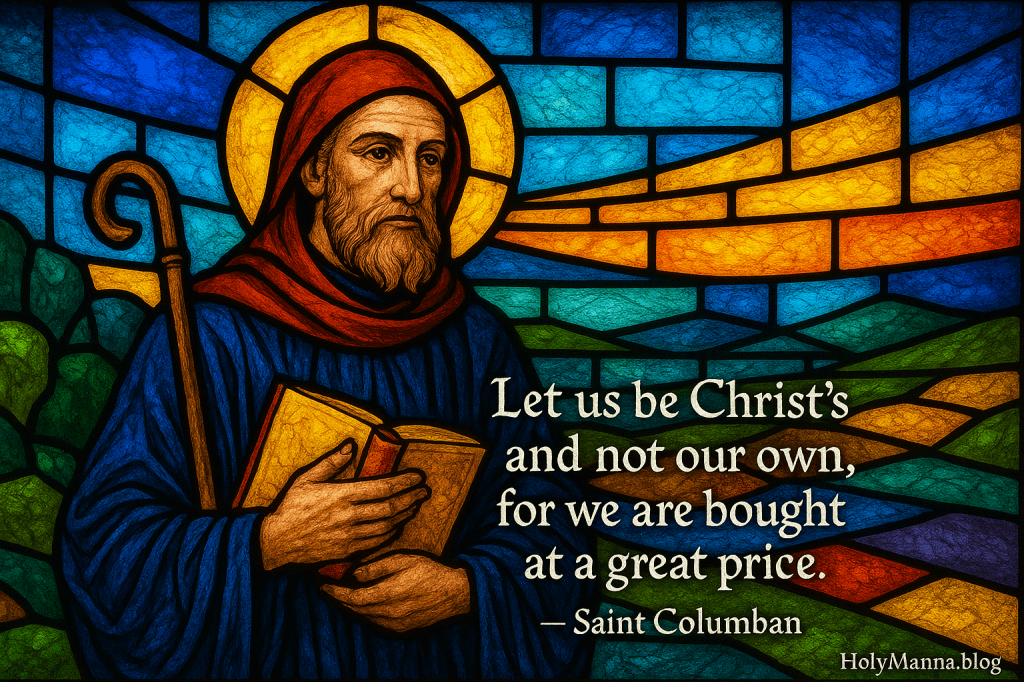
The Fiery Irish Monk Who Rekindled Europe’s Faith
Saint Columban, also known as Columbanus, stands as one of the greatest missionary monks of the early Middle Ages. Born around 543 in Leinster, Ireland, and dying in 615 in Bobbio, Italy, he helped ignite a new wave of monastic renewal throughout Western Europe. He founded influential monasteries, strengthened Christian moral life, preached conversion with bold clarity, and paved the way for the modern practice of private confession.
Known for his courage, ascetic life, love of Scripture, and fierce loyalty to the Catholic Church, Columban shows what happens when a Christian chooses holiness over comfort.
Roots Of A “Little Dove”
Columban’s name comes from an Irish root meaning “little dove,” which beautifully fits a man led by the Holy Spirit. Born into a respected family, he received a strong education in literature, languages, and especially Sacred Scripture.
As a young man, he was intensely tempted by lust and worldly approval. Seeking guidance, he visited a local holy woman who warned him with striking clarity that staying close to temptation would destroy both his purity and his soul. Her words sank deep. Instead of drifting further into sin, Columban embraced a radical conversion of life.
He entered monastic formation under Abbot Sinell and later at the famous Bangor Abbey, a center of strict discipline, continual prayer, and missionary zeal. Within this community, Columban grew into a spiritual powerhouse shaped by Scripture, penance, and the desire to bring Christ to places where the faith had grown shallow.
Feeling called to missionary exile, he left Ireland with twelve companions around the year 590. Their purpose was simple: bring renewal to a tired Christian world and awaken souls to the love of Christ.
Monasteries & Holy Boldness
Columban arrived in Gaul and found many Christians living in name only. His response was to build monastic communities that burned with holiness. At Annegray, Luxeuil, and Fontaine, he created houses of prayer, work, fasting, and Scripture that drew people from all walks of life.
His Rule of Saint Columban asked for deep humility, silence, obedience, and strong penance. Even though it was demanding, people flocked to learn from him because his asceticism was rooted in love for Christ and compassion for sinners.
One of his greatest contributions was strengthening and spreading the practice of regular private confession, which eventually became the standard in the Latin Church. This helped countless believers find renewed relationship with God through sacramental mercy.
Saint Columban was also known for remarkable miracles. Histories from his earliest followers recount episodes such as healing the sick with prayer, walking unharmed through wolves, multiplying food for his monks, restoring sight to the blind, and even ordering a bear to leave its cave so he could pray there. His intimacy with God allowed creation itself to respond to him.
His writings show a heart burning for Christ. One of his most powerful exhortations states: “Let us be Christ’s and not our own, for we are bought at a great price.”
Storms, Queens, And Exile
Columban’s fiery personality and uncompromising morals led him into heavy conflict. He clashed with local bishops over Irish customs such as the dating of Easter and the Celtic tonsure. Yet even while defending his traditions, Columban remained deeply loyal to the authority of the Bishop of Rome, affirming that the Irish were disciples of Saints Peter and Paul.
He also confronted grave immorality in the royal court. When King Theuderic II lived in open sin, Columban refused to bless the king’s illegitimate children. This infuriated Queen Brunhild, who eventually arranged his exile.
Forced onto a ship bound for Ireland, Columban seemed destined to return home. But storms repeatedly drove the ship back to shore. The captain concluded that heaven itself refused to let Columban leave the continent. Accepting this sign, the saint turned his steps toward new lands rather than defeat.
He preached in modern Switzerland, battled pagan practices, and brought many to repentance through both miracles and courageous preaching. Later he settled in northern Italy, where the Lombard king granted him land at Bobbio. There he founded one of the most important monasteries of the Middle Ages, known for its powerful defense of Catholic doctrine and its incredible library.
Rest In Bobbio
Saint Columban spent his final years teaching, praying, and guiding the monks of Bobbio. He died around November 21, 615. His tomb soon became a site of miracles, and pilgrims traveled from far distances to seek his intercession.
Relics associated with him, including portions of his bones and objects he used, have been preserved with great reverence. His monastery continued to shape Christian Europe long after his death, preserving vital manuscripts that helped protect the Church’s intellectual tradition.
Over the centuries he became known not only as a monastic father but also as a patron for travelers, including modern motorcyclists, and a powerful intercessor against floods. His legacy continued in the many monasteries founded by his disciples, as well as in the hearts of those who were reawakened by his fierce love for Christ.
Burning For Christ in a Comfort Addicted Age
Saint Columban speaks directly into a world tempted by comfort, distraction, and spiritual apathy. His life asks every believer a challenging question: Is Christ truly at the center of your life or simply one part of a busy schedule?
His example mirrors the teaching of The Catechism, which reminds us that “Christ’s call to conversion continues to resound in the lives of Christians” and that the entire Church walks “the path of penance and renewal” (CCC 1428).
Columban’s fasting and discipline were not about spiritual extremism. They were expressions of a heart that wanted to belong entirely to Jesus. He understood that interior conversion must express itself in outward acts of prayer, sacrifice, and mercy, just as the Church teaches.
For anyone battling impurity, materialism, or spiritual laziness, Columban’s early struggle with lust shows that temptation can be defeated when a person chooses concrete steps toward holiness. He did not simply pray for purity. He arranged his life for it.
His missionary spirit also encourages Catholics today to share their faith boldly, rooted in love for truth and loyalty to the Church.
Most of all, Columban reminds the Church that the Gospel is worth living with passion. His own prayer still inspires hearts today:
“Lord, grant me that love which knows no fall.”
Engage With Us!
Saint Columban’s fire still burns. Share your thoughts, reflections, or personal experiences in the comments. Let his life challenge and encourage your own journey toward holiness.
- Where do you sense Christ inviting you into deeper conversion right now, and what practical step can you take to respond?
- How does Saint Columban’s boldness inspire you to live your faith more honestly at home, at work, or online?
- What discipline of prayer, fasting, or charity could help strengthen your interior life?
- How could you make the Sacrament of Reconciliation a more regular part of your spiritual routine?
- What is one way you can bring the missionary zeal of Saint Columban into your community or relationships?
May Saint Columban pray for every reader to live a life filled with courage, purity, mercy, and passionate love for Jesus Christ. May we strive to do everything with the love and compassion our Lord taught us.
Saint Columban , pray for us!
Follow us on Instagram and Facebook for more insights and reflections on living a faith-filled life.

 Holy Manna!
Leave a comment