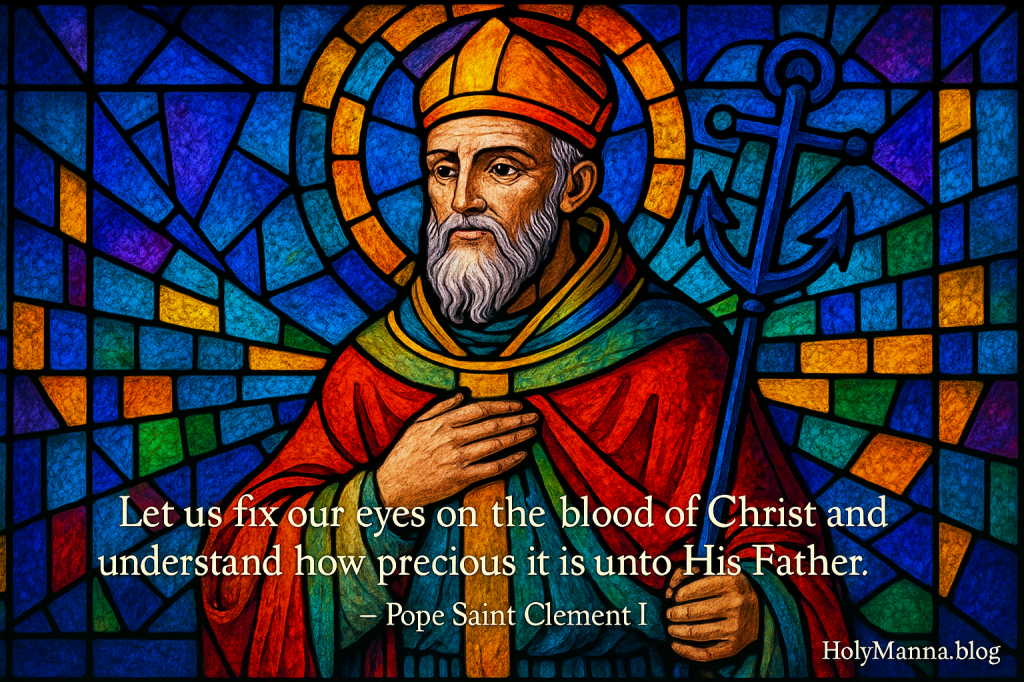
A Shepherd Standing in the Shadow of the Apostles
Pope Saint Clement I stands at the powerful meeting point between the Apostles and the early Church that followed them. As one of the first successors of Saint Peter and one of the Apostolic Fathers, he forms a bridge between the New Testament community and the unfolding life of the early Catholic Church. Early Christian writers describe him as a contemporary of the Apostles and a witness to their preaching. Tradition holds that Saint Peter himself ordained him as bishop of Rome.
Clement served as pope near the end of the first century, likely from around the year 92 to 99. His name remains in the Roman Canon of the Mass, a sign of how ancient and universal his veneration has been. He is honored as a pope, a martyr, and a patron of mariners, often depicted with an anchor that symbolizes both the manner of his death and the unshakeable hope he carried as a Christian.
Friendship with the First Generation
Ancient tradition teaches that Clement was born in Rome into a respected family, with some accounts naming his father Faustinus. His Roman background gave him familiarity with public life, culture, and the responsibilities placed on those with influence.
Clement’s significance, however, comes from something far greater than lineage. He lived close to the Apostles themselves. Early Church Fathers wrote that Clement had heard their preaching and knew them personally. This proximity is why the Church calls him an Apostolic Father. His voice echoes the living memory of those who walked with Jesus.
Clement’s most famous work is his letter known as First Clement or 1 Clement, written from the Church of Rome to the Church of Corinth. This remarkable letter is one of the earliest Christian writings outside The New Testament. For many years it was read publicly in Corinth during the liturgy because it was held in such high esteem.
The letter addresses a serious conflict: certain presbyters in Corinth had been unjustly removed from office. Clement intervened with paternal authority, calling the community back to humility, obedience, and peace. This letter is also an early witness to apostolic succession. Clement reminds the Corinthians that the Apostles appointed bishops and deacons and instructed that this ministry should continue in an orderly and faithful way. This lines up perfectly with The Catechism of the Catholic Church, which teaches that “In order that the full and living Gospel might always be preserved in the Church the apostles left bishops as their successors.” CCC 77
One of Clement’s most moving exhortations comes from 1 Clement 7, where he calls Christians to focus everything on Christ’s sacrifice: “Let us fix our eyes on the blood of Christ and understand how precious it is unto His Father.”
A Voice for Unity, Humility, and Apostolic Order
Clement’s legacy is rooted in unity. In an age of divisions, heresies, and political turbulence, he demonstrated that the Church must remain anchored to apostolic teaching. His letter to the Corinthians shows that Rome exercised a pastoral authority very early in Church history, not out of dominance, but out of a commitment to safeguard the peace of Christ’s body.
He called believers to humility, reminding them that jealousy, pride, and rivalry destroy the work of God, while peace and charity build it up. His letter reads like a spiritual father pleading with his children to remember who they are in Christ.
Clement shows the heart of a shepherd who loved the flock entrusted to him. His wisdom continues to guide the Church, because he points believers to Scripture, apostolic tradition, and the humility of Christ.
Exile, Quarry, and the Anchor of Hope
During renewed persecutions under Emperor Trajan, Clement was exiled from Rome to the distant region of Chersonesus in the Crimea, where he was forced to work in stone quarries. These quarries also held many Christian prisoners who suffered from harsh conditions and severe thirst.
Tradition recounts that, moved by compassion, Clement knelt and prayed for water. After praying, he saw a lamb on a nearby hill. When he reached the spot and struck the earth with a pickaxe, a miraculous spring burst forth, providing water for the exhausted prisoners. This miracle brought many to conversion and comforted believers who had been losing hope.
Because his influence grew even in exile, Clement eventually faced martyrdom. Tradition says he was tied to an anchor and cast into the sea to prevent Christians from venerating his relics. The anchor became his defining symbol, representing both his death and the steadfast faith that held him firm in Christ.
Although early historical sources do not describe the details of his martyrdom, the Church has consistently honored him as a martyr who remained faithful to Christ at every cost.
Streams of Grace After His Death
Clement’s martyrdom did not end devotion to him. Early Christian traditions tell that the sea receded once a year, revealing a small chapel beneath the waves where believers could honor his relics.
Centuries later, in the ninth century, Saint Cyril traveled through the region and believed he discovered Clement’s relics, including an anchor. These were carried to Rome and enshrined in the beautiful Basilica of San Clemente, where they remain to this day. The basilica itself is a living symbol of the Church’s history, with layers of ancient churches and Roman structures beneath the current building.
Portions of Clement’s relics are also venerated in other Christian communities, reflecting how widely he was loved across both East and West. His name remains in the Roman Canon, and his writings continue to guide Christians who desire unity and fidelity to the apostolic faith.
Learning from Pope Saint Clement I Today
Pope Saint Clement I offers lessons that are deeply needed in the Church today.
He reminds us that unity is not optional. It is rooted in humility, charity, and a willingness to submit to the order Christ established through the Apostles. His letter to the Corinthians shows that true authority in the Church flows from service, not power.
He also teaches Catholics to value apostolic succession as a gift that keeps the Gospel alive in every age. The Catechism explains this clearly when it states that the bishops, as successors to the Apostles, “exercise their authority in the name of Christ” and ensure the continuity of the Church’s teaching. CCC 861–862
Most of all, Clement teaches a deep focus on Christ’s sacrifice. His call to fix our eyes on the blood of Christ is a reminder that division dissolves when believers return to the humility and mercy that flow from the Cross.
Practical ways to live his example include praying regularly for the Church’s leaders, healing divisions within families and parishes, returning to Scripture and the sacraments with deeper reverence, and rooting one’s identity in Christ rather than in worldly arguments or ideologies.
Engage with Us!
You are invited to share your thoughts and reflections in the comments below. The life and witness of Pope Saint Clement I offer powerful insights for the modern Church.
- Which part of Pope Saint Clement I’s story speaks most deeply to your life right now, and why?
- How can Catholics grow in trust and respect for apostolic authority while remaining humble and discerning?
- Where might God be inviting you to respond with greater peace and humility in moments of conflict?
- How can you keep the sacrifice of Christ at the center of your daily decisions this week?
- What does the symbol of the anchor teach you about hope in times of suffering?
May the example and prayers of Pope Saint Clement I inspire you to live with courageous faith, a gentle heart, and unwavering devotion to Jesus. May every thought, word, and action be filled with the love and mercy that Christ has entrusted to His Church.
Pope Saint Clement I, pray for us!
Follow us on Instagram and Facebook for more insights and reflections on living a faith-filled life.

 Holy Manna!
Leave a comment