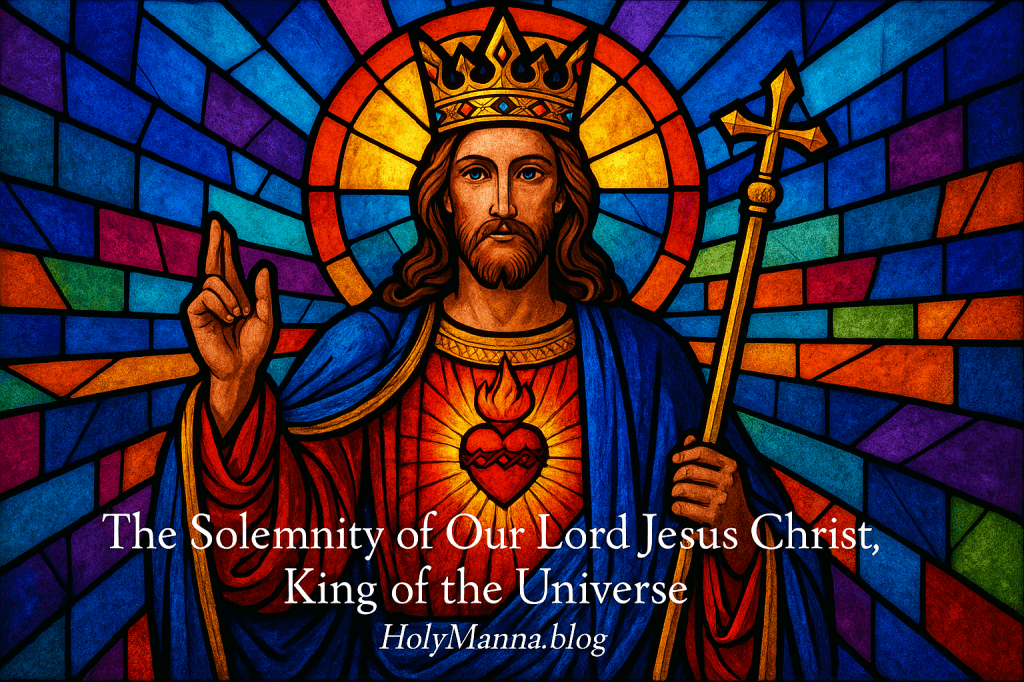
Crowned in Glory
At the very end of the liturgical year, just before Advent begins, the Church celebrates the Solemnity of Our Lord Jesus Christ, King of the Universe. On this final Sunday of Ordinary Time, the whole Church lifts its gaze to the One who brings all of history to its fulfillment. This solemnity proclaims that Christ is not just a spiritual influence or a private comfort. He is King of the cosmos, of nations, of families, and of every human heart.
Pope Pius XI established this feast in 1925 in the encyclical Quas primas, written in response to rising secularism and the widespread attempt to push Christ out of public and private life after the devastation of World War I. Originally celebrated on the last Sunday of October, it was moved in 1969 to the final Sunday of the liturgical year and elevated to a solemnity. This shift highlights the central message of the feast: everything in salvation history ends in Christ. He is the Alpha and the Omega.
From Crisis to Kingship
The background of this feast is rooted in a world shaken by turmoil. After World War I, nations were rebuilding, political movements were clashing, and many believed society could be rebuilt without God. Militant atheism and aggressive secularism were shaping culture in destructive ways.
Pope Pius XI recognized the deeper spiritual crisis at the heart of these social upheavals. In Quas primas, he lamented that “the majority of men had thrust Jesus Christ and his holy law out of their lives” and insisted that true peace could only come when individuals and societies acknowledged the loving rule of Christ.
In response, he instituted the Feast of Christ the King as a bold declaration that no earthly ruler, ideology, or movement holds ultimate authority. The kingship of Jesus is rooted in Scripture, where he proclaims in The Gospel of Matthew 28:18, “All power in heaven and on earth has been given to me.” In the Book of Revelation, he is revealed as “King of kings and Lord of lords.” The early Church Fathers also emphasized this truth, understanding Christ’s kingship as central to the Christian life.
With the reform of 1969, the feast became the Solemnity of Our Lord Jesus Christ, King of the Universe, and found its place on the final Sunday of the liturgical year. Positioned here, it points forward to Christ’s Second Coming, when his kingdom will be fully revealed and his victory over sin and death will be complete.
Lord of Heaven, Lord of History
The Solemnity of Christ the King is not a poetic title. It expresses the very heart of the Gospel.
Saint Paul writes in Ephesians 1:10 that God’s plan is “to unite all things in him, things in heaven and things on earth.” He continues in Ephesians 1:22 that God has “put all things under his feet” and made him head over all things for the Church. Christ reigns not only in heaven but over the entire created order.
The Catechism deepens this truth. CCC 668 through 672 and CCC 680 teach that Christ’s kingdom is already present in the Church, even though it is not yet fully revealed in glory. The victory has begun, but the final triumph will come at his return.
Christ’s kingship is unlike any earthly power. CCC 786 teaches that Jesus is King precisely because he made himself the servant of all. He came, as The Gospel of Mark 10:45 reminds us, “not to be served but to serve, and to give his life as a ransom for many.” The kingship of Christ is expressed in humility, sacrifice, and merciful love. This is why the Church teaches that to reign with Christ means to serve with Christ, especially in those who are poor, forgotten, or suffering.
CCC 2105 explains that individuals and societies have a moral duty to acknowledge Christ’s kingship, not through force but through authentic evangelization and witness to the truth. Christ’s kingship has social implications because the Gospel is meant to shape culture, laws, and community life with justice and charity.
Kneeling Before the Eucharistic King
This solemnity is deeply connected to the Eucharistic Heart of Jesus. The Eucharist is the throne of the King present among his people. Many parishes honor Christ the King with extended Eucharistic adoration, solemn Benediction, and holy hours. The Catechism teaches in CCC 2628 and CCC 1378 through 1380 that adoration is the first posture of a creature before the Creator and that the Eucharist prolongs the worship of the Mass.
Eucharistic processions also mark this feast in many communities. The Blessed Sacrament is carried through city streets as a public proclamation that Christ’s kingdom is real and active in the world. These processions remind everyone that faith is not a private matter but a truth meant to illuminate daily life.
One beautiful tradition associated with the feast is the Act of Dedication of the Human Race to Christ the King, beginning with “Most sweet Jesus, Redeemer of the human race”. When prayed publicly on this day, this act of consecration can carry a plenary indulgence under the usual conditions.
There are also shrines dedicated to Christ the King, such as the Sanctuary of Christ the King in Portugal, which stands as a towering reminder that nations and peoples are under the protection and lordship of Jesus. Devotions like these strengthen the faith of pilgrims and help shape hearts that recognize the gentle authority of Christ.
Processions, Crowns, and Community
Around the world, the Solemnity of Christ the King is celebrated with solemn beauty and joyful public witness.
The liturgical readings for the day shine light on various facets of Christ’s kingship. In Year C, for example, the Gospel presents the scene of Christ crucified in The Gospel of Luke, where the sign above him reads “This is the King of the Jews” and the good thief makes his bold plea, “Jesus, remember me when you come into your kingdom.” Other years highlight Christ the Shepherd King or the majestic image of the Son of Man seated upon his throne in The Gospel of Matthew 25.
Parishes often hold Eucharistic processions, enthronement of images in homes, and parish festivals dedicated to Christ the King. Hymns such as “To Jesus Christ, Our Sovereign King” fill churches across many cultures. Acts of consecration of families, parishes, and dioceses are common, as believers renew their desire to live under the reign of Jesus.
In some regions, processions move through town squares or gather at civic buildings, making a visible statement that Christ’s love and mercy are meant to reach every corner of society. The celebration is both worship and mission.
Let Him Reign
This solemnity is not only a liturgical moment. It is a call to personal conversion. If Jesus Christ is truly King of the Universe, then he deserves to be King of our time, our choices, our relationships, and our hearts.
Let Christ be King of time. The Church ends the year with this solemnity to remind us that time belongs to Christ. When we center our week on Sunday Mass and commit to daily moments of prayer, we proclaim with our lives that Jesus reigns.
Let Christ be King of the interior life. CCC 786 and CCC 2105 show that Christ’s kingship is expressed in service. Choosing forgiveness, purity, truthfulness, and humility all reflect the reign of Jesus in the heart.
Let Christ be King of relationships and decisions. Every choice becomes an opportunity to follow the King who rules not by force but by love. Seeing others as beloved children of God transforms our homes, workplaces, and parishes.
Let Christ be King through service. Since Christ reigns through sacrificial love, every act of charity is royal. Serving the poor, visiting the sick, welcoming the outsider, and extending mercy are ways to let Christ rule in us.
The world tells us to rule ourselves. Christ the King invites us to surrender ourselves. The happiest life is not self-rule but joyful service under the loving kingship of Jesus.
Engage with Us!
Share your insights, your stories, and your reflections in the comments below. Let this space inspire deeper love for Christ the King.
- Where in your life does Christ clearly reign as King, and where are there still rival kingdoms competing for your heart?
- How do the images of Christ crowned with thorns and Christ reigning in glory shape the way you see suffering, success, and failure in your own life?
- What is one practical step you can take this week to make Christ more visibly the King of your home, your friendships, your work, or your parish?
- How does serving the poor, the lonely, and the suffering help you understand what the Catechism means when it says, “to reign is to serve him”?
- If someone asked why the Church proclaims the kingship of Christ in a modern world that questions authority, how would you explain this feast to them?
May the King who hung on the cross, who is present in the Eucharist, and who will come again in glory guide every step of your life. May everything you do be shaped by his love, his mercy, and his truth. Let every day be lived under his gentle and victorious reign.
Sacred Heart of Jesus, we trust in You!
Immaculate Heart of Mary, pray for us!
Saint Michael the Archangel, defend us in battle!
Follow us on Instagram and Facebook for more insights and reflections on living a faith-filled life.

 Holy Manna!
Leave a comment