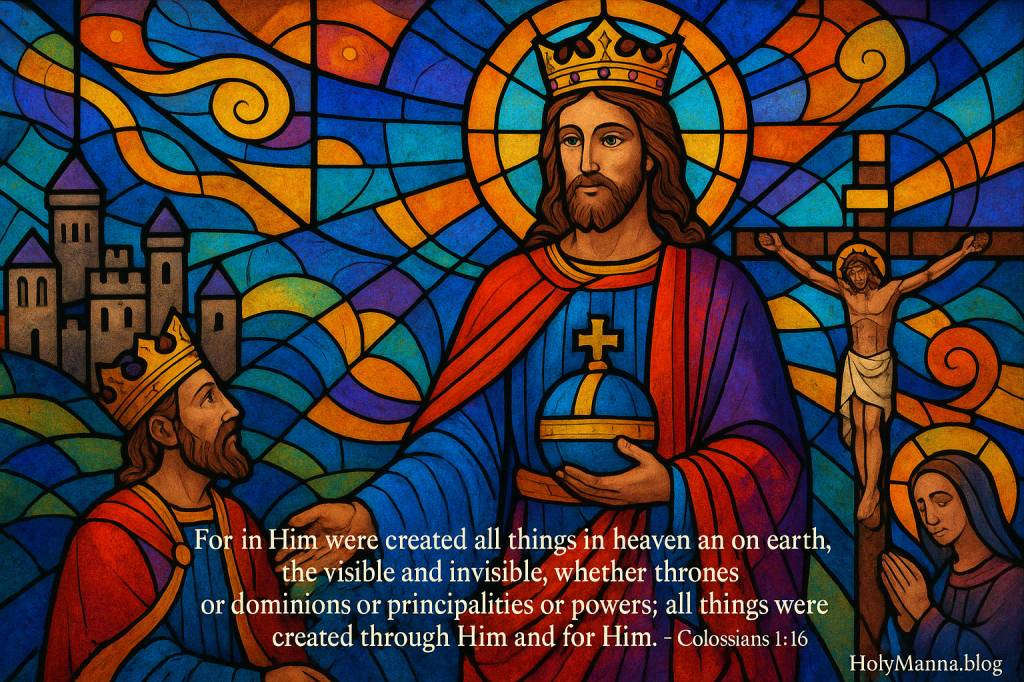
The Solemnity of Our Lord Jesus Christ, King of the Universe – Lectionary: 162
A Crown of Thorns, a Kingdom of Mercy
Every human heart is looking for someone or something to rule it, whether that is success, pleasure, power, or the opinion of others. On this great feast of The Solemnity of Our Lord Jesus Christ, King of the Universe, the Church quietly but firmly asks: Who is actually sitting on the throne of your life today?
All of today’s readings point to one stunning truth: Jesus Christ is not a symbolic king or a sentimental king, but the real King whose rule stretches from the Cross to the cosmos, from Jerusalem’s ancient walls to the depths of every human soul. In 2 Samuel 5:1-3, the tribes of Israel come to David and say that he is their own flesh and blood and that he was the one who truly led them. They anoint him king and recognize that God has chosen him to “shepherd my people Israel”. David’s kingship, rooted in covenant and service, becomes a preview of a greater Son of David who will shepherd not just one nation but all creation.
Psalm 122 then gives a glimpse of what it looks like when God’s reign is welcomed. Pilgrims rejoice as they go up to Jerusalem, the city of God’s presence, where “there are the thrones of justice, the thrones of the house of David”. The focus is not on military power but on worship, thanksgiving, and justice. This psalm hints that the true King is the One whose presence turns a place into holy ground and whose rule establishes real peace and right order.
In Colossians 1:12-20, the veil is pulled back and the Church is given a cosmic vision of Christ the King. Jesus is not only heir of David’s throne. He is “the image of the invisible God, the firstborn of all creation”, the One in whom “all things hold together”. Every throne, dominion, principality, and power ultimately exists under His authority. Yet this same King chooses a shocking way to rule. Through Him, the Father has “delivered us from the power of darkness and transferred us to the kingdom of his beloved Son”, and this transfer happens through “the blood of his cross” that reconciles all things. The Kingdom is not an idea. It is a rescue, a transfer from darkness into light.
That is why the Gospel from Luke 23:35-43 is so jarring and beautiful for the feast of Christ the King. The scene is not a golden throne room but Calvary. The inscription above His head reads, “This is the King of the Jews.” The rulers mock Him, the soldiers jeer, and one criminal demands a quick escape. Yet the other criminal, in a moment of grace, recognizes both his guilt and Christ’s innocence. He turns to the dying King and simply says, “Jesus, remember me when you come into your kingdom.” And Jesus, crowned with thorns and nailed to a cross, exercises His royal authority with a promise no earthly king could ever make: “Amen, I say to you, today you will be with me in Paradise.”
As the liturgical year comes to a close, this solemnity reminds the Church that history is not random and that the universe is not ruled by chaos. The King who was foreshadowed in David, worshiped in Jerusalem, revealed in cosmic glory in Colossians, and enthroned on the Cross in Luke is the same Lord who will come again in glory and whose Kingdom will have no end, as professed in the Creed and echoed in The Catechism. His throne is not secured by violence but by sacrificial love. His rule is not about control but about setting captives free, forgiving sins, and drawing souls into the light.
This feast invites every believer to look at Christ on the Cross and see not defeat but coronation, not weakness but the deepest kind of power. It asks a very personal question, one that cannot be ignored: If Jesus Christ is truly King of the Universe, is He allowed to be King of your choices, your relationships, your wounds, and your future today?
First Reading – 2 Samuel 5:1-3
A King After God’s Heart, A Hint of a Greater King
The scene in 2 Samuel 5:1-3 takes place at a turning point in Israel’s history. The tribes of Israel have been through years of division, conflict, and fragile leadership under Saul. Now they gather in Hebron, an ancient and deeply significant city tied to the patriarchs, to anoint David as king. This is not just a political transfer of power. It is the people recognizing that God has chosen David, the shepherd warrior, to rule them according to a covenant. In this moment, the tribes affirm their unity, their shared identity, and their trust that God’s plan is unfolding through David’s kingship.
This reading fits beautifully with the theme of The Solemnity of Our Lord Jesus Christ, King of the Universe. David’s kingship is a real historical event, but it also points beyond itself. David is a shepherd king who leads, protects, and unites the people. Christ will later fulfill this pattern perfectly as the eternal Son of David, the true Shepherd King whose throne is the Cross and whose Kingdom stretches far beyond Israel to the whole universe. As the Church listens to this reading, the heart is invited to see how God’s plan of kingship and covenant love moves from David in Hebron all the way to Christ on Calvary and to His reign in the Church today.
2 Samuel 5:1-3
New American Bible (Revised Edition)
David King of Israel. 1 All the tribes of Israel came to David in Hebron, and they said: “Look! We are your bone and your flesh. 2 In days past, when Saul was still our king, you were the one who led Israel out in all its battles and brought it back. And the Lord said to you: You shall shepherd my people Israel; you shall be ruler over Israel.” 3 Then all the elders of Israel came to the king in Hebron, and at Hebron King David made a covenant with them in the presence of the Lord; and they anointed David king over Israel.
Detailed Exegesis
Verse 1 – “All the tribes of Israel came to David in Hebron, and they said: ‘Look! We are your bone and your flesh.’”
The tribes of Israel coming to David in Hebron signifies a moment of national unity after a long period of fragmentation. The phrase “we are your bone and your flesh” echoes the language of Genesis 2:23, where Adam recognizes Eve as “bone of my bones and flesh of my flesh”. This is covenant language. It expresses deep kinship, shared identity, and a commitment that is not just political but almost familial. The people are acknowledging that David is not a distant ruler imposed from outside. He is one of them. He shares their blood, their history, their struggles.
Spiritually, this verse prepares the heart to think about Christ’s relationship with the Church. Christ, the true Son of David, takes on human nature and becomes truly one of us. The Church is His Body. Believers can say to Him, in a deeper way, that He is their own flesh and that in Him their humanity is honored, healed, and lifted up.
Verse 2 – “In days past, when Saul was still our king, you were the one who led Israel out in all its battles and brought it back. And the Lord said to you: You shall shepherd my people Israel; you shall be ruler over Israel.”
Here the people recall David’s past leadership even during Saul’s reign. They recognize that David was the real leader on the ground, the one who went out before them in battle and brought them back safely. This reflects the ancient Near Eastern expectation that a true king must protect his people and lead them personally. The key phrase is the divine word: “You shall shepherd my people Israel; you shall be ruler over Israel.”
The image of a shepherd king is central in Scripture. A shepherd knows the flock, guards it from danger, seeks the lost, and lays down his life if needed. The Lord’s promise to David becomes the foundation for the later messianic hope. The prophets will speak of a coming shepherd from David’s line who will rule with justice and care. This verse is a strong bridge to Christ, who will say in The Gospel of John, “I am the good shepherd.” The kingship God desires is not tyranny but loving, sacrificial leadership.
Verse 3 – “Then all the elders of Israel came to the king in Hebron, and at Hebron King David made a covenant with them in the presence of the Lord; and they anointed David king over Israel.”
This verse shows the formal act that seals the relationship between David and the people. The elders represent the tribes, and together with David they make a covenant “in the presence of the Lord”. The kingship is not a private agreement or a worldly power grab. It is a sacred covenant that involves God as witness and guarantor. The people anoint David, confirming publicly what God has already chosen.
The act of anointing is important. In Hebrew, the word for anointed is mashiach, or Messiah. David becomes the Lord’s anointed, a visible sign of God’s reign over His people. This points directly toward Jesus, whose title Christ means Anointed One. Christ is the fulfillment of all the anointings of the Old Testament. David’s throne is a shadow. Christ’s reign is the reality. On this solemnity, this verse helps hearts remember that Christ’s kingship is rooted in a covenant sealed not with oil but with His own Blood.
Teachings: The King and the Covenant
The Church reads the story of David’s anointing as both history and prophecy. David is a real king chosen by God, and at the same time, he is a figure who foreshadows Christ. The Catechism of the Catholic Church explains that the title “Christ” comes from His anointing by the Spirit and from His mission as priest, prophet, and king. The Catechism states: “The Messiah is one whom God will send in the last days to establish his kingdom definitively” (CCC 436). David’s anointing in Hebron is a step on the way toward that definitive Kingdom.
Another passage in The Catechism connects the promises made to David with the identity of Jesus: “Jesus is the Christ, for ‘God anointed Jesus of Nazareth with the Holy Spirit and with power’” (CCC 438). The line continues by teaching that the people of Israel were waiting for the Son of David who would bring God’s reign in fullness. In other words, the covenant at Hebron is not the final word. It is a sign pointing toward Christ, who is anointed not only as a human king but as the eternal Son sent by the Father.
There is also a strong teaching in the tradition about kingship and service. The Catechism teaches that believers share in Christ’s kingly office by serving others. It says: “The people of God shares in the royal office of Christ” and that the Christian way of kingship is lived by self denying service and holiness (CCC 786). If David’s calling was to shepherd Israel, then Christ’s followers are also called to shepherd those entrusted to them, whether in families, workplaces, parishes, or communities.
Saint Augustine often reflected on David as a figure of Christ. In his writings on the psalms, Augustine invites believers to see Christ hidden in the life and voice of David. One of his short insights can be summarized in this spirit: in David’s story a Christian can recognize the pattern of the coming Savior, the humble king who suffers, fights for the people, and leads them into peace. This helps the heart remember that Scripture is not just distant history. It is a living revelation of Christ’s heart.
Hebron itself carries historical and spiritual weight. It is associated with Abraham, the father of faith, and becomes the place where David’s kingship is confirmed. This setting underscores that God’s plan is consistent. The covenant with Abraham, the covenant with David, and the New Covenant in Christ are different stages of one great story of salvation. The Church sees all of this fulfilled and brought to perfection in Christ the King, whose Kingdom is not limited to a single city, but embraces heaven and earth.
Reflection: Letting the Shepherd King Rule the Heart
This short reading carries a lot of weight for modern disciples. It shows a people who freely come to their king and say, in effect, that they trust him and wish to be united under his leadership. It also shows a king who does not seize power by force but receives it within a covenant made before God. In a world that often treats leadership like a personal brand or a way to gain control, this passage offers a different image: leadership as service, kingship as shepherding, authority as a covenant of love and responsibility.
In daily life, this reading invites every believer to examine who or what is allowed to rule the heart. Many minds are ruled by anxiety, comparison, social media, or career ambition. Yet on this solemnity the Church holds up Christ as the true Shepherd King and gently poses a question: Is the heart united to Christ in a real covenant, or is He treated more like an occasional consultant than a King?
There are concrete ways to respond. One way is to renew a conscious choice to let Christ guide decisions in family, work, and relationships. Another way is to approach the sacraments, especially Confession and the Eucharist, as encounters with the King who shepherds His people. A believer can also begin to see any position of influence, even small ones, as a call to shepherd rather than to dominate: parents with children, bosses with employees, older siblings with younger ones, parish volunteers with those they serve.
The reading also challenges the faithful to unity. The tribes come together at Hebron after division and conflict. Many families, parishes, and communities are wounded by division, grudges, or old wounds. Christ the King calls His people to come together again in His presence and to renew their covenant with Him and with one another.
A good way to pray with this passage is to let those words echo before Christ in prayer: “We are your bone and your flesh.” That line can become a simple offering of identity and belonging. From there, some questions naturally surface: Where in life is there a need to stop resisting Christ’s kingship and instead come to Him freely, like the tribes of Israel in Hebron? In what relationships or responsibilities is there a call to act more like a shepherd and less like a controller? What would it look like this week to let Christ the King make a real covenant with the heart and not just a casual agreement?
Responsorial Psalm – Psalm 122:1-5
Going Up To The King
Psalm 122 is a song of ascent, a pilgrim hymn sung by Israelites as they went up to Jerusalem for the great feasts. Picture families and tribes climbing the hill toward the holy city, praying and singing together as they approach the Temple where God’s presence dwells in a unique way. For ancient Israel, Jerusalem was not just a capital. It was the city of God, the place of the Ark, the center of worship, justice, and identity as the people of the covenant.
On the Solemnity of Our Lord Jesus Christ, King of the Universe, this psalm takes on an even deeper meaning. Jerusalem, the city of David and the place of the Temple, points forward to Christ’s Church and to the heavenly Jerusalem. The thrones of the house of David hint at the royal line that will lead to Jesus, the Son of David, whose Kingdom is not limited to one city but extends over all creation. This psalm shows what it looks like when hearts rejoice to go into the presence of their King, to stand where He reigns, and to live under His justice and peace. It prepares the soul to recognize that Christ’s kingship is lived and celebrated in worship, in the life of the Church, and ultimately in the heavenly liturgy.
Psalm 122:1-5
New American Bible (Revised Edition)
A Pilgrim’s Prayer for Jerusalem
1 A song of ascents. Of David.
I rejoiced when they said to me,
“Let us go to the house of the Lord.”
2 And now our feet are standing
within your gates, Jerusalem.
3 Jerusalem, built as a city,
walled round about.
4 There the tribes go up,
the tribes of the Lord,
As it was decreed for Israel,
to give thanks to the name of the Lord.
5 There are the thrones of justice,
the thrones of the house of David.
Detailed Exegesis
Verse 1 – “I rejoiced when they said to me, ‘Let us go to the house of the Lord.’”
The psalm opens with joy, not obligation. The speaker does not say, “I dragged myself” but “I rejoiced.” For Israel, going to the house of the Lord meant responding to God’s command to worship at the Temple in Jerusalem. It was an act of obedience but also of deep happiness. To go to God’s house was to step into His presence, to remember His covenant, and to give thanks for His saving works.
For Christians, this verse echoes the call to the Eucharist. The house of the Lord now is above all the Church gathered around the altar, where Christ the King is truly present. When believers live under His kingship, Sunday Mass is not just a rule but a gift. The heart learns to rejoice at the invitation: come into the presence of the King.
Verse 2 – “And now our feet are standing within your gates, Jerusalem.”
The mood shifts from anticipation to arrival. The pilgrims have reached the city. Their feet are no longer on the road. They are standing within the gates of Jerusalem. This moment captures fulfillment and stability. They have come where they are meant to be.
Spiritually, this speaks to the experience of stepping from the noise of daily life into the sacred space of worship. It also points to the deeper reality of belonging in the Church and, one day, entering the heavenly Jerusalem. For a disciple of Christ the King, this verse can be prayed as a reminder that the true homeland is not an earthly nation but the Kingdom of God. There is a quiet joy in knowing that in Christ, every believer already has a place inside the walls of God’s city.
Verse 3 – “Jerusalem, built as a city, walled round about.”
Jerusalem is described as a well built, fortified city. The walls are not just architecture. They symbolize protection, order, and unity. In a world filled with threats and instability, the city of God stands firm. This image resonates with the Church as the New Jerusalem, a spiritual home that is meant to be united, secure, and ordered by the rule of Christ.
Theologically, many Fathers of the Church saw Jerusalem as a figure of the Church and of the soul. When Christ truly reigns, the inner life becomes more ordered, less scattered, more whole. The walls can be seen as God’s commandments and grace, which do not crush freedom but protect it, like city walls protect the people who live within.
Verse 4 – “There the tribes go up, the tribes of the Lord, as it was decreed for Israel, to give thanks to the name of the Lord.”
Now the focus is on the people streaming into the city. All the tribes go up, not just one. This is a powerful image of unity in worship. The nation is one people under one God, gathered in one place. They come because it has been decreed, which means this is part of their covenant life, not a random tradition. Their primary purpose is clear: to give thanks to the name of the Lord.
For the Church, this verse mirrors the way believers gather from every nation, language, and background to worship the same Lord in the liturgy. The Mass is the place where the people of God “go up” spiritually to the heavenly Jerusalem. It highlights that Christ’s Kingdom is not private and individualistic. It is communal. Christ the King gathers a people, not just isolated individuals.
Verse 5 – “There are the thrones of justice, the thrones of the house of David.”
The psalm ends by turning attention to the thrones set in Jerusalem. These are thrones of justice, belonging to the house of David. The city is not just a worship center. It is also the seat of just rule. God’s plan for Israel includes both right worship and right order in society. Justice and worship are not competing ideas. They belong together under the reign of the Davidic king.
On this solemnity, this verse clearly points forward to Christ, the true Son of David, whose throne is the Cross and whose Kingdom is founded on justice and mercy. In His Kingdom, justice is not revenge. It is the right ordering of all things according to God’s truth and love. The repentant thief in the Gospel encounters this justice on Calvary, where Christ’s royal judgment is mercy and the gift of Paradise.
Teachings: Jerusalem, the Church, and the Heavenly City
The Church sees Psalm 122 as more than a travel song. It is a window into the mystery of the Church and the Kingdom of God. The earthly Jerusalem foreshadows the Church on earth and the heavenly Jerusalem that believers hope to enter. The Catechism of the Catholic Church teaches that the liturgy is participation in the worship of heaven. Speaking of liturgy, it says: “The word ‘liturgy’ originally meant a ‘public work’ or a ‘service in the name of/on behalf of the people.’ In Christian tradition it means the participation of the People of God in the ‘work of God.’” (The Catechism of the Catholic Church, 1069). When the Church gathers to worship, it is like the tribes going up to Jerusalem, stepping into the King’s presence and joining in the work of praise and thanksgiving.
The imagery of Jerusalem as a well built city also connects to the Church as the Body of Christ. The Catechism teaches that the Church is both visible and spiritual, a structured society and a mystical body, rooted in Christ and animated by the Holy Spirit. The order and unity of Jerusalem’s walls point to the order and unity of the Church under Christ the King. This includes the visible structure of bishops and priests and the invisible reality of grace.
Saint Augustine famously reflects on the human heart’s desire for God in a way that fits this psalm’s pilgrim journey. In The Confessions, he writes: “You have made us for yourself, O Lord, and our heart is restless until it rests in you.” This restlessness is like the desire to go up to Jerusalem, to finally stand where the heart finds its home. The joy of the psalmist who rejoices at the call to go to the house of the Lord is the same joy that every restless heart experiences when it draws near to Christ the King in prayer and sacrament.
The thrones of justice in Jerusalem also echo the idea of Christ as the judge of the living and the dead. The Creed proclaims that He will come again in glory to judge, and His Kingdom will have no end. The thrones in the city of David point to His final judgment, which will fully establish justice and peace. Until that day, the Church lives as a pilgrim people, already tasting the Kingdom in the liturgy while still walking toward its full realization.
Reflection: Learning to Love the King’s House
This psalm is a gentle but powerful invitation to check the heart’s attitude toward worship and the presence of Christ the King. The psalmist rejoices at the chance to go to the house of the Lord. Many people today feel more tired than joyful, more distracted than focused, especially when it comes to Mass and prayer. Yet this reading reminds believers that real joy begins when the heart starts to love the King’s house and to see worship not as an obligation but as a homecoming.
Practically, this can mean preparing for Sunday Mass with more intention. It can look like praying with the readings beforehand, arriving a little earlier to settle into silence, or staying a few moments afterward in thanksgiving. It can mean reminding the mind and heart that the church building is not just a gathering space but a place where Christ the King is truly present in the tabernacle and in the celebration of the Eucharist.
The unity of the tribes going up together challenges the individualistic mindset that often dominates modern life. The psalm invites believers to think about their parish community and ask: How can there be a deeper sense of going up together to worship the King? That might involve reconciling with someone in the community, getting involved in a ministry, or simply paying more attention to the people in the pews instead of staying spiritually isolated.
The mention of the thrones of justice encourages a deeper trust in Christ’s rule. In a world where justice often feels slow or distorted, believers are reminded that Christ the King sees everything clearly and will set all things right. This can free the heart from bitterness and despair. Instead of trying to control everything, a disciple can learn to stand within the gates of God’s city and entrust personal wounds and global injustices to the King who judges with perfect fairness and mercy.
This psalm also invites an honest question in prayer: Does the heart rejoice at the thought of going to the house of the Lord, or has worship become routine and dry? If joy is missing, this does not mean failure. It is simply a place to begin again, asking Christ the King to renew love for His presence. A believer might sit quietly before the tabernacle and repeat the verse, “I rejoiced when they said to me, ‘Let us go to the house of the Lord.’”, asking the Holy Spirit to make that line true from the inside out.
In the end, Psalm 122 whispers a simple invitation: learn to walk like a pilgrim, love the King’s city, and let Christ’s presence become the true center of life. What would change this week if the heart really believed that every step into church is a step into the courts of the King of the Universe?
Second Reading – Colossians 1:12-20
The Cosmic Christ
The Letter to the Colossians was written to a young Christian community living in a world full of competing spiritual claims, philosophies, and local cults. Many people around them believed in layers of spiritual powers and invisible forces that shaped daily life. Into that world, Saint Paul proclaims something absolutely breathtaking: all of creation, visible and invisible, comes from Christ, exists through Christ, and returns to Christ. This is not just a message about private faith. It is a declaration that Jesus of Nazareth is the true center of reality and the rightful King of everything.
In Colossians 1:12-20, the Church hears what many scholars recognize as one of the most beautiful Christological hymns in the New Testament. It begins with thanksgiving for salvation and then rises into a powerful confession of who Jesus is. He is the image of the invisible God, the firstborn of all creation, the head of the Church, and the One through whom all things are reconciled by the blood of His Cross. On the Solemnity of Our Lord Jesus Christ, King of the Universe, this passage anchors the heart in the truth that Christ’s kingship is not symbolic or sentimental. His Kingship is cosmic, concrete, and costly. It reaches from the furthest galaxy to the hidden places of personal sin and brokenness, and He reigns by redeeming.
Colossians 1:12-20
New American Bible (Revised Edition)
12 giving thanks to the Father, who has made you fit to share in the inheritance of the holy ones in light. 13 He delivered us from the power of darkness and transferred us to the kingdom of his beloved Son, 14 in whom we have redemption, the forgiveness of sins.
His Person and Work
15 He is the image of the invisible God,
the firstborn of all creation.
16 For in him were created all things in heaven and on earth,
the visible and the invisible,
whether thrones or dominions or principalities or powers;
all things were created through him and for him.
17 He is before all things,
and in him all things hold together.
18 He is the head of the body, the church.
He is the beginning, the firstborn from the dead,
that in all things he himself might be preeminent.
19 For in him all the fullness was pleased to dwell,
20 and through him to reconcile all things for him,
making peace by the blood of his cross
[through him], whether those on earth or those in heaven.
Detailed Exegesis
Verse 12 – “Giving thanks to the Father, who has made you fit to share in the inheritance of the holy ones in light.”
The starting point is gratitude. The Father is the One who qualifies the believer to share in an inheritance. This is language from the Old Testament, where Israel received the promised land as an inheritance from God. Now, Saint Paul reveals a deeper promise. The inheritance is not just a land. It is a share in the life of God’s holy ones in light. The Father makes this possible. No one earns it. This fits the feast of Christ the King because it shows that entry into His Kingdom is pure gift. His rule is not oppressive. It is generous, drawing those who are unworthy into a royal inheritance.
Verse 13 – “He delivered us from the power of darkness and transferred us to the kingdom of his beloved Son.”
Here the language becomes very strong. There is talk of a real spiritual rescue. The Father has delivered believers from the power of darkness. This means that sin, death, and the demonic are not just ideas. They are real powers that hold people captive. Yet those who are in Christ have been transferred into a new kingdom, the kingdom of His beloved Son. This is royal language. To belong to Christ means to live under His protection, His authority, and His love. On this solemnity, this verse makes it clear that to say “Christ is King” is to say that He has actually claimed lives from darkness and brought them under His rule of light.
Verse 14 – “In whom we have redemption, the forgiveness of sins.”
Saint Paul now names what this transfer looks like on the inside. In the beloved Son, there is redemption and forgiveness. Redemption means being bought back at a price. The price is the blood of Christ. Forgiveness of sins is not a vague feeling. It is a real cleansing that restores the relationship with God. The Kingdom of Christ is not just about outward order. It is about the interior freedom that comes when sins are forgiven.
Verse 15 – “He is the image of the invisible God, the firstborn of all creation.”
This line goes straight to the identity of Jesus. He is not just a messenger from God. He is “the image of the invisible God.” That means that in Him, the God who cannot be seen becomes visible. To see Christ is to see the Father’s heart. The term “firstborn of all creation” does not mean that He is a creature. In biblical language, firstborn refers to rank, dignity, and inheritance. Christ is first in relation to all creation. He is the heir and Lord of everything. For the feast of Christ the King, this verse is a foundation: the King is truly God made visible.
Verse 16 – “For in him were created all things in heaven and on earth, the visible and the invisible.”
The hymn now blows open the horizon. Everything that exists, whether seen or unseen, was created in Christ. That includes galaxies, mountains, and oceans, but also angels, spiritual realities, and even the structures of authority like “thrones or dominions or principalities or powers”, which the rest of the verse names. All were created through Him and for Him. Nothing stands outside His scope. This means that every power, human or spiritual, is ultimately answerable to Christ the King. His Lordship is not limited to church walls. It spans the entire cosmos.
Verse 17 – “He is before all things, and in him all things hold together.”
This verse highlights Christ’s preexistence and sustaining power. He exists before anything else. He is not part of the created order. He is the eternal Son. Then comes an amazing claim: “in him all things hold together.” Christ is not just the origin point of creation. He is the One who keeps everything in existence and in order. Every breath, every heartbeat, every atom is held in being by Him. For someone trying to live under His kingship, this verse is a deep consolation. The universe is not spinning out of control. It is held together in Christ.
Verse 18 – “He is the head of the body, the church. He is the beginning, the firstborn from the dead.”
Now the focus narrows from the whole cosmos to the Church. Christ is the head of the body. The Church is not a club or a human project. It is a living body whose life flows from Christ the King. As head, He guides, nourishes, and unites the members. He is also “the firstborn from the dead.” Through His resurrection, He is the first to rise in glory and the source of resurrection for all who belong to Him. His kingship is not abstract. It is lived out in the Church, where His life is shared through Word and sacrament.
Verse 18 continues – “That in all things he himself might be preeminent.”
The purpose of all of this is simple and huge: Christ must have first place in everything. Preeminence means absolute priority. There is no area of life where He does not have the right to be first. On this feast, that line gently confronts any tendency to relegate Christ to a side compartment of life. The King of the Universe is meant to be King of time, money, relationships, thoughts, and desires.
Verse 19 – “For in him all the fullness was pleased to dwell.”
This verse tells that all the fullness, which means the fullness of divinity, dwells in Christ. In other words, nothing of God is missing in Jesus. He is not partly divine. He is fully God and fully man. The Father is pleased to let the fullness dwell in the Son. The kingship of Christ is rooted in His divine identity. He is not just a great moral leader. He is God in the flesh.
Verse 20 – “And through him to reconcile all things for him, making peace by the blood of his cross.”
The hymn ends with the mission of the King. Christ has come to reconcile all things, those on earth and those in heaven. The way He makes peace is shocking. It is “by the blood of his cross.” His throne looks like defeat to the world, but in reality, His crucified love is the act that heals the universe. This fits perfectly with the Gospel of the solemnity, where the crucified King grants Paradise to the repentant thief. The Kingdom of Christ is a kingdom of reconciliation, where enemies of God become beloved children through the Cross.
Teachings: The King Confessed by the Church
This hymn in Colossians has shaped how the Church talks about Christ for centuries. It is one of the reasons the Church proclaims Christ as true God and true man, Lord of creation and head of the Church. The Catechism of the Catholic Church summarizes this by saying: “Jesus Christ is Lord of the Church and of the world.” (The Catechism of the Catholic Church, 450). That simple sentence echoes the entire movement of this passage.
The Catechism also explains that the name “Christ” points to His mission as anointed priest, prophet, and king. It says: “To be Christian, one must believe that Jesus is the Son of God, the Christ.” (The Catechism of the Catholic Church, 454). The hymn in Colossians fills that title with content. Christ is not just a label for Jesus. It describes His unique and absolute place in God’s plan.
When the Catechism speaks about creation, the language closely mirrors Colossians 1. It teaches that the Son and the Spirit are inseparably at work with the Father in creation and in salvation. One beautiful line says: “The world was created for the glory of God.” (The Catechism of the Catholic Church, 293). In the light of Colossians, that glory shines in the face of Christ, in whom all things were created and in whom all things are reconciled.
Saint John Paul II often reflected on Christ as the center of the universe and of history. In one of his teachings, he wrote that Christ is “the center of the universe and of history.” That thought fits perfectly with this passage. Everything before Him points toward Him. Everything after Him depends on Him. He sits at the crossroads of time, holding past, present, and future in His pierced hands.
The great Doctors of the Church loved this hymn. Saint Thomas Aquinas, for example, leaned heavily on Colossians 1 when talking about Christ’s headship over the Church. The idea that Christ is the head and believers are members protects from thinking of the Church as a purely human organization. The real leader is always Christ. Any bishop, priest, or lay leader is only a servant under the King.
Reflection: Living Under the Cosmic King
This reading is like a spiritual earthquake. It quietly shakes the hidden places where lesser “kings” try to rule: fear, ambition, comfort, reputation, or even favorite sins. When Saint Paul says that in Christ “all things hold together”, that includes family tension, job stress, anxiety about the future, and the messy parts of the inner life. Christ the King is not far away from any of that. He is already holding it. He is already present in it.
To let this passage shape daily life, it helps to return to a few lines and make them personal. One powerful line is “He delivered us from the power of darkness and transferred us to the kingdom of his beloved Son.” That is not just a statement about the past. It is a description of identity right now. A believer who struggles with sin or discouragement can cling to this truth: the deepest identity is not “prisoner of darkness” but “citizen of the Kingdom of the beloved Son.”
Another practical step is to ask where Christ is being given first place and where He is not. The hymn says that “in all things he himself might be preeminent.” That might mean looking honestly at how time is spent, how money is used, how entertainment choices are made, and how relationships are handled. Christ the King does not demand perfection overnight, but He does invite a real reordering of priorities. Little acts of obedience, trust, and sacrifice are ways of letting Him have the first place.
This passage also brings huge comfort. The line “in him all things hold together” can become a breath prayer used throughout the day. In moments of stress, confusion, or fear, that simple truth can be repeated slowly before Christ. It is a way of handing Him the situation and remembering that He is not overwhelmed by anything that overwhelms the human heart.
The Cross at the end of the hymn is the key to everything. Peace is made “by the blood of his cross.” That means that the King knows suffering from the inside. He does not reign from a safe distance. He reigns from a place of wounds. Someone carrying heavy burdens can take real hope from this. Nothing is too dark for the One who descended into the darkness of death and came out alive.
This reading gently raises some deep questions: If Christ truly is the image of the invisible God and the One in whom all things hold together, what needs to change in the way life is ordered right now? What fears, sins, or attachments still act like little “kings” inside the heart, and how can they be surrendered to the real King? How might today look different if every decision, conversation, and plan was placed consciously under the rule of the beloved Son, who shed His blood to reconcile all things?
Holy Gospel – Luke 23:35-43
The King On A Cross
The scene in The Gospel of Luke 23:35-43 takes place at the most shocking throne room in history. Instead of gold and marble, there is a hill outside the city. Instead of a royal robe, there is a stripped and wounded body. Instead of adoring subjects, there are crowds staring, rulers sneering, soldiers mocking, and criminals dying beside Him. Over the head of Jesus hangs the charge meant as a cruel joke: “This is the King of the Jews.” Yet in this place of apparent defeat, the true nature of Christ’s kingship is revealed. He reigns not by saving Himself, but by saving others, even as He dies.
Historically and culturally, crucifixion was the Roman Empire’s way of crushing any claim to power or rebellion. It was public, humiliating, and meant to send a message. The religious leaders had rejected Jesus as Messiah. The political power of Rome had condemned Him as a threat. Everything about this scene screams failure to human eyes. Yet Saint Luke lets readers see something different. On one side of Jesus, a criminal mocks Him. On the other side, another criminal suddenly sees with the eyes of faith and says, “Jesus, remember me when you come into your kingdom.” In reply, Jesus speaks royal words that no earthly king could ever promise: “Amen, I say to you, today you will be with me in Paradise.”
On the Solemnity of Our Lord Jesus Christ, King of the Universe, this Gospel shows that the throne of this King is the Cross and the law of His Kingdom is mercy. The mockery of the rulers and soldiers is answered not with lightning bolts, but with forgiveness and the gift of eternal life. The inscription over His head, meant as ridicule, turns out to be the deepest truth. This is the King, and His kingdom is wide open to any sinner who turns to Him in trust.
Luke 23:35-43
New American Bible (Revised Edition)
35 The people stood by and watched; the rulers, meanwhile, sneered at him and said, “He saved others, let him save himself if he is the chosen one, the Messiah of God.” 36 Even the soldiers jeered at him. As they approached to offer him wine 37 they called out, “If you are King of the Jews, save yourself.” 38 Above him there was an inscription that read, “This is the King of the Jews.”
39 Now one of the criminals hanging there reviled Jesus, saying, “Are you not the Messiah? Save yourself and us.” 40 The other, however, rebuking him, said in reply, “Have you no fear of God, for you are subject to the same condemnation? 41 And indeed, we have been condemned justly, for the sentence we received corresponds to our crimes, but this man has done nothing criminal.” 42 Then he said, “Jesus, remember me when you come into your kingdom.” 43 He replied to him, “Amen, I say to you, today you will be with me in Paradise.”
Detailed Exegesis
Verse 35 – “The people stood by and watched; the rulers, meanwhile, sneered at him and said, ‘He saved others, let him save himself if he is the chosen one, the Messiah of God.’”
The crowd is passive. They simply stand and watch. The rulers, on the other hand, actively sneer. Their words show that they have heard of His miracles. “He saved others” is almost a backhanded confession of His power. Yet they twist that truth into a taunt. If He really is the chosen one, the Messiah, He should come down from the Cross. They imagine the Messiah as someone who proves Himself by self rescue, by displaying power in a way that fits their expectations.
Spiritually, this line exposes a temptation that still shows up today. Many hearts think, sometimes subconsciously, that if Christ is truly King, He should prove it by removing all suffering and difficulty. Yet the Messiah of God reveals His identity precisely by staying on the Cross, by loving to the end. He refuses to save Himself in order to save others.
Verse 36 – “Even the soldiers jeered at him. As they approached to offer him wine”
The soldiers represent the brute force of the empire. They join in the mocking. Offering wine could be an act of rough mercy, a way to dull the pain, but paired with jeering it becomes part of the humiliation. The one who truly created wine and worked miracles at Cana now receives a taunting offer from those who think they are in control.
This shows how the kingship of Christ is hidden under weakness. He is the true Lord of those very soldiers, holding their lives in existence, yet He allows Himself to be mocked by them. This is the kind of King He is: patient, silent, and willing to endure contempt for the sake of love.
Verse 37 – “They called out, ‘If you are King of the Jews, save yourself.’”
The soldiers echo the same logic as the rulers. If He is King, He should use His power for Himself. For them, kingship means self preservation and dominance. They cannot imagine a King who proves His royal authority by refusing to avoid suffering for the sake of His people.
This line hits close to the heart. There is a constant temptation to measure God’s love and power by whether He prevents or removes suffering. Yet Christ the King shows that the deepest victory comes not by avoiding the Cross, but by passing through it and transforming it from the inside.
Verse 38 – “Above him there was an inscription that read, ‘This is the King of the Jews.’”
The inscription is the official charge. Rome often placed the crime above the condemned person’s head. Here, the “crime” is being King of the Jews. Pilate means it as political mockery and perhaps as a jab at the Jewish leaders. Yet for believers, this line is pure truth. He really is the King. What is meant as sarcasm becomes a proclamation of the Gospel.
In the light of the feast, this inscription can be seen as a kind of earthly reflection of a heavenly reality. The King who rules the universe is not crowned in comfort but in suffering. His title is written not on a palace wall, but over a bloody Cross.
Verse 39 – “Now one of the criminals hanging there reviled Jesus, saying, ‘Are you not the Messiah? Save yourself and us.’”
The first criminal joins the chorus of mockery. His words show a desperate and very understandable human longing: get me off this cross. He wants salvation without repentance, rescue without change. His idea of the Messiah is someone who will fix his situation without touching his heart.
This voice can sound very familiar. It is the voice that says to God: prove yourself by doing what is wanted, on the timeline that is demanded. It is the heart that wants Christ as a problem solver but not as Lord. The criminal is near Jesus physically, but his heart is far away.
Verse 40 – “The other, however, rebuking him, said in reply, ‘Have you no fear of God, for you are subject to the same condemnation?’”
The second criminal, traditionally known in Christian tradition as the good thief, has a completely different reaction. He rebukes the other criminal. His first move is reverence: “Have you no fear of God.” He recognizes that something holy is happening, even in this horrible scene. He also acknowledges the reality of judgment. He knows that both of them are under condemnation.
This holy fear of God is the beginning of wisdom. In that moment, this man sees more clearly than the rulers and soldiers. He is not blinded by pride. Suffering has stripped away his illusions. He knows he is dying, and he knows he will face God. That fear opens the door to repentance and faith.
Verse 41 – “‘And indeed, we have been condemned justly, for the sentence we received corresponds to our crimes, but this man has done nothing criminal.’”
Here the good thief goes even deeper. He admits his guilt without excuses. “We have been condemned justly.” He recognizes that the punishment fits their crimes. This is real contrition. At the same time, he confesses Christ’s innocence: “this man has done nothing criminal.”
In a way, he becomes the first to proclaim publicly at Calvary what the Church will always proclaim: Jesus is the innocent Lamb who suffers for the guilty. The good thief tells the truth about himself and the truth about Jesus. That combination, humility and faith, is exactly what opens the heart to the grace of the Kingdom.
Verse 42 – “Then he said, ‘Jesus, remember me when you come into your kingdom.’”
This verse is the heart of the passage. The good thief does not ask to be taken down from the cross. He accepts the consequences of his actions. Instead, he entrusts himself to the crucified King. He calls Him by name, “Jesus,” and then makes an incredible act of faith. He believes that this dying man will come into a kingdom. He sees a crown where others see only a victim. His simple request, “remember me,” expresses humility, trust, and hope.
This prayer has become one of the most beloved in Christian tradition. It is short, honest, and powerful. It shows that no life is too broken, no past too sinful, and no moment too late for grace, as long as there is sincere repentance and trust.
Verse 43 – “He replied to him, ‘Amen, I say to you, today you will be with me in Paradise.’”
Jesus answers as a King. He does not say “maybe” or “one day.” He uses the solemn formula “Amen, I say to you.” Then He makes a promise that goes beyond anything the thief could have imagined. “Today you will be with me in Paradise.” Not just forgiveness. Not just a clean slate. Full communion with Him in Paradise, and it begins today.
This is royal judgment at its finest. The first person to hear a direct promise of Paradise from the lips of Jesus is not a saintly apostle or a righteous religious leader, but a condemned criminal. That is how this King rules. He uses His dying breath to open heaven to a repentant sinner. On the feast of Christ the King, this verse is a loud proclamation that His Kingdom is a Kingdom of mercy and that His authority is used to save.
Teachings: What The Church Proclaims About The Crucified King
The Church sees this scene at Calvary as a revelation of the true nature of Christ’s kingship. The Catechism of the Catholic Church connects His identity as Messiah and King directly to the Cross. It teaches: “Jesus accepted Peter’s profession of faith, which acknowledged him to be the Messiah, by announcing the imminent Passion of the Son of Man. He unveiled the authentic content of his messianic kingship both in the transcendent identity of the Son of Man ‘who came down from heaven’ and in his redemptive mission as the suffering Servant: ‘The Son of Man came not to be served but to serve, and to give his life as a ransom for many.’” (The Catechism of the Catholic Church, 440). This means that the Cross is not a detour from His kingship. It is the place where His kingship is fully revealed.
The promise to the good thief also connects to what the Church teaches about judgment and the destiny of the soul. The Catechism explains: “Each man receives his eternal retribution in his immortal soul at the very moment of his death, in a particular judgment that refers his life to Christ: either entrance into the blessedness of heaven, through a purification or immediately, or immediate and everlasting damnation.” (The Catechism of the Catholic Church, 1022). When Jesus tells the thief “today you will be with me in Paradise,” He is exercising this kingly authority to welcome a soul into eternal life at the moment of death.
The mercy shown on the Cross also reveals something essential about who the Kingdom is for. The Catechism says: “The Kingdom belongs to the poor and lowly, which means those who have accepted it with humble hearts. Jesus is sent to ‘announce good news to the poor’.” (The Catechism of the Catholic Church, 544). The good thief, stripped of everything, unable to do any good works, represents the poor and lowly in the most radical way. He has nothing to offer but repentance and trust, and that is exactly what opens the door of the Kingdom to him.
The tradition of the Church has also loved this scene deeply. Saint Augustine reflected often on the two thieves as icons of the two possible responses to Christ. One rejects in bitterness. The other turns in humble faith. Augustine saw in the good thief a powerful reminder that God’s grace can reach even in the final hour, but also a warning not to presume. The line often attributed to this reflection runs like this in spirit: the thief was saved at the last moment so that no one would despair, yet only one was saved so that no one would presume.
Saint John Paul II spoke of this Gospel as a revelation of divine mercy at the very heart of the Paschal mystery. The King on the Cross rules by stretching out His arms to embrace the whole world, and the good thief is like the first visible fruit of that embrace. This is the kind of King the Church celebrates: a King who forgives, a King who remembers, a King who opens Paradise from a Cross.
Reflection: Letting The Crucified King Rule Your Heart
This Gospel hits very close to real life because it shows three common reactions to Christ. The rulers and soldiers mock. The first thief demands rescue on his own terms. The second thief surrenders and trusts. Every heart leans toward one of these responses on any given day. The Solemnity of Christ the King is a gentle but serious invitation to stand with the good thief and say from the heart: “Jesus, remember me when you come into your kingdom.”
In daily life, this can begin with honest repentance. The good thief does not sugarcoat his past. He admits that he is justly condemned. A follower of Christ the King grows by telling the truth in Confession and in personal prayer. That means naming sins without excuses and trusting that the King who bled on the Cross is ready to forgive. Approaching the Sacrament of Reconciliation with this Gospel in mind can be life changing. The confessional becomes a little Calvary where the same Jesus speaks peace to a sinner’s heart.
Another step is to learn to see Christ’s kingship in the middle of suffering. A lot of hearts pray like the first thief when pain hits. There is a cry for quick rescue and a hidden accusation: if you are really God, prove it by getting me out of this. The good thief shows a different way. He does not ask to be taken down. He asks to be taken in, into Christ’s Kingdom. That does not mean pretending suffering is good. It means uniting it to the Cross and letting Christ be Lord even of the pain.
It can help to take the good thief’s prayer and use it often, especially in hard moments. Quietly repeating “Jesus, remember me when you come into your kingdom” during a stressful day, a painful memory, or a moment of temptation can reframe the whole experience. It shifts the focus from self rescue to trust in the King who rules from the Cross.
This passage also speaks strongly about hope. The good thief had wasted much of his life. He was at the end, with no time left to make up for anything. Yet a single act of humble faith opened Paradise for him. That does not mean waiting until the last moment to convert. It does mean that no one is ever too far gone. No sin, no pattern, no failure can outmatch the mercy of this King, as long as the heart turns to Him honestly.
The words of Jesus, “today you will be with me in Paradise,” can rest over every believer as a promise in seed form. Full Paradise may be ahead, but even now, being with Him begins in prayer, in the sacraments, and in acts of love. His Kingdom is not just future. It is already breaking into the present wherever He is allowed to reign.
This Gospel naturally raises some deep questions for prayer: In what areas of life does the heart still talk to Jesus like the first thief, demanding a quick fix instead of trusting His plan? Where is there a need to admit guilt honestly and stop making excuses, like the good thief did? What would it look like this week to pray “Jesus, remember me” in moments of stress, sin, or fear, and to let the Crucified King speak His peace into those places?
Let Christ Reign
The readings for the Solemnity of Our Lord Jesus Christ, King of the Universe trace a breathtaking journey of kingship that moves from David in 2 Samuel, through the joyful pilgrims of Psalm 122, into the cosmic vision of Christ in Colossians, and finally to the shocking throne of the Cross in The Gospel of Luke. Together they reveal that God’s plan has always been to give His people a Shepherd King who unites, protects, and judges with justice and mercy, and that this King is Jesus Christ, the crucified and risen Lord.
In 2 Samuel 5:1-3, the tribes of Israel gather in Hebron and say to David that he is their own flesh and that he is the one who has truly led them. They anoint him as king in a covenant made in the presence of the Lord. This moment foreshadows a greater covenant and a greater King, the Son of David whose throne will never end. In Psalm 122, the people rejoice as they go up to Jerusalem, the city of God’s presence, where “there are the thrones of justice, the thrones of the house of David.” The psalm shows what it looks like when hearts gladly go to the King’s house and stand within His walls, united in worship and thanksgiving.
Then Colossians 1:12-20 pulls back the veil and shows that this Son of David is also “the image of the invisible God”, the One in whom “all things hold together”, and the head of the body, the Church. Every throne, every power, and every part of creation exists in Him, through Him, and for Him. His kingship is not limited to one land or one time. His kingship is cosmic, eternal, and deeply personal. He rules by rescuing from the power of darkness and by “making peace by the blood of his cross.”
Finally, The Gospel of Luke 23:35-43 shows the King on His throne. It is not a golden seat but a wooden Cross. He is surrounded not by courtiers but by mockers and criminals. The sign over His head, “This is the King of the Jews”, is meant as a joke, yet it proclaims the truth. In that moment, a dying criminal turns to Him and says, “Jesus, remember me when you come into your kingdom.” The King answers with royal authority and tender mercy: “Amen, I say to you, today you will be with me in Paradise.” This is the heart of His Kingdom. He reigns by forgiving, by remembering, and by opening Paradise to those who turn to Him in humble trust.
This solemnity invites every heart to let this King move from the margins to the center. He is not just the King of the universe in a distant, abstract way. He desires to be King of thoughts, habits, relationships, wounds, and dreams. His reign is not about crushing personality or freedom. His reign is about liberating from darkness, forgiving sins, and drawing each soul into the light of the Father’s love.
A concrete response can begin very simply. A believer can take the good thief’s prayer and make it a daily habit: “Jesus, remember me when you come into your kingdom.” That line can be whispered at the start of the day, before sleep, during temptation, or in moments of stress. The heart can be offered consciously to the King at Mass, especially during the Our Father and at Holy Communion, asking Him to sit on the throne of every area that still feels scattered or divided. Confession can be approached as a personal meeting with the King who delights in saying, in a hidden way, that there is mercy and that there is still a future and a place in His Kingdom.
This feast also challenges believers to live out their share in Christ’s kingly mission. The Catechism teaches that the people of God share in Christ’s royal office by serving others, especially the poor and those in need. That means the kingship of Christ shows up in very ordinary places: in patient parenting, in honest work, in forgiving a family member, in acts of generosity, and in quiet faithfulness when no one is watching.
The question that rests over this whole solemnity is simple and deeply personal: If Jesus Christ truly is King of the Universe, will He be allowed to be King of the small universe of the heart today? What would begin to change if His Cross and His mercy became the reference point for every choice, every fear, and every hope?
The Church holds up this feast at the end of the liturgical year as a kind of anchor and compass. History is not random. Life is not ruled by chaos. The true King has already come, He already reigns from the Cross and in the Eucharist, and He will come again in glory. Letting that truth sink in is not just an idea. It is a path of peace. A good way to end this day is with a simple act of surrender: quietly telling Him that He may reign, that His will is trusted, and that His Kingdom is desired above every other. The King who remembered the good thief will not ignore that prayer.
Engage with Us!
Readers are warmly invited to share their reflections and experiences in the comments below, so that this feast of Our Lord Jesus Christ, King of the Universe can bear real fruit in daily life and in the life of the Church.
- First Reading – 2 Samuel 5:1-3: Where in life is there a need to come before Christ the King, as the tribes came before David, and consciously acknowledge that He is truly “bone and flesh” with you and has the right to lead your decisions, relationships, and future?
- Responsorial Psalm – Psalm 122:1-5: How does your heart respond to the call to “go to the house of the Lord,” and what concrete steps could help Sunday worship and visits to the church feel more like a joyful pilgrimage into the presence of the King rather than a routine obligation?
- Second Reading – Colossians 1:12-20: If Christ is the One in whom “all things hold together,” what specific area of fear, confusion, or stress needs to be placed under His kingship this week, so that His peace and order can begin to reshape it from the inside out?
- Holy Gospel – Luke 23:35-43: In the good thief’s simple prayer, “Jesus, remember me when you come into your kingdom,” what part of your own story or past do you most long for Christ the King to remember with mercy rather than with judgment, and how can that prayer become part of your daily walk with Him?
May every reader go forward with courage, choosing to live a life of faith, asking Christ to reign in every corner of the heart, and doing all things with the love, forgiveness, and mercy that Jesus taught and poured out from His Cross.
Sacred Heart of Jesus, we trust in You!
Immaculate Heart of Mary, pray for us!
Saint Michael the Archangel, defend us in battle!
Follow us on Instagram and Facebook for more insights and reflections on living a faith-filled life.

 Holy Manna!
Leave a comment