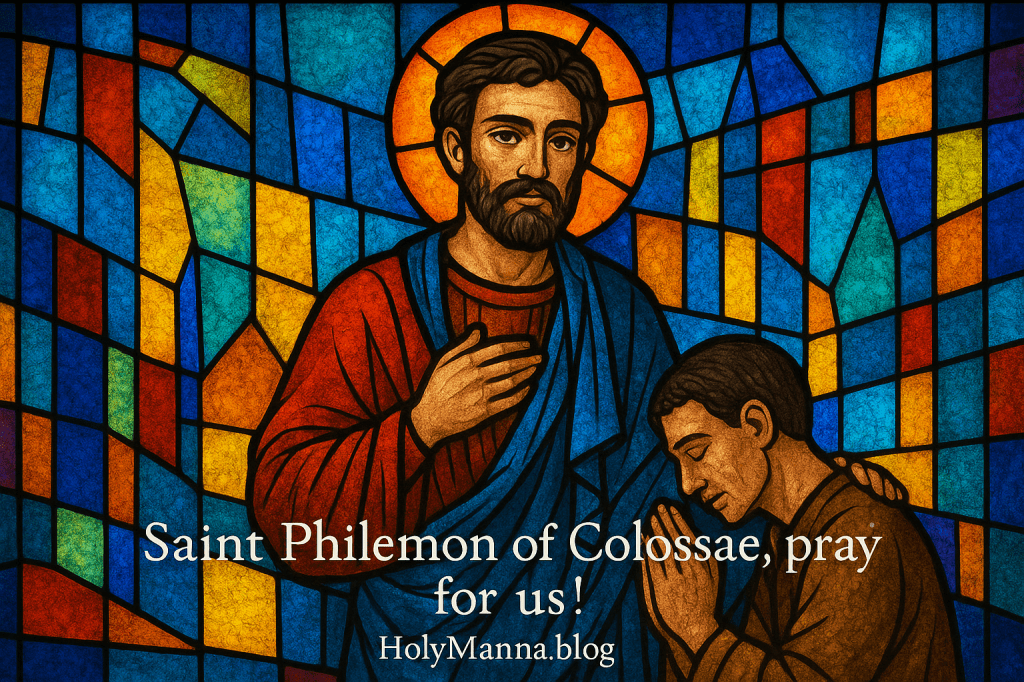
Chains into Brotherhood
Saint Philemon of Colossae is one of those hidden treasures of the New Testament. His life is not told through long narratives or dramatic speeches, but through one short, deeply personal letter that became Scripture: The Letter to Philemon. Through that inspired note, the Church sees a man whose heart was opened by grace to receive a runaway slave as a beloved brother in Christ. Philemon is venerated as a saint and martyr, remembered in both the Eastern and Western Churches, with his feast traditionally celebrated on November 22.
In Philemon, the Church discovers the Gospel at work inside a real household, with real power dynamics, real sin, and real reconciliation. His story opens a window into how the grace of Christ transforms relationships from ownership and fear into forgiveness, communion, and charity.
A Wealthy Master Meets the Gospel
Philemon was a Christian from Colossae, an ancient city in Phrygia, in what is now modern Turkey. He appears in Scripture not as a preacher or writer, but as the recipient of Saint Paul’s shortest letter. That letter addresses him as a “dear friend and fellow worker” (Philemon 1:1), which shows that he was not simply a sympathizer but an active collaborator in the mission of the Gospel.
From the hints in The Letter to Philemon itself and in Colossians, tradition and scholarship agree that Philemon was a man of means. He had a household large enough to include servants or slaves, including Onesimus, and a home big enough to host the local Christian community for worship. The church at Colossae gathered in his house, which means his home was a domestic sanctuary, a place where the Eucharist was celebrated and where the first Christians in that city learned the faith.
At some point, Philemon encountered Saint Paul and received the Gospel through his ministry. The apostle even reminds him in the letter that Philemon owes him his very spiritual life, hinting at his conversion: “you owe me even your own self” (Philemon 19). According to later tradition, Philemon eventually served as a bishop and shepherded the flock, either in Colossae or possibly in Gaza, before giving his life as a martyr under Nero.
So Philemon is remembered above all as a wealthy layman, a house church host, and a spiritual son of Saint Paul whose heart was converted to Christ and opened to radical Christian charity.
A House Church and a Runaway Slave
The most vivid window into Saint Philemon’s life is the little New Testament book that bears his name. In that letter, Paul writes from prison to Philemon, Apphia, Archippus, and “the church in your house” (Philemon 1:2), asking him to receive back Onesimus, the runaway slave, no longer only as a slave but as a brother in Christ.
Onesimus had fled from Philemon, possibly stealing or causing loss, and later encountered Paul, who was under house arrest. Through Paul’s preaching, Onesimus embraced the faith. Paul then sent him back to Philemon carrying this powerful letter of reconciliation.
At the heart of that letter stand some of the most revolutionary words in the New Testament about human relationships in Christ. Paul urges Philemon to receive Onesimus “no longer as a slave but more than a slave, a beloved brother” (Philemon 16). In a world where slavery was woven into the social and economic system, this is not a political manifesto but a deeply Christian reordering of the heart. Philemon is invited to see Onesimus not as property but as family in Christ, equal in dignity before God.
This fits perfectly with what The Catechism of the Catholic Church teaches about human dignity. The Church teaches that all people share the same origin and the same call to eternal beatitude: “all therefore enjoy an equal dignity” (CCC 1934). It also insists that “every form of social or cultural discrimination in fundamental personal rights must be curbed and eradicated as incompatible with God’s design” (CCC 1935). That is exactly the kind of conversion Paul is inviting in Philemon’s heart.
No spectacular physical miracles are recorded in Scripture about Saint Philemon. His “miracle” is the transformation of relationships inside his home, the conversion of his heart from ownership to brotherhood, and the birth of a Christian community under his roof. The letter to him shows a man whose faith is so real that Paul can pressure him, gently but firmly, to live out radical forgiveness in front of the whole church that met in his house.
The Church also sees in Philemon a concrete embodiment of charity. The Catechism describes charity as “the theological virtue by which we love God above all things and our neighbor as ourselves” (CCC 1822). Philemon is remembered and honored precisely because he opened his home, his heart, and even his rights as a master to the transforming demands of this charity.
Faith Under Nero’s Persecution
The New Testament does not tell the end of Philemon’s earthly story, but ancient Christian tradition fills in the outline. According to early sources, Philemon, his wife Apphia, and their companion Archippus were disciples and co-workers of Saint Paul and belonged to that same Christian community in Colossae.
During the persecutions under the Emperor Nero, hostile pagans targeted the Christians of Colossae. The tradition recounts that during a pagan festival, Christians who refused to join in idol worship were seized. Philemon, Apphia, and Archippus suffered torture for their fidelity to Christ. Philemon and Apphia were reportedly buried up to the waist and then stoned to death by an enraged mob.
Philemon is therefore remembered in the Latin tradition as a martyr and in the Eastern tradition as one of the Seventy Apostles, a title that highlights his role as a missionary and a witness to the Resurrection. His martyrdom shows that the charity and forgiveness reflected in Paul’s letter were not sentimental or weak. This was a man who had allowed the Gospel so deeply into his life that he was ready to die for Christ and for the Church that gathered in his home.
Quiet Strength of a Hidden Saint
Unlike more widely known saints, Philemon does not have a long catalog of recorded posthumous miracles in Western devotional literature. The Church still honors him liturgically as a martyr and saint, especially on November 22, often together with Apphia, Archippus, and Onesimus. The East titles him Equal to the Apostles, and the West remembers him as a confessor of charity and reconciliation.
The absence of many miracle stories does not mean a lack of power in his intercession. The Church believes that all saints share in the communion of grace. The Catechism of the Catholic Church teaches very simply: “The communion of saints is the Church.” (CCC 946). It also reminds the faithful that because all are united in Christ as one body, “the good of each is communicated to the others” (CCC 947).
Through this communion, the hidden fidelity of a house church host in Colossae, his costly forgiveness of a runaway slave, and his martyrdom under Nero still strengthen Christians today. Philemon’s quiet but real witness reminds believers that God often works the deepest miracles in the interior conversion of the heart and in the healing of broken relationships.
Learning Forgiveness from Saint Philemon
There is so much in Saint Philemon’s story that speaks directly into the modern world. Power dynamics, injustice, broken relationships, resentment, and wounded trust are everywhere. Into that mess, The Letter to Philemon announces that in Christ everything changes. Masters and slaves, bosses and employees, family members and friends are called into a new kind of relationship as brothers and sisters in the Lord.
The Church teaches that sin damages both communion with God and communion with the Church. The Catechism explains that reconciliation is never just a private feeling. It has a sacramental and communal dimension. Jesus gives the Church the Sacrament of Penance and Reconciliation so that the wound of sin can be healed and communion restored. The Catechism reminds the faithful that Christ instituted this sacrament for those who have fallen after Baptism and that through it, believers receive a new chance to recover grace.
Philemon stands as an early Christian example of what that reconciliation looks like in daily life. Instead of clinging to his rights as a master, he is asked to welcome Onesimus as if he were welcoming Paul himself, to forgive the past, to heal the relationship, and to see his former slave as a brother. That conversion of heart is exactly what charity demands.
The Catechism’s summary of charity fits Philemon’s call perfectly: “Charity is the theological virtue by which we love God above all things and our neighbor as ourselves.” (CCC 1822). Charity does not ignore injustice. It refuses to reduce people to their failures or their social status. It seeks their true good in Christ.
For a Catholic today, Saint Philemon’s life offers some very concrete invitations. Look at the people under one’s authority or in one’s care, and ask whether they are viewed as problems, tools, or genuine brothers and sisters in Christ. Look at people who have hurt or disappointed, and ask whether forgiveness and reconciliation have really been sought, or whether grudges and labels are still clung to in secret. Look at the home and ask whether it has become a kind of domestic church, like Philemon’s house, where Christ is honored and where mercy is practiced in real and costly ways.
Saint Philemon shows that the Gospel is not only about big moments in public life. It is about how grace transforms the living room, the dinner table, the workplace, the way authority is exercised, and the way forgiveness is offered.
Engage with Us!
Readers are invited to share thoughts and reflections in the comments below.
- What part of Saint Philemon’s story speaks most directly to personal experiences with forgiveness and reconciliation?
- Are there Onesimus figures in life right now, people who have hurt or disappointed, whom God might be asking to see again as beloved brothers or sisters in Christ?
- In what ways can a home become more like Philemon’s house church, a place where the Gospel is lived through hospitality, prayer, and mercy in daily routines?
- How does the Church’s teaching on the equal dignity of every person challenge attitudes toward social status, power, race, class, or past sins?
- What practical step can be taken this week to live out charity in a more concrete way, especially toward someone who is difficult to love?
May Jesus Christ, who turned a master and a runaway slave into family, teach every heart to forgive, to reconcile, and to do everything with the love and mercy that the Gospel proclaims.
Saint Philemon of Colossae, pray for us!
Follow us on Instagram and Facebook for more insights and reflections on living a faith-filled life.

 Holy Manna!
Leave a comment