Memorial of Saint Cecilia, Virgin and Martyr – Lectionary: 502
When God’s Justice Seems Slow
There are days when the world feels upside down, when people who ignore God seem to get ahead and those who try to stay faithful feel forgotten. On a day like that, today’s readings and the Memorial of Saint Cecilia quietly ask a hard but hopeful question: What if what looks like defeat in this life is actually the doorway into real victory with God?
In 1 Maccabees 6, the story picks up after years of brutal persecution. King Antiochus IV, the same ruler who had desecrated the Temple and tried to erase Jewish worship, is now far from home, sick in body and crushed in spirit. He hears that the Jews have torn down the abomination he put on the altar and have fortified Jerusalem again. His power is slipping. Lying on his bed, he finally admits his guilt: “I now recall the evils I did in Jerusalem” and recognizes that his suffering is connected to his sin. This is not just political collapse. It is divine justice catching up to a man who mocked the living God.
Psalm 9 feels like the soundtrack that should be playing behind that scene. The psalmist praises God as the One who overturns the plans of the wicked and defends the poor. The enemies who thought they were clever fall into the pit they dug. Their name fades, while the Lord remembers those the world forgets. The psalmist is bold enough to say that “the needy will never be forgotten, nor will the hope of the afflicted ever fade”. That is a huge claim. It only makes sense if God’s justice is bigger than what can be seen in one lifetime.
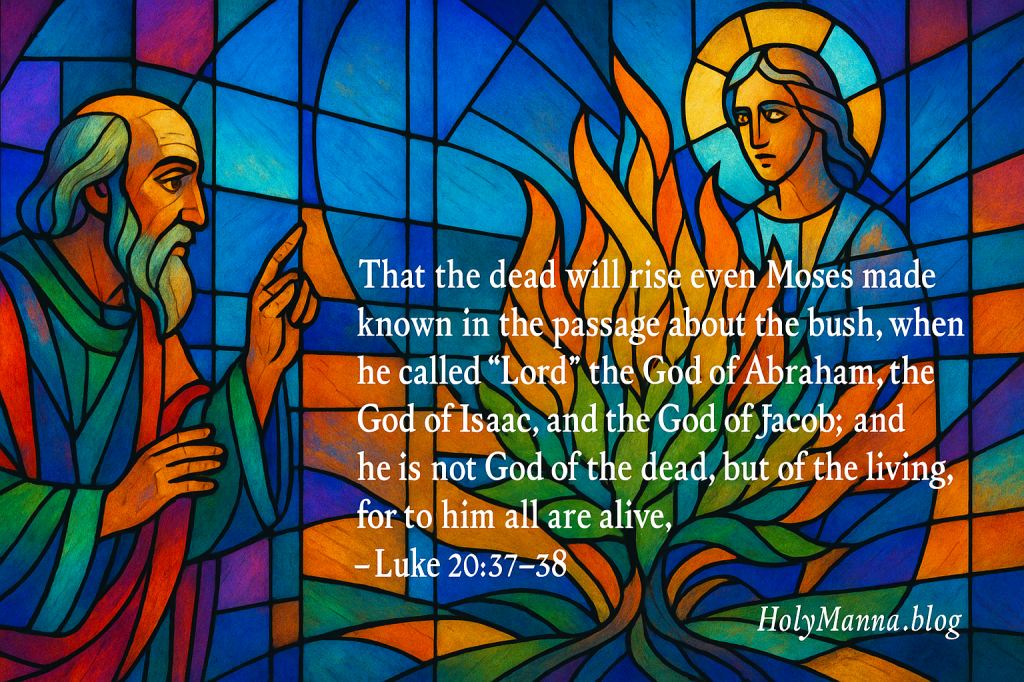
That is exactly where Luke 20:27-40 comes in. The Sadducees show up with a trick question about marriage and the resurrection. They accept only the first five books of the Bible and deny any idea of life after death. Jesus answers by lifting the conversation to a different level. He explains that those who are found worthy of the resurrection are “like angels” and are “children of God” who no longer die. Then He goes back to Exodus and reminds them that Moses calls the Lord “the God of Abraham, the God of Isaac, and the God of Jacob”, and draws the conclusion: “He is not God of the dead, but of the living, for to him all are alive”. The whole logic of divine justice depends on this truth. If there is no resurrection, then so many of God’s faithful ones died cheated. If there is a resurrection, then every hidden act of fidelity will one day be revealed and rewarded.
The Catechism of the Catholic Church teaches that from the beginning, the Christian faith in God has been inseparable from faith in the resurrection of the dead (CCC 988). It also insists that God’s justice and mercy will fully appear at the final judgment, when every secret intention and every hidden sacrifice will be brought to light (CCC 1038-1041). In other words, the Church is very clear that this life is not the full story. That is what gives courage to saints and martyrs in every age.
All of this lands beautifully on the Memorial of Saint Cecilia. Cecilia was a young Roman woman in the early centuries of the Church, living in a culture that glorified power, pleasure, and status. She consecrated her virginity to Christ, endured persecution, and suffered martyrdom for the faith. Tradition remembers her as singing to God in her heart even while facing death. Outwardly, she lost everything. In the light of Luke 20, though, she is very much alive before the face of God, a true daughter of the resurrection. Her story is a living commentary on today’s readings.
So the central thread running through this day is clear. God’s justice may look delayed, but it is never absent. Earthly empires fall, enemies trip into their own traps, and proud rulers end up on sickbeds haunted by their sins. Meanwhile, the poor, the afflicted, the faithful, and the martyrs are being prepared for a life where death cannot touch them anymore. Where in life does it feel like God is slow to act, and how might today’s readings be inviting a view of that situation through the lens of the resurrection and eternal life with Him?
First Reading – 1 Maccabees 6:1-13
When Earthly Power Crashes Into God’s Justice
This reading drops into the later stage of the Maccabean crisis, when the Jewish people have been brutally persecuted by King Antiochus IV Epiphanes, the Seleucid ruler who desecrated the Temple in Jerusalem and tried to erase faithful worship of the God of Israel. The books of Maccabees record the heroic resistance of faithful Jews who refused to abandon the covenant, even when threatened with torture and death. Antiochus is the same king who ordered pagan altars to be set up, sacrifices to false gods to be offered, and the Temple itself to be profaned. His name had become a symbol of arrogant power that tries to crush God’s people and rewrite God’s law.
By the time this passage in 1 Maccabees 6 opens, the tide has turned. The Maccabean revolt has gained strength. Jerusalem has begun to be restored. The “abomination” on the altar has been torn down. While Antiochus is away trying to plunder yet another wealthy city in Persia, he receives the news that his plans in Judah have failed. What follows is not just a political setback. It is the spiritual unraveling of a man who suddenly realizes that he has fought against the living God.
This scene fits perfectly into today’s theme of God’s ultimate justice and the hope that the afflicted are never forgotten. Antiochus, who once seemed untouchable, now lies on a bed of grief in a foreign land, confessing that his suffering is connected to the evils he committed in Jerusalem. It is a sobering reminder that every human life, no matter how powerful, will one day stand under God’s judgment. At the same time, it is a hidden consolation for the faithful, like Saint Cecilia, who may look defeated in this world but are remembered and vindicated before God.
1 Maccabees 6:1-13
New American Bible (Revised Edition)
1 As King Antiochus passed through the eastern provinces, he heard that in Persia there was a city, Elam, famous for its wealth in silver and gold, 2 and that its temple was very rich, containing gold helmets, breastplates, and weapons left there by the first king of the Greeks, Alexander, son of Philip, king of Macedon. 3 He went therefore and tried to capture and loot the city. But he could not do so, because his plan became known to the people of the city 4 who rose up in battle against him. So he fled and in great dismay withdrew from there to return to Babylon.
5 While he was in Persia, a messenger brought him news that the armies that had gone into the land of Judah had been routed; 6 that Lysias had gone at first with a strong army and been driven back; that the people of Judah had grown strong by reason of the arms, wealth, and abundant spoils taken from the armies they had cut down; 7 that they had pulled down the abomination which he had built upon the altar in Jerusalem; and that they had surrounded with high walls both the sanctuary, as it had been before, and his city of Beth-zur.
8 When the king heard this news, he was astonished and very much shaken. Sick with grief because his designs had failed, he took to his bed. 9 There he remained many days, assailed by waves of grief, for he thought he was going to die. 10 So he called in all his Friends and said to them: “Sleep has departed from my eyes, and my heart sinks from anxiety. 11 I said to myself: ‘Into what tribulation have I come, and in what floods of sorrow am I now! Yet I was kindly and beloved in my rule.’ 12 But I now recall the evils I did in Jerusalem, when I carried away all the vessels of silver and gold that were in it, and for no cause gave orders that the inhabitants of Judah be destroyed. 13 I know that this is why these evils have overtaken me; and now I am dying, in bitter grief, in a foreign land.”
Detailed Exegesis: A Proud King Faces The Truth
Verse 1: “As King Antiochus passed through the eastern provinces, he heard that in Persia there was a city, Elam, famous for its wealth in silver and gold,”
This verse sets the stage by showing Antiochus in motion, still acting like a conquering king. His focus is on wealth, especially silver and gold. The mention of Elam, a rich city in Persia, highlights his greed and his constant search for more to seize. Spiritually, this portrays a heart that never rests in God but always craves more possessions and control. The contrast with the poor and afflicted faithful in Judah is stark. They are fighting to preserve worship, while he is hunting for treasure.
Verse 2: “and that its temple was very rich, containing gold helmets, breastplates, and weapons left there by the first king of the Greeks, Alexander, son of Philip, king of Macedon.”
Here the text points out not just wealth but sacred wealth tied to a temple and to the legacy of Alexander the Great. These objects are both religious and historical trophies. Antiochus sees a temple and thinks of loot, not worship. The verse hints at a clash between the true God and the false gods or worldly powers whose treasures fill these temples. Antiochus treats what is sacred as something to be exploited, which foreshadows his earlier desecration of the Temple in Jerusalem.
Verse 3: “He went therefore and tried to capture and loot the city. But he could not do so, because his plan became known to the people of the city”
This verse shows that his usual strategy of surprise and domination fails. The people learn of his plan and resist effectively. For someone like Antiochus, who is used to success, this first “no” from reality is important. It is the beginning of God’s “no” to his unchecked ambition. The text quietly reminds that even powerful rulers are not invincible when God raises up resistance.
Verse 4: “who rose up in battle against him. So he fled and in great dismay withdrew from there to return to Babylon.”
Antiochus, who once made others flee, now flees himself. The verbs are simple but devastating. Instead of marching home victorious, he withdraws in “great dismay.” The mighty oppressor experiences fear and confusion. Babylon, the city that often symbolizes human pride and rebellion against God, becomes the place where he retreats to face his collapse.
Verse 5: “While he was in Persia, a messenger brought him news that the armies that had gone into the land of Judah had been routed;”
In biblical narratives, messengers often carry turning points. This message is not about small losses but about a decisive defeat. The armies in Judah, who had once terrorized God’s people, have been routed. God’s hidden work among the faithful, through the courage of the Maccabean fighters, now breaks into the consciousness of the king. The news hits him in a foreign land, far from the place where his sins were committed, showing that no distance can shield a person from the consequences of actions before God.
Verse 6: “that Lysias had gone at first with a strong army and been driven back; that the people of Judah had grown strong by reason of the arms, wealth, and abundant spoils taken from the armies they had cut down;”
Lysias, his trusted general, had gone with a “strong army” and still failed. The Jews, whom Antiochus once considered weak and easy to crush, have “grown strong.” They have taken arms and wealth from the very armies that tried to destroy them. This reversal is classic biblical justice. Those who were oppressed are now strengthened, not by their own glory, but by God’s providence turning the enemy’s weapons into their protection.
Verse 7: “that they had pulled down the abomination which he had built upon the altar in Jerusalem; and that they had surrounded with high walls both the sanctuary, as it had been before, and his city of Beth-zur.”
This verse goes straight to the spiritual heart of the conflict. The “abomination” on the altar, likely a pagan altar or idol set up in the Temple, has been torn down. The sanctuary has been protected again with strong walls. This is not merely a military setback. It is a humiliation of Antiochus’s attempt to replace the worship of the true God. The city of Beth-zur, which had strategic importance in the defense of Judah, is fortified. The people are not just surviving. They are restoring what is holy. God’s dwelling place is being honored again, which signals that God’s honor is being publicly restored.
Verse 8: “When the king heard this news, he was astonished and very much shaken. Sick with grief because his designs had failed, he took to his bed.”
The emotional collapse of Antiochus begins here. He is “astonished and very much shaken,” moved from confidence to inner trembling. His grief is not only physical. It is spiritual and psychological. His “designs” have failed, which means his plans to control God’s people and God’s Temple have been overturned. He responds not with repentance at first, but with despair. He takes to his bed like someone whose identity has been shattered.
Verse 9: “There he remained many days, assailed by waves of grief, for he thought he was going to die.”
The text lingers on his suffering. He does not simply die quickly. He is “assailed by waves of grief,” an image of spiritual torment. He senses death approaching, which often strips human pride. The one who caused so many deaths now contemplates his own. This time of lying on the bed becomes, in a way, his forced retreat, where God’s justice and his conscience finally take center stage.
Verse 10: “So he called in all his Friends and said to them: ‘Sleep has departed from my eyes, and my heart sinks from anxiety.’”
Antiochus turns to his inner circle, the “Friends” of the king, a formal title for close advisers and nobles. He admits that he cannot sleep and that his heart is overcome with anxiety. This is the language of someone whose conscience is no longer numb. Power, wealth, and status cannot give peace. This verse is a powerful psychological portrait of a sinner who is finally disturbed by his own past.
Verse 11: “‘I said to myself: Into what tribulation have I come, and in what floods of sorrow am I now! Yet I was kindly and beloved in my rule.’”
He recognizes that he is in “tribulation” and “floods of sorrow.” However, he tries to comfort himself by remembering that he was “kindly and beloved” in his rule. This mixture of self pity and partial self knowledge shows how hard it is for a proud person to see clearly. There may have been moments of kindness, but they do not erase the brutal persecution he inflicted. The verse exposes the way sinners often see only part of their story until grace pushes them to deeper honesty.
Verse 12: “‘But I now recall the evils I did in Jerusalem, when I carried away all the vessels of silver and gold that were in it, and for no cause gave orders that the inhabitants of Judah be destroyed.’”
Here the real breakthrough happens. He admits “the evils I did in Jerusalem.” He remembers how he plundered the holy vessels of the Temple and ordered the destruction of the people “for no cause.” This is more than regret over failed policy. It is an admission of moral guilt. He finally names his actions as “evils.” This verse shows that even a hardened oppressor can be brought to an awareness of sin. Yet the timing matters. His conversion comes late, on the edge of death, after massive damage has been done.
Verse 13: “‘I know that this is why these evils have overtaken me; and now I am dying, in bitter grief, in a foreign land.’”
Antiochus explicitly connects his suffering with his sins. “I know that this is why these evils have overtaken me” is a confession of divine justice. He recognizes that his death in a foreign land, separated from home and security, is part of the consequences of his choices. The “bitter grief” he feels is the taste of a life spent fighting against God. The verse is tragic, but it also proves the truth that no injustice escapes God’s gaze. Even kings must face what they have done.
Teachings: Divine Justice, Human Responsibility, And Hope
This passage shows a ruler learning, too late, that God is not mocked. Antiochus thought he could desecrate the Temple, destroy God’s people, and build a world on his own terms. His inner collapse on a foreign bed is a lived commentary on the biblical truth that God’s justice is real and that sin carries consequences.
The Catechism of the Catholic Church affirms that God’s justice and mercy are not abstract ideas but realities that will be fully revealed in the final judgment. CCC 1038 teaches: “The resurrection of all the dead, of both the just and the unjust, will precede the Last Judgment.” That means every Antiochus like figure, and every hidden martyr or faithful believer, will one day stand before Christ in truth. There is no such thing as a sin that vanishes simply because history moves on.
At the same time, the Church insists that the resurrection and judgment are part of the core of Christian faith. CCC 988 states: “The resurrection of the dead is one of the essential elements of the Christian faith.” Without this, stories like Antiochus’s would only be lessons in temporary payback. With the resurrection, they become warnings and invitations. Warnings, because those who oppress and desecrate what is holy will meet the God they opposed. Invitations, because even in late repentance there is a call to turn back while there is still time.
The Catechism also explains why God permits evil and apparent victories of the wicked. CCC 412, reflecting on sin and redemption, teaches: “God permits evil in order to draw forth some greater good.” In the Maccabean crisis, the persecution of Antiochus forced Israel to choose between compromise and faithful courage. The suffering purified many hearts, produced martyrs, and led to a renewed dedication to the covenant and the Temple. In God’s providence, the evil that Antiochus unleashed did not have the last word.
Saint Augustine famously reflects on God’s sovereignty over evil in the Enchiridion when he writes: “For the good God would never permit evil, if He could not bring good out of evil.” Antiochus’s wickedness did real damage, but God brought out of it the strengthened faith of the Maccabees, the restoration of the Temple, and a powerful witness to divine justice that still speaks today.
In the larger biblical story, the humiliation of tyrants like Antiochus points forward to the ultimate victory of Christ. Jesus, in today’s Gospel of Luke 20:27-40, reveals that God is “not God of the dead, but of the living” and that those found worthy of the resurrection are “children of God.” The fall of Antiochus is an early sign that no human empire can erase the people of the resurrection. The martyrs, like Saint Cecilia, stand in direct contrast to Antiochus. They lose everything externally but gain eternal life with the God of the living.
This reading also highlights human responsibility. Antiochus knows that his suffering is not random. He says clearly: “I know that this is why these evils have overtaken me.” There is no blaming of fate or of others. The Catechism teaches that human beings are truly free and accountable. CCC 1731 describes freedom as the power to act or not act, and CCC 1734 explains that “Freedom makes man responsible for his acts to the extent that they are voluntary.” Antiochus’s confession is a tragic proof of that teaching. He used his freedom to persecute God’s people, and now he faces the consequences.
Reflection: Let God Interrupt The Illusion Of Control
This reading is not just an old story about a bad king. It is a mirror held up to any heart that tries to build life on power, control, or self glorification while pushing God to the side. Antiochus represents the part of the human heart that thinks it can desecrate what is holy with no real fallout, that believes success and strength are signs of being untouchable.
In daily life, that attitude can look subtle. It might show up as a habit of treating people as tools rather than gifts, bending moral lines to get ahead, or ignoring God’s law in areas like sexuality, money, or honesty because there seem to be no immediate consequences. Over time, that path leads to a kind of inner exile. Sleep becomes restless. Anxiety grows. The soul feels far from home.
One of the graces in this passage is that Antiochus eventually connects his suffering with his sin. That does not make him a hero, but it does show what honest examination of conscience looks like. A good step in spiritual life is to regularly ask: Where might present restlessness or grief be linked to choices that have pushed God’s law aside? That question is not meant to crush the heart but to open it to conversion.
In practical terms, this reading suggests a few concrete moves. First, it encourages frequent examination of conscience, not only before confession, but as a normal part of the day. Instead of waiting until life collapses, the wise disciple lets God’s word shine its light on attitudes and patterns early. Second, it invites a deep respect for what is holy. The Temple for the Jews was the dwelling place of God’s presence. Today, the Church teaches that the bodies of believers are temples of the Holy Spirit and that the Eucharist is the real presence of Christ. To treat these realities casually or to use them for personal advantage risks falling into the same contempt Antiochus showed, even if on a smaller scale.
Finally, this passage offers comfort to those who have suffered under injustice or persecution. The downfall of Antiochus reassures that no abuser of power, no matter how confident or protected, is beyond the reach of God’s justice. Are there situations in life where it feels like those who hurt others have escaped consequences, and how might this reading strengthen trust that God sees and will act in His time?
The contrast between Antiochus and a martyr like Saint Cecilia is striking. He dies in bitter grief in a foreign land, haunted by his own crimes. She dies in fidelity, singing to God in her heart, fully at home in the love of Christ. Which direction do the current choices of daily life point toward, and what would it look like today to step more clearly onto the path of humble obedience and trust in the God of the living?
Responsorial Psalm – Psalm 9:2-4, 6, 16, 19
The God Who Sees The Forgotten And Trips The Proud
This section of Psalm 9 comes from a song of praise where Israel celebrates God as a just judge who defends the oppressed and brings down arrogant nations. In a world where powerful rulers like Antiochus in 1 Maccabees 6 seem unstoppable, Psalm 9 steps in as a faith filled protest against appearances. It insists that God does not ignore evil, that the wicked are not as secure as they think, and that the poor are never invisible to Him.
In the liturgy today, this psalm answers the fall of King Antiochus with a deeper spiritual explanation. While 1 Maccabees shows his collapse on a human level, Psalm 9 sings about the God who stands behind history, letting the nations fall into the very traps they set. At the same time, it gives voice to the quiet confidence of those who suffer. The psalmist declares that the hope of the afflicted does not fade before God, even when the world shrugs them off.
This fits beautifully with the Memorial of Saint Cecilia. She was outwardly weak in the eyes of Rome, just another young woman with no political power. Yet she staked everything on the God described in Psalm 9 and now lives as a daughter of the resurrection, remembered and honored by the Church. The same God who overturned Antiochus and upheld the Maccabees is the One before whom Cecilia sang in her heart.
Psalm 9:2-4, 6, 16, 19
New American Bible (Revised Edition)
2 I will praise you, Lord, with all my heart;
I will declare all your wondrous deeds.
3 I will delight and rejoice in you;
I will sing hymns to your name, Most High.
4 When my enemies turn back,
they stumble and perish before you.
6 You rebuked the nations, you destroyed the wicked;
their name you blotted out for all time.
16 The nations fall into the pit they dig;
in the snare they hide, their own foot is caught.
19 For the needy will never be forgotten,
nor will the hope of the afflicted ever fade.
Detailed Exegesis: The Praise, The Pit, And The Promise
Verse 2: “I will praise you, Lord, with all my heart; I will declare all your wondrous deeds.”
The psalm begins with a full hearted decision. The psalmist chooses to praise the Lord with the whole heart, not half interested, not distracted. This is important in times of injustice. Praise here is not naïve optimism. It is a deliberate act of trust in God’s character. The commitment to “declare all your wondrous deeds” means remembering and speaking about the times God has already acted in history. For Israel, that meant the Exodus, the covenant, and many victories against enemies. In the context of today’s readings, it includes God’s protection of the faithful in the Maccabean revolt and His vindication of martyrs like Saint Cecilia. The verse invites believers to fight discouragement by rehearsing God’s past faithfulness.
Verse 3: “I will delight and rejoice in you; I will sing hymns to your name, Most High.”
Here, the joy of the psalmist is centered on God Himself, not on circumstances. To “delight and rejoice in you” is to anchor happiness in who God is rather than in whether enemies seem to be winning or losing at the moment. Calling God “Most High” recognizes His absolute authority over all earthly powers. Even when rulers like Antiochus appear to dominate, God is still higher. Singing hymns to His name is a form of spiritual resistance. It proclaims that no empire, no persecution, and no suffering can dethrone the Lord. The Church carries this spirit into the liturgy, where believers sing even in times of trial, echoing martyrs who praised God in prisons and arenas.
Verse 4: “When my enemies turn back, they stumble and perish before you.”
This verse shifts from praise to a memory of God’s past interventions. The psalmist has seen enemies “turn back” and stumble, not because of clever strategy but “before you.” The real battlefield is spiritual. It is God who stands before the enemies of His people and brings their plans to ruin. In light of 1 Maccabees 6, this line sounds like a commentary on Antiochus’s experience. He hears of his armies routed, his abomination torn down, and his enemies, the Jews, growing strong. The stumble and fall of worldly power is not random. It happens in the presence of God, who defends His covenant. For the Christian, this verse also points to the ultimate fall of the last enemy, death, conquered by Christ in the resurrection.
Verse 6: “You rebuked the nations, you destroyed the wicked; their name you blotted out for all time.”
The language here is strong and sobering. God does not simply advise the nations. He rebukes them. When collective sin reaches a certain level, when societies embrace violence, idolatry, and oppression, God’s justice responds. “You destroyed the wicked” does not primarily mean that God enjoys punishment. It means that He takes evil seriously and protects the innocent. The line “their name you blotted out for all time” speaks of the disappearance of their legacy. History remembers many powerful people only as cautionary tales. Antiochus thought his name would shine as a great king. Instead, his memory is tied to defeat, desecration, and remorse. In contrast, saints like Cecilia, who seemed insignificant, have their names honored for centuries.
Verse 16: “The nations fall into the pit they dig; in the snare they hide, their own foot is caught.”
This verse is one of the clearest statements of biblical poetic justice. The image is vivid. The nations dig a pit for others, but end up falling into it themselves. They set a hidden snare, but their own feet get trapped. This is not superstition. It is a spiritual law that pride and malice carry within themselves the seeds of collapse. When individuals or societies plot against God’s ways, they set up systems of injustice that eventually backfire. Antiochus built a system of persecution that hardened resistance among the Jews and led to his own downfall. In a deeper sense, the cross of Christ shows the ultimate form of this pattern. Those who condemned Jesus thought they were silencing Him. Instead, the very cross became the instrument of salvation and the exposure of sin.
Verse 19: “For the needy will never be forgotten, nor will the hope of the afflicted ever fade.”
This final verse is the beating heart of the psalm in today’s context. It declares that the needy are not abandoned and that the hope of the afflicted does not evaporate in God’s sight. On earth, the poor and persecuted are often treated as disposable. Their cries get ignored. Their stories are overlooked. This verse insists that God’s memory works differently. He carries the pain of the suffering into His heart and into eternity. Martyrs like Saint Cecilia looked like total failures to the Roman authorities. Yet in heaven, their hope has not faded. They live in the presence of God, and their witness continues to strengthen the Church. This line is a promise that every hidden tear and every quiet act of fidelity will be remembered and redeemed.
Teachings: The Psalms, God’s Justice, And The Hope Of The Poor
The Church has always seen the Psalms as the voice of Christ and His Body, the Church, praying to the Father. The Catechism of the Catholic Church says in CCC 2586: “The Psalms constitute the masterwork of prayer in the Old Testament.” They teach believers how to speak to God from the depths of the heart, especially in times of injustice and suffering. When the Church prays Psalm 9 today, it is not just remembering Israel’s past. It is letting Christ Himself, who suffered unjustly and rose in glory, pray within the hearts of the faithful.
This psalm also connects with the Church’s teaching on God’s justice and the final judgment. CCC 1039 describes the last judgment in striking terms: “In the presence of Christ, who is Truth itself, the truth of each man’s relationship with God will be laid bare.” That future moment is the ultimate fulfillment of what Psalm 9 proclaims. The nations that plotted against God and trampled on the poor will see how their pits were truly dug beneath their own feet. At the same time, the needy and afflicted who trusted in the Lord will see that they were never forgotten.
The Church has a special love for the poor because God reveals His heart in passages like this. CCC 2448 teaches: “In its various forms, material deprivation, unjust oppression, physical and psychological illness and death, human misery in general, is the obvious sign of the inherited condition of frailty and need for salvation in which man finds himself as a consequence of original sin.” The psalm speaks directly into that reality. It does not pretend that the poor are fine on their own. It names their affliction and insists that God remembers them and will act for them.
Saint Augustine often reflected on the Psalms as the voice of the whole Christ, Head and members. Commenting on similar themes, he explains that when the poor cry out in the Psalms, Christ cries in them. Augustine writes: “Our Lord Jesus Christ, the Son of God, is he who prays for us, who prays in us, and who is prayed to by us.” That means the promise that “the needy will never be forgotten” is rooted in Christ Himself, who became poor for our sake and now intercedes for all who suffer.
The psalm’s confidence that the wicked fall into their own traps also echoes the Church’s understanding of sin. CCC 1861 notes the gravity of mortal sin, stating: “Mortal sin results in the loss of charity and the privation of sanctifying grace, that is, of the state of grace.” Sin carries its own inner destruction. It digs a pit in the soul. When Psalm 9 says that the nations fall into the pit they dig, it is expressing in poetic form what the Catechism teaches in doctrinal language. Turning away from God is not just breaking a rule. It is stepping toward a snare that ultimately catches the sinner.
Seen together with 1 Maccabees 6 and Luke 20:27-40, this psalm becomes a bridge. It stands between the collapse of Antiochus and the promise of resurrection. It tells believers that history is not random, that God is working through time to bring justice, and that the final word belongs to the God of the living.
Reflection: Learning To Sing Justice While Waiting
This psalm has a way of reading the heart. Many people carry quiet questions about injustice. Corrupt people seem to get promoted. Those who bend the rules appear rewarded. The poor, the faithful, the ones who try to stay honest, can feel sidelined. Psalm 9 does not deny those realities. Instead, it teaches how to live in them without losing hope.
The first step is to imitate the psalmist’s choice to praise God “with all my heart.” That means making time to remember and thank God for His past faithfulness, both in Scripture and in personal life. Gratitude is not escapism. It is spiritual training. It strengthens trust that the same God who acted before will act again. Setting aside even a few minutes each day to recall and thank God for specific “wondrous deeds” can shift the heart from anxiety to confidence.
The next step is to internalize the truth that God’s justice often moves quietly and slowly from the human point of view. The line about enemies falling into the pit they dig encourages patience. It suggests that evil is not as solid as it looks. It carries its own self destruction. This can help believers resist the temptation to envy the wicked or to imitate their methods. Are there situations in life where it feels tempting to compromise God’s law in order to avoid being overlooked or oppressed, and how might this psalm invite a deeper trust in God’s timing instead?
The final step is to stand with the “needy” and “afflicted” in a very concrete way. If God never forgets them, then neither should the Church. That can look like paying attention to the lonely person at work, visiting someone who is sick, giving generously to those in material need, or listening with patience to someone who feels ignored. When believers move toward the afflicted, they step into the heart of this psalm and reflect God’s own remembrance.
Saint Cecilia models the spirit of Psalm 9. She praised God with her whole heart in a hostile culture. She trusted that her hope would not fade, even as she faced death. Her life is proof that God truly is “Most High,” that the seemingly small and forgotten are precious to Him, and that the God of justice is also the God of resurrection. Where might God be asking for a choice today to praise, to trust, and to stand with the forgotten, in quiet confidence that He will not let their hope fade?
Holy Gospel – Luke 20:27-40
Children Of The Resurrection And The God Of The Living
This Gospel scene unfolds in Jerusalem late in Jesus’ public ministry, when several groups are lining up to test and trap Him. The Sadducees appear here as one of those groups. They were a powerful religious and political elite tied closely to the Temple and the priestly class. Unlike the Pharisees, they accepted only the first five books of Scripture as fully authoritative and denied the resurrection of the dead, the existence of angels as personal beings, and much of what later Judaism believed about life after death. That background is essential, because their question is not a sincere search for truth. It is a staged riddle designed to make the resurrection look ridiculous.
They base their trap on the law of levirate marriage from Deuteronomy 25:5, where Moses commands that if a man dies childless, his brother should marry the widow in order to raise up descendants for the deceased brother. This law protected the family line and the woman’s security. The Sadducees stretch this law into an extreme hypothetical. Seven brothers all marry the same woman in succession, all die childless, and then the woman dies. Then they ask whose wife she will be in the resurrection. On the surface it is clever. Underneath it reveals a complete misunderstanding of what risen life with God actually is.
Jesus does not just win the argument. He reveals something precious about the destiny of those who belong to Him. He explains that the children of “this age” live in a world marked by death, so marriage and family lines matter in a particular way. In the “coming age” and the resurrection, those who are deemed worthy are no longer subject to death and live like the angels, as children of God. Then, because the Sadducees accept Moses, He takes them back to the burning bush scene in Exodus, where God calls Himself the God of Abraham, Isaac, and Jacob. Jesus draws the conclusion that if God calls Himself their God, then they must be alive to Him. “He is not God of the dead, but of the living, for to him all are alive.”
Within today’s theme, this Gospel is the crown. 1 Maccabees 6 shows a tyrant crashing into God’s justice. Psalm 9 sings of a God who remembers the afflicted. Luke 20 explains why that hope is not wishful thinking. There is a resurrection. There is a coming age. There are children of God who will live beyond death in a way that fulfills and surpasses anything known now. Saint Cecilia belongs in that company. She chose Christ in a culture that offered her comfort, status, and compromise. Outwardly she lost everything. In the light of this Gospel, she stands as a daughter of the resurrection, fully alive before the God of the living.
Luke 20:27-40
New American Bible (Revised Edition)
27 Some Sadducees, those who deny that there is a resurrection, came forward and put this question to him, 28 saying, “Teacher, Moses wrote for us, ‘If someone’s brother dies leaving a wife but no child, his brother must take the wife and raise up descendants for his brother.’ 29 Now there were seven brothers; the first married a woman but died childless. 30 Then the second 31 and the third married her, and likewise all the seven died childless. 32 Finally the woman also died. 33 Now at the resurrection whose wife will that woman be? For all seven had been married to her.” 34 Jesus said to them, “The children of this age marry and are given in marriage; 35 but those who are deemed worthy to attain to the coming age and to the resurrection of the dead neither marry nor are given in marriage. 36 They can no longer die, for they are like angels; and they are the children of God because they are the ones who will rise. 37 That the dead will rise even Moses made known in the passage about the bush, when he called ‘Lord’ the God of Abraham, the God of Isaac, and the God of Jacob; 38 and he is not God of the dead, but of the living, for to him all are alive.” 39 Some of the scribes said in reply, “Teacher, you have answered well.” 40 And they no longer dared to ask him anything.
Detailed Exegesis: Jesus Answers Death With Resurrection
Verse 27: “Some Sadducees, those who deny that there is a resurrection, came forward and put this question to him,”
This opening line sets the tension. The Sadducees are defined by their denial of the resurrection. Their identity is tied to a limited reading of Scripture and a worldview that does not see beyond this life. The fact that they “put this question” to Jesus signals that they are testing Him rather than seeking conversion. The conflict is not just about a point of doctrine. It is about whether God’s justice extends beyond the grave or is confined to the here and now.
Verse 28: “saying, ‘Teacher, Moses wrote for us, If someone’s brother dies leaving a wife but no child, his brother must take the wife and raise up descendants for his brother.’”
They begin respectfully with “Teacher” and then appeal to Moses, since they accept the books of Moses as authoritative. They quote the law of levirate marriage, which had a real purpose in Israel’s life. It protected widows and preserved family lines. The law was not a loophole for strange hypotheticals. It was an expression of covenant solidarity. The Sadducees, however, treat it as raw material for a puzzle. They use the law not to love but to argue. That habit can still tempt religious hearts, to treat God’s word as a debating tool instead of a path to life.
Verse 29: “Now there were seven brothers; the first married a woman but died childless.”
The scenario starts in a plausible way. A husband dies childless, which activates the levirate law. The mention of “childless” is key. In that culture, childlessness meant the family line ended, and it could be seen as a heavy misfortune. The Sadducees lean on that fear and anxiety as they build their case.
Verse 30: _“Then the second” and Verse 31: “and the third married her, and likewise all the seven died childless.”
Their story snowballs into something absurd. One brother after another marries the same woman and dies childless. The repetition emphasizes how exaggerated the scenario is. That is part of their strategy. If the resurrection is imagined as nothing more than the continuation of earthly conditions, then certain laws and situations become impossible to resolve. The Sadducees think this proves the resurrection cannot be real. In reality, it proves that their imagination of resurrection life is too small.
Verse 32: “Finally the woman also died.”
This short line closes their story. Everyone is dead. For a group that denies resurrection, this is the end. The scene is almost darkly comic. Seven men and one woman, all gone. No children, no resolution. Humanly speaking, it looks like a story of total failure and frustration. That hopeless feeling mirrors what life looks like if there is no resurrection, if everything ends in the grave.
Verse 33: “Now at the resurrection whose wife will that woman be? For all seven had been married to her.”
Here comes the punchline. They assume the resurrection, if it existed, would simply restart earthly status arrangements in a different location. Marriage would function the same way, with the same legal claims and emotional dynamics. The question is framed to make the idea of resurrection look chaotic and unjust. In the Sadducees’ logic, God would be trapped in a messy situation with competing claims. Their fundamental mistake is to imagine the coming age as nothing more than this age with more time and less decay.
Verse 34: “Jesus said to them, ‘The children of this age marry and are given in marriage;’”
Jesus begins His reply by making a distinction between “this age” and the coming age. In this age, marriage is part of God’s good plan. It images God’s covenant love, provides a context for children, and offers companionship in a world marked by death and vulnerability. Marriage belongs deeply to this present order. Jesus does not belittle it. He simply situates it. The phrase “children of this age” also hints that some people live with their hearts anchored only in this passing order, without reference to the age to come.
Verse 35: “‘but those who are deemed worthy to attain to the coming age and to the resurrection of the dead neither marry nor are given in marriage.’”
This verse is loaded. First, there is the phrase “deemed worthy.” Resurrection glory is not automatic. It is gift and judgment at once. Those who receive it have responded to grace with faith and obedience. Second, Jesus reveals that in the coming age, the structure of marriage as known now no longer applies. Those who rise in glory neither enter marriage nor are given in marriage. This does not diminish the love shared on earth. Instead, it means that all human loves find their fulfillment in the direct union with God that heaven offers. There is no fear of death, no need to pass on life through children, no vulnerability that calls for the protection of marriage. The order of love is fulfilled and transformed.
Verse 36: “‘They can no longer die, for they are like angels; and they are the children of God because they are the ones who will rise.’”
Here Jesus explains why the pattern changes. The risen no longer die. Death is the main reason marriage and family lines matter in their current form. Once death is defeated, the dynamics shift. To be “like angels” does not mean becoming angels or losing bodies. It means sharing in the angels’ deathless life and total orientation toward God. The central identity of the risen is “children of God.” Their deepest truth is not spouse, parent, citizen, or role. It is beloved son or daughter of the Father. This verse pulls back the veil on what Saint Cecilia and all the saints already live. They can no longer die. Their whole being is centered on God in a way that does not erase their story but transfigures it.
Verse 37: “‘That the dead will rise even Moses made known in the passage about the bush, when he called Lord the God of Abraham, the God of Isaac, and the God of Jacob;’”
Jesus now meets the Sadducees on their own ground. They accept Moses, so He goes straight to Exodus 3, the burning bush. There, God reveals His name to Moses and identifies Himself as the God of the patriarchs. Jesus points out that in that scene God speaks in the present tense. He is, not was, the God of Abraham, Isaac, and Jacob. Jesus reads Scripture with deep attention to those details. The implication is that those patriarchs are alive to God, even if dead in earthly terms. Moses himself, whom the Sadducees claim to follow, bears witness to the resurrection in seed form.
Verse 38: “‘and he is not God of the dead, but of the living, for to him all are alive.’”
This is one of the most powerful lines in the Gospels. Jesus draws out the full meaning of God’s self revelation. If God is truly God, then He cannot be God of corpses and extinguished souls. He is God of the living. For Him all are alive. That does not erase the reality of physical death, but it shows that those who belong to Him are held in His life. For the disciple, this changes everything about how death is viewed. Believers do not clutch at this life as if it were all there is. They live as people destined for a deep, indestructible communion with the Father. This is the verse that gives ultimate meaning to the stories of martyrs like Cecilia. Even when the world silences their voice, they continue to live and praise God in His presence.
Verse 39: “Some of the scribes said in reply, ‘Teacher, you have answered well.’”
The scribes, usually on the opposite side from Jesus in other debates, now recognize the force and clarity of His answer. They may disagree with the Sadducees on resurrection, so they are pleased to see Jesus demonstrate the doctrine using Moses. Their comment, “you have answered well,” is a public acknowledgment that Jesus has not been trapped. Instead, He has turned the trick question into a moment of revelation.
Verse 40: “And they no longer dared to ask him anything.”
The final line shows that something has shifted. The opponents run out of clever questions. Not because Jesus has humiliated them with sarcasm, but because His answers expose their shallow thinking and force a choice. Either accept His authority and adjust life to the truth He reveals, or quietly back away. The silence that follows is heavy. It points forward to the cross, where Jesus will embody His own teaching on death and resurrection. Those who refuse to question Him any further will soon seek to kill Him. He will pass through death and prove in His own body that God truly is the God of the living.
Teachings: Resurrection, Identity, And The Fulfillment Of Love
This Gospel is one of the clearest windows into the Church’s teaching on the resurrection of the dead. The Catechism of the Catholic Church states in CCC 988: “The Christian Creed, the profession of our faith in God the Father, the Son, and the Holy Spirit and in God’s creative, saving, and sanctifying action culminates in the proclamation of the resurrection of the dead on the last day and in life everlasting.” The resurrection is not a side topic. It is the climax of the Creed and the horizon for every moral choice.
Jesus’ insistence that the dead will rise and that those found worthy will be like angels is echoed in CCC 992: “God revealed the resurrection of the dead to his people progressively. Hope in the bodily resurrection of the dead is the logical consequence of faith in God, the creator of the whole man, soul and body.” The Sadducees’ mistake was to imagine God as a distant lawgiver, not as the creator and sustainer of every aspect of human existence. If God is truly the creator of the whole person, then it makes sense that His saving plan would include the whole person, body and soul, in the age to come.
The Catechism explains what “rising” actually means. CCC 997 teaches: “What is ‘rising’? In death, the separation of the soul from the body, the human body decays and the soul goes to meet God, while awaiting its reunion with its glorified body. God, in his almighty power, will definitively grant incorruptible life to our bodies by reuniting them with our souls, through the power of Jesus’ Resurrection.” That description fits perfectly with Jesus’ words that the risen “can no longer die.” The believer’s ultimate destiny is not as a ghost or a vague spiritual energy. It is as a fully reconstituted human person in a glorified body, sharing in the life of the risen Christ.
Jesus also speaks about identity. The risen are “children of God.” The Catechism describes heaven as a communion of life and love with the Trinity. CCC 1024 says: “This perfect life with the Most Holy Trinity, this communion of life and love with the Trinity, with the Virgin Mary, the angels and all the blessed is called ‘heaven.’ Heaven is the ultimate end and fulfillment of the deepest human longings, the state of supreme, definitive happiness.” That is the reality Jesus gestures toward when He talks about the coming age. In that state, human loves are not erased. They are purified, healed, and caught up into God’s own love. Marriage as an earthly institution is no longer needed, because every relationship is suffused with God’s direct presence.
One more line from the Catechism helps connect this teaching to the present. CCC 1002 explains: “Christ will raise us up ‘on the last day’; but it is also true that, in a certain way, we have already risen with Christ. For, by virtue of the Holy Spirit, Christian life is already now on earth a participation in the death and Resurrection of Christ.” That means the Gospel is not only about what happens after physical death. It is also about how resurrection life begins now. When a person turns away from sin, embraces the cross, and lives as a child of God, that person is already tasting the life of the coming age.
The saints have always lived out this mystery. Saint Cecilia is a vivid example. Her virginity and martyrdom are not a rejection of love. They are a radical anticipation of the life of the resurrection, where God Himself fills the heart as its complete spouse. The tradition remembers her as singing to God in her heart even while facing death. Her song is the echo of Jesus’ words that those who are found worthy “can no longer die” and are “like angels.”
Saint Augustine reflects in City of God on the difference between earthly and heavenly life. He writes: “There we shall rest and see, see and love, love and praise. This is what shall be in the end without end.” That is a poetic commentary on this Gospel. The coming age is not a cold, abstract existence. It is endless seeing, loving, and praising in the presence of the God of the living.
Reflection: Living Today As A Child Of The Resurrection
This Gospel challenges and comforts at the same time. It challenges any tendency to live as if this age were all that exists. Career, romance, family, reputation, security, all of these are good gifts. Yet if any of them become the ultimate horizon, life starts to feel small and fragile. Death turns into a wall of fear that nothing can climb. The Sadducees in the story are a warning. Their denial of resurrection leads them to treat God’s word like a game and to trap themselves inside a world that ends in the grave.
At the same time, Jesus’ words offer deep comfort. The God revealed here is not a distant judge watching from far away. He is the God who calls Himself the God of Abraham, Isaac, and Jacob, who holds His friends in life even beyond death. That same God holds the martyrs, the forgotten, the faithful grandparents, the hidden saints in everyday parishes. For the believer who has lost someone in Christ, this passage whispers that those loved ones are not swallowed up by nothingness. They are alive to God and await the full resurrection of the body.
In daily life, living as a child of the resurrection means making choices with eternity in mind. It affects how relationships are treated. Romantic love and marriage are received as paths to holiness, not as idols that must satisfy every longing. Friendships are nurtured with an eye toward helping each other reach heaven. Sacrifices made for the faith, whether in purity, honesty, or forgiveness, are no longer seen as pointless losses. They are investments in a future where God Himself will be the reward.
Practically, this can look like a regular act of faith in the resurrection, perhaps in the Creed at Mass or in personal prayer. It can mean asking for the grace to see hard situations through the lens of the coming age instead of only the present moment. It can mean leaning into the sacraments, especially Confession and the Eucharist, where the risen Christ meets the soul and strengthens it for eternal life.
This Gospel also speaks directly into fear of death. Fear of pain is natural. Yet the terror that clings to this life at any cost often comes from forgetting that God is the God of the living. Jesus’ words invite a different posture. Life on earth is precious, but it is not the final stop. For those who die in God’s friendship, physical death becomes a doorway into the fullness of what has already begun in baptism and grace. The martyrs, including Saint Cecilia, show that this is not abstract theory. It is a living reality that can give courage in the face of real danger.
Where might daily decisions reveal a heart still clinging to this age as if it were the only one, and how could this Gospel invite a shift toward living more consciously as a child of the resurrection?
How does the truth that God is “not God of the dead, but of the living” change the way grief, loss, and the memory of loved ones who have died are carried?
What one concrete choice today would reflect trust that God’s justice and love do not end at the grave, but continue into a coming age where those found worthy can no longer die and live fully as children of God?
Singing Toward The God Of The Living
Today’s readings and the Memorial of Saint Cecilia line up like a single melody that moves from collapse, to trust, to unshakable hope. 1 Maccabees 6 shows a king who thought he was untouchable lying on a foreign bed, crushed by grief, finally admitting the “evils I did in Jerusalem”. His story exposes the lie that sin has no consequences and that power can protect a person from God’s justice.
Psalm 9 answers that scene with praise that is both realistic and bold. It remembers that God makes the wicked fall into the pit they dug and dares to proclaim that “the needy will never be forgotten, nor will the hope of the afflicted ever fade”. This is not cheap comfort. It is a declaration that behind the rise and fall of empires stands a God who sees every tear and every hidden act of fidelity.
Then Luke 20:27-40 lifts the curtain even higher. Jesus reveals that God’s justice does not stop at the grave. There is a coming age. There is a resurrection. Those who are found worthy can no longer die and live as children of God, like the angels. The Lord grounds this in the very heart of God’s name, reminding that “He is not God of the dead, but of the living, for to him all are alive”. That one line makes sense of the courage of martyrs and the patience of the poor. If God is truly God of the living, then those who lose everything for His sake are not lost at all.
Saint Cecilia stands in the middle of all of this like a living bridge. She was a young woman in a pagan culture that worshiped comfort, pleasure, and status. She chose Christ, consecrated her body and heart to Him, and accepted martyrdom rather than betray her Lord. From the outside, her story looks like failure. From the perspective of today’s Gospel, her story shines as victory. She now lives as a daughter of the resurrection, fully alive before the God of the living, while the names of many powerful persecutors have faded into footnotes.
Taken together, the day offers a clear message. Sin is not harmless. Injustice is not invisible. Suffering for God is not wasted. God’s justice may feel slow, but it never sleeps, and His memory holds every moment of faithfulness. The present age with all its loves, struggles, and battles is real, but it is not the full story. There is a coming age where those who belong to Christ will no longer die and will know love and joy in a way that every good thing on earth only hinted at.
So the invitation is simple and demanding at the same time. Examine life with Antiochus’s honesty, but without waiting for rock bottom. Let any restless conscience or nagging regret become a doorway to repentance rather than to despair. Pray with the faith of Psalm 9, choosing to praise God with the whole heart and to stand close to the poor, the afflicted, and the forgotten, trusting that He never forgets them. Live with the Gospel’s horizon, making decisions as a child of the resurrection and not as someone chained to this passing age. Learn from Saint Cecilia how to sing to God in the heart in the middle of pressure, misunderstanding, and even suffering.
Where is God asking for a concrete “yes” that only makes sense if the resurrection is real and His justice is more solid than human approval?
Which attachment, habit, or hidden compromise would look different if the gaze of the God of the living were kept in view more often?
What one step today, whether in prayer, repentance, mercy toward someone in need, or renewed purity of life, can open the heart more fully to the God who never forgets the afflicted and who prepares His children for a life where death can no longer touch them?
Engage with Us!
Take a moment to slow down and share what stood out from today’s readings in the comments below. Your reflections, struggles, and insights can really help others see how God is moving in their lives too.
- First Reading – 1 Maccabees 6:1-13
Where do you see even small traces of Antiochus’s attitude in your own heart, especially in the desire for control, comfort, or recognition?
How has God used consequences or interior restlessness to wake your heart up and invite you into deeper repentance and trust in Him? - Responsorial Psalm – Psalm 9:2-4, 6, 16, 19
In what concrete situations do you need to cling to the promise that the needy are never forgotten and that the hope of the afflicted will not fade before God?
How can praise and thanksgiving become a real weapon against discouragement and bitterness in your daily spiritual life? - Holy Gospel – Luke 20:27-40
How does Jesus’ teaching about the resurrection and the “coming age” change the way you think about your relationships, your sacrifices, and your fears about the future or about death?
What is one decision you can make this week that only really makes sense if you truly believe that God is the God of the living and that you are called to be a child of the resurrection?
May these questions lead to real conversation with God, honest sharing with others, and courageous choices in everyday life. May every thought, word, and action be shaped by faith, and may everything be done with the love and mercy that Jesus has taught and poured out for all.
Sacred Heart of Jesus, we trust in You!
Immaculate Heart of Mary, pray for us!
Saint Michael the Archangel, defend us in battle!
Follow us on Instagram and Facebook for more insights and reflections on living a faith-filled life.

 Holy Manna!
Leave a comment