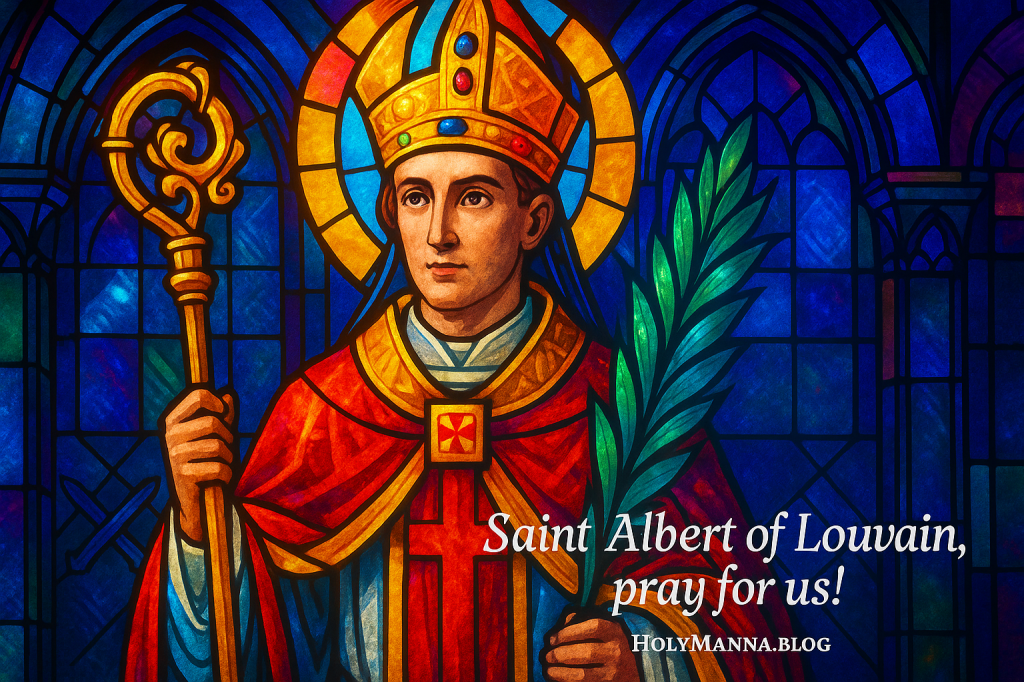
A Shepherd Who Would Not Be Bought
Saint Albert of Louvain, also known as Albert of Brabant, lived at a time when powerful nobles tried to treat a bishopric like a political prize. The Diocese of Liège was wealthy, influential, and strategically important, which made it a target for secular manipulation. Albert’s significance rests in his unshakable fidelity to the Church’s freedom and to the proper order of apostolic succession. Canonically elected by the cathedral chapter of Liège in 1191, he refused to yield to an imperial faction that pushed a rival claimant. He traveled to Rome, placed his cause in the hands of the Pope, and accepted whatever the Church judged to be right. Pope Celestine III received him favorably, advanced him through Holy Orders, and directed that he be consecrated a bishop. Albert submitted to this process without shortcuts, which reveals a heart formed by obedience and a conscience anchored in the truth that Christ governs his Church through apostolic ministry. This is why his memory endures. He is venerated as a martyr for ecclesial freedom, a man who would not let wealth or influence buy the soul of a local Church.
Roots of Strength
Albert was born around 1166 in Louvain into the ducal house of Brabant. His father was Godfrey III, Duke of Brabant, and his mother was Margaret of Limburg. Raised in a world that prized chivalry, diplomacy, and noble duty, he also encountered the beauty and discipline of the Church’s life. He became a canon and received a serious education that included time in Liège and likely in Paris, where many future bishops and theologians were trained. Reports from his early life show a young cleric who loved prayer, reverence in the liturgy, and the life of study. The fall of Jerusalem in 1187 stirred him deeply. He took the cross for a time, showing the courage and honor admired in his age, and then returned fully to clerical service with renewed purpose. As archdeacon of Liège, he learned how a diocese truly runs: safeguarding the sacraments, disciplining abuses, caring for schools, preaching the Gospel, and protecting Church goods for the poor. These experiences prepared him to serve as a bishop who understood both the spiritual needs of souls and the practical demands of governance.
Sent to Shepherd
After his canonical election in 1191, Albert faced heavy political pressure, yet he sought only ecclesial clarity. He appealed to the Pope, who created him a cardinal-deacon, ordained him to the priesthood, and directed that he be consecrated bishop at Reims in September 1192. This sequence underscores what the Church professes about Holy Orders. “Episcopal consecration confers, together with the office of sanctifying, also the offices of teaching and ruling.” The bishop is configured to Christ in a unique way for the care of a specific local Church. Albert embraced that identity not as a title but as a mission. He knew that a bishop is not a manager appointed by princes. A bishop is a successor of the apostles, entrusted with the truth of the Gospel and the salvation of souls. His determination to receive and exercise this office only in communion with Peter and the Church’s law is exactly what makes his witness so timely.
Faith Over Force
No spectacular public miracles are reliably recorded during Albert’s lifetime. What shines is a supernatural steadiness that does not bend to intimidation. He cared about proper governance, the integrity of sacred worship, and the defense of the poor from exploitation. His ministry shows what the Catechism teaches about ordained service: “In the ecclesial service of the ordained minister, it is Christ himself who is present to his Church as Head of his Body, Shepherd of his flock, high priest of the redemptive sacrifice, Teacher of Truth.” When Albert resisted political coercion, he was not acting as a lone hero. He was acting as a servant of Christ present in his Church. That quiet, unwavering fidelity is a real grace, because such constancy under threat is not natural. It is born from prayer, formed by obedience, and sustained by the sacraments.
Steel and Sanctity
The imperial party refused to accept Albert’s consecration. Negotiations failed, tensions rose, and violence followed. In November 1192, near Reims, three German knights lured Albert outside the safety of the city and murdered him on November 24. The shock was immediate and intense. Clergy and laity recognized that a shepherd had been struck down because he would not place secular power above apostolic order. The Church responded firmly against those responsible. From the beginning, the faithful honored Albert as a martyr who died for the freedom of the Church and for the right of the People of God to receive their bishop in peace. The Catechism speaks plainly about what his death signifies: “Martyrdom is the supreme witness given to the truth of the faith; it means bearing witness even unto death.” Albert’s martyrdom was not about political victory. It was about the holiness of the Church and the dignity of Christ’s flock.
After the Sword
Devotion to Saint Albert of Louvain spread in the Low Countries and in Reims, where he had been consecrated and where his life ended. The faithful asked his intercession for courage, for righteous leadership, and for the protection of the Church from worldly domination. He was formally canonized in 1613, which affirmed the long-standing devotion to him as a martyr. After the First World War, when Reims Cathedral lay scarred, excavations helped identify his resting place. His relics were recognized and honorably translated, renewing local veneration and reminding the faithful that God brings new life from ruins. Accounts of specific posthumous miracles do not survive in abundance, yet the persistence of his cult across centuries speaks for itself. Pilgrims praying near his relics and communities invoking his name have testified to favors received and to the strengthening of conscience. The Church honors this steady stream of grace because God often works through the humble fidelity of a martyr’s intercession rather than through constant spectacle.
How to Imitate Saint Albert Today
Saint Albert’s life offers a clear pattern for anyone tempted to compromise when pressure mounts. He shows that obedience to Christ and unity with the Church are not obstacles to effective action. They are the only sure foundation for it. Pray daily for your bishop and priests by name, because the weight they carry is real. Make time for the sacraments that formed Albert’s courage, especially Confession and the Eucharist. Practice integrity in small things at work and at home so that you are ready to be faithful in big moments. Speak the truth in charity, even when it costs you. Consider a simple weekly penance for the freedom of the Church and for the protection of those who shepherd it. Let the Catechism’s language about witness shape your imagination: “Martyrdom is the supreme witness given to the truth of the faith; it means bearing witness even unto death.” Most Christians will not face violent persecution, but every Christian will be asked to love the truth more than comfort. That is where Saint Albert stands beside you.
Engage with Us!
What detail from Saint Albert’s life challenges your comfort zone today?
Where is God asking for courage rather than compromise in your vocation or work?
- When has faith invited you to resist peer pressure or political pressure, and how did you respond?
- What concrete step can you take this week to pray for and support your bishop in his teaching, sanctifying, and governing mission?
- How might you cultivate fortitude so that small daily sacrifices prepare you for bigger acts of witness if they are ever required?
Keep going with confidence. Live a life of faith that is honest and brave, and do everything with the love and mercy Jesus taught us.
Saint Albert of Louvain, pray for us!
Follow us on Instagram and Facebook for more insights and reflections on living a faith-filled life.

 Holy Manna!
Leave a comment