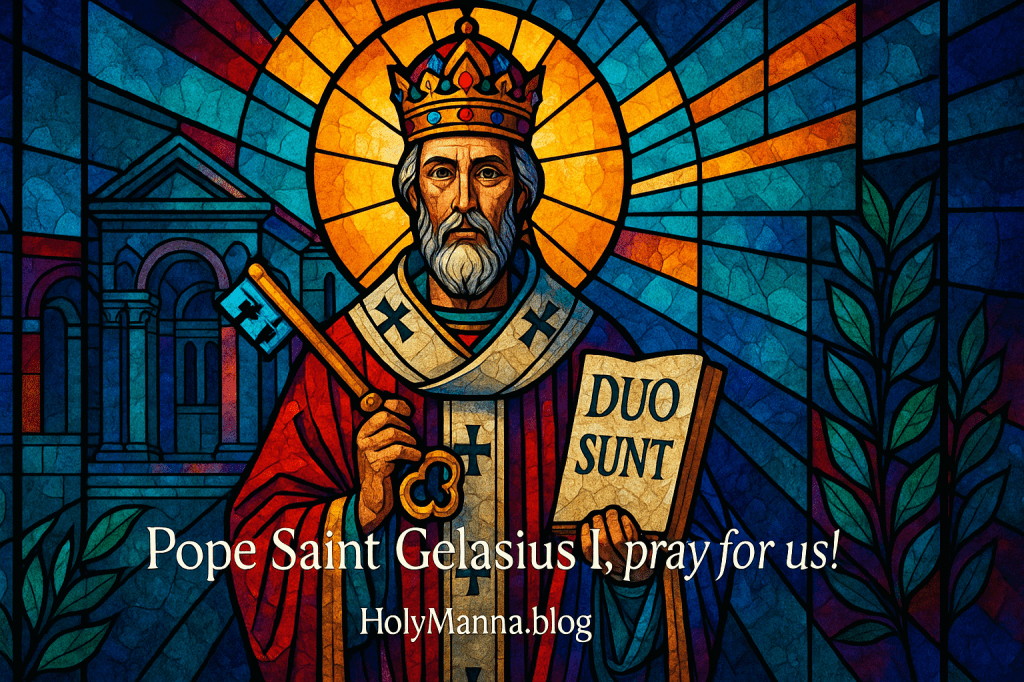
The Shepherd Who Balanced Altar and Throne
Pope Saint Gelasius I stepped into the Chair of Peter in 492, just years after the fall of the Western Roman Empire, when Rome was hungry, anxious, and tempted by compromise. He offered a steady hand and a clear voice. His most famous teaching came in a 494 letter to the emperor, where he framed the right relationship between Church and state with the line: “There are two powers, august Emperor, by which this world is chiefly ruled, the sacred authority of the priests and the royal power.” That vision guided Christian civilization for centuries. Gelasius defended the Council of Chalcedon’s confession of Christ’s two natures, purified lingering pagan practices in the city, strengthened worship and discipline, and poured out the Church’s resources for the poor of Rome. His short pontificate, from 492 to 496, left a legacy of clarity, charity, and courage that still challenges believers today.
Rome-Born, Africa-Rooted Disciple
Ancient sources describe Gelasius as Roman by birth and of African lineage, a son of the universal Church living at the crossroads of cultures. Before his election he served for years as a deacon to Pope Felix III, gaining a reputation for learning, holiness, and good judgment. That diaconal apprenticeship shaped his pastoral heart. It trained him to love right worship, to guard the deposit of faith, and to notice the needs of ordinary people. When he was chosen Bishop of Rome on March 1, 492, the city was fragile and divided. Gelasius brought steady reform, warm mercy, and a willingness to say hard truths for the sake of unity. He is most remembered for articulating the “two powers,” for resisting attempts to blur the teaching of Chalcedon, for rooting out errors like Manichaeism, and for generous care of the poor that left him personally with very little material wealth at his death.
A Pastor With a Pen and a Backbone
Gelasius believed that doctrine and worship belong together. He wrote vigorous letters to bishops and emperors alike, insisting that the primacy of the Roman See served the unity of the whole Church. He refused to heal the Acacian Schism with vague formulas, since the truth about Christ’s full divinity and full humanity must be confessed without confusion. He encouraged reverent liturgy and sound governance, and he is traditionally associated with several beautiful prayers later preserved in Roman sacramentaries. In order to expose secret Manichaeans in Rome who shunned the chalice, Gelasius for a time insisted that Holy Communion be received under both kinds, which made their error visible and protected the faithful. He set a strong example of charity by dividing Church goods in a way that ensured the poor were not forgotten. He also put a stop to the old Lupercalia festival, explaining that Christians cannot keep pagan rites alive and expect the Gospel to flourish. His miracles were the kind that reorder a city’s loves: renewed worship, clear teaching, and real bread for the hungry.
Fire Without the Sword
There was no martyrdom by blood for Gelasius, but there was real fire. He faced pressure from imperial officials who wanted unity at the expense of truth and criticism from those who considered Rome’s claims too bold. He held fast with a shepherd’s patience and an apostle’s courage. The same letter that gave the Church the classic “two powers” line also reminded the emperor that priests answer to God even for rulers’ souls, a reminder that religion cannot be reduced to politics and that conscience must be formed by revelation. Gelasius bore misunderstanding and opposition without resentment, confident that fidelity is more persuasive than flattery. He died in 496 after four intense years that steadied the Church without spilling a drop of the truth.
Quiet Veneration and a Lasting Light
After his death Gelasius was buried at the Basilica of Saint Peter and honored locally as a saint. The Roman Martyrology commemorates him on November 21. There are no early collections of spectacular posthumous miracles tied to his tomb, yet his teaching continued to work a slower miracle of culture. Pastors, theologians, and rulers returned to his words when they needed a map for conscience and governance. His memory became a beacon for anyone trying to love the earthly city while seeking the City of God.
Conscience Formed by Truth
Gelasius’s witness fits hand in glove with the Catechism of the Catholic Church. When the Catechism describes the Pope’s service to unity, it echoes the Gelasian conviction that Peter’s office safeguards the truth for the whole family of God: “The Pope, Bishop of Rome and Peter’s successor, is the perpetual and visible source and foundation of the unity of both the bishops and of the whole company of the faithful.” It also teaches how believers navigate civil life with a conscience shaped by the Gospel: “The citizen is obliged in conscience not to follow the directives of civil authorities when they are contrary to the demands of the moral order, to the fundamental rights of persons, or the teachings of the Gospel.” Gelasius’s love for the poor reflects the Catechism’s steady call to works of mercy: “God blesses those who come to the aid of the poor and rebukes those who turn away from them.” In practical terms, his life suggests a simple rhythm. Let worship be reverent and central. Let doctrine be clear and charitable. Let almsgiving be concrete and generous. Pray for civic leaders, participate in public life with wisdom, and keep the care of souls first. That is how Christians become light for a world that still longs for order, justice, and mercy.
Engage with Us!
- Where does Gelasius’s teaching on the “two powers” challenge personal assumptions about politics and faith today?
- How can reverent worship and daily charity work together in a parish family, the way they did in Gelasius’s Rome?
- What would it look like to defend truth without bitterness in current cultural debates?
- Which concrete act of generosity will you offer this week for someone in need, in honor of Pope Saint Gelasius I?
Go forward encouraged, rooted in the sacraments, devoted to the truth, and ready to love with the mercy Jesus taught, so every act becomes a living hymn to God.
Pope Saint Gelasius I, pray for us!
Follow us on Instagram and Facebook for more insights and reflections on living a faith-filled life.

 Holy Manna!
Leave a comment