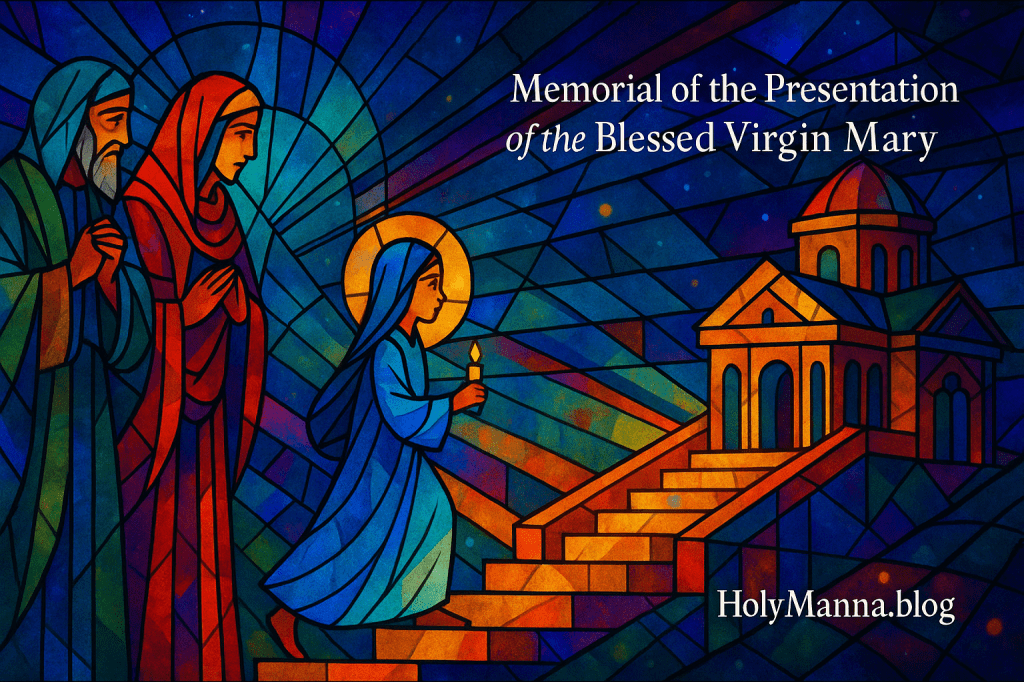
Behold, the Temple’s Living Temple
The Memorial of the Presentation of the Blessed Virgin Mary invites a prayerful look at Mary’s childhood dedication to God and the way her life became a lamp for the path of every disciple. The Church holds this day with affection because it shows Mary as the living Temple, a dwelling prepared for the coming of the Word. This memory does not add facts to Scripture but treasures an ancient Christian tradition that underscores the total consecration of Mary’s life. It points to the heart of Marian devotion, which is always Christ centered and ecclesial. The Catechism of the Catholic Church expresses this beautifully in a line many know by heart: “The Church’s devotion to the Blessed Virgin is intrinsic to Christian worship.” The liturgy echoes that truth in the Collect when it prays that through Mary’s intercession the faithful may receive from the fullness of God’s grace. The feast sits at the doorstep of Advent and gently trains the eyes to look where Mary always points, to Jesus who comes.
From Jerusalem’s Steps to the Roman Calendar
The earliest written account behind this celebration appears in the second century Protoevangelium of James, which tells how Saints Joachim and Anne, grateful for the gift of a child after long waiting, brought three year old Mary to the Temple in Jerusalem and offered her to the Lord. The scene is simple and striking. The child ascends the steps with freedom and joy, and the narrative highlights that grace accompanies her from the beginning. While this text is not part of the biblical canon, the tradition shaped Christian memory, preaching, and art for many centuries. Historically the feast flowered first in the East. In the sixth century, after Emperor Justinian built the splendid Nea Church of Saint Mary near the Temple Mount, Jerusalem began to mark this mystery with solemn liturgy. The celebration then spread through the Byzantine world, where it is still known as the Entrance of the Theotokos into the Temple. In the West the memorial gained ground later. It appeared in Avignon in the fourteenth century after being promoted at the papal court, found a home in local calendars, entered the Roman books in the fifteenth century, and after some adjustments during calendar reforms it was firmly restored to the universal calendar in the late sixteenth century. By the twentieth century the Church also paired November 21 with special prayer for cloistered religious, which highlights how Mary’s youthful dedication mirrors the Church’s contemplative heart.
Total Consecration, Ecclesial Holiness, and the New Temple
The theological center of this feast is the mystery of Mary’s complete belonging to God. The Church confesses that God prepared Mary uniquely for her vocation as Mother of the Redeemer, which is why the tradition of her early dedication fits the pattern of grace already proclaimed in doctrine. The Catechism of the Catholic Church states with clarity, “By the grace of God Mary remained free of every personal sin her whole life long.” Her presentation in the Temple is therefore read as a sign of what God was doing in her from the beginning and as an image of what the Church is called to be, a people set apart for praise. The feast also shines a light on consecrated life. Papal teaching through the centuries has pointed to Mary as the perfect model for those who offer their whole selves to God in poverty, chastity, and obedience. Documents on religious life in the modern era renew that link and tie November 21 to prayer and gratitude for monasteries and convents that anchor the Church in constant intercession. The typology is rich. Mary is often called the Ark of the New Covenant because she bears the Word within her. Her entrance into the earthly temple quietly announces that a greater Temple is arriving, the body of Christ, and that God’s dwelling among his people will surpass stone and gold.
Holy Places, Holy People, and a Day for Cloistered Life
This memorial has a natural home in places that keep Mary close. In Rome there are chapels and altars that depict the Presentation, where pilgrims pause to pray for the grace of a willing heart. In Jerusalem the memory still points to the ancient Christian witness that grew up around the Temple precincts, reminding visitors that salvation history turns on concrete places and real lives. In Poland the Basilica of the Presentation of the Blessed Virgin Mary in Wadowice holds a special spot in many hearts since it is the baptismal church of Saint John Paul II, and on this day the parish highlights both Marian devotion and the call to holiness from the first moments of life. Communities under Mary’s patronage also renew their vows of service. The Presentation Sisters, founded by Nano Nagle in the eighteenth century, often keep November 21 with solemn Mass, renewed commitment to the poor, and thanksgiving for the charism they share. The Church proposes a practical work of mercy on this date through Pro Orantibus Day, which invites every parish and household to pray for cloistered nuns and monks and to remember them with material support when possible. Visiting a shrine, lighting a candle, offering a Rosary, or spending quiet time before the tabernacle on this memorial draws believers into the same current of grace that shaped Mary’s life.
East and West Sing One Mystery
Around the world this feast wears different garments yet proclaims the same joy. In the Eastern Catholic and Orthodox churches it is one of the great feasts of the year and is marked with a forefeast, a vigil, and the radiant Troparion that many can recite from memory. The hymn announces the mystery in simple lines: “Today is the prelude of the good will of God. The Virgin appears in the temple of God and in anticipation proclaims Christ to all.” Icons in the East often show the little Virgin welcomed by the high priest and received into the Temple, while Saints Joachim and Anne look on with reverence. In the Roman Rite the memorial is celebrated with a proper Mass and readings drawn from the Common of the Blessed Virgin Mary, along with antiphons and orations that emphasize holiness, joy, and availability to the will of God. Schools, parishes, and religious houses named in honor of the Presentation often gather for processions, Marian hymns, and acts of service in their neighborhoods. Families sometimes bring flowers to a statue of Mary, teach children the Angelus, and share the story of Saints Joachim and Anne as a way to connect grandparents and grandchildren in faith. In every culture the pattern is the same. Mary’s childlike offering becomes a gentle school of surrender for the whole community.
Learning Mary’s Yes in Ordinary Days
This memorial is not meant to remain a beautiful scene in a distant past. It is an invitation to let God shape the mind and heart in the present moment. The pattern is simple. Begin the day with a small Fiat by offering work, study, and relationships to the Lord, and end the day with a brief examen that names graces and asks for mercy where love fell short. Pray the Angelus at least once a day and let its rhythm teach receptivity to the Word. Consider adopting a monastery in prayer and remember its community by name, since the hidden life of intercession sustains the mission of the Church in ways that are not always seen. Read a paragraph from the Catechism of the Catholic Church or a page of the Liturgy of the Hours in the evening as a quiet way to prepare for Advent. Choose one hidden act of charity each day and offer it for those who most need hope. Mary’s Presentation shows that God delights to begin great things in small and faithful steps.
Engage with Us!
Share your thoughts below—your insights help all of us grow.
- How does Mary’s total self-gift challenge or inspire the way you offer your own life to God right now?
- What is one concrete “temple step” you can take this week (a habit, a sacrifice, a prayer) to deepen your consecration to God?
- Which aspect of this feast—history, liturgy, or devotion—most helped you see Mary’s role in leading us to Christ?
- How might you support a cloistered community this month—in prayer, encouragement, or practical aid?
Go forth encouraged: offer your day to Jesus through Mary, love generously, and do everything with the love and mercy Jesus taught us, with a heart like Mary’s, wholly given to God.
Sacred Heart of Jesus, we trust in You!
Immaculate Heart of Mary, pray for us!
Saint Michael the Archangel, defend us in battle!
Follow us on Instagram and Facebook for more insights and reflections on living a faith-filled life.

 Holy Manna!
Leave a comment