Memorial of the Presentation of the Blessed Virgin Mary – Lectionary: 501
House of Prayer, Heart of Consecration
Today’s memorial invites a quiet step into the Temple with Mary, the young girl wholly given to God, and to listen for the sound of rededication. The Memorial of the Presentation of the Blessed Virgin Mary remembers the ancient Jerusalem tradition of honoring a church near the Temple and celebrates Mary’s total consecration to the Lord, a gift that made her the living Ark and model of the Church. Against this backdrop, the readings move like a single procession from rubble to renewal, from noisy commerce to pure worship, from outward cleansing to interior consecration. In 1 Maccabees 4, Judas Maccabeus leads Israel to purify the sanctuary and restore the altar on the twenty fifth of Kislev, the moment that gave rise to the eight-day festival of dedication and joy, a testimony that God reclaims what bears his Name. David’s blessing in 1 Chronicles 29 places that restoration in its proper frame as he proclaims, “Yours, Lord, are greatness and might… for all in heaven and on earth is yours.” The Psalm response teaches that true rededication begins by recognizing God’s kingship, since worship is not a human invention but a grateful return of what already belongs to him. In the Holy Gospel, Luke 19:45 48, Jesus enters the Temple and drives out what corrupts prayer, declaring, “My house shall be a house of prayer.” His words do not only address a building. They reach the place where the Lord desires to dwell most, the human heart, which the Church calls the inner sanctuary of encounter with God (CCC 2563). The central theme is cleansing and consecration for right worship. The Lord purifies his house so that praise and teaching can flourish, as seen when Jesus teaches daily in the Temple and the people hang on his words. Mary’s Presentation shows what that looks like in fullness. She is the wholly given Temple where the Word takes flesh, the pattern of the Church and of every disciple’s life in grace (CCC 507; CCC 583–586; CCC 1179; CCC 1197–1199). Where does the Lord want to cleanse and consecrate your heart anew today so it becomes a house of prayer and a place of praise?
First Reading – 1 Maccabees 4:36–37, 52–59
Rededication and the Joy of Right Worship
The Books of Maccabees open a window onto a turbulent second century before Christ, when faithful Jews resisted the cultural and religious pressures of the Seleucid rulers who had desecrated the Jerusalem Temple. Into this crisis stepped Judas Maccabeus, who led a campaign not only for political survival but for the restoration of true worship. The passage recounts the purification and rededication of the Temple on the twenty fifth day of Kislev, the moment that gave rise to the eight day feast of dedication remembered in Israel’s life of prayer. This scene fits today’s theme of cleansing and consecration by showing how God’s people repair what sin and sacrilege have broken so that praise can rise again. On the Memorial of the Presentation of the Blessed Virgin Mary, the Church sees in Mary the living Temple wholly given to God, the pattern of every disciple who becomes a dwelling place for the Lord in the Spirit (CCC 507; CCC 1197). The narrative sets the stage for the Gospel, where Jesus insists that God’s house must be a house of prayer, and it invites a response of interior rededication that matches the exterior renewal of the altar.
1 Maccabees 4:36-37, 52-59
New American Bible (Revised Edition)
Purification and Rededication of the Temple. 36 Then Judas and his brothers said, “Now that our enemies have been crushed, let us go up to purify the sanctuary and rededicate it.” 37 So the whole army assembled, and went up to Mount Zion.
52 They rose early on the morning of the twenty-fifth day of the ninth month, that is, the month of Kislev, in the year one hundred and forty-eight, 53 and offered sacrifice according to the law on the new altar for burnt offerings that they had made. 54 On the anniversary of the day on which the Gentiles had desecrated it, on that very day it was rededicated with songs, harps, lyres, and cymbals. 55 All the people prostrated themselves and adored and praised Heaven, who had given them success.
56 For eight days they celebrated the dedication of the altar and joyfully offered burnt offerings and sacrifices of deliverance and praise. 57 They ornamented the facade of the temple with gold crowns and shields; they repaired the gates and the priests’ chambers and furnished them with doors. 58 There was great joy among the people now that the disgrace brought by the Gentiles was removed. 59 Then Judas and his brothers and the entire assembly of Israel decreed that every year for eight days, from the twenty-fifth day of the month Kislev, the days of the dedication of the altar should be observed with joy and gladness on the anniversary.
Detailed Exegesis
Verse 36 – “Then Judas and his brothers said, ‘Now that our enemies have been crushed, let us go up to purify the sanctuary and rededicate it.’”
Victory is not treated as an end in itself. The goal is purified worship. The verbs “purify” and “rededicate” reveal that the real battle is for the heart of Israel’s communion with God. The people recognize that right worship restores right order, which is the deepest healing after conflict.
Verse 37 – “So the whole army assembled, and went up to Mount Zion.”
Liturgical renewal is a communal act. The army becomes a worshiping assembly, modeling how every victory is offered back to God. Mount Zion signals both geography and theology, the meeting point of God and his people in covenant.
Verse 52 – “They rose early on the morning of the twenty-fifth day of the ninth month, that is, the month of Kislev, in the year one hundred and forty-eight,”
The precise dating underlines the historicity of the event and its annual remembrance. Rising early shows zeal for God’s glory. The care with time and calendar anticipates later Christian attentiveness to sacred time in the liturgical year.
Verse 53 – “and offered sacrifice according to the law on the new altar for burnt offerings that they had made.”
Worship is measured by fidelity to God’s revelation. “According to the law” highlights obedience, not improvisation, as the path to restored communion. A new altar signifies a new beginning rooted in the covenant.
Verse 54 – “On the anniversary of the day on which the Gentiles had desecrated it, on that very day it was rededicated with songs, harps, lyres, and cymbals.”
God turns a day of shame into a day of glory. The same date becomes a sign of reversal and mercy. The named instruments evoke the Davidic tradition of temple praise, reminding readers that authentic worship engages the whole person, body and soul.
Verse 55 – “All the people prostrated themselves and adored and praised Heaven, who had given them success.”
Prostration embodies repentance and adoration. “Heaven” is a reverent way of naming God’s sovereignty. The text teaches gratitude by attributing victory to God, not to human strength, which corrects pride after triumph.
Verse 56 – “For eight days they celebrated the dedication of the altar and joyfully offered burnt offerings and sacrifices of deliverance and praise.”
Eight days symbolize new creation and completion. “Deliverance and praise” unite sacrifice and thanksgiving, the pattern that will be fulfilled in the Eucharist where Christ’s self offering becomes the Church’s thanksgiving.
Verse 57 – “They ornamented the facade of the temple with gold crowns and shields; they repaired the gates and the priests’ chambers and furnished them with doors.”
Beauty belongs to worship because glory befits God. Practical repairs stand alongside ornamentation, showing that holiness includes both reverent aesthetics and responsible stewardship of sacred space.
Verse 58 – “There was great joy among the people now that the disgrace brought by the Gentiles was removed.”
Joy follows cleansing. When sacrilege is healed, shame is lifted from the community. The people taste the freedom that comes from living again in covenant fidelity.
Verse 59 – “Then Judas and his brothers and the entire assembly of Israel decreed that every year for eight days, from the twenty-fifth day of the month Kislev, the days of the dedication of the altar should be observed with joy and gladness on the anniversary.”
A decree codifies memory. Annual celebration safeguards identity and transmits faith to future generations. The community promises to keep joy alive by returning, year after year, to the works of God.
Teachings
The rededication of the Temple points to the fuller reality of Christ and the Church. CCC 1197 teaches, “Christ is the true temple of God, ‘the place where his glory dwells’; by the grace of God, Christians also become temples of the Holy Spirit, living stones out of which the Church is built.” The Temple’s cleansing anticipates Jesus’ zeal for his Father’s house. CCC 584 states, “Jesus went up to the Temple as the privileged place of encounter with God. For him, the Temple was the dwelling of his Father, a house of prayer, and he was angered that its outer court had become a place of commerce.” At the same time, the New Covenant widens the horizon of worship. CCC 1198 explains, “In its earthly state the Church needs places where the community can gather together. Our visible churches, holy places, are images of the holy city, the heavenly Jerusalem, toward which we are making our way on pilgrimage.” This outward renewal always seeks an inward home for God. CCC 2563 teaches, “The heart is the dwelling-place where I am, where I live; according to the Semitic or Biblical expression, the heart is the place ‘to which I withdraw.’ The heart is our hidden center, beyond the grasp of our reason and of others; only the Spirit of God can fathom the human heart and know it fully. The heart is the place of decision, deeper than our psychic drives. It is the place of truth, where we choose life or death.” On this memorial the Church looks to Mary as the exemplar of consecrated worship. CCC 507 confesses, “At once virgin and mother, Mary is the symbol and the most perfect realization of the Church: ‘the Church indeed . . . by receiving the word of God in faith becomes herself a mother. By preaching and Baptism she brings forth sons, who are conceived by the Holy Spirit and born of God, to a new and immortal life.’”
Reflection
The first task after any victory is worship. When God removes obstacles, the right response is to purify what has grown cluttered and to rededicate time, space, and habits to the Lord. Consider setting aside a specific day to examine the state of personal prayer, the reverence shown in church, and the beauty offered to God in daily life. Make a concrete plan to repair what neglect has broken, whether that is regular confession, a renewed commitment to Sunday Mass, or a small act of beautifying a prayer corner at home. Offer thanks out loud for God’s recent mercies. Ask the Blessed Virgin Mary to help with wholehearted consecration. What needs cleansing so that prayer can flourish again? Where can gratitude replace self reliance? How might a weekly habit of thanksgiving keep memory alive so joy endures through the year?
Responsorial Psalm – 1 Chronicles 29:10–13
The King Who Owns Everything and Teaches Us Thanksgiving
This psalm comes from David’s great prayer before the assembled people of Israel as they prepare to provide for the future Temple in Jerusalem. The setting is deeply communal and profoundly liturgical. Israel stands at a hinge point between promise and fulfillment, with David acknowledging that every resource and victory flows from God’s sovereign hand. Within today’s theme of cleansing and consecration, David’s blessing frames true worship as grateful recognition of God’s kingship. The Temple must be renewed not only in stone but in spirit, and thanksgiving is the language that keeps God at the center. On the Memorial of the Presentation of the Blessed Virgin Mary, this prayer finds a living echo in Mary’s total offering, since she embodies the heart that knows all belongs to the Lord and returns to him in praise.
1 Chronicles 29:10-13
New American Bible (Revised Edition)
David’s Prayer. 10 Then David blessed the Lord in the sight of the whole assembly. David said:
“Blessed are you, Lord,
God of Israel our father,
from eternity to eternity.
11 Yours, Lord, are greatness and might,
majesty, victory, and splendor.
For all in heaven and on earth is yours;
yours, Lord, is kingship;
you are exalted as head over all.
12 Riches and glory are from you,
and you have dominion over all.
In your hand are power and might;
it is yours to give greatness and strength to all.
13 Therefore, our God, we give you thanks
and we praise the majesty of your name.
Detailed Exegesis
Verse 10 – “Then David blessed the Lord in the sight of the whole assembly. David said: ‘Blessed are you, Lord, God of Israel our father, from eternity to eternity.’”
Public blessing roots Israel’s life in worship. David blesses God before the “whole assembly” because gratitude is meant to be shared. Calling God “our father” draws the nation into intimate covenant identity, while “from eternity to eternity” proclaims that consecration rests on God’s eternal faithfulness, not on fluctuating human strength.
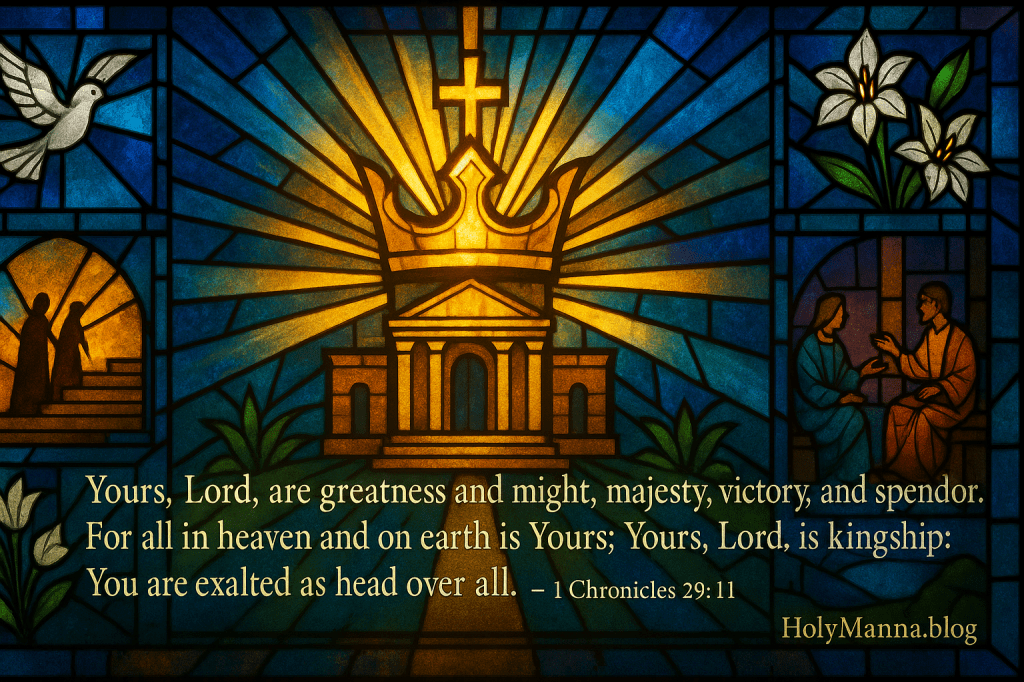
Verse 11 – “Yours, Lord, are greatness and might, majesty, victory, and splendor. For all in heaven and on earth is yours; yours, Lord, is kingship; you are exalted as head over all.”
This cascade of divine attributes centers worship on God’s absolute sovereignty. The repeated “yours” dismantles any illusion of self possession. By confessing that “all in heaven and on earth” belongs to God, David places the Temple project, national hopes, and personal plans under the Lord’s reign. This is the foundation for cleansing, since right order begins with the rightful King.
Verse 12 – “Riches and glory are from you, and you have dominion over all. In your hand are power and might; it is yours to give greatness and strength to all.”
Stewardship flows from this conviction. If riches and honor come from God, then the people are administrators of a trust, not owners of a hoard. “In your hand” is the biblical way to say that history is not random. Consecration recognizes gifts as given for God’s purposes and returns them to him in love.
Verse 13 – “Therefore, our God, we give you thanks and we praise the majesty of your name.”
“Therefore” ties theology to liturgy. What Israel believes becomes how Israel prays. Thanksgiving is not an optional sentiment but the fitting response to God’s kingship. Praise restores joy after trials and guards the heart against pride after victories.
Teachings
David’s blessing models adoration, the first movement of true religion. “Adoration is the first act of the virtue of religion.” CCC 2096. Thanksgiving belongs at the heart of Christian prayer because it recognizes that every good originates in God and returns to him in praise. “Thanksgiving characterizes the prayer of the Church which, in celebrating the Eucharist, reveals and becomes more fully what she is.” CCC 2637. In the liturgy, the Church learns to say with David that everything is the Lord’s and to offer it back without reserve. Christian prayer itself is defined by this upward movement of the heart. “Prayer is the raising of one’s mind and heart to God or the requesting of good things from God.” CCC 2559. The saints echo David’s posture of praise and dependence. Saint Augustine confesses, “You have made us for yourself, O Lord, and our heart is restless until it rests in you.” Confessions I.1. This rest is the fruit of adoration and thanksgiving, the inner consecration that mirrors the cleansing of the Temple and the total offering seen in Mary’s Presentation.
Reflection
Gratitude is the doorway to consecration. Begin and end the day by naming specific gifts and returning them to God in praise. Practice stewardship by dedicating time, talent, and treasure with intentionality, since everything already belongs to the Lord. When anxiety rises, pray David’s words slowly and let them reorder priorities under God’s kingship. Make the next visit to church an act of adoration by kneeling in silence and blessing God for who he is before asking for anything. What gift today can be returned to God in thanksgiving? Where has self reliance crept in and muted praise? How might a simple daily doxology turn the heart into a house of prayer and keep joy alive through trials and triumphs alike?
Holy Gospel – Luke 19:45–48
Zeal for the Father’s House and the Renewal of the Heart
The scene unfolds in the courts of the Jerusalem Temple during the final week of Jesus’ public ministry. The Temple was the sacred heart of Israel’s worship, with sacrificial animals and money changers present to facilitate offerings, especially in the Court of the Gentiles where many nations could draw near. Into this setting Jesus steps as the Son who claims the Father’s house and restores its purpose. By cleansing the Temple and teaching daily within it, he exposes the clutter that smothers prayer and reorients God’s people to adoration and truth. Within today’s theme of cleansing and consecration, this Gospel shows that holy places must serve holy purposes, and that outward reform seeks an inward renewal. On the Memorial of the Presentation of the Blessed Virgin Mary, the Church sees the perfect image of a consecrated dwelling, since Mary’s heart is entirely given to God and becomes the pure sanctuary where the Word takes flesh.
Luke 19:45-48
New American Bible (Revised Edition)
The Cleansing of the Temple. 45 Then Jesus entered the temple area and proceeded to drive out those who were selling things, 46 saying to them, “It is written, ‘My house shall be a house of prayer, but you have made it a den of thieves.’” 47 And every day he was teaching in the temple area. The chief priests, the scribes, and the leaders of the people, meanwhile, were seeking to put him to death, 48 but they could find no way to accomplish their purpose because all the people were hanging on his words.
Detailed Exegesis
Verse 45 – “Then Jesus entered the temple area and proceeded to drive out those who were selling things,”
Jesus acts with prophetic authority. He does not oppose sacrifice itself but confronts the disorder that has turned a place of prayer into a marketplace. His action recalls the prophets who purified worship so that Israel could encounter the living God without distraction or exploitation.
Verse 46 – “saying to them, ‘It is written, ‘My house shall be a house of prayer, but you have made it a den of thieves.’’”
Jesus grounds his zeal in Scripture, joining the promise of a house of prayer with the warning against corrupt religion. He judges by the Word, not by personal preference. The charge of “den of thieves” unmasks a deeper problem than noise or clutter. It reveals a spiritual theft where hearts take from God the reverence that is due to him.
Verse 47 – “And every day he was teaching in the temple area. The chief priests, the scribes, and the leaders of the people, meanwhile, were seeking to put him to death,”
Cleansing makes room for teaching. Once space is reclaimed for prayer, the Word of God is heard again. Opposition rises because Jesus challenges the structures that benefit from confusion. The leaders sense that authentic worship undermines their control, and they move to silence the voice that exposes their motives.
Verse 48 – “but they could find no way to accomplish their purpose because all the people were hanging on his words.”
The magnetic power of truth protects Jesus for a time. The people cling to his teaching because their hearts recognize the authority that restores life. This response is the Gospel’s invitation. A cleansed house becomes a listening house, and a listening house becomes a place where faith grows.
Teachings
The Church reads this passage as a revelation of Jesus’ love for the Temple and his mission to perfect worship in himself. “Like the prophets before him Jesus expressed the deepest respect for the Temple in Jerusalem.” CCC 583. “Jesus went up to the Temple as the privileged place of encounter with God. For him, the Temple was the dwelling of his Father, a house of prayer, and he was angered that its outer court had become a place of commerce.” CCC 584. “On the threshold of his Passion Jesus announced the coming destruction of this splendid building, of which there would not remain one stone upon another.” CCC 585. “Far from having been hostile to the Temple, where he gave the essential part of his teaching, Jesus was willing to be put to death because he foretold its destruction.” CCC 586. At the same time the New Covenant lifts worship into a universal horizon. “The worship ‘in Spirit and in truth’ of the New Covenant is not tied exclusively to any one place. The whole earth is sacred and entrusted to the children of men.” CCC 1179. The saints echo Christ’s jealousy for prayer. Saint Teresa of Avila urges a return to the inner chapel, “The important thing is not to think much, but to love much, and so do that which best stirs you to love.” The Interior Castle. This love is what Jesus protects in the Temple. On today’s memorial, Mary shines as the exemplar of consecration. “At once virgin and mother, Mary is the symbol and the most perfect realization of the Church.” CCC 507.
Reflection
The Lord still cleanses so that prayer can breathe. Welcome his zeal by letting him overturn whatever trades prayer for convenience. Set aside time this week for a quiet visit to church and allow silence to reintroduce the soul to adoration. Make a good confession to let grace clear what commerce cannot touch. Build small habits that keep the heart attentive to the Word, such as praying with a short passage of the Gospel each day and lingering over a phrase that stands out. What tables need overturning so the heart can be a house of prayer again? Where has noise or distraction crowded out listening to the Lord? How can a daily moment of silent adoration help cling to the words of Jesus with fresh desire?
Consecrate the House, Guard the Fire
The Word today gathers around one clear call to the heart and to the Church: cleanse, consecrate, and let praise rise. In 1 Maccabees 4, Israel repairs the altar and rededicates the Temple so that worship can breathe again with joy. In 1 Chronicles 29:10–13, David teaches the posture that keeps worship pure by proclaiming, “Yours, Lord, are greatness and might… for all in heaven and on earth is yours.” In Luke 19:45–48, Jesus claims the Father’s house and restores it to its purpose with the judgment and mercy of truth, “My house shall be a house of prayer.” On the Memorial of the Presentation of the Blessed Virgin Mary, the Church contemplates the perfect pattern of consecration in the one whose whole life says yes to God, the living sanctuary who shows what it means to belong completely to the Lord (CCC 507; CCC 583–586; CCC 1179; CCC 1197–1199).
Let the Lord purify what has grown cluttered, and let thanksgiving become the language of every day. Choose one concrete act of rededication and make it real. Set a time for silent adoration in church or at home. Open Luke 19 and linger until a single phrase becomes a prayer. Offer a sincere confession and allow grace to clear what effort cannot. End the day by blessing God with David’s words and return every gift to the Giver in gratitude. Ask Mary to lead the way into total offering so that the heart becomes a listening place where Christ teaches daily. What table needs overturning so prayer can flourish? What gift can be returned in thanks before the sun sets? Where can a simple yes open space for the Lord to dwell today?
Engage with Us!
Share your reflections in the comments below and build up the community through prayerful conversation.
- First Reading – 1 Maccabees 4:36–37, 52–59: Where is the Lord inviting a concrete act of cleansing in daily life so that prayer can flourish again, and what specific step of rededication can be made this week?
- Responsorial Psalm – 1 Chronicles 29:10–13: What gift needs to be returned to God in thanksgiving today, and how could a simple daily doxology reorder priorities under his kingship?
- Holy Gospel – Luke 19:45–48: What table would Jesus overturn in the heart so it can become a house of prayer, and how will time be made to hang on his words each day?
Go forward with courage, keep the flame of consecration alive, and choose to do everything with the love and mercy Jesus taught.
Sacred Heart of Jesus, we trust in You!
Immaculate Heart of Mary, pray for us!
Saint Michael the Archangel, defend us in battle!
Follow us on Instagram and Facebook for more insights and reflections on living a faith-filled life.

 Holy Manna!
Leave a comment