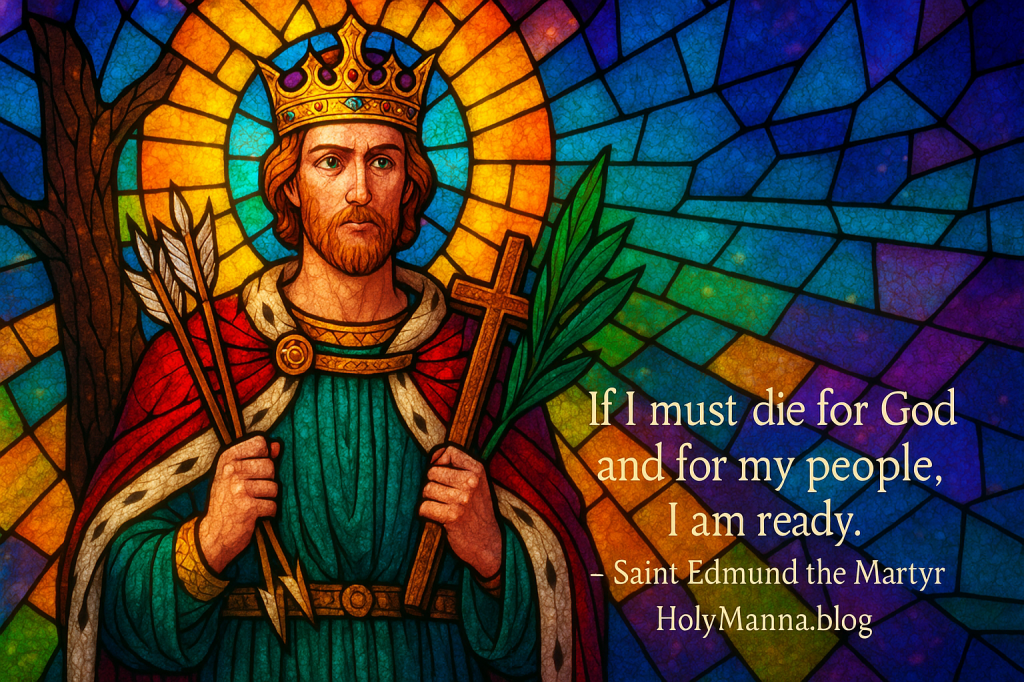
Crowned for Christ
Saint Edmund the Martyr, the young king of East Anglia who laid down his life for the kingship of Jesus, stands as a luminous reminder that authority is service and that fidelity to God outranks every other allegiance. His feast on November 20 kept his memory alive across centuries, drawing people to imitate his justice, prayer, and mercy. The witness of his martyrdom formed one of medieval England’s strongest currents of devotion, and his name became a rallying point for Christians who believed that holiness can and should shape public life. Edmund’s life is not a legend softened by time. It is a concrete challenge to lead with a clean heart, to love the poor without calculation, and to hold fast to Christ when compromise promises comfort.
Roots of a Christian King
Edmund was likely born around 841 or 842 and was chosen king while still a teenager. He was acclaimed and, by tradition, crowned in 855, beginning his rule the following year. The early sources describe a young ruler intent on holiness more than pomp. They present a king who shunned flattery, sought wisdom from Scripture, and kept regular prayer as the rhythm of his day. Some ancient accounts remember that he devoted himself to learning the Psalms so thoroughly that he could pray them from memory, a sign that his leadership flowed from worship rather than ambition. The East Anglian royal genealogies are sparse, so details about his parents and childhood remain uncertain, yet the broad picture holds: Edmund was formed by the Word of God and carried a sincere desire to be a shepherd more than a sovereign. His reputation for justice, personal purity, and almsgiving grew early, and that moral authority would become his most enduring legacy.
Governance as Gift
If one comes looking for spectacular wonders during Edmund’s reign, the earliest testimonies offer something different and arguably rarer. They show a king whose steady acts of justice, clemency, and mercy served his people in a season of upheaval. Edmund’s court was remembered for fair judgments and for a special solicitude for widows, orphans, and the poor. His generosity was not political theater. It flowed from a heart schooled by the Psalms and the teachings of the Church. In that sense, his “miracles” were moral rather than flashy. He healed social wounds by truth-telling, calmed conflicts by equity, and taught with the quiet authority of a man who prayed before he ruled. In later homiletic traditions, Edmund is praised as a model of Christian governance whose daily decisions formed an invisible cathedral of faith over his kingdom.
Arrows and a Crown of Glory
The crisis came with the advance of the Great Heathen Army in 869. East Anglia was pressed by experienced raiders who demanded submission and tribute. The ancient Passio insists that Edmund refused to save his throne by apostasy or by serving as a puppet under pagan rule. He was seized, beaten, and bound to a tree, then shot with so many arrows that his body resembled a bristling thicket. Finally, he was beheaded. Over time, names like Ivar and Ubba were attached to the story, and historians note that some particulars remain debated, but the heart of the account is clear: Edmund confessed Christ without flinching and accepted death rather than betray the covenant he had made with God and his people. The oldest narrative places on his lips a simple confession of resolve that sums up his royal soul: “Almighty God knows that I will never turn from His worship.” Another line attributed to him in the tradition of the Passio captures the same courage: “If I must die for God and for my people, I am ready.” The date associated with his martyrdom is November 20, 869, and the Church venerates him as a true martyr whose blood testified to the lordship of Jesus.
Wonders at the Shrine
After Edmund’s execution, his followers searched for the severed head. The story tells that they were guided by a mysterious cry, “Here, here,” and found the head guarded by a wolf that did not harm it. When the head was reunited with the body, the neck appeared whole, and the body remained incorrupt. These marvels ignited a wave of devotion. His remains were eventually enshrined at Beodricesworth, which came to be called Bury St Edmunds. Pilgrims flocked to his tomb, reporting healings of body and spirit, reconciliations in families long divided, and protection in times of danger. The cult grew so strong that major translations of his relics were celebrated with solemnity, including a renowned translation in the late eleventh century when a great church rose over his resting place. Although the shrine was destroyed during the Dissolution of the Monasteries in the sixteenth century and the exact fate of his relics is uncertain, the intercession of St Edmund kept nourishing faith long after stones had fallen. Accounts from the medieval period speak of the sick restored to health, sailors saved from peril, and rulers converted to mercy at his shrine.
A Nation Remembers
Edmund’s memory took root with astonishing reach. Within a generation or two, coinage appeared that honored him, a powerful sign that his sanctity resonated across political lines. His name became a symbol of a Christian vision for England in which authority bows to Christ and power serves the common good. Kings sought his patronage, monasteries took his name, and ordinary Christians carried his story like a torch through dark centuries. The abbey at Bury St Edmunds grew into one of the most important spiritual centers in the land, not because Edmund wielded force, but because he exemplified sacrificial leadership. His cult bridged peoples who had once been enemies. Even those with roots among the invaders who killed him eventually minted coins in his honor, a quiet testimony that sanctity outlasts violence and can convert cultures over time.
Faith Speaks Through Blood
The Church names Edmund’s witness for what it is. “Martyrdom is the supreme witness given to the truth of the faith. It means bearing witness even unto death.” The Catechism of the Catholic Church continues with a sweeping claim about the power of these lives: “The martyrs bear witness to Christ who died and rose, to whom they are united by charity. They bear witness to the truth of the faith and of Christian doctrine.” This is not an abstract ideal. It is a pattern of life made concrete in Edmund’s choices. The Catechism also teaches that the virtue of fortitude “ensures firmness in difficulties and constancy in the pursuit of the good,” which is exactly what Edmund displayed when threats and suffering surrounded him. When the world offers compromise dressed up as wisdom, Edmund’s martyrdom exposes the cost of discipleship and the glory of belonging to Christ without reserve.
Living Edmund’s Courage Today
Saint Edmund speaks to every Christian who carries responsibility, whether that is a home, a classroom, a shop floor, a shift team, or a parish. Leadership begins on the knees. Let prayer set the day’s direction and let Scripture cleanse motives before decisions are made. Justice is not an agenda item but a habit formed in small acts of honesty and fairness. Mercy starts with the person in front of you whom no one notices. When fear whispers that faith should retreat to keep the peace, Edmund’s calm courage answers that real peace is born from truth. Consider choosing one Psalm to pray slowly each day this week and let a single verse become the day’s compass. Make a concrete plan to give time or resources to someone who cannot repay you. Examine your conscience each night with clarity and gratitude. Edmund’s path was simple and costly: love Jesus first, serve people well, and never trade the truth for the illusion of safety.
Engage with Us!
Share your thoughts and reflections in the comments below.
- Where do convenience and comfort most tempt you to compromise your faith, and how could Edmund’s resolve strengthen your next decision?
- What would justice and mercy look like in your leadership at home, at work, or in your parish this week?
- Which Psalm will you pray today as a step toward Edmund’s Scripture-shaped heart, and how will you live one line of it in action?
Go forward with courage. Live a life of faith, and do everything with the love and mercy Jesus taught.
Saint Edmund the Martyr, pray for us!
Follow us on Instagram and Facebook for more insights and reflections on living a faith-filled life.

 Holy Manna!
Leave a comment