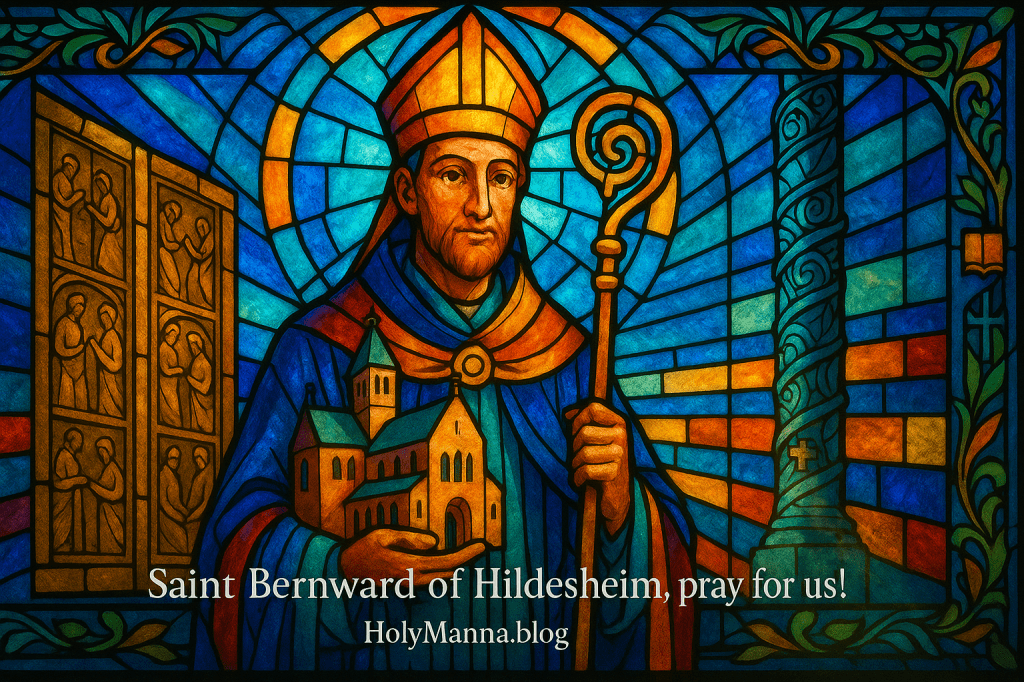
Master Builder of Faith
Saint Bernward, thirteenth Bishop of Hildesheim, stands out as a pastor who taught the Gospel through beauty. He formed souls, defended right worship, and renewed the liturgical life of his diocese with learning and love. His legacy includes the abbey church of St. Michael at Hildesheim, the monumental bronze doors with scenes from Genesis and the Gospels, and the towering Christ Column that narrates the life of Jesus. His holiness and his vision for catechesis through art have inspired pilgrims for a thousand years. The Church celebrates his feast on November 20, and his canonization was confirmed in 1193. In the spirit of the Catechism of the Catholic Church, sacred art in Bernward’s hands became evangelization in bronze, stone, and light. “Sacred art is true and beautiful when its form corresponds to its particular vocation, evoking and glorifying, in faith and adoration, the transcendent mystery of God.”
Roots in Saxony and a Heart Educated for Heaven
Bernward was born around 960 into a noble Saxon family and lost his parents at a young age. Family placed him under the care of learned churchmen who saw both intelligence and virtue in him. He studied the liberal arts and sacred doctrine with unusual seriousness for a teenager, and he also trained in practical crafts such as metalwork and architecture, skills that later served the altar. He was ordained a priest at Mainz and soon served as imperial chaplain in the Ottonian court. His reputation for integrity and learning led to his role as tutor to the young Otto III, an appointment that deepened his sense of responsibility for the soul of Christian culture. In 993 he was elected Bishop of Hildesheim. From the day of his consecration, his heart was fixed on forming a people who could pray with the Church, think with the Church, and adore Christ with reverence and beauty. Bernward is best known for founding St. Michael’s Abbey, commissioning the great bronze doors in 1015, and raising the Christ Column as a triumphant testimony to the Lord’s saving work.
A Shepherd’s Daily Work
Bernward’s episcopal ministry blended pastoral care with artistic genius. He reformed clerical life, strengthened schools, and supported monastic renewal, since he knew that sound formation brings fruit in preaching and prayer. He encouraged the works of mercy, cared for the poor, and invested diocesan resources in churches that lifted hearts to God. At St. Michael’s he planned a double-choir basilica with a crypt that invited prayer near the saints. The Bernward Doors, cast in a single piece for each leaf, pair scenes of the Fall in Genesis with the healing and redemption found in the Gospels, so that anyone crossing that threshold would read salvation history with the eyes of faith. The Christ Column rises like an ancient victory column, but its spiral reliefs proclaim the true Victor, Jesus Christ. Bernward did not decorate for mere beauty. He catechized with images, teaching through narrative and symbol so that worshipers could see how creation, fall, and redemption flow into the Eucharist. Accounts from his contemporaries describe a bishop who prayed, fasted, preached, and even fashioned vessels for the altar with skilled hands. Miracles in his lifetime were not the showy kind, yet people saw God’s grace in the conversion of hearts, the reverence of the liturgy, and the steady reform of a diocese that learned to love Christ more.
Trials Faced with Prudence, Courage, and Humility
Bernward’s era brought political tensions, shifting alliances, and the constant need to safeguard the Church’s freedom. He dealt with contested jurisdictions, the maintenance of city defenses, and the practical burdens that come with shepherding a culturally important and strategically placed diocese. He met these challenges with prayer, prudent administration, and a firm commitment to justice and charity. Near the end of his life he chose the humility of the monastic habit, receiving it shortly before his death, which came on November 20, 1022. He was not a martyr in the strict sense, yet he offered a form of daily martyrdom by dying to self, bearing responsibility for his people, and pouring out his gifts so that God would be glorified in a holy, educated, and worshiping Church.
Healings and Hope at His Tomb
After Bernward’s death, devotion grew rapidly. Pilgrims visited his tomb in the crypt of St. Michael’s, and reports of healings and favors spread among the faithful. Monks recorded answered prayers, recoveries from illness, and the quiet transformations that so often accompany veneration of holy bishops who lived what they taught. These signs of God’s mercy through Bernward’s intercession supported the recognition of his sanctity and sustained the pilgrim tradition that continues in Hildesheim to this day. His relics have been honored for centuries, and the churches shaped by his vision remain places where believers encounter Christ in word, sacrament, and the beauty of sacred art.
Let Beauty Evangelize and Love Become Skill
Bernward shows that beauty is not a luxury in the Church, it is a school of faith. His life teaches that art, architecture, music, and craftsmanship form minds and hearts when they serve the Gospel with humility. This lesson reaches into ordinary life. A family can make the home a small church with a crucifix on the wall, a prayer corner, and music that lifts the mind to God. A parish can invest in reverent liturgy, dignified vestments, and catechesis that draws children into the stories depicted in stained glass and on sacred images. Professionals and tradespeople can offer their skills to God, since Bernward reminds everyone that excellence belongs at the service of the altar. When worship becomes beautiful and true, faith becomes stronger, hope becomes steadier, and charity becomes more concrete. “The fine arts, but above all sacred art, are, of their nature, directed toward expressing in some way the infinite beauty of God in works made by human hands.” This conviction, echoed in the Catechism, shaped a holy bishop who still teaches the Church how to pray with her eyes and adore with her whole heart.
Note on quotations: there are no widely attested personal sayings from Saint Bernward that the Church proposes as verified quotations, so none are included here.
Engage with Us!
Share your reflections below and enrich the conversation with prayerful insight.
- How does Saint Bernward’s use of beauty to teach the faith challenge your view of sacred art and church architecture?
- Where have you personally encountered art or music that drew you closer to Christ in prayer?
- What concrete step could your parish take this month to make the liturgy and sacred space more clearly point to the mysteries of salvation?
- How might Bernward’s steady pastoral leadership encourage you to practice faithfulness in today’s cultural pressures?
May Saint Bernward’s intercession help all to build lives that glorify God, doing everything with the love and mercy Jesus taught.
Saint Bernward of Hildesheim, pray for us!
Follow us on Instagram and Facebook for more insights and reflections on living a faith-filled life.

 Holy Manna!
Leave a comment