Wednesday of the Thirty-third Week in Ordinary Time – Lectionary: 499
Faith That Risks and Yields Return
Here is a day to let courage grow roots and to let trust become action. In 2 Maccabees 7, a mother and her seven sons face brutal pressure under Antiochus IV’s Hellenistic crackdown, refusing to violate God’s law and staking everything on the Creator’s promise of resurrection, even as the mother urges her son with the hope that God will “give you back both breath and life”. That same conviction rises in Psalm 17, where the just cling to God’s path and pray to be hidden under His wings until the deepest desire is granted in the words “let me see your face”. Near Jerusalem, with expectations soaring, Luke 19:11-28 clarifies what waiting for the Kingdom looks like: not fear, not passivity, but faithful risk with what the King has entrusted, so that the returning Lord may say “Well done, good servant!” after telling His servants to “Engage in trade until I return.” Set against the late-season rhythm of Ordinary Time, when the Church turns hearts toward judgment, resurrection, and the Kingship of Christ, these readings press the same truth from different angles: courageous fidelity to God’s law, persevering prayer that longs for His face, and bold stewardship that multiplies His gifts while the King seems away. The witness of martyrdom and the hope of resurrection affirmed in CCC 2473-2474 and CCC 993-1014, together with the call to fruitful responsibility taught in the parables in CCC 546, all converge under the sovereignty of Christ’s reign in CCC 668-674. What talent, time, or testimony needs to be placed at God’s disposal today so that fear gives way to faith and waiting becomes work that bears real fruit?
First Reading – 2 Maccabees 7:1, 20–31
Courage that Chooses God and Trusts the Resurrection
Under the brutal policies of Antiochus IV Epiphanes in the second century before Christ, Jewish families were pressured to abandon the covenant and adopt Hellenistic customs, including eating pork forbidden by the Law. The story in 2 Maccabees 7 records a mother and her seven sons who refuse compromise and choose fidelity even unto death. Their courage springs from belief in the Creator who made all things from nothing and who will raise the faithful to life. This narrative anchors today’s theme: courageous fidelity to God’s law that actively hopes in the resurrection and strengthens every act of stewardship for the true King. The mother’s witness becomes a living catechesis on creation, moral freedom, and eternal hope, preparing hearts to hear the Lord’s call in the Gospel to invest every gift in view of the Kingdom.
2 Maccabees 7:1, 20-31
New American Bible (Revised Edition)
Martyrdom of a Mother and Her Seven Sons. 1 It also happened that seven brothers with their mother were arrested and tortured with whips and scourges by the king to force them to eat pork in violation of God’s law.
20 Most admirable and worthy of everlasting remembrance was the mother who, seeing her seven sons perish in a single day, bore it courageously because of her hope in the Lord. 21 Filled with a noble spirit that stirred her womanly reason with manly emotion, she exhorted each of them in the language of their ancestors with these words: 22 “I do not know how you came to be in my womb; it was not I who gave you breath and life, nor was it I who arranged the elements you are made of. 23 Therefore, since it is the Creator of the universe who shaped the beginning of humankind and brought about the origin of everything, he, in his mercy, will give you back both breath and life, because you now disregard yourselves for the sake of his law.”
24 Antiochus, suspecting insult in her words, thought he was being ridiculed. As the youngest brother was still alive, the king appealed to him, not with mere words, but with promises on oath, to make him rich and happy if he would abandon his ancestral customs: he would make him his Friend and entrust him with high office. 25 When the youth paid no attention to him at all, the king appealed to the mother, urging her to advise her boy to save his life. 26 After he had urged her for a long time, she agreed to persuade her son. 27 She leaned over close to him and, in derision of the cruel tyrant, said in their native language: “Son, have pity on me, who carried you in my womb for nine months, nursed you for three years, brought you up, educated and supported you to your present age. 28 I beg you, child, to look at the heavens and the earth and see all that is in them; then you will know that God did not make them out of existing things. In the same way humankind came into existence. 29 Do not be afraid of this executioner, but be worthy of your brothers and accept death, so that in the time of mercy I may receive you again with your brothers.”
30 She had scarcely finished speaking when the youth said: “What is the delay? I will not obey the king’s command. I obey the command of the law given to our ancestors through Moses. 31 But you, who have contrived every kind of evil for the Hebrews, will not escape the hands of God.
Detailed Exegesis
Verse 1 – “It also happened that seven brothers with their mother were arrested and tortured with whips and scourges by the king to force them to eat pork in violation of God’s law.”
The scene opens with persecution aimed at coercing apostasy through a direct violation of the covenant. The pressure is targeted and public, designed to humiliate and unravel fidelity. The text frames resistance not as stubbornness but as obedience to divine revelation written into Israel’s life with God. This sets the moral stakes: allegiance to God over a tyrant’s demand.
Verse 20 – “Most admirable and worthy of everlasting remembrance was the mother who, seeing her seven sons perish in a single day, bore it courageously because of her hope in the Lord.”
The mother’s heroism is more than maternal affection. Her courage flows from theological hope. The sacred author marks her memory as perpetual because her hope in the Lord interprets suffering through the lens of God’s fidelity and future vindication.
Verse 21 – “Filled with a noble spirit that stirred her womanly reason with manly emotion, she exhorted each of them in the language of their ancestors with these words:”
Her exhortation arises from the Spirit’s strengthening. The description highlights virtue infused by God, not a merely natural stoicism. Speaking in the ancestral tongue roots her words in covenant identity and liturgical memory.
Verse 22 – “I do not know how you came to be in my womb; it was not I who gave you breath and life, nor was it I who arranged the elements you are made of.”
She confesses dependence on the Creator. Human parenthood participates in but does not originate life. This humility counters the king’s claim to power and locates origin and destiny in God alone.
Verse 23 – “Therefore, since it is the Creator of the universe who shaped the beginning of humankind and brought about the origin of everything, he, in his mercy, will give you back both breath and life, because you now disregard yourselves for the sake of his law.”
Creation grounds resurrection hope. The logic is simple and profound: the God who created can re-create. Mercy, not mere power, is the motive. Self-offering for God’s law becomes the path to receiving life again.
Verse 24 – “Antiochus, suspecting insult in her words, thought he was being ridiculed. As the youngest brother was still alive, the king appealed to him, not with mere words, but with promises on oath, to make him rich and happy if he would abandon his ancestral customs: he would make him his Friend and entrust him with high office.”
The tyrant shifts from cruelty to flattery. Riches, status, and friendships at court are presented as substitutes for covenant identity. The text unmasks temptation’s pattern: seduction through power and comfort to replace worship with compromise.
Verse 25 – “When the youth paid no attention to him at all, the king appealed to the mother, urging her to advise her boy to save his life.”
Refusal by the son reveals interior freedom. The king then targets the mother’s influence, attempting to invert her role as teacher of faith into an advocate for betrayal.
Verse 26 – “After he had urged her for a long time, she agreed to persuade her son.”
A dramatic pause signals strategy. The mother will indeed persuade, but toward faith, not capitulation. The narrative tension heightens the clarity of her conviction.
Verse 27 – “She leaned over close to him and, in derision of the cruel tyrant, said in their native language: ‘Son, have pity on me, who carried you in my womb for nine months, nursed you for three years, brought you up, educated and supported you to your present age.’”
Her maternal appeal authenticates her instruction. She claims the right to guide his conscience because she has borne and formed him. Love is not sentimental here; it is moral and theological.
Verse 28 – “‘I beg you, child, to look at the heavens and the earth and see all that is in them; then you will know that God did not make them out of existing things.[a] In the same way humankind came into existence.’”
She teaches creation out of nothing and calls for contemplative reason. The heavens and earth become a catechism. Recognizing creatio ex nihilo strengthens trust in God’s capacity to restore life.
Verse 29 – “‘Do not be afraid of this executioner, but be worthy of your brothers and accept death, so that in the time of mercy I may receive you again with your brothers.’”
Mercy frames the horizon. Death for fidelity is not annihilation but participation in a future reunion. Worthiness here means constancy under trial and solidarity with the faithful.
Verse 30 – “She had scarcely finished speaking when the youth said: ‘What is the delay? I will not obey the king’s command. I obey the command of the law given to our ancestors through Moses.’”
The son’s confession is terse and decisive. The contrast between the king’s command and the Mosaic Law clarifies that obedience to God has priority over any human authority.
Verse 31 – “‘But you, who have contrived every kind of evil for the Hebrews, will not escape the hands of God.’”
Final judgment is affirmed. Human injustice does not have the last word. The persecutor will face divine justice, which vindicates the faithful.
Teachings
The Church names this witness with clarity in CCC 2473: “Martyrdom is the supreme witness given to the truth of the faith: it means bearing witness even unto death; the martyr bears witness to Christ who died and rose, to whom he is united by charity.” The mother and her sons image this definition, showing that love of God can triumph over fear and violence. The Catechism deepens the theme of hope in CCC 296: “We believe that God needs no pre-existent thing or any help in order to create, nor is creation any sort of necessary emanation from the divine substance. God creates freely ‘out of nothing.’” Their confession of creatio ex nihilo naturally opens to resurrection faith articulated in CCC 993: “The Pharisees and many of the Lord’s contemporaries hoped for the resurrection. Jesus teaches it firmly.”
Moral freedom stands at the center. CCC 1730 teaches: “God created man a rational being, conferring on him the dignity of a person who can initiate and control his own actions.” The youths exercise this freedom rightly, even against a violent ruler. When civil authority commands evil, the faithful cannot comply. CCC 2242 states: “The citizen is obliged in conscience not to follow the directives of civil authorities when they are contrary to the demands of the moral order, to the fundamental rights of persons or the teachings of the Gospel.” Their fortitude exemplifies the virtue described in CCC 1808: “Fortitude is the moral virtue that ensures firmness in difficulties and constancy in the pursuit of the good.”
The martyrs’ blood becomes seed for future faith, as Tertullian writes in Apologeticus: “The blood of the martyrs is the seed of Christians.” The Church also preserves the voice of Saint Polycarp as quoted in CCC 2474: “Eighty-six years have I served him, and he has done me no wrong. How can I blaspheme my King and Savior?” These testimonies echo the mother’s appeal, showing that the God who creates from nothing also crowns fidelity with life.
Reflection
Faith today faces subtler pressures than a tyrant’s whip, yet the choices are just as real. Entertainment, comfort, and approval can promise an easier path if the heart will trade away a piece of the Gospel. The Maccabean family teaches that courage grows when eyes are lifted to the Creator and when hope in resurrection is more than a theory. Concrete habits shape this courage: daily examination of conscience, regular confession, frequent meditation on the passion and the glory of Christ the King, and small acts of costly fidelity when no one is watching. Charity toward the vulnerable, truth spoken gently in difficult conversations, and keeping the Lord’s Day holy are ways to invest the “coin” entrusted by God with real returns for the Kingdom. Which pressure today asks for a quiet compromise rather than courageous fidelity to God? What concrete step can be taken to honor the Creator with time, speech, or choices so that fear loses its grip? Where does hope in the resurrection need to move from an idea to a daily practice that orders decisions, unlocks courage, and multiplies love?
Responsorial Psalm – Psalm 17:1, 5–6, 8, 15
Sheltered Under His Wings, Striving to See His Face
Composed as a prayer of David amid hostility, Psalm 17 is a covenant appeal for God to vindicate the innocent and shelter the faithful. In Israel’s worship this language carried temple imagery, where the mercy seat was overshadowed by cherubim and the faithful drew near for refuge. The phrase “apple of your eye” evokes the pupil, the most guarded part of the eye, signaling intimate protection, while the “shadow of your wings” evokes God’s nearness and care. Prayed alongside 2 Maccabees 7, the psalm becomes the inner voice of courageous fidelity that refuses compromise, trusts divine justice, and hopes to behold God. In the arc of Ordinary Time as hearts fix on Christ’s return, the psalm’s longing to see God’s face prepares for the Gospel’s call to invest every grace with bold, persevering faith.
Psalm 17:1, 5-6, 8, 15
New American Bible (Revised Edition)
Prayer for Rescue from Persecutors
1 A prayer of David.
Hear, Lord, my plea for justice;
pay heed to my cry;
Listen to my prayer
from lips without guile.
5 My steps have kept to your paths;
my feet have not faltered.
6 I call upon you; answer me, O God.
Turn your ear to me; hear my speech.
8 Keep me as the apple of your eye;
hide me in the shadow of your wings
15 I am just—let me see your face;
when I awake, let me be filled with your presence.
Detailed Exegesis
Verse 1 – “Hear, Lord, my plea for justice; pay heed to my cry; Listen to my prayer from lips without guile.”
The psalm begins with a threefold petition that underscores urgency and trust. “Lips without guile” points to integrity of heart, which Scripture links to effective prayer. The just do not claim sinlessness, but they come without deceit, appealing to God’s faithful love and righteous judgment.
Verse 5 – “My steps have kept to your paths; my feet have not faltered.”
Covenant fidelity is described as walking the Lord’s paths. Stability under pressure is not self-generated courage but grace-enabled perseverance. This verse harmonizes with the steadfast witness of the Maccabean family, showing that God steadies those who choose His way.
Verse 6 – “I call upon you; answer me, O God. Turn your ear to me; hear my speech.”
The prayer intensifies with direct address. Petition is an act of relational trust, not a last resort. The psalmist expects God to listen, which anticipates the hope of resurrection and vindication for the faithful who suffer for the law.
Verse 8 – “Keep me as the apple of your eye; hide me in the shadow of your wings.”
The imagery of protective sight and overshadowing wings blends tenderness and strength. In temple symbolism the wings recall the cherubim over the mercy seat, signaling God’s enthroned presence among His people. The faithful do not seek escape from mission but shelter within it.
Verse 15 – “I am just; let me see your face; when I awake, let me be filled with your presence.”
The desire reaches its summit in the hope of beholding God. “When I awake” can suggest both daily renewal and, in the fuller light of revelation, resurrection. The psalmist longs not merely for rescue from enemies but for communion that satisfies every hunger.
Teachings
The Church situates this psalm within the heart of prayer. CCC 2559 teaches with Saint John Damascene: “Prayer is the raising of one’s mind and heart to God or the requesting of good things from God.” The psalm’s petitions are exactly this lifting of mind and heart in covenant trust. The ultimate aim of the psalm’s longing appears in the doctrine of the beatific vision. CCC 1028 states: “Because of his transcendence, God cannot be seen as he is, unless he himself opens up his mystery to man’s immediate contemplation and gives him the capacity for it. The Church calls this mysterious gift of God ‘the beatific vision.’” The cry “let me see your face” finds its fulfillment in that promised vision.
Saint Augustine names the restlessness behind this desire in Confessions I, 1: “You have made us for yourself, O Lord, and our heart is restless until it rests in you.” The psalm’s thirst for God’s face resonates with this enduring human ache. The Church also teaches that sincere prayer requires honesty and conversion. CCC 2710 echoes Saint Teresa of Avila on contemplative prayer: “Contemplative prayer in my opinion is nothing else than a close sharing between friends; it means taking time frequently to be alone with him who we know loves us.” The language of “apple of your eye” and “shadow of your wings” invites exactly this trusting closeness. In seasons of trial, the faithful remember that God guards the just and will vindicate them in due time, which aligns with the moral courage celebrated in CCC 1808 on fortitude: “Fortitude is the moral virtue that ensures firmness in difficulties and constancy in the pursuit of the good.”
Reflection
This psalm trains hearts to bring pressure, fear, and confusion into God’s presence rather than into anxious self-reliance. A simple way to live it is to pray these verses slowly at the start or close of the day, asking for clean speech, steady steps, and a listening heart. Integrity in small choices, guarding speech from cynicism, and choosing truth when reputations are on the line are concrete ways to walk the Lord’s paths. Acts of mercy become a shelter for others, mirroring the shadow of His wings. When prayer feels dry, resting in silent adoration with the words “let me see your face” can reawaken desire for God more than for quick solutions. Where does God invite a return to guileless speech and honest prayer today? What decision requires steady steps so that feet do not falter on the Lord’s path? How can time be set aside this week to seek God’s face so that awakening is filled with His presence and courage for faithful stewardship?
Holy Gospel – Luke 19:11–28
Investing the King’s Gifts with Courageous Fidelity
Near Jerusalem, expectations about the immediate arrival of God’s Kingdom press upon the crowd in Luke 19:11–28. Jesus answers with a royal parable that would have resonated in a world familiar with client rulers who traveled away to receive authority and then returned to exercise it. The story sets a clear horizon. The true King will return, there will be an accounting, and the time between His departure and return is not for fear or passivity but for faithful, risk-taking stewardship. Read alongside 2 Maccabees 7 and Psalm 17, this Gospel shows that courageous fidelity to God’s law produces real fruit while waiting for the King. The disciple lives in hope of the Kingdom, prays for protection and vision, and invests every entrusted “coin” for the Lord’s glory until the day of reckoning.
Luke 19:11-28
New American Bible (Revised Edition)
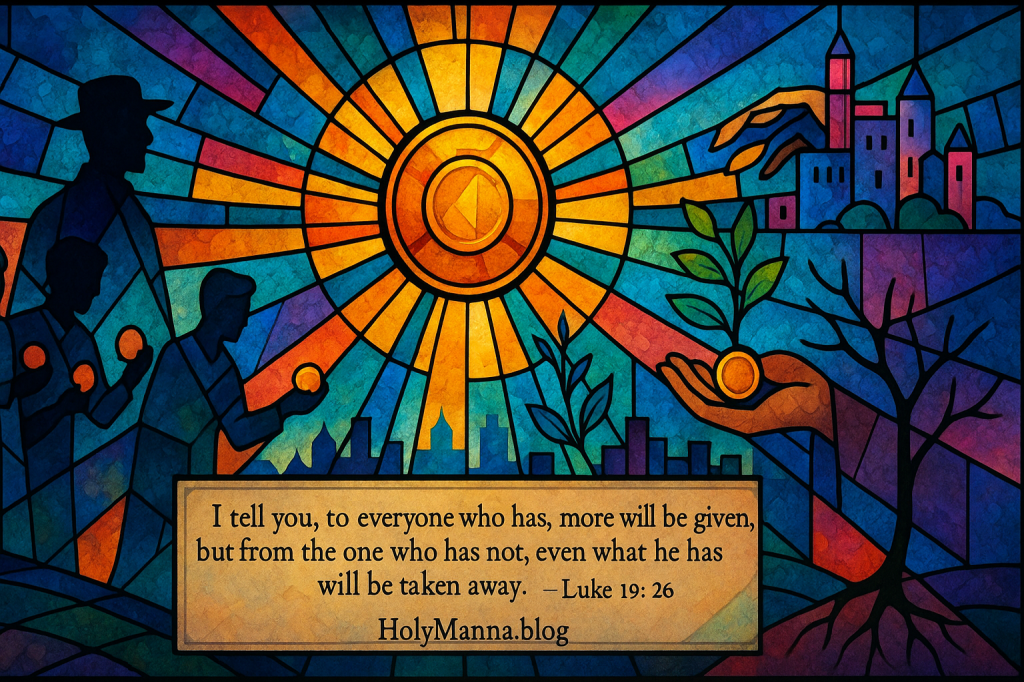
11 While they were listening to him speak, he proceeded to tell a parable because he was near Jerusalem and they thought that the kingdom of God would appear there immediately. 12 So he said, “A nobleman went off to a distant country to obtain the kingship for himself and then to return. 13 He called ten of his servants and gave them ten gold coins and told them, ‘Engage in trade with these until I return.’ 14 His fellow citizens, however, despised him and sent a delegation after him to announce, ‘We do not want this man to be our king.’ 15 But when he returned after obtaining the kingship, he had the servants called, to whom he had given the money, to learn what they had gained by trading. 16 The first came forward and said, ‘Sir, your gold coin has earned ten additional ones.’ 17 He replied, ‘Well done, good servant! You have been faithful in this very small matter; take charge of ten cities.’ 18 Then the second came and reported, ‘Your gold coin, sir, has earned five more.’ 19 And to this servant too he said, ‘You, take charge of five cities.’ 20 Then the other servant came and said, ‘Sir, here is your gold coin; I kept it stored away in a handkerchief, 21 for I was afraid of you, because you are a demanding person; you take up what you did not lay down and you harvest what you did not plant.’ 22 He said to him, ‘With your own words I shall condemn you, you wicked servant. You knew I was a demanding person, taking up what I did not lay down and harvesting what I did not plant; 23 why did you not put my money in a bank? Then on my return I would have collected it with interest.’ 24 And to those standing by he said, ‘Take the gold coin from him and give it to the servant who has ten.’ 25 But they said to him, ‘Sir, he has ten gold coins.’ 26 ‘I tell you, to everyone who has, more will be given, but from the one who has not, even what he has will be taken away. 27 Now as for those enemies of mine who did not want me as their king, bring them here and slay them before me.’”
The Entry into Jerusalem. 28 After he had said this, he proceeded on his journey up to Jerusalem.
Detailed Exegesis
Verse 11 – “While they were listening to him speak, he proceeded to tell a parable because he was near Jerusalem and they thought that the kingdom of God would appear there immediately.”
The parable responds to a mistaken timetable. Proximity to Jerusalem heightens messianic hopes. Jesus corrects urgency that expects instant triumph by teaching about responsible mission during the King’s apparent absence.
Verse 12 – “So he said, ‘A nobleman went off to a distant country to obtain the kingship for himself and then to return.’”
The nobleman’s journey mirrors known political procedures of the age and serves the theological point. The King’s reign is real, yet His return introduces a period of testing. Authority is certain, but accountability awaits His coming.
Verse 13 – “He called ten of his servants and gave them ten gold coins and told them, ‘Engage in trade with these until I return.’”
The command defines discipleship in the interim. The gifts are not ornaments. They are capital for mission. To “engage in trade” means to put grace, charisms, opportunities, and responsibilities to work for the Kingdom’s increase.
Verse 14 – “His fellow citizens, however, despised him and sent a delegation after him to announce, ‘We do not want this man to be our king.’”
Open rejection frames the servants’ task. Stewardship unfolds amid hostility. Fidelity will require courage, not comfort.
Verse 15 – “But when he returned after obtaining the kingship, he had the servants called, to whom he had given the money, to learn what they had gained by trading.”
The King’s return is the moment of judgment. The criterion is fruitfulness with the entrusted goods. The question is not merely about preservation but about increase.
Verse 16 – “The first came forward and said, ‘Sir, your gold coin has earned ten additional ones.’”
The servant reports multiplication. The increase is attributed to the King’s own gift. The servant recognizes stewardship, not ownership.
Verse 17 – “He replied, ‘Well done, good servant! You have been faithful in this very small matter; take charge of ten cities.’”
Faithfulness with small things leads to greater participation in the King’s rule. The reward is not leisure but deeper responsibility in communion with the King.
Verse 18 – “Then the second came and reported, ‘Your gold coin, sir, has earned five more.’”
Different results, same fidelity. The King values fruitfulness proportionate to opportunity and courage. Comparison gives way to commendation.
Verse 19 – “And to this servant too he said, ‘You, take charge of five cities.’”
Justice is measured, generous, and tailored. Authority in the Kingdom corresponds to demonstrated trustworthiness.
Verse 20 – “Then the other servant came and said, ‘Sir, here is your gold coin; I kept it stored away in a handkerchief,’”
Fear-driven inaction appears. Hiding the gift protects neither the coin nor the servant’s vocation. Neglect is not neutrality. It is refusal.
Verse 21 – “‘for I was afraid of you, because you are a demanding person; you take up what you did not lay down and you harvest what you did not plant.’”
A distorted image of the King justifies paralysis. The servant projects severity onto the master and excuses failure to love and risk for the Kingdom.
Verse 22 – “He said to him, ‘With your own words I shall condemn you, you wicked servant. You knew I was a demanding person, taking up what I did not lay down and harvesting what I did not plant;’”
The King judges the servant by the servant’s stated premise. If the master is so exacting, then inaction is indefensible. The problem is not the master’s character but the servant’s refusal of mission.
Verse 23 – “‘why did you not put my money in a bank? Then on my return I would have collected it with interest.’”
Even minimal effort would have honored the King. The rebuke exposes that fear masked sloth and indifference. Love always finds at least a small way to bear fruit.
Verse 24 – “And to those standing by he said, ‘Take the gold coin from him and give it to the servant who has ten.’”
Gifts migrate toward fruitfulness. In the Kingdom, unused grace is reassigned to those who will serve with it.
Verse 25 – “But they said to him, ‘Sir, he has ten gold coins.’”
The onlookers protest what appears inequitable. The parable challenges human notions of fairness by unveiling divine generosity toward faithful love.
Verse 26 – “‘I tell you, to everyone who has, more will be given, but from the one who has not, even what he has will be taken away.’”
This principle summarizes Kingdom economics. Receptivity and responsible action open the door to greater participation. Refusal shrinks the capacity for communion and service.
Verse 27 – “‘Now as for those enemies of mine who did not want me as their king, bring them here and slay them before me.’”
A sobering word of judgment underscores that rejection of the rightful King has consequences. Mercy is offered, but contempt for the King’s reign culminates in justice.
Verse 28 – “After he had said this, he proceeded on his journey up to Jerusalem.”
The narrative shifts from parable to pilgrimage. The teaching points directly to the Passion, where the true King secures His Kingdom through the Cross and will return in glory.
Teachings
The Church explains why Jesus teaches in parables and what they demand. CCC 546 states: “Jesus’ invitation to enter his kingdom comes in the form of parables, a characteristic feature of his teaching.” It adds a searching question: “What use has he made of the talents he has received?” The parable of the gold coins confronts disciples with that exact examination. God dignifies human action within His providence. CCC 307 teaches: “God thus enables men to be intelligent and free causes in order to complete the work of creation, to perfect its harmony for their own good and that of their neighbors. Though often unconscious collaborators with God’s will, they can also enter deliberately into the divine plan by their actions, their prayers, and their sufferings.”
Authentic stewardship presumes true freedom. CCC 1730 affirms: “God created man a rational being, conferring on him the dignity of a person who can initiate and control his own actions.” Courage is required for this mission. CCC 1808 defines fortitude: “Fortitude is the moral virtue that ensures firmness in difficulties and constancy in the pursuit of the good.” The saints echo this cooperation with grace. Saint Augustine teaches the synergy of divine initiative and human response: “He who created you without you will not justify you without you.” This Gospel therefore forms disciples who reject fearful inertia, embrace responsible risk for love of the King, and live every day as an offering that will be accounted for at His return.
Reflection
This teaching lands where decisions are actually made. Gifts and opportunities sit in pockets and calendars waiting to be traded for the King’s increase. Consider naming the concrete “coin” entrusted in this season, whether a relationship, a skill, a post of service, or a quiet suffering that can be offered in love. Make a simple plan to invest it with faith. Take a small risk for the Gospel that has been delayed out of fear, such as initiating a hard but charitable conversation, serving a neglected neighbor, or committing to consistent prayer and confession that shapes decisions. Ask the Holy Spirit for fortitude when excuses and projections about God’s severity begin to rise. Which entrusted gift needs to be taken out of the handkerchief and placed into action this week? What single courageous step would honor the King’s command to “engage in trade” until He returns? How can daily prayer recalibrate the image of the King so that fear gives way to love and stewardship bears fruit that lasts?
Courage That Sees His Face and Invests His Gifts
Today’s Word draws a single line through 2 Maccabees 7, Psalm 17, and Luke 19:11–28: courageous fidelity to God that hopes in the resurrection, prays to see His face, and turns entrusted gifts into real fruit for the Kingdom. The mother and her sons in 2 Maccabees 7 fix their hearts on the Creator who “will give you back both breath and life”, which anchors every choice in the promise of restoration. The just one in Psalm 17 walks God’s paths and pleads, “let me see your face” Ps 17:15, trusting that divine protection forms brave hearts under the shadow of His wings. The Lord in Luke 19:11–28 commands, “Engage in trade until I return”, revealing that waiting for the true King is never passive. It is the daily adventure of love that invests time, talents, and trials so that the returning King may say, “Well done, good servant!”
This is the rhythm of discipleship at the close of Ordinary Time. Hope in the resurrection fuels holy risk. Prayer purifies desire until only God satisfies. Stewardship becomes worship as every coin is offered for the King’s increase. The Church’s teaching in CCC 1808 names the virtue for this hour as fortitude, a steady courage that chooses the good even when fear whispers excuses. Let hearts hold fast to the Creator, ask boldly to see His face, and put grace to work with confident love.
Here is the call to action. Name the one gift that has been hidden out of fear and place it at God’s disposal today. Choose one courageous step that serves someone concrete and gives God a return on what He has entrusted. Let prayer each morning echo the psalm, “Hear, Lord, my plea for justice” Ps 17:1, and let every evening ask how the coin was traded for His glory. What specific act of fidelity will honor the King today? How will time, speech, and service be invested so that fear gives way to faith and hope becomes love in action?
Engage with Us!
Share reflections in the comments below and help the community grow in wisdom and courage together.
- First Reading – 2 Maccabees 7:1, 20–31: Where is fidelity to God asking for costly courage this week? How does contemplating the Creator who made all from nothing strengthen hope in the resurrection and steady difficult choices? What subtle compromise needs to be renounced today in order to honor God’s law with a clear heart?
- Responsorial Psalm – Psalm 17:1, 5–6, 8, 15: What would guileless speech sound like in one conversation today, and how can prayer prepare the heart for it? Where is the “shadow of His wings” being sought for protection and peace right now? How can the day be arranged to seek God’s face so that awakening is filled with His presence?
- Holy Gospel – Luke 19:11–28: Which entrusted “coin” has been hidden out of fear, and what concrete action will place it in service of the King? How can time, skills, and relationships be invested this week so that love bears real fruit? What step will help purify the image of the King so that fear gives way to trust and generous stewardship?
Live boldly in faith today, and do everything with the love and mercy Jesus taught, so that every choice reflects His Kingdom and every action gives Him glory.
Sacred Heart of Jesus, we trust in You!
Immaculate Heart of Mary, pray for us!
Saint Michael the Archangel, defend us in battle!
Follow us on Instagram and Facebook for more insights and reflections on living a faith-filled life.

 Holy Manna!
Leave a comment