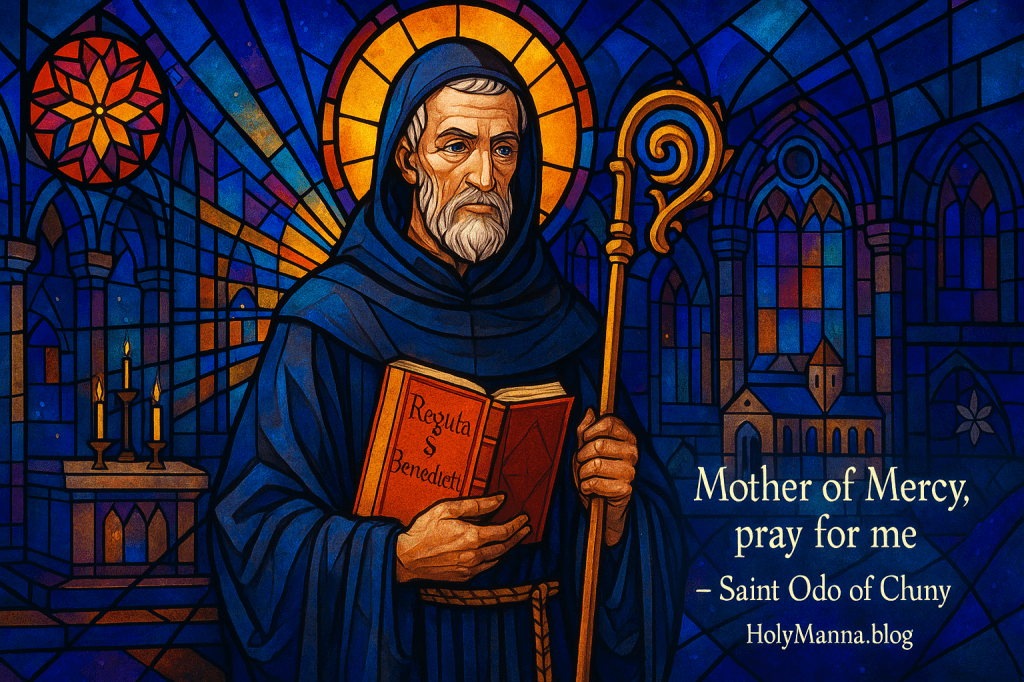
A bright lamp in a dark century
Saint Odo of Cluny (c. 878–942) stands as a fierce and joyful reformer who helped rekindle monastic life when much of Europe felt weary and disordered. As the second abbot of Cluny, he called monks and laypeople alike back to the Rule of St. Benedict with a wisdom that married reverence for the liturgy, love for the poor, and courage in peacemaking. Odo wrote spiritual works that fed a Eucharistic faith and a Marian tenderness, and he labored tirelessly to restore monasteries in France and Italy to prayerful discipline. He has long been remembered as a shepherd who turned hearts toward the holiness of God and the beauty of worship, reminding the Church that authentic reform begins on our knees before the Lord. A cherished line from his teaching on the Eucharist captures the heart of his devotion: “At the Creator’s word the substance changes.”
Claimed by St. Martin, trained for holiness
Odo was born near Le Mans into a noble family and was placed under the patronage of St. Martin of Tours from infancy. He grew up in the shadow of Martin’s holiness, served as a canon at the Basilica of St. Martin, and pursued studies in Tours and Paris under masters who shaped his mind for both Scripture and sacred learning. The turning point came when he encountered the Rule of St. Benedict. Its clarity about prayer, work, obedience, and humility pierced his heart. This encounter moved him to leave the relative comfort of a canonical life and seek the stricter path of the monk. He entered Baume under Abbot Berno, then, upon Berno’s death, was chosen abbot of Cluny in 927. From that moment he became known across Christendom as a father of renewal. His piety had a tender Marian note that began in his youth; a simple prayer he loved reveals that intimacy with the Mother of God: “Mother of Mercy, pray for me.” Odo is best known for setting Cluny on a course of disciplined prayer, solemn liturgy, and charity that would shape monastic culture for generations.
Reform with beauty, mercy, and Eucharistic faith
Odo governed Cluny with a happy severity that sprang from love for God and souls. He insisted that the Divine Office be sung with dignity, that churches be kept beautiful yet simple, and that the poor be treated as honored guests of Christ. He wrote the Collationes to urge conversion of life, the Vita Sancti Geraldi Auriliacensis to show that laypersons can reach real sanctity, and devotional pages that glow with Eucharistic awe. He frequently traveled to visit houses attached to Cluny, strengthened wavering communities, and promoted study and sacred music within the bounds of monastic moderation. He urged rulers to seek concord, monasteries to embrace their vows with joy, and priests to celebrate the sacred mysteries with pure hearts. The memory of his preaching lingers for its warmth and fire. He loved to gather children and teach them simple hymns, rewarding their efforts with small gifts so that joy would accompany sacred song. His biographer preserves episodes that believers recognized as signs of God’s favor: brigands who turned back in sudden fear as the abbot passed praying the psalms, provisions arriving unexpectedly for hungry monks during fasts, and narrow escapes on Alpine roads that he attributed to providence rather than his own skill. These moments testified to a life steeped in prayer and protected for the sake of the mission God had entrusted to him.
Carrying the cross for the peace of the Church
Odo never shed his blood for Christ, yet he tasted the long obedience of a white martyrdom. Reform always meets resistance, and he faced criticism from communities that had grown lax and from leaders who resented Cluny’s influence. He crossed the Alps multiple times on demanding journeys to reconcile warring factions, to comfort afflicted monasteries, and to advise bishops and princes. He struggled with infirmities near the end of his life, but he refused idleness and pressed on until he could return to the beloved city of Tours. There, near the tomb of St. Martin who had watched over him since childhood, Odo surrendered his soul to God on November 18, 942. His life shows how God can use firm gentleness to heal a broken age: a monk who loved silence and chant, a diplomat who prized peace without compromising truth, and a pastor who believed that the beauty of worship draws sinners home.
A memory that heals and gathers
Christians honored Odo quickly after his death, treasuring his memory at Tours and within the Cluniac family. Tradition speaks of healings obtained through his intercession and of pilgrims who drew strength for conversion at sites associated with him. His relics were venerated in Tours, and devotion to him spread wherever Cluny had planted houses. The Church continues to keep his feast on November 18. His legacy breathes in every monastery that cherishes the psalms, guards silence, feeds the poor at the gate, and celebrates the sacred mysteries with humble awe. The pattern of his intercession has a familiar shape: peace for feuding hearts, courage for reformers, mercy for the suffering, and a deeper love for the Eucharist that he adored as the beating Heart of the Church.
Learning Odo’s way today
Saint Odo invites a return to first things. He calls believers to let the Eucharist become the source and summit of daily life, to confess sins with sincerity, and to receive Holy Communion in a state of grace, because Christ’s Real Presence is not a symbol but a sacrament of love. He urges a more reverent Sunday, a guarded tongue, and a generous hand toward the poor. He teaches that sacred worship is not mere formality but the praise of God that transforms communities from the inside out. He models Marian trust that stays simple and strong in times of trial. Consider adopting a small Benedictine rhythm at home: a fixed time of morning and evening prayer, a brief nightly examen, a weekly hour of Adoration, and a habit of almsgiving that pinches just enough to convert the heart. Read a short passage from the Rule of St. Benedict, learn a simple hymn, and keep a crucifix or icon where eyes fall on it often. Reform begins quietly and bears fruit in due season. The Church needs Odo’s spirit now as much as ever, because holiness is always the most persuasive reform.
Engage with Us!
Share your thoughts and graces from St. Odo’s story in the comments.
- Where is Jesus inviting deeper reverence for the Eucharist in your life right now?
- What concrete step toward silence and prayer could begin this week?
- How might you serve the poor near you as part of your conversion?
- Which practice from the Benedictine spirit—stability, obedience, or humility—do you feel called to grow in this month?
- How can devotion to Mary as “Mother of Mercy” reshape your daily prayer?
May Saint Odo help every reader live a life of faith, offering everything with the love and mercy that Jesus taught.
Saint Odo of Cluny, pray for us!
Follow us on Instagram and Facebook for more insights and reflections on living a faith-filled life.

 Holy Manna!
Leave a comment