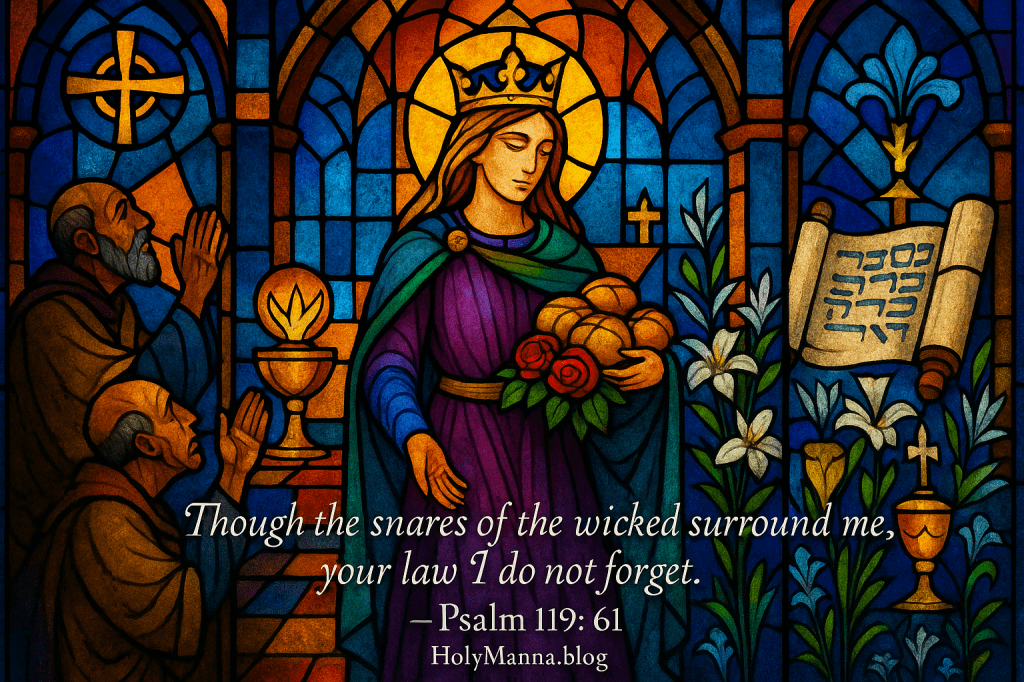
Memorial of Saint Elizabeth of Hungary, Religious – Lectionary: 497
Eyes Opened, Hearts Steadfast
On this Memorial of Saint Elizabeth of Hungary, the Word draws a straight line from steadfast fidelity to merciful action, showing how God opens eyes and then sends His people to love. The central theme is simple and searching: courageous loyalty to God’s covenant clears spiritual sight and overflows in concrete charity. In 1 Maccabees 1:10-15, 41-43, 54-57, 62-63, Israel faces a cultural storm under Antiochus IV Epiphanes, with forced conformity to pagan customs, the desecration of the altar, and executions for clinging to the Law. In that pressure cooker, the faithful remnant chooses obedience, even at the cost of life, a living picture of the virtue of fortitude described in CCC 1808. Psalm 119 sings from the same place of holy grit, grieving over lawlessness yet refusing to forget the Lord’s precepts, trusting that divine mercy sustains those who keep His statutes. Then Luke 18:35-43 brings the crisis home, as a blind beggar near Jericho cries out with persevering faith, “Jesus, Son of David, have pity on me!” Christ halts for him, and with royal authority declares, “Have sight; your faith has saved you.” The result is sight, discipleship, and praise, a pattern that reveals what God longs to do whenever hearts resist the crowd and cling to His mercy.
This same pattern shines in Saint Elizabeth of Hungary, a thirteenth century princess who embraced humble service and radical almsgiving in the spirit of Saint Francis. Formed by prayer and penance, she recognized Christ in the poor, built hospitals, and poured out her goods for the least, living what The Catechism calls the preferential love for the poor in CCC 2443-2449 and the works of mercy in CCC 2447. Her life answers today’s readings with a witness both countercultural and tender, proving that fidelity under pressure does not harden the heart, it clarifies the gaze. When God grants true sight, love becomes practical, reverent, and brave. Where is the heart tempted to blend in rather than belong to the Lord, and where is Christ asking for the courage to see and to serve today?
First Reading – 1 Maccabees 1:10-15, 41-43, 54-57, 62-63
Covenant fidelity under cultural pressure
The rise of Antiochus IV Epiphanes set off an aggressive program of forced Hellenization across Judea, pushing Israel to exchange the covenant for the prestige of Greek customs. The desecration of the Jerusalem Temple, the suppression of the Law, and the outlawing of core practices like circumcision and kosher observance created a crucible that tested Israel’s identity. In this setting, 1 Maccabees presents two paths. One path compromises with the spirit of the age and embraces idols. The other path clings to the covenant and accepts suffering, even death. This reading fits today’s theme by showing that courageous fidelity clears spiritual sight and births heroic love. The faithful remnant in Judea refuses to blend in and chooses obedience to God over the approval of the empire, preparing the heart to grasp Christ’s mercy and to live it with the clarity of Saint Elizabeth of Hungary, who recognized the Lord in the poor and served Him with fearless charity.
1 Maccabees 1:10-15, 41-43, 54-57, 62-63
New American Bible (Revised Edition)
10 There sprang from these a sinful offshoot, Antiochus Epiphanes, son of King Antiochus, once a hostage at Rome. He became king in the one hundred and thirty-seventh year of the kingdom of the Greeks.
Lawless Jews. 11 In those days there appeared in Israel transgressors of the law who seduced many, saying: “Let us go and make a covenant with the Gentiles all around us; since we separated from them, many evils have come upon us.” 12 The proposal was agreeable; 13 some from among the people promptly went to the king, and he authorized them to introduce the ordinances of the Gentiles. 14 Thereupon they built a gymnasium in Jerusalem according to the Gentile custom. 15 They disguised their circumcision and abandoned the holy covenant; they allied themselves with the Gentiles and sold themselves to wrongdoing.
Religious Persecution. 41 Then the king wrote to his whole kingdom that all should be one people, 42 and abandon their particular customs. All the Gentiles conformed to the command of the king, 43 and many Israelites delighted in his religion; they sacrificed to idols and profaned the sabbath.
54 On the fifteenth day of the month Kislev, in the year one hundred and forty-five, the king erected the desolating abomination upon the altar of burnt offerings, and in the surrounding cities of Judah they built pagan altars. 55 They also burned incense at the doors of houses and in the streets. 56 Any scrolls of the law that they found they tore up and burned. 57 Whoever was found with a scroll of the covenant, and whoever observed the law, was condemned to death by royal decree.
62 But many in Israel were determined and resolved in their hearts not to eat anything unclean; 63 they preferred to die rather than to be defiled with food or to profane the holy covenant; and they did die.
Detailed Exegesis
Verse 10 – “There sprang from these a sinful offshoot, Antiochus Epiphanes, son of King Antiochus, once a hostage at Rome. He became king in the one hundred and thirty-seventh year of the kingdom of the Greeks.”
Antiochus IV Epiphanes emerges as a ruler determined to unify his realm through cultural and religious conformity. The phrase “sinful offshoot” signals a theological reading of history, where kings are assessed by their relation to God’s covenant, not merely by power or success. The date situates readers in the Seleucid timeline and frames the persecution that follows.
Verse 11 – “In those days there appeared in Israel transgressors of the law who seduced many, saying: ‘Let us go and make a covenant with the Gentiles all around us; since we separated from them, many evils have come upon us.’”
Internal betrayal compounds external pressure. The proposed “covenant with the Gentiles” is a rival alliance that displaces the covenant with the Lord. The temptation cloaks itself in pragmatism, blaming fidelity for misfortune and promising relief through compromise.
Verse 12 – “The proposal was agreeable.”
Consent to compromise spreads quickly. The brevity underlines the ease with which communities can normalize what contradicts God’s law when comfort or status beckons.
Verse 13 – “Some from among the people promptly went to the king, and he authorized them to introduce the ordinances of the Gentiles.”
Political permission is sought for religious innovation. Authority becomes the mechanism that imposes a counter-religion, revealing how civil power can be leveraged against divine worship when it seeks uniformity at any cost.
Verse 14 – “Thereupon they built a gymnasium in Jerusalem according to the Gentile custom.”
The gymnasium represents more than athletics. It is a cultural center transmitting Greek identity, values, and cultic practices, signaling an attempt to reshape Israel from the heart of its capital outward.
Verse 15 – “They disguised their circumcision and abandoned the holy covenant; they allied themselves with the Gentiles and sold themselves to wrongdoing.”
Shame of the covenantal sign leads to renunciation of the covenant itself. The text names this drift “selling themselves,” a biblical image for idolatry and moral slavery that follows disobedience.
Verse 41 – “Then the king wrote to his whole kingdom that all should be one people,”
Imperial unity is invoked to justify the erasure of religious distinctiveness. The rhetoric of oneness hides coercion, turning tolerance on its head by demanding uniformity.
Verse 42 – “And abandon their particular customs. All the Gentiles conformed to the command of the king,”
The suppression of “particular customs” aims at Israel’s unique vocation. What looks like cultural policy is actually a direct assault on worship, identity, and conscience.
Verse 43 – “And many Israelites delighted in his religion; they sacrificed to idols and profaned the sabbath.”
Some do not merely comply. They “delight” in false worship, showing how sin can move from reluctant compromise to enthusiastic participation when the heart turns from God.
Verse 54 – “On the fifteenth day of the month Kislev, in the year one hundred and forty-five, the king erected the desolating abomination upon the altar of burnt offerings, and in the surrounding cities of Judah they built pagan altars.”
The “desolating abomination” marks the profanation of the Temple, likely an idolatrous altar set atop the Lord’s altar. Worship is redirected from the living God to a lifeless image, devastating Israel’s liturgical center.
Verse 55 – “They also burned incense at the doors of houses and in the streets.”
Idolatry becomes public and pervasive. Daily life is saturated with false cult, making fidelity costly at every turn.
Verse 56 – “Any scrolls of the law that they found they tore up and burned.”
The destruction of Scripture targets the source of Israel’s identity and memory. Erasing the Word attempts to sever the people from God’s voice.
Verse 57 – “Whoever was found with a scroll of the covenant, and whoever observed the law, was condemned to death by royal decree.”
Possessing and practicing the Law becomes a capital crime. The text exposes the stark line between divine command and unjust human law.
Verse 62 – “But many in Israel were determined and resolved in their hearts not to eat anything unclean;”
Here stands the remnant. Conscience is formed by God’s commandments, and diet becomes a battleground where fidelity is tested in ordinary choices.
Verse 63 – “They preferred to die rather than to be defiled with food or to profane the holy covenant; and they did die.”
Martyrdom crowns fidelity. The faithful choose obedience over life, witnessing that communion with God is worth more than survival. Their sacrifice anticipates Christian martyrdom, where love for God is proven unto death.
Teachings
The Church recognizes in this passage the clash between unjust laws and the primacy of God’s law. The Catechism teaches the virtue required to stand firm under pressure in CCC 1808: “Fortitude is the moral virtue that ensures firmness in difficulties and constancy in the pursuit of the good. It strengthens the resolve to resist temptations and to overcome obstacles in the moral life. The virtue of fortitude enables one to conquer fear, even fear of death, and to face trials and persecutions. It disposes one even to renounce and sacrifice his life in defense of a just cause.” This reading also unmasks idolatry’s perennial threat in CCC 2113: “Idolatry not only refers to false pagan worship. It remains a constant temptation. Idolatry consists in divinizing what is not God. Man commits idolatry whenever he honors and reveres a creature in place of God, whether this be gods or demons, for example Satan, power, pleasure, race, ancestors, the state, money, etc. Idolatry rejects the unique lordship of God; it is therefore incompatible with communion with God.” When civil authority commands what God forbids or forbids what God commands, conscience must resist, as taught in CCC 2242: “The citizen is obliged in conscience not to follow the directives of civil authorities when they are contrary to the demands of the moral order, to the fundamental rights of persons or the teachings of the Gospel. Refusing obedience to civil authorities, when their demands are contrary to those of an upright conscience, finds its justification in the distinction between serving God and serving the political community. ‘Render therefore to Caesar the things that are Caesar’s, and to God the things that are God’s.’” The faithful who choose death rather than apostasy embody CCC 2473: “Martyrdom is the supreme witness given to the truth of the faith: it means bearing witness even unto death. The martyr bears witness to Christ who died and rose, to whom he is united by charity. He bears witness to the truth of the faith and of Christian doctrine. He endures death through an act of fortitude.” Historically, the persecution under Antiochus IV in 167 BC catalyzed the Maccabean revolt and the rededication of the Temple, a memory that formed Israel to expect God’s deliverance and to hold fast under oppression. Spiritually, this passage trains disciples to read cultural pressure as a summons to deeper covenant love.
Reflection
Fidelity in small decisions prepares the soul for heroic choices when the heat turns up. The faithful in 1 Maccabees guard God’s law at the table, in the marketplace, and at the risk of their lives. Practical steps flow from their example. Choose daily practices that keep the heart anchored in God, like Scripture before screens, a brief examination of conscience at midday, and one concrete act of mercy for someone in need. Speak truth with charity when faith is mocked. Fast from what dulls zeal for God. Ask for fortitude in prayer and cultivate friendships that reinforce holiness rather than dilute it. Where is the heart tempted to trade covenant identity for acceptance or ease? Which small act of obedience today will strengthen the will for tomorrow’s trials? How is the Lord inviting a clearer, braver love that sees Him and serves Him in the least, following the path of Saint Elizabeth of Hungary?
Responsorial Psalm – Psalm 119:53, 61, 88, 134, 150, 155, 158
Law under fire, hearts anchored in God
Psalm 119 arises from a community battling pressure and compromise, lifting up the beauty of God’s law in the face of hostility. As the longest psalm and a meditation on the Torah, it trains the heart to love God’s commandments as life itself. In today’s context, the psalmist’s grief over lawlessness and plea for deliverance mirror the faithful remnant in 1 Maccabees who would rather die than betray the covenant. The psalm’s voice also harmonizes with the blind beggar of Luke 18:35-43, whose persistent cry draws mercy and healing. This prayer prepares the soul to see clearly and to live courageously. It sets the interior posture that Saint Elizabeth of Hungary embodied when she recognized Christ in the poor and served with generous fidelity. Spiritual sight and steadfast obedience belong together, and this psalm keeps both in view.
Psalm 119:53, 61, 88, 134, 150, 155, 158
New American Bible (Revised Edition)
53 Rage seizes me because of the wicked;
they forsake your law.
61 Though the snares of the wicked surround me,
your law I do not forget.
88 In your mercy give me life,
to observe the testimonies of your mouth.
134 Free me from human oppression,
that I may observe your precepts.
150 Malicious persecutors draw near me;
they are far from your law.
155 Salvation is far from sinners
because they do not cherish your statutes.
158 I view the faithless with loathing
because they do not heed your promise.
Detailed Exegesis
Verse 53 – “Rage seizes me because of the wicked; they forsake your law.”
Holy indignation rises when God’s law is abandoned, not because of wounded pride but because sin destroys persons and communities. The verse names the moral fracture of society and teaches zeal rightly ordered toward God’s glory and human flourishing.
Verse 61 – “Though the snares of the wicked surround me, your law I do not forget.”
Pressure does not excuse disobedience. Remembering God’s law under threat is the seed of fortitude. Fidelity here is not abstract. It is the daily choice to recall and keep God’s commands when compromise seems easier.
Verse 88 – “In your mercy give me life, to observe the testimonies of your mouth.”
Life is received as mercy, and mercy empowers obedience. The psalmist does not seek relief to return to comfort but asks for life precisely to keep God’s word. This is grace ordering freedom toward the good.
Verse 134 – “Free me from human oppression, that I may observe your precepts.”
Deliverance is requested for a purpose. Freedom is not mere escape from pressure. Freedom is the capacity to serve God. The psalmist desires social space to practice the covenant publicly and joyfully.
Verse 150 – “Malicious persecutors draw near me; they are far from your law.”
Closeness in space contrasts with distance from God. Persecutors may approach, but their distance from the law reveals the deeper reality. Proximity to danger does not cancel proximity to God’s will.
Verse 155 – “Salvation is far from sinners because they do not cherish your statutes.”
Distance from salvation is self-chosen when the heart refuses God’s ways. The verse is diagnostic, not despairing, and invites repentance by linking salvation to a heart that treasures God’s commands.
Verse 158 – “I view the faithless with loathing because they do not heed your promise.”
The psalm speaks the shock of covenant betrayal. The emotion is intense, yet the focus remains theological. The scandal is not merely bad behavior, it is contempt for God’s promise. The remedy is renewed love for God’s word and intercession for conversion.
Teachings
The Catechism describes the moral law as God’s fatherly instruction, anchoring the psalmist’s affection for the divine precepts: “The moral law is the work of divine Wisdom. Its biblical meaning can be defined as fatherly instruction, God’s pedagogy. For God gives this law to man to guide him to his beatitude. He prescribes for man the ways, the rules of conduct that lead to the promised beatitude; he prescribes them to the moral law.” (CCC 1950). Obedience under pressure requires the virtue praised in this psalm and displayed in the martyrs of 1 Maccabees: “Fortitude is the moral virtue that ensures firmness in difficulties and constancy in the pursuit of the good. It strengthens the resolve to resist temptations and to overcome obstacles in the moral life. The virtue of fortitude enables one to conquer fear, even fear of death, and to face trials and persecutions. It disposes one even to renounce and sacrifice his life in defense of a just cause.” (CCC 1808). The psalm’s plea for life to keep the commandments reflects the New Law’s interior grace: “The New Law is called a law of love, a law of grace, a law of freedom.” (CCC 1972). Conscience must be formed so that remembrance of the law becomes living judgment: “Conscience must be informed and moral judgment enlightened. A well-formed conscience is upright and truthful. It formulates its judgments according to reason, in conformity with the true good willed by the wisdom of the Creator.” (CCC 1783). The psalm’s cry for freedom from oppression so as to observe God’s precepts finds concrete expression in love for the poor as witnessed by Saint Elizabeth of Hungary: “God blesses those who come to the aid of the poor and rebukes those who turn away from them. It is by what they have done for the poor that Jesus Christ will recognize his chosen ones.” (CCC 2443). The works of mercy describe the shape of that fidelity in action: “The works of mercy are charitable actions by which we come to the aid of our neighbor in his spiritual and bodily necessities.” (CCC 2447). Saint Thomas Aquinas clarifies why this law deserves love: “Law is an ordinance of reason for the common good, made by him who has care of the community, and promulgated.” (Summa Theologiae I–II, q.90, a.4).
Reflection
This psalm teaches how to pray when culture pulls in the opposite direction and when habits drift toward spiritual sleep. Start the day by praying one verse slowly and asking for the grace to remember God’s word when pressure arrives. Choose a concrete act that embodies fidelity, such as a short examination of conscience at midday and a small mortification that keeps the heart free for obedience. Pair prayer with mercy by planning one specific work of service each week in honor of Saint Elizabeth of Hungary. When anger rises at the sight of sin, turn it into intercession for conversion and into gratitude for God’s patient mercy. Which verse from this psalm will be carried on the lips today as a shield and a guide? Where is freedom being asked for, not to do less, but to love God more? How will fidelity to God’s precepts become visible love for the poor this week?
Holy Gospel – Luke 18:35-43
Faith that will not be silenced and sight that becomes discipleship
Near Jericho, a city long associated with God’s decisive interventions in Israel’s history, a blind beggar cries out with messianic hope. The title “Son of David” signals faith that recognizes Jesus as the promised King whose reign brings mercy to the afflicted. In a culture where crowds often managed access to honor and power, this man refuses to be quiet, and Jesus responds with royal compassion. The encounter perfectly fits today’s theme. Courageous fidelity opens spiritual eyes, and true sight becomes following and praise. The remnant’s fortitude in 1 Maccabees and the psalmist’s steadfast love for the Law converge here in a living picture of persevering prayer that receives healing and moves immediately into worship and witness. Saint Elizabeth of Hungary prayed, saw Christ in the poor, and served Him with concrete works of mercy; the Gospel shows where that kind of merciful clarity begins.
Luke 18:35-43
New American Bible (Revised Edition)
35 Now as he approached Jericho a blind man was sitting by the roadside begging, 36 and hearing a crowd going by, he inquired what was happening. 37 They told him, “Jesus of Nazareth is passing by.” 38 He shouted, “Jesus, Son of David, have pity on me!” 39 The people walking in front rebuked him, telling him to be silent, but he kept calling out all the more, “Son of David, have pity on me!” 40 Then Jesus stopped and ordered that he be brought to him; and when he came near, Jesus asked him, 41 “What do you want me to do for you?” He replied, “Lord, please let me see.” 42 Jesus told him, “Have sight; your faith has saved you.” 43 He immediately received his sight and followed him, giving glory to God. When they saw this, all the people gave praise to God.
Detailed Exegesis
Verse 35 – “Now as he approached Jericho a blind man was sitting by the roadside begging,”
The setting highlights both need and promise. Jericho evokes memories of God’s saving power. The blind beggar represents humanity’s helplessness without grace and the Church’s mission toward those at the margins. The road becomes a catechism of salvation, where need meets divine mercy.
Verse 36 – “And hearing a crowd going by, he inquired what was happening.”
Hearing replaces sight, and inquiry replaces passivity. Even in darkness, desire for truth moves the heart toward Jesus. The Gospel honors the first stirrings of faith that begin with questions and with listening.
Verse 37 – “They told him, ‘Jesus of Nazareth is passing by.’”
A simple report becomes a summons. The name “Jesus of Nazareth” anchors the story in history and opens the door to faith’s confession. Grace often arrives through ordinary words that carry extraordinary possibility.
Verse 38 – “He shouted, ‘Jesus, Son of David, have pity on me!’”
The beggar’s cry unites confession and petition. “Son of David” is messianic recognition, and “have pity” is the humble plea that unlocks mercy. This is the heart of the Jesus Prayer and the pattern of Christian supplication.
Verse 39 – “The people walking in front rebuked him, telling him to be silent, but he kept calling out all the more, ‘Son of David, have pity on me!’”
Social pressure attempts to muffle faith, yet perseverance intensifies. The man refuses to outsource access to God to the crowd. He teaches the Church to pray with holy insistence when opposition rises.
Verse 40 – “Then Jesus stopped and ordered that he be brought to him; and when he came near, Jesus asked him,”
The King stands still for a beggar. Command and compassion meet as Jesus both takes initiative and invites personal encounter. Nearness is the prelude to healing, and divine questions draw forth freedom.
Verse 41 – “‘What do you want me to do for you?’ He replied, ‘Lord, please let me see.’”
Jesus dignifies desire by asking. The title “Lord” deepens the man’s confession, and the petition “let me see” names the core need. Physical sight points to spiritual illumination that recognizes Christ.
Verse 42 – “Jesus told him, ‘Have sight; your faith has saved you.’”
Healing and salvation are joined. Faith becomes the conduit of divine power, not as magic but as trust that receives the gift. The word of Christ effects what it declares.
Verse 43 – “He immediately received his sight and followed him, giving glory to God. When they saw this, all the people gave praise to God.”
Sight becomes discipleship. The healed man follows, and praise spreads through the crowd. Personal mercy turns into public worship, revealing the missionary momentum of grace.
Teachings
The Catechism highlights how Jesus receives and answers the prayer of faith: “Prayer to Jesus is answered by him already during his ministry, through signs that anticipate the power of his death and Resurrection: Jesus hears the prayer of faith, expressed in words or in silence. The urgent request of the blind men, ‘Have mercy on us, Son of David’ or ‘Jesus, Son of David, have mercy on me!’ has been renewed in the traditional prayer to Jesus known as the Jesus Prayer: ‘Lord Jesus Christ, Son of God, have mercy on me, a sinner.’” (CCC 2616). The signs reveal the Kingdom and invite belief: “The signs worked by Jesus attest that the Father has sent him. They invite belief in him. To those who turn to him in faith, he grants what they ask.” (CCC 548). Christ’s healing touch continues sacramentally: “Often Jesus asks the sick to believe. He makes use of signs to heal: spittle and the laying on of hands, mud and washing. The sick try to touch him, ‘for power came forth from him and healed them all.’ Thus in the sacraments Christ continues to ‘touch’ us in order to heal us.” (CCC 1504). Faith is the virtue that receives and follows: “Faith is the theological virtue by which we believe in God and believe all that he has said and revealed to us, and that Holy Church proposes for our belief.” (CCC 1814). True prayer is humble and trusting: “Prayer is the raising of one’s mind and heart to God or the requesting of good things from God.” (CCC 2559). Grace that opens the eyes becomes works of mercy, a truth embodied by Saint Elizabeth of Hungary: “The works of mercy are charitable actions by which we come to the aid of our neighbor in his spiritual and bodily necessities.” (CCC 2447). The Church reminds that love for the poor is nonnegotiable: “God blesses those who come to the aid of the poor and rebukes those who turn away from them. It is by what they have done for the poor that Jesus Christ will recognize his chosen ones.” (CCC 2443). Conversion keeps this mercy alive: “Conversion is accomplished in daily life by gestures of reconciliation, concern for the poor, the exercise and defense of justice and right, by the admission of faults to one’s brethren, fraternal correction, revision of life, examination of conscience, spiritual direction, acceptance of suffering, endurance of persecution for the sake of righteousness. Taking up one’s cross each day and following Jesus is the surest way of penance.” (CCC 1435).
Reflection
The Gospel invites a prayer that will not be silenced, a trust that names the real need before God, and a response that follows Jesus with praise. Begin the day by praying slowly, “Jesus, Son of David, have pity on me.” Ask for sight to recognize God’s presence in the demands and interruptions that await. When voices within or around say to quiet down, keep calling out all the more and let that persistence carry into a concrete act of mercy inspired by Saint Elizabeth of Hungary. Make room for the sacraments where Christ still touches and heals. End the day by thanking God for any moments of clarity and by asking for deeper sight tomorrow. What crowd is trying to quiet the cry for mercy today? Where is the Lord asking for a clear request rather than vague longing? How will newly opened eyes turn into a practical work of love for someone who needs it right now?
Stand Firm, See Clearly, Serve Boldly
The Word today forms a single path of grace. 1 Maccabees 1:10-15, 41-43, 54-57, 62-63 shows a faithful remnant that refuses to trade covenant identity for cultural approval, choosing obedience to God even at great cost. Psalm 119 gives the interior soundtrack of that fidelity, grieving over lawlessness while clinging to the life-giving mercy found in God’s commandments. Luke 18:35-43 reveals what steadfast faith receives, as the blind beggar cries out, “Jesus, Son of David, have pity on me!”, and hears the royal answer, “Have sight; your faith has saved you.” The Catechism reminds that fortitude holds the line in trial, that faith welcomes the healing word, and that love takes concrete shape in works of mercy (CCC 1808, CCC 1814, CCC 2447). Saint Elizabeth of Hungary stands as a living bridge among these texts, since she saw Christ with the eyes of faith and then poured out her life for the poor with courageous tenderness.
The calling is clear and good. Choose covenant faithfulness in small decisions so that the heart is ready for larger tests. Carry on the lips the simple prayer that moves mountains, “Lord Jesus Christ, Son of God, have mercy on me, a sinner.” Let newly opened eyes become practical love through a specific work of mercy, a concrete sacrifice for the sake of holiness, and time set apart for prayer and the sacraments. Where is compromise asking for quiet consent, and where is the Lord inviting brave loyalty today? What cry for mercy needs to be named plainly before God, so that true sight can follow? How will the next act of fidelity become visible love for someone who needs Christ’s kindness right now? May courageous fidelity open clear sight, and may clear sight overflow in generous service, so that every step of the day gives glory to God.
Engage with Us!
Share your reflections in the comments below. Your prayerful insights help others see how the Holy Spirit is moving through these readings today.
- First Reading – 1 Maccabees 1:10-15, 41-43, 54-57, 62-63
Where is compromise tempting the heart to trade covenant identity for comfort or approval?
What concrete practice this week will strengthen fortitude to choose God’s law when pressure rises? - Responsorial Psalm – Psalm 119:53, 61, 88, 134, 150, 155, 158
Which verse from this psalm will be carried and prayed when temptation or ridicule appears?
How can zeal for God’s law be transformed into intercession and mercy rather than irritation or resentment? - Holy Gospel – Luke 18:35-43
What specific request needs to be spoken to Jesus with persistence today, without letting the crowd quiet the cry for mercy?
Where will newly opened eyes become a concrete work of mercy for someone in need this week?
Keep walking in courageous fidelity, ask boldly for holy sight, and let every step be done with the love and mercy Jesus taught, so that God is glorified in word and deed.

 Holy Manna!
Leave a comment