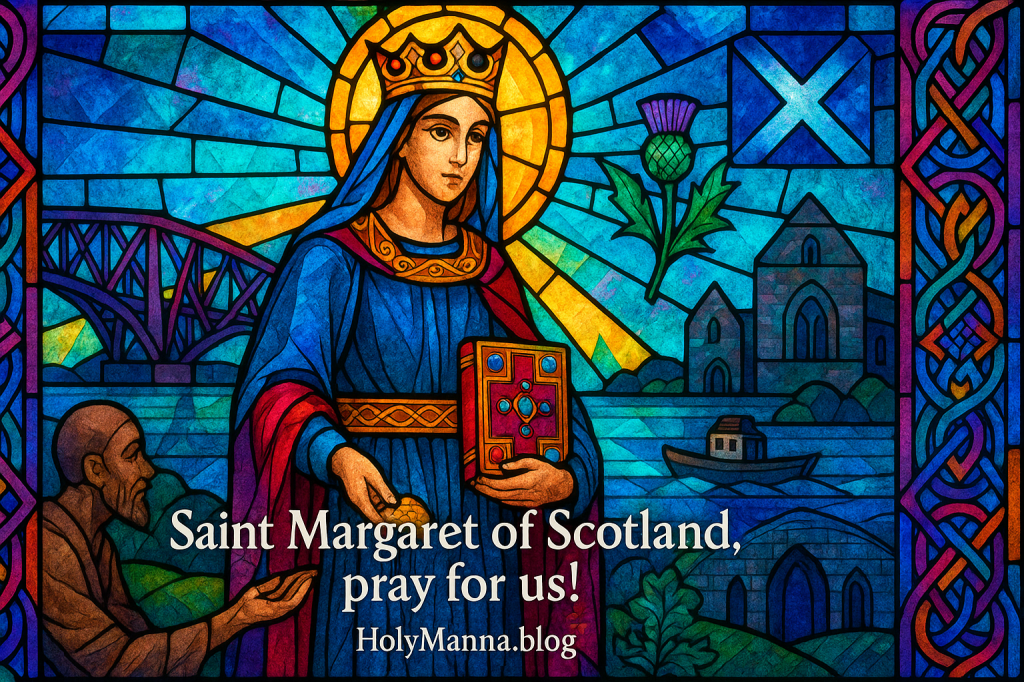
A Queen After God’s Own Heart
Saint Margaret of Scotland stands out as a saint who let grace reshape an entire culture through the ordinary and the royal all at once. She is remembered for renewing the practice of the faith in Scotland, for elevating reverence for the Eucharist and Sunday, and for restoring dignity to the poor with concrete acts of mercy. Her holiness touched the throne, the marketplace, and the hearth. The Church venerates her because she shows how prayer, gentle strength, and wisdom can transform family life and public life together. The picture that emerges from her contemporaries is not a distant noble but a mother, intercessor, and teacher whose love of Scripture and liturgy bore visible fruit. The Catechism of the Catholic Church describes this kind of charity as real and demanding. “The works of mercy are charitable actions by which we come to the aid of our neighbor in his spiritual and bodily necessities.” (Catechism of the Catholic Church, 2447). Margaret lived that line in the rhythm of every day.
From Exile to the Highlands
Around 1045, Margaret was born into the royal House of Wessex while her family lived in exile in Hungary. Her father was Edward the Exile, an English prince, and her mother was Agatha. The young Margaret learned piety and learning in a Christian court where prayer, reading, and almsgiving shaped her habits early. She returned to England in the final years of Edward the Confessor and grew in devotion to the Scriptures and the sacred liturgy. Political upheaval after the Norman Conquest sent her family north. Tradition recounts that a storm drove their ship to the Fife coast, where King Malcolm III of Scotland welcomed them with protection rather than suspicion. Margaret married Malcolm around 1070, and their marriage became a workshop of holiness. She raised eight children with a tender realism and a supernatural vision. Three sons, Edgar, Alexander I, and David I, later wore the Scottish crown. Those who knew her tell of a queen who took counsel in prayer, who read the Gospel daily, and who taught by example how a household can be ordered toward God. She is best known for her reforming zeal, her love for the poor, and her ability to unite royal duty with humble service.
Reform, Mercy, and a Gospel That Would Not Sink
Margaret’s reforms were careful and pastoral. She encouraged synods and worked with bishops and monks so that Scottish practice would be in full harmony with the wider Church. She promoted proper Lenten discipline, honored Sunday as a day of worship and rest, and urged worthy reception of Holy Communion according to the Church’s discipline. She fostered confession, catechesis, and the beauty of the sacred rites, convinced that truth shines through reverent worship. She rebuilt and endowed churches and monasteries, notably at Dunfermline, which became a spiritual heart for the realm. She also supported learning and the making of beautiful liturgical books. A cherished tradition tells of her Gospel book that slipped into a river and was later found intact, with the colors and letters preserved as if Providence guarded the Word she loved. The sign fit the woman. She held the Gospel so close that it shaped policy, charity, and prayer into one coherent life.
Her mercy was hands on. She fed the poor with her own hands, welcomed orphans to the royal table, and washed the feet of the suffering as a penance of love. During fasts and great feasts, she made sure that the hungry were served first. She established hospices and built a ferry across the Firth of Forth to ease the path of pilgrims journeying to St Andrews. The names North Queensferry and South Queensferry still echo her care. The Catechism reminds the faithful that Sunday has a social dimension beyond church doors. “On Sundays and other holy days of obligation the faithful are to refrain from engaging in work or activities that hinder the worship owed to God, the joy proper to the Lord’s Day, the performance of the works of mercy, and the appropriate relaxation of mind and body.” (Catechism of the Catholic Church, 2185). Margaret wove that teaching into law and custom with a mother’s instinct and a queen’s authority.
Direct quotations from Margaret herself are scarce, since most details come from the life written by her confessor and friend, Turgot, but the portrait is consistent. She prayed before acting, asked forgiveness readily, and treated the vulnerable as honored guests.
Crosses Carried With Courage
Holiness did not spare Margaret from sorrow. Court life demanded diplomacy and sacrifice. Reform stirred resistance. Family life brought the daily trials that every parent knows. In her final months she suffered intense illness. In November 1093, news reached her that Malcolm and their eldest son, Edward, had been killed in battle near Alnwick. Her body was already weakened, yet her soul leaned into Christ with trust. She died in Edinburgh Castle on November 16, 1093, after receiving the sacraments and commending her family and kingdom to God. She was not a martyr, but the pattern of her life resembles an offering poured out. The Catechism speaks of this spiritual worship with clarity. “By uniting themselves with his sacrifice, Christians can make their lives a sacrifice to God.” (Catechism of the Catholic Church, 2100). Margaret carried her cross with a quiet strength that teaches the same lesson today.
A Living Legacy That Heals
After her death, pilgrims flocked to her tomb at Dunfermline seeking healing and consolation. Accounts tell of cures, conversions, and protection through her intercession. The growth of her cult was steady and deep, reflecting how thoroughly her witness had taken root in the people. In 1250 Pope Innocent IV canonized her, and the Church held up her life as a pattern for rulers, spouses, and servants of the poor. Devotion to her spread far beyond Fife. Her son, King David I, honored her memory by fostering religious life across the kingdom and by dedicating a small Romanesque chapel on Castle Rock that remains the oldest building in Edinburgh. In later centuries, political and religious upheavals scattered many relics, yet devotion endured. She is venerated as patroness of Scotland, of families, and of all who serve the needy for love of Christ. Her feast is kept on November 16, and her memory still draws hearts to a mercy that looks like Christ.
Walking With Saint Margaret Today
Saint Margaret’s path points straight through the home. Begin with prayer that fits your state in life and stick with it. Read the Gospels daily, even if only a short passage. Let Sunday shape the week with Mass at the center, real rest, and works of mercy. If you have influence at work, in parish life, or in public service, use it to make worship more beautiful, formation more serious, and almsgiving more concrete. Keep the poor close, not in theory but in practice. Invite someone in need to your table. Offer your time for a neighbor who cannot repay you. The Catechism calls beauty a way to God. “Truth is beautiful in itself. When it inspires a childlike and humble attitude, it causes charity to shine.” (Catechism of the Catholic Church, 2500). Margaret believed that and proved it. Her life shows that the Gospel does not sink in the currents of the world when a household guards it with love, discipline, and joy.
Engage with Us!
- Where does Saint Margaret’s example challenge your approach to prayer, family, and work this week?
- What is one concrete act of mercy you can offer today to someone who cannot repay you?
- How can you better honor Sunday so that worship and rest renew your home and friendships?
- What is one way you can bring beauty into your parish or home to help others encounter God?
- If you hold influence at work or in your community, how can you use it to lift the poor and defend the dignity of the vulnerable?
May the witness of Saint Margaret of Scotland strengthen your resolve to live a life of faith. Do everything with the love and mercy that Jesus taught, and let His grace turn your home into a lighthouse for the world.
Saint Margaret of Scotland, pray for us!
Follow us on Instagram and Facebook for more insights and reflections on living a faith-filled life.

 Holy Manna!
Leave a comment