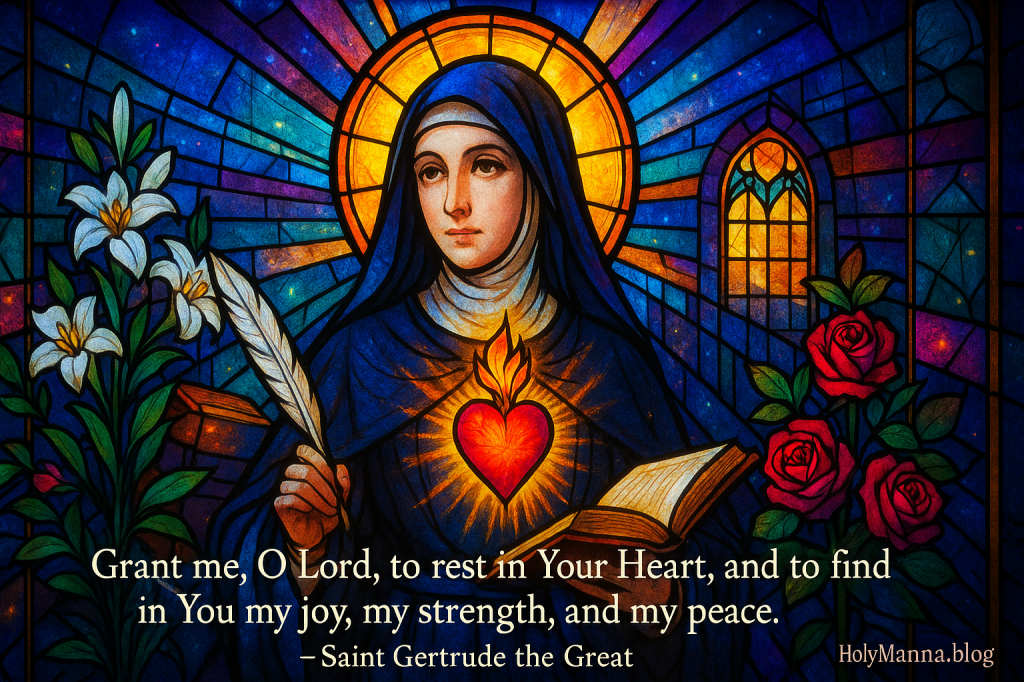
A Flaming Heart for Christ
Saint Gertrude of Helfta (1256–1301 or 1302) shines as a Benedictine nun whose entire life became a living invitation into the Heart of Jesus. She is honored as “the Great” because her mystical theology is both profound and pastoral. Her writings shaped Catholic devotion to the Sacred Heart long before it blossomed in later centuries. She loved Scripture, the liturgy, and the Church, and she carried a burning zeal for the salvation of souls, especially the holy souls undergoing purification. Readers still find in her a steady guide into confident friendship with Christ, a guide who constantly points to the transforming mercy that flows from His Heart. In her own words addressed to Jesus, “You flooded me with your gifts, opening the noble sacrarium of your Divine Heart.”
From Classroom Prodigy to Friendship with Christ
Gertrude was born on January 6, the Feast of the Epiphany, and was entrusted to the monastery school at Helfta around the age of five. The community became her home, her family, and her university. Under the leadership of Abbess Gertrude of Hackeborn, the school formed brilliant minds and holy hearts. There she developed a deep friendship with Saint Mechtilde of Hackeborn, whose prayer and example helped kindle in Gertrude a love for contemplative life. Gifted with an exceptional intellect, she mastered languages and the liberal arts. Then, at twenty four, she received a decisive grace that redirected her path. Christ made Himself known to her with a tenderness that pierced through her academic pride and restlessness. The Lord drew her from purely human learning into Scripture, theology, and intimate union with Him. She never forgot that first overwhelming encounter, when the Savior spoke to her heart with liberating clarity: “I have come to comfort you and bring you salvation.” From that point forward, she dedicated her studies to the service of the Gospel, to the consolation of others, and to the praise of God.
Living in the Heart of Jesus
The monastery at Helfta became a true school of love where learning and holiness converged. Gertrude wrote and inspired the writings we know as The Herald of Divine Love (Legatus divinae pietatis) and the Spiritual Exercises. The community preserved her memories and teachings, recognizing in them a reliable witness to God’s work. In her pages, Jesus reveals His Heart as a sanctuary, a furnace of charity, and a home for wounded sinners. She adored the Eucharist with profound reverence and prayed to live every hour as a response to the love she received. Her spirituality is nuptial, scriptural, and liturgical. She heard the Lord invite her into His Passion and share in His thirst for souls. Contemporaries speak of her gift of counsel, her insight into hearts, and graces that led to conversions and healings through her intercession. She never treated such favors as curiosities. She saw them as invitations to deeper repentance, greater humility, and a bolder confidence in the mercy of Jesus. One of her most beautiful prayers shows her response to grace: “Receive me, O loving Jesus, into the sanctuary of Your most gentle Heart.”
Illness, Interior Purification, and Persevering Love
Gertrude did not shed blood for the faith, but she walked a real path of the Cross. Infirmities weighed on her in different seasons and kept her from the ordinary rhythm of monastic work and choir. She also endured stretches of interior dryness and misunderstanding. She offered these hidden sufferings for the Church, for priests, for sinners, and for the departed. Her patience in sickness was not passive. It was an active surrender, a steady yes to God’s will in the small and ordinary moments of daily life. In that quiet fidelity, her love matured and her confidence in the Heart of Jesus grew solid and calm. She teaches that holiness is often forged in the humble acceptance of limitations, united to Christ, and offered for the salvation of others.
A Quiet Torrent of Influence
Saint Gertrude’s earthly life concluded around 1301 or 1302, but her influence only widened. The memory of her holiness remained vivid in the Helfta community, and her writings began to circulate beyond Benedictine walls. Devotion to the Sacred Heart drew strength from her testimony that Christ’s Heart is an open refuge for every soul. Many have reported favors and healings through her intercession, especially when praying for the holy souls in need of purification. The exact location of her tomb is unknown, so there is little formal relic veneration. Yet pilgrims continue to turn to her spiritual legacy rather than to a shrine, seeking the grace of deeper conversion and a heart set on the things of God. It is fitting that the Church remembers her on November 16, since her life remains a living epiphany of the tenderness of Jesus.
Purgatory, the Holy Souls, and Catholic Teaching
Gertrude’s love for the departed mirrored Catholic teaching on purification after death. The Church professes that those who die in God’s grace but still need healing are purified before entering the joy of heaven. From the earliest days, Christians have offered prayers, alms, and especially the Holy Sacrifice of the Mass for the dead. Gertrude embraced this with urgency and hope. She constantly commended souls to the mercy of Christ and encouraged others to do the same. She reminds believers that doctrine and devotion are meant to serve each other. Clear teaching anchors the heart, and humble prayer opens it to grace. With disarming simplicity she prayed, “O Jesus, let the brightness of Your love shine upon those who long for You, and let Your mercy complete what is lacking in them.”
Reflection for the Heart
Saint Gertrude shows what happens when study, prayer, and love converge in one generous life. She teaches a pattern that any Christian can adopt: listen to Scripture daily, receive the Eucharist as often as the Church invites, bring every burden to the Heart of Jesus, and remember the dead with hope. Make a small, steady rule of prayer that includes intercession for family and friends, a few minutes of silence before the Lord, and a brief act of love to the Sacred Heart throughout the day. Let her trusted rhythm guide the week: confession on a regular schedule, a simple fast that awakens hunger for God, and acts of mercy that bring comfort to the lonely. Gertrude would insist that progress in holiness looks like growing trust. It looks like handing over fears, sins, and dreams to the One who loves perfectly. Her own confession of love captures this posture of surrender: “Grant me, O Lord, to rest in Your Heart, and to find in You my joy, my strength, and my peace.”
Engage with Us!
- What part of Saint Gertrude’s story most challenges the current priorities in your life, and how might Christ be inviting you to reorder them?
- How does devotion to the Sacred Heart help you trust Jesus with concrete struggles at home, at work, or in your friendships?
- When was the last time you offered Mass or a rosary for a departed loved one, and what habit of prayer for the holy souls could you begin this week?
- Which line from Gertrude’s own words moves you to deeper faith? Consider praying it slowly before the Blessed Sacrament.
May her intercession help every reader live a life of faith, hope, and burning charity, doing everything with the love and mercy Jesus taught.
Saint Gertrude the Great, pray for us!
Follow us on Instagram and Facebook for more insights and reflections on living a faith-filled life.

 Holy Manna!
Leave a comment