Thirty-third Sunday in Ordinary Time – Lectionary: 159
Under the Sun of Justice
Today’s readings bring together the urgency of the end and the holiness of the everyday, calling for a faith that stands steady, sings loudly, and rolls up its sleeves. The central theme is steadfast hope expressed through holy perseverance. God’s judgment is not a scare tactic; it is the promise that the Lord will set things right for those who fear his name. How does that promise shape the way a disciple lives and works today? In Malachi 3:19–20 the language is apocalyptic and pastoral at once, warning of a burning day for unrepentant hearts while promising the faithful that “the sun of justice will arise with healing in its wings.” This hope is not quiet resignation. It blossoms into praise in Psalm 98, where creation itself welcomes the true King who “comes to govern the earth… with justice.” In other words, judgment is good news for the righteous because it is the triumph of God’s order over chaos.
The New Testament readings anchor this hope in daily fidelity and courageous witness. In 2 Thessalonians 3:7–12 the Apostle corrects end-times complacency. Waiting for the Lord never excuses idleness or spiritual meddling. Disciples imitate apostolic example through disciplined labor, personal responsibility, and quiet service, remembering the hard line that “if anyone was unwilling to work, neither should that one eat.” In Luke 21:5–19 Jesus speaks within the sacred precincts of the Temple, a structure soon to fall in A.D. 70, and uses that looming catastrophe to prepare disciples for every age. Wars, earthquakes, and persecutions will test hearts, yet these trials become a stage for testimony as the Lord promises a wisdom no adversary can refute and seals the call with “By your perseverance you will secure your lives.” Catholic teaching reads this chapter with a double horizon, near and ultimate, recognizing both the fall of Jerusalem and the Church’s final trial before Christ’s return, as articulated in CCC 675–677. This same hope energizes work, culture, and vocation rather than draining them, since the renewal of creation dignifies human labor here and now, as taught in CCC 2427 and the eschatological hope of CCC 1040–1050. Where does the Lord invite a firmer, quieter perseverance that keeps praying, keeps working, and keeps witnessing until the true King is revealed?
First Reading – Malachi 3:19–20
A burning day, a healing dawn
The prophet in Malachi 3:19–20 speaks into the weary atmosphere of post-exilic Judah, when the rebuilt Temple stood but many hearts had cooled. Under Persian rule and after the initial zeal of return, the people wrestled with spiritual laxity, corrupt worship, and a cynical question about whether serving God still mattered. Malachi answers with the language of the Day of the Lord. Judgment will be real, purifying, and decisive. Yet for those who fear the name of the Lord, that same day will break not as a blaze of ruin but as a sunrise of righteousness. The title “sun of justice” became a beloved way the Church contemplates Christ’s advent, the radiant fulfillment of God’s promises. In today’s theme of holy perseverance, this reading teaches that final judgment is not meant to paralyze with fear. It calls for reverent fidelity now, because the Judge is also the Healer who brings justice and joy.
Malachi 3:19-20
New American Bible (Revised Edition)
19 For the day is coming, blazing like an oven,
when all the arrogant and all evildoers will be stubble,
And the day that is coming will set them on fire,
leaving them neither root nor branch,
says the Lord of hosts.
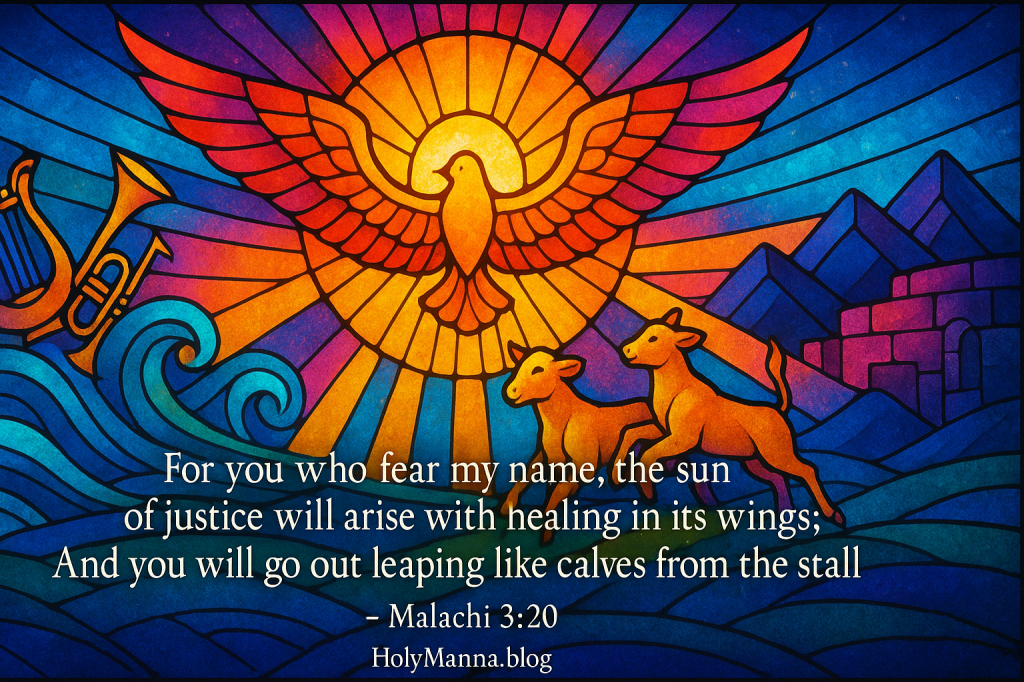
20 But for you who fear my name, the sun of justice
will arise with healing in its wings;
And you will go out leaping like calves from the stall
Detailed Exegesis
Verse 19 – “For the day is coming, blazing like an oven, when all the arrogant and all evildoers will be stubble, And the day that is coming will set them on fire, leaving them neither root nor branch, says the Lord of hosts.”
This verse announces the Day of the Lord as a total judgment on pride and practiced evil. The image of an oven evokes a kiln that consumes chaff. “Neither root nor branch” signals complete uprooting of wickedness, which comforts the righteous who have suffered scandal at apparent impunity. In biblical theology, divine judgment exposes truth and restores order. It is not cruelty but justice tempered by God’s patience. The Church reminds believers that the Last Judgment calls every heart to conversion while there is still time in this present age, aligning one’s life with God’s holiness rather than presuming on mercy without repentance. This verse invites a sober examination of the roots and branches in daily choices, habits, and allegiances.
Verse 20 – “But for you who fear my name, the sun of justice will arise with healing in its wings; And you will go out leaping like calves from the stall.”
“Fear my name” means filial reverence, not servile terror. Those who honor God’s covenant will experience the same Day as dawn. The “sun of justice” conveys warmth, light, and life, while “healing in its wings” suggests the rays of the sun spreading restorative power. In the Christian reading, this anticipates Christ, whose rising brings justification and sanctification. The leaping calves image captures unrestrained freedom after long confinement, a vivid promise that fidelity now ends in exuberant joy. Eschatological hope, then, is not abstract. It heals wounds, loosens bonds, and turns worship into overflowing delight.
Teachings
CCC 1808 defines the virtue needed to stand firm when the Day tests every work: “Fortitude is the moral virtue that ensures firmness in difficulties and constancy in the pursuit of the good.” This virtue guards perseverance when cultural winds blow cold or when personal trials tempt compromise.
CCC 2427 dignifies the ordinary labor that faith animates while awaiting the dawn of perfect justice: “Work honors the Creator’s gifts and the talents received from him. It can also be redemptive. By enduring the hardship of work in union with Jesus, the carpenter of Nazareth and the one crucified on Calvary, man collaborates in a certain fashion with the Son of God in his redemptive work. He shows himself to be a disciple of Christ by carrying the cross, daily, in the work he is called to accomplish.” This connects Malachi’s promise with a lifestyle of faithful effort rather than apocalyptic idleness.
CCC 1041 frames divine judgment as a saving summons rather than a threat to dread: “The message of the Last Judgment calls men to conversion while God is still giving them ‘the acceptable time,’ ‘the day of salvation.’ It inspires a holy fear of God and commits them to the justice of the Kingdom of God.” This holy fear is precisely what Malachi 3:20 praises.
CCC 1831 names the gift that orients the heart toward reverent obedience: “The seven gifts of the Holy Spirit are wisdom, understanding, counsel, fortitude, knowledge, piety, and fear of the Lord.” The fear of the Lord is the inner posture that receives the rising of the sun of justice as healing rather than as harm.
Saint Augustine expresses the mystery of grace and cooperation that Malachi’s call implies: “He who created you without you will not justify you without you.” The promised dawn calls for response, repentance, and steady fidelity.
Saint Teresa of Ávila gives language for persevering hope amid trials that precede the dawn: “Let nothing disturb you, let nothing frighten you, all things are passing away. God never changes. Patience obtains all things. Whoever has God lacks nothing. God alone suffices.” This patience is the posture that waits for the sun of justice with peaceful courage.
Reflection
Judgment and joy are not rivals in the Christian life. The fire that consumes arrogance illuminates the path of the humble. The question is not whether the Day will come, but how to live before it arrives. Choose reverence in small decisions, truthful speech, honest work, and heartfelt worship. Make room daily for Scripture, silence, and an examen that uproots hidden pride before it hardens. Reconcile quickly, forgive generously, and cultivate the gift of the fear of the Lord by blessing the holy name at the beginning and end of each day. When anxiety about the future rises, return to Malachi’s promise and breathe a simple prayer of hope. Where is the Lord inviting a shift from fear of disaster to fear of his holy name? What concrete habit can be embraced this week that welcomes the healing rays of the sun of justice? Which relationship needs a humble step toward reconciliation so that the heart is free to leap with joy when the dawn breaks?
Responsorial Psalm – Psalm 98:5–9
Creation’s standing ovation for the coming King
The Church places Psalm 98:5–9 at the heart of today’s liturgy to teach that the right response to the Lord’s coming judgment is joy, not dread. In ancient Israel this kingship hymn likely accompanied great processions at the Temple, with lyres, horns, and communal singing that proclaimed the Lord as true sovereign over Israel and the nations. Trumpets and the ram’s horn signaled covenant moments, enthronements, and victories, so this psalm sounds like a coronation liturgy for the God who judges with fidelity. The poetry personifies seas, rivers, and mountains, reminding hearers that all creation belongs in the choir. Within today’s theme of holy perseverance, this psalm trains the soul to praise in advance of the final vindication. Judgment is good news for the righteous because the Judge is faithful, and his verdict is justice and healing.
Psalm 98:5-9
New American Bible (Revised Edition)
5 Sing praise to the Lord with the lyre,
with the lyre and melodious song.
6 With trumpets and the sound of the horn
shout with joy to the King, the Lord.
7 Let the sea and what fills it resound,
the world and those who dwell there.
8 Let the rivers clap their hands,
the mountains shout with them for joy,
9 Before the Lord who comes,
who comes to govern the earth,
To govern the world with justice
and the peoples with fairness.
Detailed Exegesis
Verse 5 – “Sing praise to the Lord with the lyre, with the lyre and melodious song.”
Israel’s worship involves real instruments, real voices, and real beauty. Praise is not a mood; it is a covenant duty that forms hearts to love what God loves. The doubled mention of the lyre underlines intentionality and craft in worship. Ordered praise prepares believers to endure trials with steady hearts because adoration places God, not fear, at the center.
Verse 6 – “With trumpets and the sound of the horn shout with joy to the King, the Lord.”
Trumpets and horn recall royal enthronements and covenant assemblies. The psalm identifies the Lord as King, which reframes human power struggles. Joyful shouting is not noise for its own sake; it is faith’s public witness that God reigns. In seasons of upheaval, liturgical joy becomes resistance to despair and a proclamation that the world is governed by Providence.
Verse 7 – “Let the sea and what fills it resound, the world and those who dwell there.”
Creation joins the choir. The sea, often a symbol of chaos, becomes an instrument of praise. This reversal hints at the future harmony promised in the new creation, where nothing hostile remains. Human praise is not isolated piety; it is the priestly voice of creation offered back to the Creator.
Verse 8 – “Let the rivers clap their hands, the mountains shout with them for joy,”
Rivers clapping and mountains shouting are vivid Hebrew images that teach reverent imagination. All realms of life, from workaday places to lofty spaces, can become sanctuaries of joy. The baptized share in a royal priesthood that consecrates the ordinary to God through gratitude and song.
Verse 9 – “Before the Lord who comes, who comes to govern the earth, To govern the world with justice and the peoples with fairness.”
The psalm names the reason for praise. The Lord is coming to judge, which means to set things right. Justice and fairness define the manner of his reign. Believers do not panic at signs of the times; they praise the Judge whose verdict restores the world. This verse anchors today’s theme: perseverance that works, worships, and witnesses because the King is at the door.
Teachings
CCC 2639 defines the heart of this psalmic response: “Praise is the form of prayer which recognizes most immediately that God is God. It lauds God for his own sake and gives him glory, quite beyond what he does, but simply because HE IS.” When praise is rooted in who God is, it remains steady when circumstances shake.
CCC 2096 identifies the virtue that shapes all right worship: “Adoration is the first act of the virtue of religion. To adore God is to acknowledge him as God, as the Creator and Savior, the Lord and Master of everything that exists, as infinite and merciful Love.” The psalm’s instruments and shouts serve this deep act of the soul.
CCC 2097 describes the interior posture that praise requires: “To adore God is to acknowledge, in respect and absolute submission, the ‘nothingness of the creature’ who would not exist but for God. To adore God is to praise and exalt him and to humble oneself, as Mary did in the Magnificat, confessing with gratitude that he has done great things and holy is his name.” This humility opens the heart to persevering joy.
CCC 341 situates creation’s song within God’s wise design: “The beauty of the universe: the order and harmony of the created world results from the diversity of beings and from the relationships which exist among them. Man discovers them progressively as the laws of nature. They call forth the admiration of scholars. The beauty of creation reflects the infinite beauty of the Creator and ought to inspire the respect and submission of man’s intellect and will.” When seas resound and mountains shout in the psalm, the Church hears creation reflecting the Creator’s beauty.
CCC 1149 explains why the Church’s worship draws on visible signs from creation: “The liturgy of the Church presupposes, integrates, and sanctifies elements from creation and human culture, conferring on them the dignity of signs of grace, of the new creation in Jesus Christ.” Instruments, voices, and gathered bodies become sacramental signs that anticipate the renewed world governed by justice.
CCC 1040–1041 frames the joyful seriousness of the Lord’s coming: “The Last Judgment will come when Christ returns in glory. Only the Father knows the day and the hour; only he determines the moment of its coming. Then through his Son Jesus Christ he will pronounce the final word on all history.” “The message of the Last Judgment calls men to conversion while God is still giving them ‘the acceptable time,’ ‘the day of salvation.’ It inspires a holy fear of God and commits them to the justice of the Kingdom of God.” The psalm’s joy flows from this confident hope.
Reflection
Praise is the practice that keeps hope young. When the soul learns to sing before the victory appears, perseverance becomes lighter and witness becomes brighter. Make a habit of audible thanksgiving each morning and evening, even if it begins as a whisper. Offer work as worship by starting tasks with a brief prayer of praise and ending them with gratitude. Bring creation into prayer by noticing skies, rivers, and trees and blessing the Lord for their beauty. In times of anxiety, recite verse nine slowly until peace returns. What would change this week if praise became the first word on the lips and not fear? Where can a conscious act of adoration interrupt complaining and turn it into gratitude? How might Sunday worship be prepared through small daily hymns of thanks so that the heart arrives ready to shout with joy to the King, the Lord?
Second Reading – 2 Thessalonians 3:7–12
Persevering hope looks like quiet, faithful work
The church in Thessalonica lived in a bustling port city filled with trade, temples, and the imperial cult. Some believers had grown restless as they awaited the Lord’s return and slipped into spiritual idleness and social disruption. 2 Thessalonians 3:7–12 addresses this disorder with the concrete witness of the apostles’ own labor. The reading insists that eschatological hope produces steadiness, not sloth. In the context of today’s theme, holy perseverance is not a dramatic sprint but a daily fidelity that serves others, refuses to burden the community, and keeps hands and hearts engaged until the King appears.
2 Thessalonians 3:7-12
New American Bible (Revised Edition)
7 For you know how one must imitate us. For we did not act in a disorderly way among you, 8 nor did we eat food received free from anyone. On the contrary, in toil and drudgery, night and day we worked, so as not to burden any of you. 9 Not that we do not have the right. Rather, we wanted to present ourselves as a model for you, so that you might imitate us. 10 In fact, when we were with you, we instructed you that if anyone was unwilling to work, neither should that one eat. 11 We hear that some are conducting themselves among you in a disorderly way, by not keeping busy but minding the business of others. 12 Such people we instruct and urge in the Lord Jesus Christ to work quietly and to eat their own food.
Detailed Exegesis
Verse 7 – “For you know how one must imitate us. For we did not act in a disorderly way among you,”
The apostolic pattern is the curriculum. Authentic teaching is embodied in a way of life that rejects chaos. Disorder here signals behavior out of step with the gospel’s order. The Church expects disciples to learn by imitation, which is why saints and mentors matter so much in forming habits that endure trials.
Verse 8 – “nor did we eat food received free from anyone. On the contrary, in toil and drudgery, night and day we worked, so as not to burden any of you.”
The apostles chose manual labor to avoid financial strain on a young community. Their “toil and drudgery” underline the dignity of hard work and the charity of self-support in mission. This is not a denial that ministers deserve support; it is a voluntary witness of love that protects the weak and models responsibility.
Verse 9 – “Not that we do not have the right. Rather, we wanted to present ourselves as a model for you, so that you might imitate us.”
Paul acknowledges a legitimate right to support, but he surrenders it to teach by example. Christian freedom is not grasping for every right, but discerning when surrender serves the gospel. The point is formation. A community shaped by models of generous labor resists envy, entitlement, and resentment.
Verse 10 – “In fact, when we were with you, we instructed you that if anyone was unwilling to work, neither should that one eat.”
This firm line targets unwillingness, not inability. Those who can work should do so for their own good and for the common good. The Church reads this as a call to shared responsibility, where charity never becomes an excuse for idleness and where justice safeguards the dignity of both giver and receiver.
Verse 11 – “We hear that some are conducting themselves among you in a disorderly way, by not keeping busy but minding the business of others.”
Idleness breeds meddling. When hands are empty, tongues often wander. This verse confronts the spiritual and social damage of gossip and distraction. The path of perseverance is quiet focus on one’s vocation rather than supervision of everyone else’s.
Verse 12 – “Such people we instruct and urge in the Lord Jesus Christ to work quietly and to eat their own food.”
The remedy is simple and beautiful. Work quietly. Provide for oneself and one’s dependents. Live peaceably. This command stabilizes a community under pressure and witnesses to the world that Christian hope produces dependable, fruitful citizens whose lives announce the coming King without fanfare.
Teachings
CCC 2427: “Work honors the Creator’s gifts and the talents received from him. It can also be redemptive. By enduring the hardship of work in union with Jesus, the carpenter of Nazareth and the one crucified on Calvary, man collaborates in a certain fashion with the Son of God in his redemptive work. He shows himself to be a disciple of Christ by carrying the cross, daily, in the work he is called to accomplish.” This paragraph illuminates the apostles’ “toil and drudgery” as a share in Christ’s own labor that builds up the Church.
CCC 2428: “In work, the person exercises and fulfills in part the potential inscribed in his nature. The primordial value of labor stems from man himself, its author and its beneficiary. Work is for man, not man for work.” This safeguards dignity while calling every able person to meaningful contribution.
CCC 2429: “Everyone has the right to economic initiative; everyone should make legitimate use of his talents to contribute to the abundance that will benefit all and to harvest the just fruits of his labor.” The apostolic example encourages enterprise tempered by justice and charity.
CCC 2478: “To avoid rash judgment, everyone should be careful to interpret insofar as possible his neighbor’s thoughts, words, and deeds in a favorable way.” This is an antidote to “minding the business of others,” replacing suspicion with charity and focus.
Scripture resonates across the Thessalonian letters. 1 Thessalonians 4:11 exhorts believers to the same path: “to aspire to live a tranquil life, to mind your own affairs, and to work with your own hands, as we instructed you.” The monastic tradition distilled this wisdom with clarity. Saint Benedict writes, “Idleness is the enemy of the soul.” The Church’s history shows that communities thrive when Christians sanctify ordinary labor, care for families, and serve the poor through steady work that honors God.
Reflection
This reading teaches a spirituality of Monday that is worthy of Sunday. Quiet work, offered to God, becomes a steady hymn of trust that resists panic and distraction. Set an intentional rhythm for the week that begins with prayer, names the people entrusted to your care, and commits to diligent tasks without complaint. Avoid the trap of digital gossip by limiting idle scrolling and using words to bless rather than to pry. If unemployed or underemployed, seek counsel, training, and community support while contributing through volunteer service and household responsibilities. If in a position to hire or mentor, look for ways to dignify the work of others with fair pay, patience, and clear expectations. Where is the Lord inviting a quieter, more focused approach to vocation this week? Which habit of distraction needs to be replaced with a simple act of diligence? How can purposeful work today lighten the burdens of family, parish, or neighbor and become a living testimony to the coming King?
Holy Gospel – Luke 21:5–19
Courage, clarity, and calm in a shaking world
Jesus speaks within the precincts of the Temple, a symbol of covenant identity and divine presence. In the decades after his words, Jerusalem would fall to Rome in A.D. 70, and the Temple would be razed. This historical horizon stands behind Luke 21:5–19 and opens a larger horizon that reaches to the end of the age. The Lord teaches disciples how to live between these horizons with courage, clarity, and calm. The significance for today’s theme is unmistakable. Holy perseverance refuses panic, resists deception, embraces daily fidelity, and welcomes persecution as an unexpected pulpit. The Judge who will set all things right equips his witnesses with wisdom and guards their ultimate life.
Luke 21:5-19
New American Bible (Revised Edition)
5 While some people were speaking about how the temple was adorned with costly stones and votive offerings, he said, 6 “All that you see here—the days will come when there will not be left a stone upon another stone that will not be thrown down.”
The Signs of the End. 7 Then they asked him, “Teacher, when will this happen? And what sign will there be when all these things are about to happen?” 8 He answered, “See that you not be deceived, for many will come in my name, saying, ‘I am he,’ and ‘The time has come.’ Do not follow them! 9 When you hear of wars and insurrections, do not be terrified; for such things must happen first, but it will not immediately be the end.” 10 Then he said to them, “Nation will rise against nation, and kingdom against kingdom. 11 There will be powerful earthquakes, famines, and plagues from place to place; and awesome sights and mighty signs will come from the sky.
The Coming Persecution. 12 “Before all this happens, however, they will seize and persecute you, they will hand you over to the synagogues and to prisons, and they will have you led before kings and governors because of my name. 13 It will lead to your giving testimony. 14 Remember, you are not to prepare your defense beforehand, 15 for I myself shall give you a wisdom in speaking that all your adversaries will be powerless to resist or refute. 16 You will even be handed over by parents, brothers, relatives, and friends, and they will put some of you to death. 17 You will be hated by all because of my name, 18 but not a hair on your head will be destroyed. 19 By your perseverance you will secure your lives.
Detailed Exegesis
Verse 5 – “While some people were speaking about how the temple was adorned with costly stones and votive offerings, he said,”
The conversation begins with admiration for sacred architecture and gifts. Jesus redirects attention from external splendor to the destiny of God’s plan. The gospel consistently warns against trusting appearances. True security rests in God, not in stones or offerings.
Verse 6 – “All that you see here, the days will come when there will not be left a stone upon another stone that will not be thrown down.”
Jesus foretells the Temple’s destruction, which occurred in A.D. 70. The prophecy teaches detachment from earthly sanctuaries and systems. Even holy things pass, while God’s kingdom endures. Judgment dismantles false confidences and invites deeper faith.
Verse 7 – “Then they asked him, ‘Teacher, when will this happen? And what sign will there be when all these things are about to happen?’”
Curiosity about timing and signs is natural. Jesus will answer by forming hearts, not by satisfying calendars. The Christian posture is vigilance and fidelity rather than prediction.
Verse 8 – “He answered, ‘See that you not be deceived, for many will come in my name, saying, ‘I am he,’ and ‘The time has come.’ Do not follow them!’”
The first command is discernment. False messiahs and timetables prey on fear. Authentic disciples resist spiritual clickbait and stay anchored in the Church’s teaching. The safest rule is simple obedience to Christ and his body, the Church.
Verse 9 – “‘When you hear of wars and insurrections, do not be terrified; for such things must happen first, but it will not immediately be the end.’”
Conflict does not equal the finish line. The Lord forbids terror and invites trust. History’s convulsions are real, yet they are not sovereign. Providence governs even in upheaval.
Verse 10 – “Then he said to them, ‘Nation will rise against nation, and kingdom against kingdom.’”
Escalating strife across peoples is part of the pattern before the end. The disciple’s task is not to calculate dates but to remain faithful and to practice peacemaking under Christ the King.
Verse 11 – “‘There will be powerful earthquakes, famines, and plagues from place to place; and awesome sights and mighty signs will come from the sky.’”
Creation itself groans. Disciples read such events with sober realism, neither superstition nor denial. These are reminders of contingency and calls to conversion and mercy.
Verse 12 – “‘Before all this happens, however, they will seize and persecute you, they will hand you over to the synagogues and to prisons, and they will have you led before kings and governors because of my name.’”
Persecution is not an accident. It is the expected path of those who belong to Jesus. Public trials place the Church before rulers and cultures that need the gospel.
Verse 13 – “‘It will lead to your giving testimony.’”
Suffering becomes a microphone. The Lord reframes loss as mission. Every pressure point is an opportunity to confess the truth with love.
Verse 14 – “‘Remember, you are not to prepare your defense beforehand,’”
This is not a ban on study or prudence. It is a promise that ultimate effectiveness comes from grace. Anxiety about perfect scripts yields to trust in the Spirit.
Verse 15 – “‘for I myself shall give you a wisdom in speaking that all your adversaries will be powerless to resist or refute.’”
Jesus pledges his own wisdom to his witnesses. The testimony that saves does not rely on rhetorical tricks. It flows from communion with the Lord who speaks through his Church.
Verse 16 – “‘You will even be handed over by parents, brothers, relatives, and friends, and they will put some of you to death.’”
The cross cuts through the closest bonds. Martyrdom is not failure. It is the highest conformity to the Crucified and the seed of future believers.
Verse 17 – “‘You will be hated by all because of my name,’”
Hostility toward Christ will attach to his disciples. The name that saves also scandalizes. Endurance in charity becomes the defining mark of authenticity.
Verse 18 – “‘but not a hair on your head will be destroyed.’”
In light of verse sixteen, this promise points to ultimate security. Bodies can be killed, yet the person who belongs to Christ will be kept for resurrection. Nothing truly good in God is lost.
Verse 19 – “‘By your perseverance you will secure your lives.’”
Perseverance is the narrow road that leads to life. Salvation is a gift, yet it is received through steadfast fidelity. The path is long, but grace is sufficient.
Teachings
CCC 675: “Before Christ’s second coming the Church must pass through a final trial that will shake the faith of many believers.” This paragraph places the Gospel’s warnings within the Church’s expectation of a last testing.
CCC 676: “The Antichrist’s deception already begins to take shape in the world every time the claim is made to realize within history that messianic hope which can only be realized beyond history through the eschatological judgment.” This clarifies why disciples reject political or ideological saviors that promise heaven now.
CCC 2471: “Before Pilate, Christ proclaims that he ‘has come into the world, to bear witness to the truth.’ The Christian is not to ‘be ashamed then of testifying to our Lord.’” Witness is the Gospel’s heart in persecution and peace.
CCC 1808: “Fortitude is the moral virtue that ensures firmness in difficulties and constancy in the pursuit of the good.” Fortitude empowers the perseverance that secures life.
CCC 162: “Faith is an entirely free gift that God makes to man. We can lose this priceless gift, as St. Paul indicated to St. Timothy: ‘Wage the good warfare, holding faith and a good conscience.’ To live, grow, and persevere in the faith to the end we must nourish it with the word of God; we must beg the Lord to increase our faith; it must be ‘working through charity,’ abounding in hope, and rooted in the faith of the Church.” The Gospel’s call to endurance finds its practical nourishment here.
CCC 1041: “The message of the Last Judgment calls men to conversion while God is still giving them ‘the acceptable time,’ ‘the day of salvation.’ It inspires a holy fear of God and commits them to the justice of the Kingdom of God.” The Church hears Jesus’ discourse as an invitation to conversion, not to panic.
The fall of Jerusalem in A.D. 70 under the Roman general Titus stands as a historical backdrop that confirms Jesus’ prophecy. The Church reads this near fulfillment as a pattern for the final fulfillment, a double horizon that trains disciples for discernment, courage, and hope.
Reflection
The Lord’s words form a school of steady hearts. Begin each day with a short act of abandonment to Providence, and close each day with a brief examen that names fear and returns it to God. Practice discernment by measuring every sensational claim against Scripture, the Creed, and the Magisterium. When conflicts arise, refuse alarm and choose a concrete work of mercy, since love casts out fear. Prepare for witness by praying with verse fifteen until it rests on the tongue, and entrust conversations to the Holy Spirit. If hostility comes from family or friends, answer with patience and truth, then carry that pain to prayer and the sacraments. Where does fear try to rule the imagination, and how can trust reclaim that territory today? Which daily habit will strengthen perseverance, such as fixed times of prayer, weekly confession, or a fast from anxious news cycles? Who needs a calm, loving testimony this week so that the wisdom of Jesus can speak through a peaceful heart?
When the King Draws Near
Malachi promises a decisive Day when the proud wither like stubble, yet for the faithful “the sun of justice will arise with healing in its wings” in Malachi 3:20. The psalm answers with a trumpet blast of hope as creation rejoices “before the Lord who comes… to govern the world with justice” in Psalm 98:9. Saint Paul makes this hope practical in 2 Thessalonians 3:7–12, where holy expectation looks like quiet responsibility, honest labor, and charity that refuses to burden others, even to the point of the hard saying “if anyone was unwilling to work, neither should that one eat” in 2 Thessalonians 3:10. Jesus then sets hearts steady in Luke 21:5–19, warning against deception, forbidding panic, and promising divine help in witness, sealing it with “By your perseverance you will secure your lives.”
The message comes together with clarity. Judgment is not a threat for those who fear the Lord, it is the longed-for arrival of justice and healing. Praise trains the soul to meet that Day with joy. Work dignifies the waiting and protects the community. Persevering witness, even under pressure, becomes the stage where Christ speaks through his disciples. The path forward is simple and strong: adore the coming King, sanctify daily labor, and hold fast in trials with a calm confidence that rests on God.
Choose a concrete rhythm that reflects this hope. Begin and end the day with brief praise from Psalm 98. Offer daily tasks to the Lord with the intention of serving rather than being seen. Practice discernment by measuring every sensational claim against the steady voice of Scripture and the Church. Prepare for testimony by praying with Luke 21:15 until trust grows. Seek the sacraments regularly so that grace strengthens perseverance. Where can praise replace anxiety today? What simple act of diligence will serve family, parish, or neighbor this week? How will perseverance take shape in prayer, work, and courageous love so that the heart is ready when the sun of justice rises with healing?
Engage with Us!
Share your reflections in the comments below and encourage a friend by naming one concrete way to live today’s readings with courage and joy.
- First Reading – Malachi 3:19–20: Where is the Lord inviting a deeper fear of his name so that the rising “sun of justice” can heal what feels wounded or weary? What specific habit or reconciliation can uproot pride and make room for freedom that “leaps like calves from the stall”?
- Responsorial Psalm – Psalm 98:5–9: What daily practice of praise will help the heart sing before the victory is visible, such as a brief song or spoken thanksgiving at morning and night? How does imagining seas, rivers, and mountains rejoicing “before the Lord who comes” reshape anxiety about the future into hope-filled worship?
- Second Reading – 2 Thessalonians 3:7–12: Which task, relationship, or responsibility needs quiet, faithful work rather than restless distraction this week? What small change could replace “minding the business of others” with focused diligence and charitable speech?
- Holy Gospel – Luke 21:5–19: Where is the choice today between panic and perseverance, and what concrete step will anchor trust in Jesus rather than in signs and timelines? Who needs a calm and loving testimony that relies on the Lord’s promised wisdom rather than carefully scripted words?
Go forward with steady hearts. Live a life of faith that praises God, works with integrity, and bears witness with courage. Do everything with the love and mercy that Jesus taught, and trust that his justice brings healing and joy.
Sacred Heart of Jesus, we trust in You!
Immaculate Heart of Mary, pray for us!
Saint Michael the Archangel, defend us in battle!
Follow us on Instagram and Facebook for more insights and reflections on living a faith-filled life.

 Holy Manna!
Leave a comment