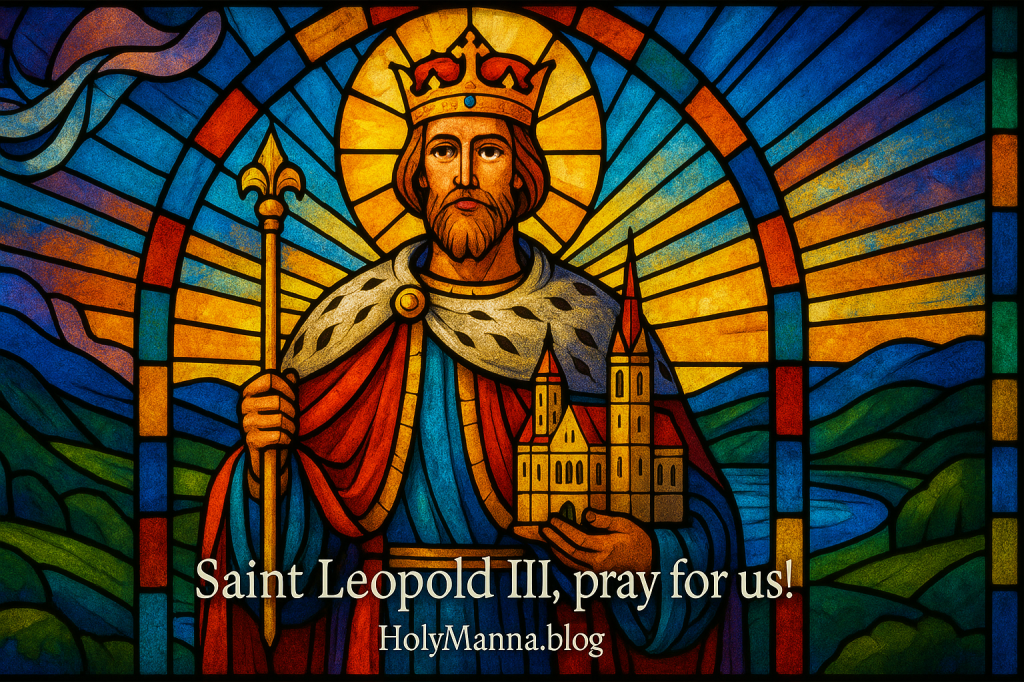
A Ruler After God’s Own Heart
Saint Leopold III, known affectionately as Leopold the Good, ruled as margrave of Austria in the early twelfth century and showed how political authority can be a genuine path to sanctity. He did not separate faith from public life. He allowed the Gospel to inform the way he judged disputes, protected the poor, and patronized monasteries that became centers of prayer, learning, and charity. The Church honors him on November 15 and remembers him as a patron of Austria, especially venerated in Lower Austria. His canonization by Pope Innocent VIII in 1485 confirmed a reputation already cherished by the faithful, who saw in him a model of lay leadership rooted in the Beatitudes. His legacy embodies the heart of The Catechism of the Catholic Church: those who exercise authority should do so as a service (Catechism, 2235). He stands out because he used influence to build communion, not to consolidate personal power, and because he fostered sacred places where generations could meet the living God.
Roots of Nobility, School of Holiness
Leopold was born around 1073 into the Babenberg dynasty, the ruling house of the Austrian march. His father, Leopold II, and his mother, Ida, gave him a noble heritage, but it was the spiritual formation of reform-minded churchmen that shaped his conscience. He grew up during the Gregorian Reform, a renewal that called rulers and clergy back to evangelical simplicity and fidelity. His education was steeped in respect for the Church’s freedom and in love for the sacred liturgy, and this formation became the compass of his life. In 1106 he married Agnes of Germany, daughter of Emperor Henry IV and the widow of Frederick I of Swabia. Their marriage united important lines of Europe’s nobility, but more importantly it became a home where faith was practiced and transmitted. Their family included future leaders in Church and state, among them Otto of Freising, a Cistercian monk who became a bishop and a renowned historian, and the future dukes Leopold IV and Henry II Jasomirgott. Through this household, Leopold’s influence radiated into monasteries, cathedrals, and chancelleries across the empire. He is most known for his just governance, for wisely steering Austria through tense political currents, and for building and endowing monasteries that anchored Christian culture.
Stones and Sanctity, Cloister and Crown
Leopold’s reign became a living homily on how public authority can create space for grace. He championed Augustinian canons at Klosterneuburg, where a community of priests lived in common to pray the Divine Office and serve the people with preaching and the sacraments. Tradition holds that the foundation of Klosterneuburg was inspired by a providential sign. On their wedding day the wind carried off Agnes’s veil; years later Leopold discovered it intact on a hillside near the Danube and, recognizing God’s providence, established a monastery there under the protection of Our Lady. He later invited Cistercian monks to found Heiligenkreuz Abbey in 1133, which matured into a powerhouse of contemplative prayer and pastoral influence. None of this was accidental. It flowed from Leopold’s conviction that a healthy society breathes with the lungs of prayer and justice. While hagiography preserves few spectacular wonders during his lifetime, the quieter miracles of mercy were constant. The hungry received food, parishes received pastors, and feuds cooled under the steady patience of a ruler who listened carefully and spoke with measured conviction. The Lord’s beatitude fits him well: Blessed are the peacemakers, for they shall be called sons of God (The Gospel of Matthew 5:9). In Leopold’s hands, monasteries became lighthouses that guided families and craftsmen, nobles and peasants, toward the harbor of Christ.
Trials of a Just Prince
Leopold governed during the long aftershocks of the Investiture Controversy, when the boundaries between spiritual and temporal authority were fiercely contested. He faced pressure to choose sides for advantage, yet he consistently sought a path that upheld the freedom of the Church and the common good of his people. After Emperor Henry V died in 1125, leading nobles considered Leopold as a candidate for the German crown. He declined the offer, not out of timidity but from prudence and a desire to preserve peace in a fractured realm. He was not a martyr in the literal sense, but he embraced a daily martyrdom of duty, renouncing prestige to protect unity and to serve those entrusted to him. His choices echo the Church’s teaching that the common good requires respect for persons, the development of society, and peace. In the words of The Catechism, authority is exercised legitimately only when it seeks the common good of the group concerned and if it employs morally licit means to attain it (Catechism, 1903). Leopold’s statesmanship showed that holiness does not retreat from public life. It enters the arena with integrity, accepts limits, and refuses to purchase victory at the price of conscience.
A Legacy That Kept Shining
Saint Leopold died on November 15, 1136, and was laid to rest at Klosterneuburg, the very house he had nurtured. After his death, people reported healings and favors through his intercession, especially in matters of family reconciliation, civic peace, and the flourishing of Christian culture. Pilgrims continued to visit his tomb, and the monasteries he founded remained wells of living water for Austria. Over time his feast became a beloved celebration, with faithful families coming to pray, to ask his intercession, and to renew their commitment to Christ. The enduring vitality of Heiligenkreuz and Klosterneuburg bears witness to his vision. His intercession seems to gravitate toward works of mercy and concord, encouraging believers to clothe the poor, to educate the young, and to reconcile adversaries. The Catechism situates this beautifully within the Christian life: the corporal works of mercy consist especially in feeding the hungry, sheltering the homeless, clothing the naked, visiting the sick and imprisoned, and burying the dead (Catechism, 2447). The places Leopold loved became schools where these works are learned and lived.
Live Like Leopold
Saint Leopold III teaches that leadership becomes luminous when authority is understood as service and when prayer nourishes every decision. His fidelity to the Church, his affection for monastic life, and his preference for peace over prestige sketch a path anyone can follow. At work, practice justice even when shortcuts promise quicker results. At home, cultivate a domestic monastery with set times of prayer, shared meals, and patient forgiveness. In the parish, support vocations and the contemplative life with concrete generosity. Let love for the Blessed Virgin shape devotion, since Leopold’s most famous foundation was entrusted to her care. The Christian mission in civic life still needs rulers, managers, parents, and neighbors who embody the Gospel without fanfare. In all of this, the Church anchors the vision with a simple truth: the human person is and ought to be the principle, the subject, and the object of every social organization (Catechism, 1881). When that truth governs choices, society becomes a home where God’s grace can be seen and felt.
Engage with Us!
Share your thoughts and reflections in the comments below.
- Where is God inviting a choice for peace over prestige in daily responsibilities right now?
- What concrete step could strengthen a life of prayer at home, inspired by Saint Leopold’s love for monasteries and the Church?
- How might authority be exercised as service this week, in family life, in leadership roles, or in the community?
- Which work of mercy stands out today, and what is one specific way to practice it before Sunday?
Carry this day with courage and clarity. Choose service over status, prayer over noise, and mercy over pride. Live the faith with love, and let everything be done with the compassion and truth that Jesus taught.
Saint Leopold III, pray for us!
Follow us on Instagram and Facebook for more insights and reflections on living a faith-filled life.

 Holy Manna!
Leave a comment