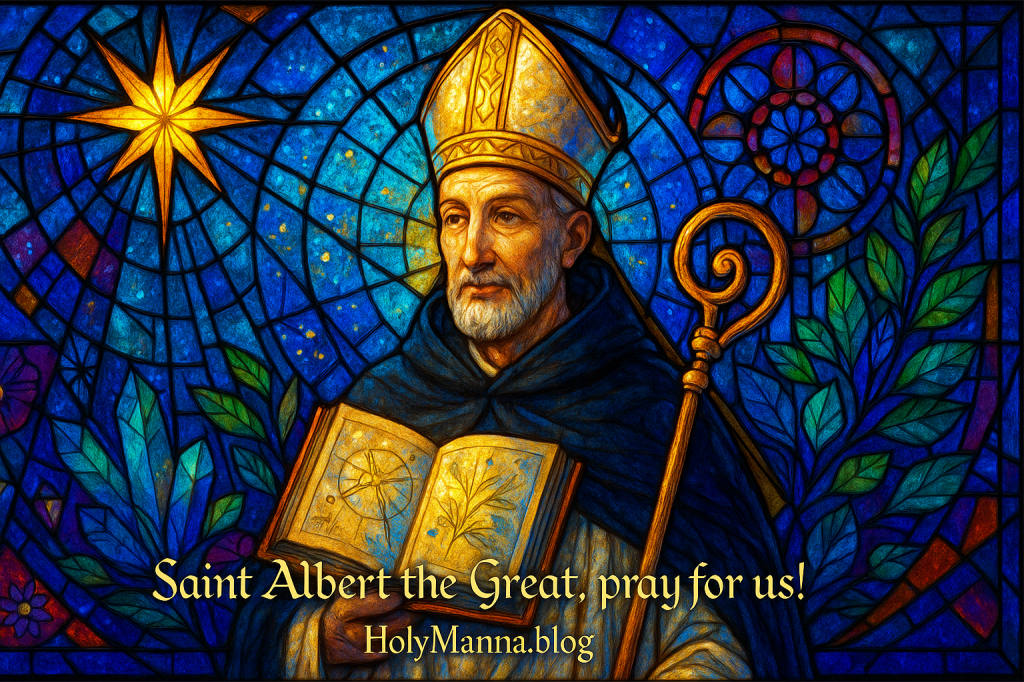
A Mind Ablaze for God’s Wisdom
Saint Albert the Great, known in Latin as Albertus Magnus, shines as a model of how faith and reason belong together. A Dominican friar who became bishop of Regensburg and teacher of Saint Thomas Aquinas, he earned the title Doctor of the Church because his learning served the Gospel with humility and zeal. He wrote extensively on theology and the natural sciences, and he showed by his life that studying creation is a pathway to adore the Creator. The Catechism safeguards this harmony with the clear teaching: “Though faith is above reason, there can never be any real discrepancy between faith and reason.” (CCC 159). Albert’s legacy invites hearts to love God with the whole mind and to let every discovery end in praise.
The Seeds of a Scholar
Born around 1200 in Lauingen in the Swabian region of present-day Germany, Albert grew up in a Christian home that encouraged learning and virtue. His family sent him south for studies, and in Padua he encountered the preaching of Blessed Jordan of Saxony, the successor of Saint Dominic. That encounter stirred a decisive response and he entered the Order of Preachers around 1223. Formation in the Dominican life shaped him for prayer, study, community, and preaching. He advanced through rigorous schooling, mastered Scripture and the Fathers, and became known for patience with students and charity toward the poor. What people remember most is not only his brilliance but his obedience to the Church, his love for the truth, and his fatherly care for those he taught and served.
Building an Intellectual Renaissance for Christ
Albert’s public life stretched across the great universities of medieval Europe. He taught in Cologne and Paris, earned the master’s degree in theology at Paris, and later founded the Dominican studium generale in Cologne, where he formed a young friar named Thomas Aquinas. He read Aristotle widely and took pains to show how careful observation of nature could be integrated within a Catholic worldview. His writings filled libraries: commentaries on Scripture and on Dionysius, treatises on ethics and metaphysics, and influential works on the natural world like De animalibus, De mineralibus, and De vegetabilibus et plantis. He led as Dominican provincial in Germany, attended the Second Council of Lyon, and served as bishop of Regensburg. After reforming that troubled diocese with simplicity and firm charity, he resigned and returned to study and preaching. His students saw a man who could spend hours in prayer, then turn to teaching with clarity and patience. A line often linked to his approach sums up his scientific spirit: “The aim of natural science is not simply to accept the statements of others, but to investigate the causes that are at work in nature.” He taught that honest inquiry, carried out in humility, becomes a work of love offered to God.
Wonder More Than Wonders
Saint Albert is not best known for dramatic healings or public wonders. Medieval stories grew around his name, including tales of an enchanted winter garden and a mechanical speaking figure, but serious historians treat these as literary legends rather than documented miracles. What stands firm is the sign of grace that marked his daily life: remarkable intellectual gifts used in service of the Church, tireless pastoral travel on foot across Germany and beyond, and a fatherly commitment to raise up faithful scholars who would strengthen Catholic doctrine for centuries. His classroom became a place of conversion and mission, where minds were trained for holiness. The steady witness of a learned, prayerful, and charitable bishop is itself a miracle of grace that continues to feed the Church.
Trials Without Blood
Albert shouldered the weight of reform when he accepted the bishopric of Regensburg. He embraced poverty, walked the streets, and brought order where confusion had taken root. Leadership brought criticism from some who feared change, and public life immersed him in theological controversies. When misunderstandings about Aristotle and theology stirred debate, Albert defended sound doctrine and traveled to explain the Catholic synthesis with patience and precision. In his final years his memory faded, a cross he bore quietly while remaining faithful to prayer. He died in Cologne on November 15, 1280, after a life poured out for truth and charity. The Church later honored him as a Doctor in 1931 and entrusted students of the natural sciences to his patronage, recognizing how he held scholarship and sanctity together.
After the Scholar’s Rest
Veneration of Saint Albert took root quickly in the regions he served, especially in Cologne, where his relics are honored and his memory draws pilgrims, students, and teachers. Over centuries the faithful have asked his intercession for clarity of mind, perseverance in study, and humility in success. Many have testified to timely favors and renewed zeal for learning through his prayers. While his canonization in 1931 followed the Church’s careful process of investigating sanctity and heavenly favor, his most enduring “miracle” remains the conversion of countless hearts to a deeper love of God through study ordered to worship. His feast on November 15 keeps that grace before the Church each year and encourages all who love truth to seek holiness first.
Pray, Study, Love, Repeat
Saint Albert teaches a way of life for anyone who works with ideas, technology, or the natural world. He prayed before he studied, so that study became a kind of worship. He loved the Church’s teaching and never separated inquiry from obedience to Christ. He served people more than arguments and treated students as souls to be shepherded. The Catechism puts the goal in a single radiant line that Albert embodied: “God cannot deny himself, nor can truth ever contradict truth.” Let prayer anchor every project. Let Sunday worship shape the rest of the week. Let humility and charity guide conversations at work and at home. Consider adopting Saint Albert’s rhythm: begin with a quiet prayer for light, work diligently with integrity, and end by thanking God for whatever was learned and accomplished. In time, that rhythm forms hearts that love truth and hands that serve the poor.
Engage with Us!
Share thoughts and graces in the comments below.
- Where is the Lord inviting deeper integration between your study, your work, and your worship?
- Which part of creation most moves you to praise God, and how can you contemplate it prayerfully this week?
- How might Saint Albert’s example change the way you learn, teach, or work with the sciences or the arts?
- What steps can you take to ensure that your pursuit of knowledge is rooted in humility, charity, and fidelity to the Church?
Go forward with courage. Live the faith with a bright mind and a burning heart, and do everything with the love and mercy Jesus taught.
Saint Albert the Great, pray for us!
Follow us on Instagram and Facebook for more insights and reflections on living a faith-filled life.

 Holy Manna!
Leave a comment