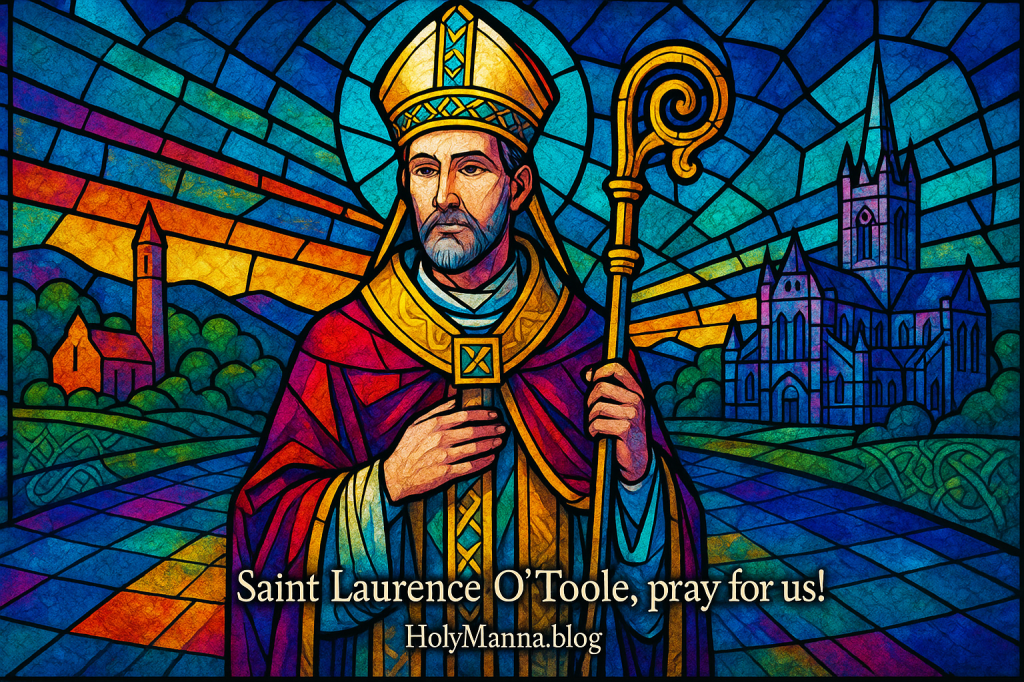
A Shepherd in Stormy Times
Saint Laurence O’Toole, born Lorcán Ua Tuathail, shines as Ireland’s great reforming bishop and steadfast peacemaker in the twelfth century. As Archbishop of Dublin during the Norman invasion, he renewed worship, disciplined clergy life, and put the poor at the center of pastoral care. He is venerated for tireless mediation between Irish rulers and Anglo-Norman powers, for Eucharistic devotion, and for a charity that never looked away from human suffering. The Church holds up the saints as living proof that holiness is possible in every age, and the Catechism of the Catholic Church reminds us: “By canonizing some of the faithful… the Church recognizes the power of the Spirit of holiness within her.” (Catechism of the Catholic Church, 828). Laurence died on November 14, 1180, was canonized in 1225, and is patron of the Archdiocese of Dublin.
From Hostage to Holy Abbot
Laurence was born around 1128 near Castledermot in County Kildare into the Ua Tuathail family, a Gaelic ruling house of Leinster. As a boy, about ten years old, he was given as a political hostage to Diarmait Mac Murchada, King of Leinster, and experienced fear, hardship, and the frailty of earthly power at close range. That early suffering softened his heart toward the poor and stirred a longing for the things of God. Eventually released into the care of the monks of Glendalough, he received a formation steeped in Scripture, liturgy, and the monastic love of prayer. By his mid-twenties he was elected Abbot of Glendalough, where he became known for personal austerity, wise governance, and a daily love for the hungry who found a place at his table.
A Bishop Who Reformed and Rebuilt
In 1162, Laurence was unanimously chosen as Archbishop of Dublin. He guided a city that mixed Norse and Gaelic cultures and needed deep spiritual rebuilding. He invited Augustinian canons to reform the cathedral chapter at Holy Trinity, now Christ Church Cathedral, and he promoted the worthy celebration of the sacred liturgy, including the reverent use of Gregorian chant. He restored churches, strengthened clerical discipline, encouraged frequent Confession and worthy reception of Holy Communion, and made his residence a place of refuge where the hungry were fed and abandoned children were sheltered. His leadership echoed the Church’s perennial teaching on mercy: “The works of mercy are charitable actions by which we come to the aid of our neighbor in his spiritual and bodily necessities.” (Catechism of the Catholic Church, 2447). He fasted regularly, wore a hairshirt beneath his vestments, and kept an annual forty-day retreat at St. Kevin’s cave in Glendalough so that public ministry would always flow from hidden prayer.
Miracles While Bearing the Cross
Laurence’s sanctity was not theoretical. It showed up in crisis. While visiting England for church business after the martyrdom of Saint Thomas Becket, a deranged assailant struck him a violent blow on the head as he was approaching the altar. Those around him thought he was dying. Laurence asked for water, blessed it, had the wound washed, and the bleeding stopped at once. He then completed the Mass with composure that came from deep Eucharistic faith. Contemporary accounts from his life and early miracles also speak of healings obtained through his blessing and prayer, especially among the poor he served and the wounded he tended during the upheavals of the invasion. His calm courage, his preference for the altar over fear, and his readiness to suffer rather than abandon the flock reveal the texture of heroic virtue.
Trials, Peacemaking, and a Holy Death
Laurence lived at the crossroads of Irish and Anglo-Norman worlds. He negotiated tirelessly on behalf of peace, helped shape terms later associated with the Treaty of Windsor in 1175, and represented the Irish Church at the Third Lateran Council in 1179, after which Pope Alexander III appointed him papal legate for Ireland. He refused to let politics eclipse the Gospel. He tended the wounded during street violence, he insisted on the sanctuary rights of churches, and he spoke truth to power without bitterness. In 1180 he traveled again to plead for just treatment of his people. He fell ill in Normandy and was carried to the Abbey of St. Victor at Eu, where he surrendered his life to God on November 14. Tradition preserves tender last words that unveil the heart of a true father and shepherd: “God knows, I have not a penny under the sun to leave anyone.” and “Alas, you poor, foolish people, what will you do now? Who will take care of you in your trouble? Who will help you?” His death was the final homily of a bishop who spent all he had, down to his last breath, for the Church and the poor.
Signs and Wonders After His Passing
After his burial at Eu, pilgrims flocked to his tomb and reported healings that strengthened devotion to the holy archbishop. His relics became a focus of prayer for the sick and the sorrowing. In Dublin, his heart was enshrined at Christ Church Cathedral, a visible reminder that a bishop’s love does not end when earthly work is done. The centuries did not diminish that love. The heart was stolen in 2012 and, to the joy of the faithful, was recovered and returned to public veneration in 2018. Pilgrims today still honor him in Eu and in Dublin, asking his intercession for peace in divided times, courage in public witness, and healing for wounds that seem too deep to mend.
Why His Witness Matters Now
Saint Laurence O’Toole shows what Gospel leadership looks like in real life. Prayer comes first, then penance that purifies the heart, then mercy that feeds and shelters the poor, then courage that seeks peace without abandoning truth. His Eucharistic-centered resilience in crisis calls every disciple to anchor the day in the Mass and to let the presence of Jesus form a quiet, steady soul. His love for the poor teaches that structures and strategies matter, yet the heart of renewal is always personal sacrifice for the neighbor in need. His peacemaking offers a model for families, parishes, and communities that long for justice but refuse the poison of hatred. The Catechism sums up the rhythm of conversion that marked his life: “The seasons and days of penance in the course of the liturgical year are intense moments of the Church’s penitential practice.” (Catechism of the Catholic Church, 1438). Holiness, for him and for us, begins on our knees and bears fruit at our neighbor’s table.
Engage with Us!
Share thoughts and graces from Saint Laurence’s story in the comments. Consider these prompts for prayer and conversation:
- Where is God inviting a deeper spirit of penance and prayer, following Saint Laurence’s example of retreats and self-denial?
- How can daily life reflect works of mercy, especially toward those who are homeless, hungry, or forgotten in your city?
- What does Laurence’s calm fidelity at Mass during crisis teach about anchoring every day in the Eucharist?
- Where is there a need to be a peacemaker in family, parish, or workplace, and what first step can be taken today?
- How can devotion to the saints, and veneration of their relics, strengthen confidence in the communion of saints and the power of intercession?
Keep going with courage and joy. Live the faith boldly, serve the poor generously, and do everything with the love and mercy Jesus taught. Saint Laurence O’Toole, pray for us.
Saint Laurence O’Toole, pray for us!
Follow us on Instagram and Facebook for more insights and reflections on living a faith-filled life.

 Holy Manna!
Leave a comment