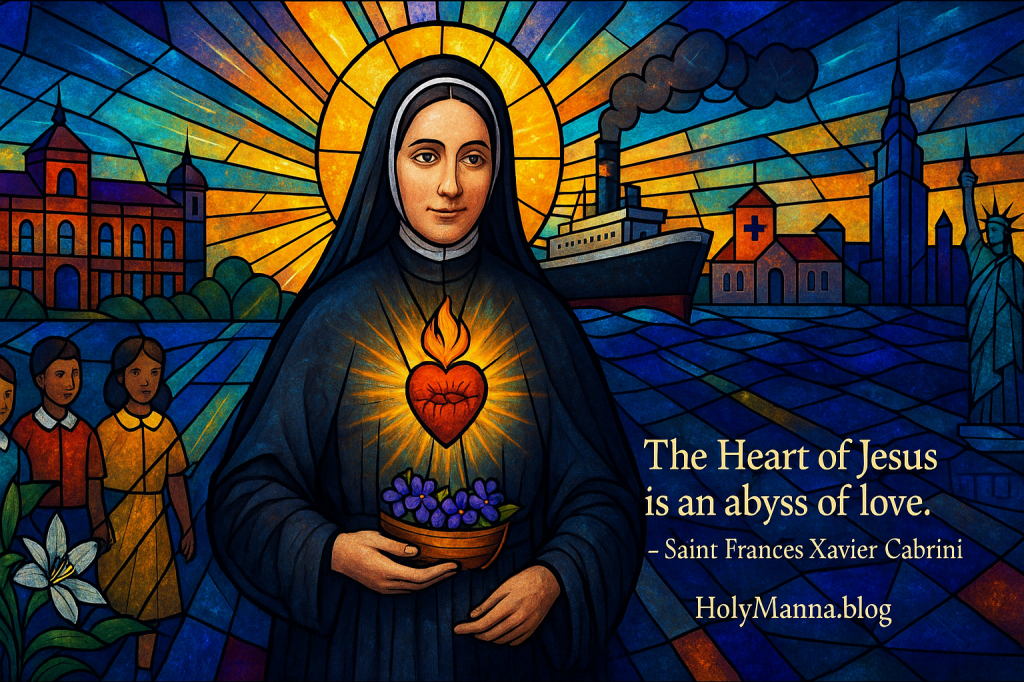
A Heart On Fire For The Sacred Heart
Saint Frances Xavier Cabrini, known across the world as Mother Cabrini, is the first United States citizen to be canonized. The Church venerates her as patron of immigrants because her life mirrored the Heart of Jesus for those forced to begin again in a new land. She founded the Missionary Sisters of the Sacred Heart of Jesus and, through relentless trust in Providence, built a living network of schools, hospitals, and orphanages that protected dignity and preached the Gospel in her deeds. Her own words reveal the engine of that mission: “I will go anywhere and do anything in order to communicate the love of Jesus to those who do not know Him or have forgotten Him.” Another favorite line still convicts busy Christians today: “We must pray without tiring, for the salvation of mankind does not depend upon material success but on Jesus alone.”
From Sant’Angelo To Mission Territory
Maria Francesca Cabrini was born on July 15, 1850, in Sant’Angelo Lodigiano in Lombardy, the youngest of thirteen children. Fragile health followed her from childhood, yet a missionary spark was already lighting up her imagination. As a little girl she folded paper boats and filled them with violets, sending them down a stream as “missionaries” bound for lands that had never heard the name of Jesus. She trained as a teacher and longed to enter religious life, but several communities hesitated because of her poor health. Providence redirected that disappointment into a new beginning. With spiritual counsel and a circle of devoted women, she founded the Missionary Sisters of the Sacred Heart of Jesus in Codogno in 1880. At profession in 1877 she had taken the name “Frances Xavier” after the great Jesuit evangelist to signal a life aimed at mission. Planning for China, she sought papal guidance, and Pope Leo XIII gave the famous instruction that shaped modern Catholic history: “Not to the East, but to the West.” Obedience moved her across the Atlantic in 1889 to serve neglected Italian immigrants in New York. She later became a naturalized citizen in 1909, a prophetic sign that holiness can take root and blossom in the American story.
Love That Builds And Heals
Mother Cabrini believed that love must be organized. Charity, for her, was not sporadic sentiment but a way of life anchored in the Eucharist and poured into institutions that would outlast her. She and her Sisters walked into tenements, taught catechism in cramped apartments, cared for the sick, and gathered orphans into homes where they learned to pray, study, and hope. Schools rose in neighborhoods where immigrants faced prejudice and poverty. Hospitals opened so that the vulnerable could receive care regardless of background or ability to pay. By the end of her earthly life she had founded dozens of institutions across the United States, Italy, and the Americas, each one a lighthouse of Catholic mercy. She crossed the ocean more than twenty times, battling seasickness and fatigue so that the Sacred Heart could be known in new places. Her daily spirituality was simple and strong: “The Heart of Jesus is an abyss of love.” That conviction gave practical courage for contracts, construction, staffing, and the hidden acts of motherly care that no ledger ever captures.
Wonders Along The Way
Stories from people who knew her speak of favors and protections that came as answers to confident prayer. In the mountains above Denver, she prayed when water was scarce for the Sisters and children. Tradition recounts that, after directing a search on the hillside, a spring began to flow and continues to refresh pilgrims. In city after city benefactors arrived at the last minute, debts were met against all odds, and building doors opened when it seemed they would remain closed. She taught her daughters and friends to pray with bold filial trust: “Jesus, fortify me with the grace of Your Holy Spirit and give Your peace to my soul.” Those who crossed her path often began to hope again, not because problems vanished, but because grace felt near and concrete in the presence of a woman who believed that Christ really reigns.
Trials That Tempered Courage
Mother Cabrini’s mission met real resistance. Anti-immigrant hostility, language barriers, and tight finances threatened her foundations. Some civic officials and even a few church leaders questioned the scale of her plans. Her health remained delicate and travel was exhausting, yet she refused to let fear write the script. Upon arriving in New York, the Sisters discovered that promised housing had evaporated, so they spent the first night in a shabby boarding house and began again the next morning with prayer and work. She endured misunderstandings and legal tangles with a steady peace rooted in adoration of the Blessed Sacrament. There was no martyrdom in the literal sense, but there was the white martyrdom of poured-out charity. She died on December 22, 1917, in Chicago at a room in the hospital her Sisters ran, finishing her race in the service of the poor she loved.
Miracles After Her Death
After Mother Cabrini’s death, miraculous healings were recorded through her intercession. One well-known case involved a newborn boy who had been accidentally burned in the eyes by a caustic solution in a hospital nursery. The Sisters prayed through the night, entrusted the child to Mother Cabrini’s prayers, and by morning the injuries were gone. The same child later survived a severe illness against all expectation and grew up to serve as a priest. Other documented cures in New York and Chicago included recoveries from paralysis and life-threatening infections at critical hours. These public miracles stood alongside countless quiet stories of conversions, reconciled families, and renewed vocations. The Church recognized her heroic virtue and authenticated miracles, leading to beatification in 1938 and canonization in 1946. Pilgrims have continued to report favors large and small, the kind that strengthen faith and rekindle gratitude.
Where Her Memory Lives
Mother Cabrini’s memory continues to gather people to prayer and mercy. In Washington Heights her major relics invite the faithful to venerate a woman who spent everything on Christ and His little ones. In Chicago the preserved room where she died draws visitors who come seeking peace, healing, and courage for their own vocations. In the foothills near Golden, Colorado, pilgrims climb a hillside crowned by a statue of the Sacred Heart and visit a spring linked to her prayer, a reminder that God provides in barren places. Schools, hospitals, and ministries that bear her name keep teaching, healing, and evangelizing in the spirit she gave them, proving that institutions can, in fact, become instruments of love when they remain rooted in Christ.
Charity With Backbone
Mother Cabrini lived the Catholic vision of mercy with doctrinal clarity. The Catechism of the Catholic Church teaches, “The works of mercy are charitable actions by which we come to the aid of our neighbor in his spiritual and bodily necessities.” She organized those works with intelligence and perseverance so that the poor received more than a handout. They received a home, a school, a chapel, and a future. The Catechism also teaches about the duty to welcome those forced to migrate: “The more prosperous nations are obliged, to the extent they are able, to welcome the foreigner in search of the security and the means of livelihood which he cannot find in his country of origin.” Her life proves that Catholic social teaching is not a theory for classrooms only. It is a call that can shape city blocks, heal families, and rehumanize public life when believers let the Sacred Heart govern plans, budgets, and timelines.
Dying To Self, Living For Christ
Mother Cabrini shows that holiness is practical and contagious. Prayer before the Eucharist comes first because strength flows from Jesus, not from personality or hustle. Obedience to the Church guards zeal from drifting into pride. Love for the poor chooses the hard, hidden tasks that make a home livable and a school worthy of a child. Hospitality becomes a habit when Christians remember that Christ is present in the newcomer who feels lost. Her counsel still steadies anxious hearts: “Be patient in trials and constant in prayer.” Her courage still lights up fearful days: “Courage, let us pray and go forward for the glory of God and the salvation of souls.” Following her example today means building something concrete for others and letting Jesus set the pace.
Engage with Us!
Share your thoughts and prayers for Saint Frances Xavier Cabrini in the comments below.
- Where is Christ inviting you to welcome the stranger with concrete love this week?
- How might daily Eucharistic prayer shape your work for those who suffer or feel unseen?
- What small institutional good, like tutoring or hospital volunteering, could you help build in your community?
- Which line from the Catechism or from Mother Cabrini’s own prayer speaks most to your current season of life?
- What fear needs to be surrendered to the Sacred Heart so that charity can move freely through you?
Go forward with confidence. Live the ordinary tasks of each day with the extraordinary love and mercy of Jesus. In every person, especially the migrant and the poor, meet the Heart of Christ and let Him work wonders through you.
Saint Frances Xavier Cabrini, pray for us!
Follow us on Instagram and Facebook for more insights and reflections on living a faith-filled life.

 Holy Manna!
Leave a comment