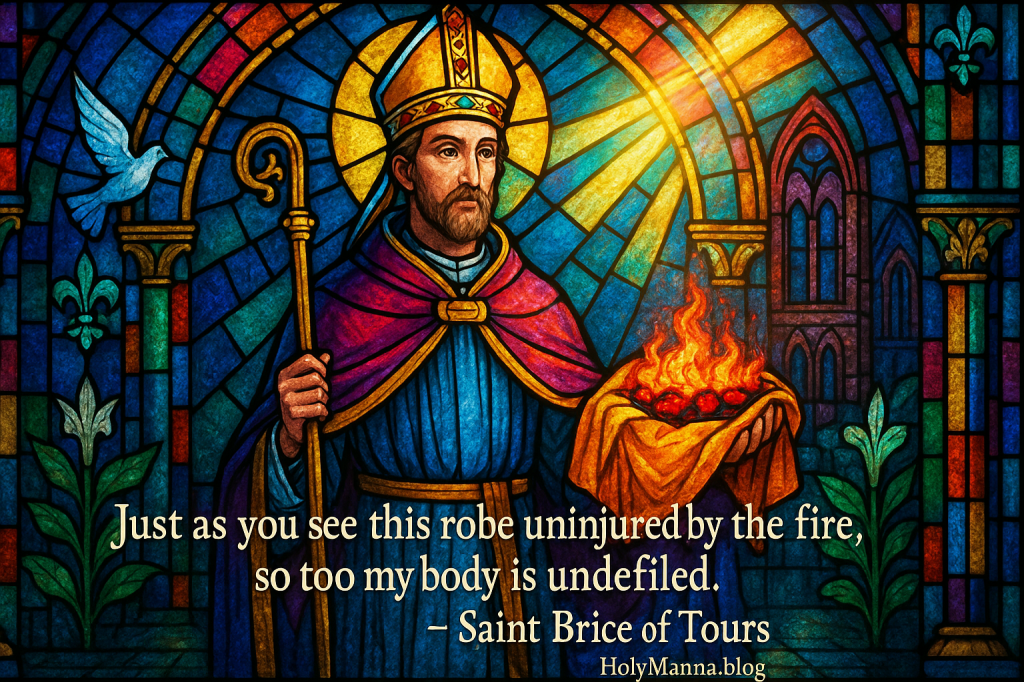
A Bishop Forged in Fire and Mercy
Saint Brice of Tours, who died in 444 after forty-seven years as bishop, took the staff of leadership from the hands of Saint Martin and learned to carry it with humility. His story matters because it shows how grace can conquer pride and reshape a sharp temperament into a pastor’s heart. The Church honors bishops as successors of the Apostles who shepherd the People of God in communion with the Pope, and Brice learned that vocation through correction, repentance, and perseverance. He is remembered as a confessor rather than a martyr, and his memorial falls on November 13, a quiet reminder that God does not waste a complicated past when a soul lets Him finish the work He begins.
Restless Beginnings and a Prophecy
Tradition remembers Brice as an orphan raised near Tours under the watch of Saint Martin’s monastic community at Marmoutier. He was gifted, handsome, quick-witted, and also quick-tempered. Those who formed him saw real promise but also real danger in his ambition. The tension came to a head when Brice, still young, spoke rashly about Martin. The older saint reportedly replied that Brice would one day wear the mitre, but that the office would purify him through suffering. In time, the clergy and people elected Brice to succeed Martin in 397. The prophecy held. The episcopate did not flatter him; it refined him. Brice is best known for this dramatic arc from brash youth to penitent father, a living illustration of the Church’s teaching that conversion is ongoing and always the work of grace described in the Catechism of the Catholic Church (see 1427–1432).
Signs That Burned Bright
Years into his ministry, Brice faced a public scandal when a woman who had adopted religious dress gave birth and the angry crowd accused him of being the father. He refused to defend himself with clever words and instead invoked the holy Name of Jesus. He brought the thirty-day-old child before the assembly and said, “I adjure you in the Name of the Lord Jesus Christ, declare publicly to all if I begot you.” According to the tradition, the baby answered, “It is not you who are my father.” The crowd still hesitated, and Brice offered another sign rooted in Scripture’s images of fire and purity. He gathered red-hot coals into his cloak, carried them to the tomb of Saint Martin, and then opened the mantle to show it unscorched, saying, “Just as you see this robe uninjured by the fire, so too my body is undefiled.” These episodes did not only clear his conscience before God; they began to clear his vision. He wanted not vindication but holiness, and holiness looks like patience, prayer, and submission to the judgment of the Church.
Exile, Penance, and a Shepherd’s Return
The accusations sparked unrest, and Brice was driven from his own see. He set out for Rome, sought the judgment of the Apostolic See, and embraced penance for years. That long season of humiliation proved to be the real turning point. The man who had once been hard toward Saint Martin learned gentleness at the tombs of the Apostles. He prayed, offered the Holy Sacrifice, and waited for God to open a path home. When that path finally opened, the rival who had been forced upon Tours died as Brice returned, and the people received their bishop again. The last seven years of his episcopate were marked by humility, steadiness, and pastoral fidelity. He died in peace, having allowed suffering to do its merciful work. The Catechism teaches that the Sacrament of Penance restores communion with the Church and gives peace to a troubled conscience (see 1468–1470). Brice’s life shows that this is not an abstract doctrine. It is the story of a real man who learned to be a father.
A Memory That Heals
Unlike some saints whose tombs became famous for long catalogs of posthumous miracles, Brice’s afterlife in Christian memory centers on his moral miracle: a proud heart converted by grace. Early veneration grew in Tours and throughout Gaul, and his name became fixed in calendars and place-names, a sign that the faithful recognized a shepherd worth remembering. The absence of thick miracle-collections after his death does not diminish his sanctity. It highlights the kind of witness he offered. His legacy is not a spectacular shrine but a reliable lesson. God’s grace can make a sinner into a trustworthy pastor and can turn a scandal into a school of holiness.
Let Grace Rewrite Your Reputation
Brice’s path speaks to anyone who has ever been hot-headed, misunderstood, or tempted to posture. He misread a living saint. He hurt people with his pride. He was accused and humiliated. Yet he let grace finish what God began. The Catechism warns against rash judgment and calumny because a neighbor’s good name is part of justice and charity (see 2477–2478). Brice challenges believers to guard others’ reputations with the same zeal they wish others would guard theirs. Practically, that looks like going to Confession regularly, receiving difficult feedback without defensiveness, blessing those who speak ill, and choosing silence over gossip. It looks like praying for pastors rather than critiquing them from a distance. Above all, it looks like beginning again with hope, because the Lord delights to raise the lowly and to purify those He calls.
Engage with Us!
Share your thoughts and what stood out to you in the comments below.
- Where do you see pride or impatience in your life, and how might God be inviting you to real conversion right now?
- When have you been unfairly judged, and how did you respond? What would a Christ-like response look like today?
- How can you actively protect someone’s good name this week, especially in conversations or on social media?
- What practical step will you take to return to the sacraments and begin again with humility and hope?
Keep going with courage. Live the faith with conviction. Do everything with the love and mercy Jesus taught.
Saint Brice of Tours, pray for us!
Follow us on Instagram and Facebook for more insights and reflections on living a faith-filled life.

 Holy Manna!
Leave a comment