Memorial of Saint Frances Xavier Cabrini, Virgin – Lectionary: 494
Wisdom in Motion
Pause for a moment and look around, because the Word is already at work. Today’s readings unveil a single thread: Divine Wisdom forms hearts to recognize and reveal the Kingdom that is already present, and this Wisdom sends disciples into concrete works of mercy. In Wisdom 7:22–8:1, the sacred author describes Wisdom as “the reflection of eternal light” who “passes into holy souls” and “governs all things well”, which means God’s own life animates ordinary people to become friends of God and prophets in their time. Psalm 119 reminds that “Your word, Lord, stands forever”, and that “the revelation of your words sheds light”, so the rule of God does not arrive through hype or headlines but through steady fidelity to the statutes that shape daily choices. In Luke 17:20–25, Jesus corrects anxious speculation about dates and signs, teaching that “the kingdom of God is among you”, present in hidden ways now, yet destined to blaze forth in glory after the Son of Man suffers and is rejected. This is the classic pattern of the Kingdom taught in CCC 541–546: it dawns in Christ, grows quietly in the Church, and advances through conversion, sacrifice, and charity.
The memorial of Saint Frances Xavier Cabrini places flesh on this vision. Born in Italy in 1850 and sent to the United States amid massive transatlantic migration, Mother Cabrini read the needs of immigrant families as a living page of the Gospel. She founded schools, hospitals, and orphanages, not to chase visible triumphs, but to let Wisdom give light to the simple and dignity to the poor, an embodiment of the Church’s mission described in CCC 851 and the works of mercy in CCC 2447. Her life shows how the Kingdom grows wherever Christ’s disciples, taught by Scripture and strengthened by the Spirit’s gift of wisdom in CCC 1831, choose courageous love over comfort, and faithful presence over the pursuit of spiritual spectacle. Where is the Kingdom already breaking in around you, and how might Wisdom move you to serve today?
First Reading – Wisdom 7:22–8:1
Wisdom’s Living Light Forms Saints For Mission
The Book of Wisdom arises from the Jewish diaspora in Hellenistic Alexandria, where Israel’s faith met Greek philosophy in lively conversation. In this setting, the sacred author personifies Divine Wisdom as God’s own radiant presence active in creation and in the hearts of the just. The passage unfolds like a hymn, naming qualities that reveal Wisdom’s divine origin and her mission to renew the world by dwelling in holy souls. This fits today’s theme by showing that Wisdom does not remain abstract. Wisdom fashions men and women into friends of God who make the hidden Kingdom visible through sacrificial love and courageous service, the very pattern seen in the life of Saint Frances Xavier Cabrini and in the Church’s mission described in CCC 851 and the works of mercy in CCC 2447. Within the drama of salvation history, this text prepares readers to see how God’s Word forms character, orders society toward the good, and quietly advances the reign of Christ from within.
Wisdom 7:22-8:1
New American Bible (Revised Edition)
7:22 for Wisdom, the artisan of all, taught me.
Nature and Incomparable Dignity of Wisdom
For in her is a spirit
intelligent, holy, unique,
Manifold, subtle, agile,
clear, unstained, certain,
Never harmful, loving the good, keen,
23 unhampered, beneficent, kindly,
Firm, secure, tranquil,
all-powerful, all-seeing,
And pervading all spirits,
though they be intelligent, pure and very subtle.
24 For Wisdom is mobile beyond all motion,
and she penetrates and pervades all things by reason of her purity.
25 For she is a breath of the might of God
and a pure emanation of the glory of the Almighty;
therefore nothing defiled can enter into her.
26 For she is the reflection of eternal light,
the spotless mirror of the power of God,
the image of his goodness.
27 Although she is one, she can do all things,
and she renews everything while herself perduring;
Passing into holy souls from age to age,
she produces friends of God and prophets.
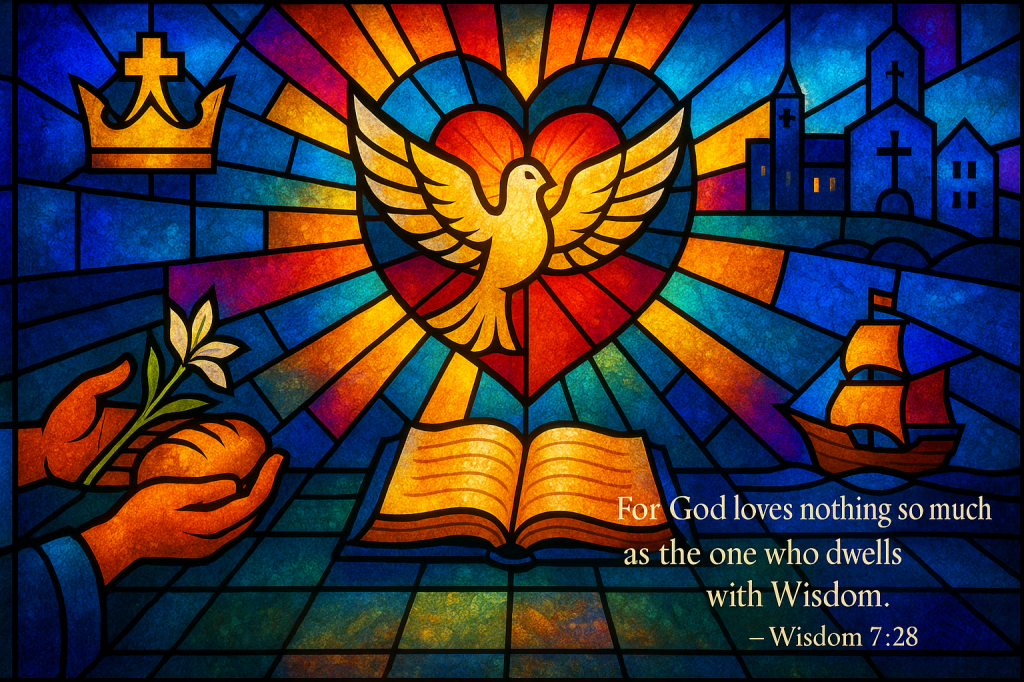
28 For God loves nothing so much as the one who dwells with Wisdom.
29 For she is fairer than the sun
and surpasses every constellation of the stars.
Compared to light, she is found more radiant;
30 though night supplants light,
wickedness does not prevail over Wisdom.
8:1 Indeed, she spans the world from end to end mightily
and governs all things well.
Detailed Exegesis
Verse 7:22 – “for Wisdom, the artisan of all, taught me.”
The sacred author confesses that Wisdom is teacher and craftsman of everything that truly lasts. The line frames the entire unit as received revelation, not human speculation. Divine Wisdom instructs the mind and shapes the heart, echoing the gift of wisdom given by the Holy Spirit in CCC 1831, which disposes believers to judge all things by God’s standards.
Verse 22 – “For in her is a spirit intelligent, holy, unique, Manifold, subtle, agile, clear, unstained, certain, Never harmful, loving the good, keen,”
The cascading attributes underline Wisdom’s transcendence and moral purity. Intelligence and holiness show that Wisdom unites truth and goodness. Clarity, innocence, and certainty indicate that Wisdom enlightens without deceit or violence. These traits anticipate Christian teaching that the gifts of the Spirit “complete and perfect the virtues” so that believers readily obey divine inspirations, as stated in CCC 1831.
Verse 23 – “unhampered, beneficent, kindly, Firm, secure, tranquil, all-powerful, all-seeing, And pervading all spirits, though they be intelligent, pure and very subtle.”
Wisdom is free, generous, and gentle, yet unshakably strong. The text shifts from moral qualities to cosmic scope. Wisdom “pervades” every spirit, which signals God’s provident governance of creation and prepares for the Christian understanding of charisms as graces for the common good, as taught in CCC 799.
Verse 24 – “For Wisdom is mobile beyond all motion, and she penetrates and pervades all things by reason of her purity.”
Wisdom’s mobility surpasses physical motion. Purity here means undividedness and perfect transparency to God. Because Wisdom is unmingled with error, she can reach and heal every part of creation. This resonates with the Church’s affirmation that God creates through wisdom and orders all things, as taught in CCC 299.
Verse 25 – “For she is a breath of the might of God and a pure emanation of the glory of the Almighty; therefore nothing defiled can enter into her.”
Using temple and theophany language, the author states that Wisdom shares in God’s own splendor. Since Wisdom is an outpouring of divine glory, sin cannot cohabit with her. The line calls for conversion and purification so that God’s presence may dwell within the soul.
Verse 26 – “For she is the reflection of eternal light, the spotless mirror of the power of God, the image of his goodness.”
Three metaphors affirm that Wisdom perfectly reveals God. Reflection, mirror, and image all point to a likeness that communicates truth without distortion. The Christian tradition reads such language as anticipating the full revelation of God’s Wisdom in Christ, in whom believers are refashioned into God’s image through grace.
Verse 27 – “Although she is one, she can do all things, and she renews everything while herself perduring; Passing into holy souls from age to age, she produces friends of God and prophets.”
Wisdom is one and inexhaustible, yet she multiplies her effects across generations. Her hallmark is renewal. When Wisdom enters the holy, she raises up intimate companions of God and prophets who speak and act for the common good. The line illumines the sanctity and apostolic fruitfulness seen in saints such as Frances Xavier Cabrini.
Verse 28 – “For God loves nothing so much as the one who dwells with Wisdom.”
Divine favor rests upon those who welcome Wisdom’s indwelling. The verse invites a life of docility to the Holy Spirit and daily discernment ordered by God’s truth.
Verse 29 – “For she is fairer than the sun and surpasses every constellation of the stars. Compared to light, she is found more radiant;”
Even the brightest created lights cannot rival Wisdom’s beauty. The line teaches that all created splendor is sacramental only insofar as it points beyond itself to God, the source of every good and every gift.
Verse 30 – “though night supplants light, wickedness does not prevail over Wisdom.”
Darkness can temporarily obscure created light, but it cannot overcome God’s wise plan. Hope is theological realism. Evil has limits. God’s Wisdom is indefectible.
Verse 8:1 – “Indeed, she spans the world from end to end mightily and governs all things well.”
The conclusion gathers the whole: Wisdom’s reach is universal, and her governance is benevolent. This line grounds Christian confidence that God’s providence orders history and empowers mission in every age.
Teachings
The Church identifies Wisdom as a gift of the Holy Spirit that shapes judgment and life according to God. CCC 1831 teaches: “The seven gifts of the Holy Spirit are wisdom, understanding, counsel, fortitude, knowledge, piety, and fear of the Lord. They complete and perfect the virtues of those who receive them. They make the faithful docile in readily obeying divine inspirations.” The fruitful effects described in Wisdom 7:27 align with the Church’s teaching on charisms. CCC 799 states: “Whether extraordinary or simple and humble, charisms are graces of the Holy Spirit which directly or indirectly benefit the Church, ordered as they are to her building up, to the good of men, and to the needs of the world.” Wisdom’s cosmic scope reflects God’s orderly creation. CCC 299 affirms: “Because God creates through wisdom, his creation is ordered: ‘You have arranged all things by measure and number and weight’ (Wis 11:20).” The practical outflow of Wisdom appears in mercy and mission. CCC 2447 explains: “The works of mercy are charitable actions by which we come to the aid of our neighbor in his spiritual and bodily necessities.” Such doctrine illuminates how saints become “friends of God and prophets” in history. Saint Frances Xavier Cabrini allowed divine Wisdom to direct concrete works for immigrants and the poor, showing that authentic contemplation blossoms into service that builds up the Church and heals society.
Reflection
Wisdom invites a home in the soul so that everyday choices manifest God’s reign in hidden and steady ways. Begin by asking the Holy Spirit for the gift of wisdom and then return to God’s Word until the heart is teachable and the mind is clear. Choose one act of mercy for someone nearby and carry it through with kindness and firmness. Seek mentors who radiate peace and learn their habits of prayer, study, and service. When discouragement comes, remember that wickedness does not prevail over Wisdom and that renewal is Wisdom’s signature in every season. Where is Divine Wisdom calling for renewal in your life right now? Which work of mercy can become the daily practice that opens space for Wisdom to dwell? How might God be inviting you to join Him in producing “friends of God and prophets” through concrete service today?
Responsorial Psalm – Psalm 119:89–91, 130, 135, 175
The Enduring Word That Lights The Hidden Kingdom
Composed as an alphabetic acrostic, Psalm 119 is Israel’s long love song to the Torah, the revealed instruction that forms a people to walk in the ways of the Lord. Prayed in synagogue and embraced deeply by the early Church, the psalm shaped communities to see God’s faithful governance in every season and to live by statutes that heal the heart and order society. These selected verses proclaim that God’s Word is firm, luminous, and life giving, which fits today’s theme by showing how Divine Wisdom makes the Kingdom present through steady obedience rather than spectacle. In the memorial of Saint Frances Xavier Cabrini, this psalm sounds like a blueprint for mission. The Word stands forever, gives light to the simple, and moves disciples to concrete mercy that reveals Christ’s reign among the poor and the vulnerable.
Psalm 119:89-91, 130, 135, 175
New American Bible (Revised Edition)
89 Your word, Lord, stands forever;
it is firm as the heavens.
90 Through all generations your truth endures;
fixed to stand firm like the earth.
91 By your judgments they stand firm to this day,
for all things are your servants.
130 The revelation of your words sheds light,
gives understanding to the simple.
135 Let your face shine upon your servant;
teach me your statutes.
175 Let my soul live to praise you;
may your judgments give me help.
Detailed Exegesis
Verse 89 – “Your word, Lord, stands forever; it is firm as the heavens.”
The psalmist anchors hope not in shifting circumstances but in the permanence of God’s speech. As the heavens remain, so does the promise. In Christian life, this steadiness grounds discernment and keeps zeal from drifting into activism without contemplation, aligning with the Church’s conviction that Scripture is the stable norm of faith and life.
Verse 90 – “Through all generations your truth endures; fixed to stand firm like the earth.”
God’s fidelity is transgenerational. The image of the earth fixed in place evokes covenant stability. Communities shaped by this truth can build institutions of charity that outlast one generation and bless the next, a pattern seen in the schools and hospitals founded by saints who trusted the Word more than trends.
Verse 91 – “By your judgments they stand firm to this day, for all things are your servants.”
Creation itself is obedient to God’s wise ordinances. The line teaches a sacramental worldview: the world is not random but responsive to the Creator. Learning the Lord’s judgments trains the soul to cooperate with Providence, making daily work an offering that serves the Kingdom’s quiet advance.
Verse 130 – “The revelation of your words sheds light, gives understanding to the simple.”
Revelation is illumination. Divine speech does not merely inform but transforms, granting discernment to the humble who receive it. The “simple” are not simplistic, but teachable. This verse invites lectio divina and docility to the Holy Spirit so that decisions flow from light rather than impulse.
Verse 135 – “Let your face shine upon your servant; teach me your statutes.”
The shining face recalls the priestly blessing and signals covenant favor. Instruction is relationship. To learn statutes is to live before God’s gaze with filial confidence. Mercy and mission begin here, because those who know they are seen and loved can serve without fear.
Verse 175 – “Let my soul live to praise you; may your judgments give me help.”
Life, praise, and help converge. The psalmist asks not only for survival but for a life oriented to worship. God’s judgments do not crush; they sustain and assist. Obedience becomes freedom because it aligns the heart with divine wisdom.
Teachings
The Church safeguards and proclaims the enduring character of God’s Word. CCC 141 teaches: “The Church has always venerated the divine Scriptures as she venerated the Body of the Lord; both nourish and govern the whole Christian life.” This nourishment is not optional piety but essential formation. Hence CCC 133 exhorts: “The Church ‘forcefully and specifically exhorts all the Christian faithful to learn ‘the surpassing knowledge of Jesus Christ,’ by frequent reading of the divine Scriptures. ‘Ignorance of the Scriptures is ignorance of Christ.’” Learning to read rightly includes receiving the senses of Scripture. CCC 115 states: “According to an ancient tradition, one can distinguish between two senses of Scripture: the literal and the spiritual, the latter being subdivided into the allegorical, moral, and anagogical senses.” The unity of God’s plan also shapes interpretation. CCC 129 preserves the maxim of Saint Augustine: “The New Testament lies hidden in the Old and the Old Testament is unveiled in the New.” Taken together, these teachings show why Psalm 119 is a school of discipleship. The Word abides, gives light, and forms a people whose praise becomes service, just as Mother Cabrini’s fidelity to Scripture and sacramental life overflowed into institutions of mercy that made the Kingdom visible.
Reflection
Let the permanence and light of the Word shape the next concrete choice. Set aside unhurried time to read a short passage slowly and ask for understanding with the humility of the “simple.” Choose one statute of the Lord to practice today, such as truthful speech, justice in work, or tender care for a neighbor in need, and carry it through even when it is costly. Return to God’s gaze throughout the day by repeating a verse as a quiet prayer until it becomes the rhythm of the heart. Which line from today’s psalm can become the prayer that steadies your steps this week? Where might God be inviting a teachable spirit that receives light instead of clinging to control? How could fidelity to the Word today spill over into a work of mercy that lets the Kingdom be seen among the least?
Holy Gospel – Luke 17:20–25
Hidden Reign, Public Cross, Vigilant Hearts
Second Temple Judaism longed for God’s kingdom as a visible restoration of Israel’s fortunes, yet Jesus reframes these hopes by revealing a reign that is already present in his very person while still awaiting its manifest glory. In this scene, the Pharisees press for a timetable, but the Lord redirects attention from curiosity about signs to fidelity to his presence and mission. The apocalyptic title “Son of Man” evokes Daniel’s vision and underscores that the Kingdom arrives through the path of suffering before it bursts forth universally. This fits today’s theme because Divine Wisdom teaches disciples to recognize and reveal the Kingdom already among them through steadfast charity and courageous mission, as seen in the life of Saint Frances Xavier Cabrini, whose works made Christ’s reign tangible among the poor.
Luke 17:20-25
New American Bible (Revised Edition)
The Coming of the Kingdom of God. 20 Asked by the Pharisees when the kingdom of God would come, he said in reply, “The coming of the kingdom of God cannot be observed, 21 and no one will announce, ‘Look, here it is,’ or, ‘There it is.’ For behold, the kingdom of God is among you.”
The Day of the Son of Man. 22 Then he said to his disciples, “The days will come when you will long to see one of the days of the Son of Man, but you will not see it. 23 There will be those who will say to you, ‘Look, there he is,’ [or] ‘Look, here he is.’ Do not go off, do not run in pursuit. 24 For just as lightning flashes and lights up the sky from one side to the other, so will the Son of Man be [in his day]. 25 But first he must suffer greatly and be rejected by this generation.
Detailed Exegesis
Verse 20 – “Asked by the Pharisees when the kingdom of God would come, he said in reply, ‘The coming of the kingdom of God cannot be observed,’”
The question seeks external markers, but Jesus insists that the Kingdom is not reducible to measurable phenomena. The correction invites humble discernment rather than speculative timelines. The Church reads this as a call to attend to the presence of grace rather than chase predictions.
Verse 21 – “‘and no one will announce, ‘Look, here it is,’ or, ‘There it is.’ For behold, the kingdom of God is among you.’”
The Kingdom is already at hand in the person of Christ and in the community he gathers. “Among you” signals a communal reality that grows quietly wherever Christ reigns in hearts and structures. The line summons trust in the Lord’s hidden work through Scripture, sacraments, and works of mercy.
Verse 22 – “Then he said to his disciples, ‘The days will come when you will long to see one of the days of the Son of Man, but you will not see it.’”
Longing marks the time between the Lord’s ministry and his return. Disciples will ache for clarity and consolation, yet faith matures precisely in this longing. The Gospel trains desire so that hope does not collapse into impatience.
Verse 23 – “‘There will be those who will say to you, ‘Look, there he is,’ [or] ‘Look, here he is.’ Do not go off, do not run in pursuit.’”
Jesus warns against spiritual restlessness and sensationalism. The disciple resists the lure of novelty and stays anchored in the ordinary means of grace. False urgency fractures communion and distracts from authentic conversion.
Verse 24 – “‘For just as lightning flashes and lights up the sky from one side to the other, so will the Son of Man be [in his day].’”
The final manifestation will be unmistakable and public. No elite insider will corner the moment. This image protects the faithful from anxiety and from manipulation by claims of secret arrivals.
Verse 25 – “‘But first he must suffer greatly and be rejected by this generation.’”
Glory comes by way of the Cross. The Kingdom’s definitive unveiling follows the Passion, a pattern that also shapes every disciple’s mission. Rejection does not negate God’s plan; it reveals its depth. The Church learns to serve without spectacle, even amid misunderstanding.
Teachings
CCC 541 anchors the Gospel’s proclamation of the Kingdom: “‘Now after John was arrested, Jesus came into Galilee, preaching the gospel of God, and saying: ‘The time is fulfilled, and the kingdom of God is at hand; repent, and believe in the gospel.’ To carry out the will of the Father Christ inaugurated the kingdom of heaven on earth. Now the Father’s will is ‘to raise up men to share in his own divine life’. He does this by gathering men around his Son Jesus Christ. This gathering is the Church, ‘on earth the seed and beginning of that kingdom.’”
The Catechism also clarifies the “already and not yet” of the Kingdom in CCC 672: “Before his Ascension Christ affirmed that the hour had not yet come for the glorious establishment of the messianic kingdom awaited by Israel which, according to the prophets, was to bring all men the definitive order of justice, love, and peace. According to the Lord, the present time is the time of the Spirit and of witness, but also a time still marred by ‘distress’ and the trial of evil which does not spare the Church and ushers in the struggles of the last days. It is a time of waiting and watching.”
The Church’s prayer confesses the same hope in the Nicene Creed: “He will come again in glory to judge the living and the dead and his kingdom will have no end.”
Finally, the Church situates the Kingdom’s hidden presence within her worship, as taught in CCC 2816: “The kingdom of God has been coming since the Last Supper. It is in our midst in the Eucharist.”
Reflection
Set aside the chase for religious spectacle and attend to Christ’s quiet reign in the Word, in the Eucharist, and in the neighbor who needs concrete love today. Stay faithful to the ordinary means of grace through consistent prayer, confession, and Communion, and let that fidelity overflow into works of mercy that no headline will capture but heaven will never forget. Hold longing and patience together by remembering that lightning will one day stretch from horizon to horizon, and every hidden yes will be revealed. Where has the Lord placed his Kingdom “among you” today, and how can that presence shape the next decision? What restless pursuits need to be surrendered so that attention returns to the places where Christ truly meets his people? How might the Cross you carry right now become the very doorway through which the Kingdom becomes visible to someone else?
Walk in Wisdom, Reveal the Kingdom
Divine Wisdom does not stay distant or abstract. In Wisdom 7:22–8:1, the Spirit is described as “the reflection of eternal light” who “passes into holy souls” to renew the world through faithful men and women. Psalm 119 answers with trust in the unshakable Word, confessing “Your word, Lord, stands forever” and asking for the light that gives understanding to the teachable heart. Then Luke 17:20–25 makes the point unmistakable: “the kingdom of God is among you”, present in the simple fidelity of disciples who refuse spiritual spectacle and stay close to Jesus on the path that leads through the Cross to glory. The memorial of Saint Frances Xavier Cabrini stitches all of this together in real history. Formed by Scripture and sacraments, she let Wisdom shape courageous mercy for immigrants, building schools, hospitals, and homes that made the hidden Kingdom visible in daily life, a living witness to the mission described in CCC 541–546, the impulse of evangelization in CCC 851, the gift of wisdom in CCC 1831, and the works of mercy in CCC 2447.
Here is the invitation. Ask the Holy Spirit for wisdom, open the Scriptures each day until light breaks in, and choose one concrete work of mercy that puts love in motion for someone near at hand. Stay faithful to prayer and the sacraments, keep promises when it is costly, and let the steady brightness of God’s judgments guide decisions at home and at work. The Kingdom grows wherever the Word is welcomed, charity gets practical, and hope holds fast even when rejected or misunderstood. Where is Wisdom nudging a step of courageous mercy today? How can the Word you heard become the choice you make before the day ends?
Engage with Us!
Share your reflections in the comments below and encourage a real conversation that helps everyone grow in holiness.
- First Reading – Wisdom 7:22–8:1: How is Divine Wisdom inviting a practical act of renewal today, and what step can be taken so that God may “pass into” the heart with greater freedom through prayer, study, and mercy?
- Responsorial Psalm – Psalm 119:89–91, 130, 135, 175: Which line from the psalm can become a daily prayer this week, and how will fidelity to God’s statutes shape one concrete decision at home or at work?
- Holy Gospel – Luke 17:20–25: Where is the Kingdom already “among you” in hidden ways, and what restless pursuit needs to be surrendered so attention returns to Christ’s presence in the Word, the Eucharist, and the neighbor in need?
- Memorial – Saint Frances Xavier Cabrini: Which work of mercy closest to your daily routine can reveal the Kingdom for someone who feels unseen, and how will a small but consistent act of love become a habit this week?
Go forward with courage and peace. Live a life of faith, stay close to Jesus in prayer and the sacraments, and do everything with the love and mercy he taught.
Sacred Heart of Jesus, we trust in You!
Immaculate Heart of Mary, pray for us!
Saint Michael the Archangel, defend us in battle!
Follow us on Instagram and Facebook for more insights and reflections on living a faith-filled life.

 Holy Manna!
Leave a comment