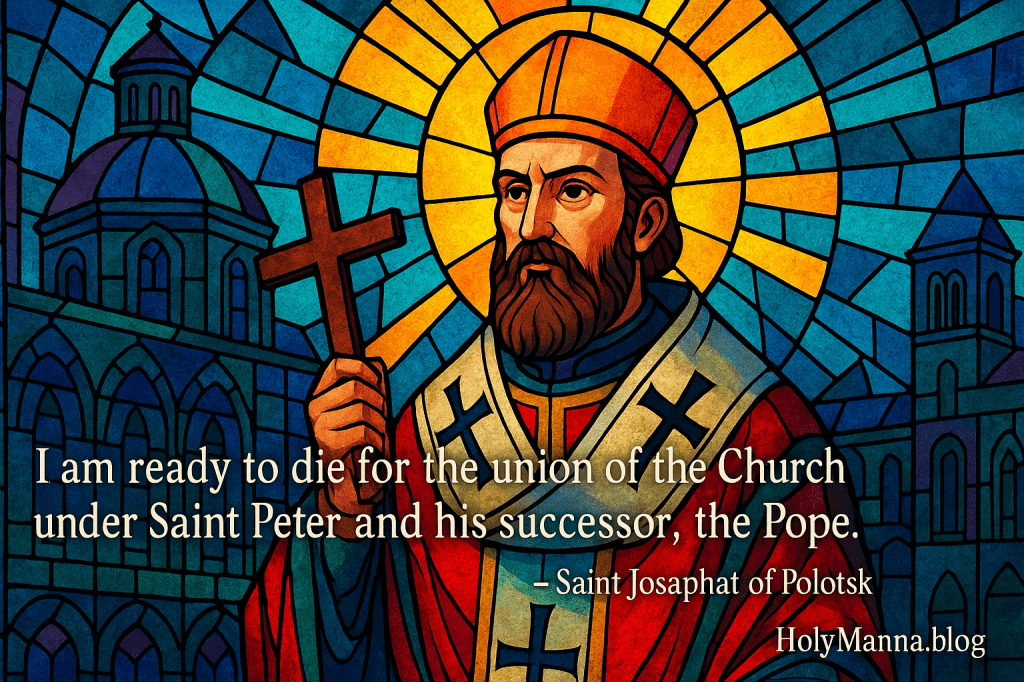
Crowned for Unity
Saint Josaphat of Polotsk stands as a bishop and martyr whose entire vocation was fixed on a single, blazing goal: full, visible communion in the one Church of Christ, faithful to the Successor of Peter while preserving the riches of the Byzantine tradition. As a Basilian monk and later Archbishop of Polotsk, he renewed clergy life, reconciled divided communities, defended the Eastern Catholic liturgy, and preached unity with conviction and tenderness. His death at Vitebsk on November 12, 1623, confirmed that witness with his blood, and the Church venerates him as a patron of reconciliation, pastoral courage, and truth spoken in charity.
A Heart Awakened
Born around 1580 in Volodymyr-Volynskyi, in what is now Ukraine, to Gabriel and Maryna Kuntsevych, the boy John (Ivan) loved the liturgy and icons from his earliest days. A treasured family memory tells how, as a small child while his mother explained an icon of the Crucified Lord, he felt a spark of love pierce his heart and set it aflame for Christ. Sent to Vilnius to learn commerce, he worked for a respected merchant and quickly proved capable, yet the tug toward God grew stronger. He turned down an offer of wealth and marriage, choosing the narrow path of consecrated life. In 1604 he entered the Holy Trinity Monastery of the Order of Saint Basil the Great in Vilnius and received the name Josaphat. Ordained a priest in 1609, he was named archimandrite in 1614, consecrated bishop in 1617, and became Archbishop of Polotsk in 1618. Partnering closely with Metropolitan Josyf Velamin Rutsky, he helped spark the Basilian reform and devoted himself to healing the wounds opened by history, guiding many to embrace communion with Rome according to the Union of Brest.
Monk in Miter
Josaphat never separated contemplation from action. He prayed like a monk and governed like a father. As archbishop he restored dilapidated churches, convened synods throughout his eparchy, and issued a straightforward catechism for clergy, insisting it be learned by heart so preaching would be clear and sound. He drafted rules for priestly life, entrusted deacons to help uphold discipline, and worked to raise educational and moral standards. He defended the Byzantine rite with zeal, insisted on dignified worship, and cared personally for the poor and the condemned. His preaching drew listeners from every social rank, not because of spectacle but because of credibility. In a time of suspicion, he modeled how unity can honor legitimate diversity of rites while remaining rooted in the apostolic center.
That They May Be One
Accounts from his contemporaries emphasize not dramatic healings but the spiritual fruit of his ministry. The signs around Josaphat were conversions of heart, reconciled parishes, and a steady return to sacramental life. His long fasts, midnight prayer, and austere charity gave weight to his words. When opposition flared, he answered with patience, teaching, and the works of mercy. Two lines often remembered as his own spiritual resolve echo the heart of his mission: “Please God I will give my life for the holy union, for the supremacy of Peter and of the Holy Father, his successor. Lord, grant me the grace to shed my blood for the unity of the Church and for obedience to the Holy See.”
Axes, Bullets, and Mercy
The pushback against unity hardened when a rival hierarchy was secretly established in 1620, inflaming tensions across the region. In November 1623, agitators roused a mob in Vitebsk. They first seized a priest; Josaphat intervened and secured the priest’s release, then faced the crowd at his residence. He begged them not to harm his household and spoke with the calm of a true shepherd. His words, remembered in tradition, reveal a heart already poured out: “You wait in ambush for me in the streets, on the bridges, on the highways, in the marketplace, everywhere. Here I am, I came to you as a shepherd. You know I would be happy to give my life for you. I am ready to die for the union of the Church under Saint Peter and his successor, the Pope.” Moments later he was struck with a halberd, shot, and his body was thrown into the Dvina. The martyr’s courage was matched by his mercy, since he prayed for his assailants and sought the safety of others to the end.
God’s Seal After the Sword
In the years that followed, reports of favors and healings multiplied. A papal commission opened in 1628 took sworn testimony from 116 witnesses, a remarkable early portrait of a bishop whose sanctity had already moved hearts. Five years after his death, his body was found incorrupt, a sign received by the faithful as God’s seal upon his life. He was beatified in 1643 and canonized by Pope Pius IX in 1867. History also records reconciliations among former enemies, including notable figures who once opposed him. His relics traveled through turbulent centuries, resting at various times in Polotsk, Biala, and Vienna, before their translation to Rome in 1949. Since November 25, 1963, by the will of Pope John XXIII, the body of Saint Josaphat has rested beneath the Altar of Saint Basil the Great in Saint Peter’s Basilica, a fitting place for a monk who guarded the Byzantine patrimony within Catholic unity.
One Church, One Hope
Saint Josaphat’s witness flows right out of the Church’s mind and heart. The Catechism of the Catholic Church teaches, “Christ bestowed unity on his Church from the beginning. This unity… subsists in the Catholic Church… The Church must always pray and work to maintain, reinforce, and perfect the unity that Christ wills for her.” (CCC 820) The same Catechism recognizes that “many elements of sanctification and of truth are found outside the visible confines of the Catholic Church” and that these gifts are ordered to Catholic unity (CCC 818). It adds, “The desire to recover the unity of all Christians is a gift of Christ and a call of the Holy Spirit.” (CCC 821) Josaphat guarded communion with Peter while defending the beauty of the Eastern liturgy, showing that real unity never cancels authentic diversity, it purifies and elevates it.
Living His Lesson Today
Unity in Christ is not sentimental; it is a cruciform love that tells the truth and refuses to return hate for hate. Saint Josaphat’s life invites a daily choice to pray for Christian unity, to study the faith with diligence, and to repair divisions in families and parishes with patience and humility. Support for Eastern Catholic communities, reverence at the Divine Liturgy or the Roman Mass, frequent confession, and intercession for those who disagree are simple, steady ways to imitate him. The Lord who strengthened Josaphat will strengthen anyone who seeks peace without surrendering the truth. Where is the Lord inviting you to be a bridge-builder today, beginning with your closest relationships?
Engage with Us!
Share your thoughts and graces in the comments below. Then take a few minutes to pray with these prompts.
- What concrete step can be taken this week to reconcile with someone who thinks differently about faith or worship, and how can prayer prepare that conversation?
- How does the Catechism’s teaching on unity challenge common assumptions about ecumenism, and what habit could help you live it more faithfully?
- Where might God be asking for perseverance in parish life, even when misunderstandings or opposition arise?
- What part of Josaphat’s witness—his monastic discipline, pastoral charity, or martyr courage—most speaks to your own vocation right now?
Take heart and keep going. Live the faith with a generous spirit, and do everything with the love and mercy Jesus taught us.
Saint Josaphat of Polotsk, pray for us!
Follow us on Instagram and Facebook for more insights and reflections on living a faith-filled life.

 Holy Manna!
Leave a comment