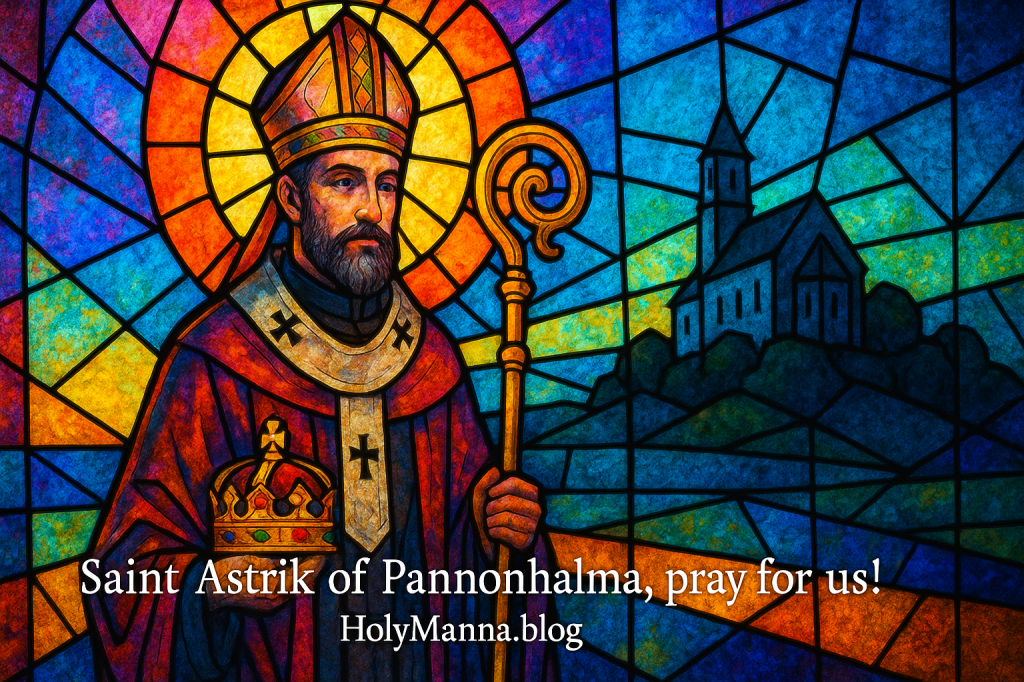
A Crown for a Nation, A Shepherd for a People
Saint Astrik stands at the turning point when the Gospel took deep root among the Magyars. Known variously as Astrik, Astricus, Astericus, or Anastasius, he is remembered as a monk, abbot, missionary, bishop, and the first archbishop in the emerging Hungarian Church. He worked closely with Saint Stephen I, guided the organization of dioceses, and served as Stephen’s envoy to Pope Sylvester II for the recognition of Hungary as a Christian kingdom. Tradition locates his death in the 1030s, after decades of pastoral leadership that helped shape a nation’s baptismal identity. The Catechism of the Catholic Church teaches that Christ sent His Church “to all peoples to make them disciples,” and that the bishops, in union with Peter, serve the unity and growth of the Church. Astrik’s life is a case study in those teachings lived out in real history.
A Monk Shaped by Mission
Sources name him Radla at birth, most likely in Bohemia, and place his early formation within the Benedictine reform that energized Central Europe at the end of the first millennium. Taking the monastic name Anastasius, later rendered Astrik in Hungarian tradition, he became a close collaborator of Saint Adalbert of Prague. Many scholars connect him with the new abbey at Břevnov near Prague, and some also link him to an Adalbert mission foundation in what is now western Poland. When Adalbert’s work met fierce opposition, Astrik crossed into the lands of the Magyars to aid Duke Géza’s household and then the young ruler Stephen. In 997 he is attested as the founding abbot of the Benedictine Abbey of Saint Martin on Mount Pannon, known today as Pannonhalma, which quickly became a powerhouse of prayer, teaching, and culture. From there, Astrik served as ecclesial architect and counselor to Stephen as the kingdom’s Christian institutions took shape.
Building the Church
Astrik’s contribution shines in how he wove together monastic vitality, episcopal leadership, and loyalty to the See of Peter. At Stephen’s request he traveled to Rome, and Pope Sylvester II confirmed Stephen’s kingship and sent a royal crown, publicly binding the new kingdom to the Apostolic See. Astrik returned to help oversee a network of dioceses and to anchor the Hungarian Church around primatial leadership. Medieval records and later scholarship debate whether Astrik’s archiepiscopal seat was at Esztergom or Kalocsa, but the consensus is clear that he exercised founding, nationwide authority in service to Stephen’s Christian reforms. The Catechism reminds the faithful that bishops “in a singular way are the visible source and foundation of unity” in their particular Churches, and that the Roman Pontiff has “full, supreme, and universal power over the whole Church.” Astrik’s work embodied these truths on the ground. No flash or theatrics, just the slow, faithful labor of planting the Gospel and forming a people for Christ.
Signs of Grace
The medieval sources highlight Astrik’s leadership more than spectacular wonders, so the record offers no specific, well-attested miracle stories during his lifetime. That silence does not diminish sanctity. The durable fruits of his vocation are easy to see: monastic life flourished, clergy were formed, diocesan structures stabilized, and a once-pagan people embraced the sacraments. In the language of the Fathers, the “miracle” is a nation newly alive in Christ. As for personal sayings, no authentic quotations from Astrik have survived in the sources, so it is best to honor the record by not supplying words he did not leave.
Trials, Uncertainties, and Steadfast Hope
Astrik lived amid real headwinds. Pagan customs lingered, political rivalries simmered, and reformers often faced hostility. Even the historical record bears marks of those turbulent decades, which is why scholars sometimes debate aspects of Astrik’s early identity and precise titles. What is not in doubt is his perseverance. He shepherded the young Church through fragile beginnings, kept communion with Rome at the center, and supported Stephen as Christian law and worship took root. This is sanctity in the key of fidelity, the kind that endures misunderstanding and opposition while quietly building what lasts.
After the Shepherd’s Rest
Astrik’s memory continued in the cathedrals and monasteries he helped to foster. An elaborate medieval archiepiscopal grave uncovered at Kalocsa in 1910 later gained fresh attention when radiocarbon analysis in the early 2010s dated the remains to roughly 1001 to 1030, aligning with Astrik’s lifetime and strengthening the long-standing identification of the tomb with him. The burial included insignia suitable for a founding archbishop, such as a crosier and liturgical items. Veneration at sites like Pannonhalma and Kalocsa has kept alive the story of a monk-turned-archbishop whose obedience to Christ and love for the Church created conditions for holiness to spread for centuries.
Fidelity, Unity, and Mission
Astrik’s witness reads like a blueprint for everyday discipleship. Holiness often looks like showing up, serving one’s community, and staying rooted in the Church’s sacramental life. The Catechism describes the Church as “missionary by her very nature” and urges all the faithful to share in that mission through prayer, catechesis, charity, and public witness. Astrik reminds every believer that unity with the successor of Peter is not a political posture but a spiritual lifeline that safeguards the Gospel and strengthens evangelization. Take his path to heart by praying for your bishop and priests, learning the faith with diligence, frequenting Confession and the Eucharist, and building little altars of Christian culture in your home, workplace, and online life. Quiet fidelity changes history because grace uses faithful instruments.
Engage with Us!
Share your thoughts and reflections below. How does Saint Astrik challenge comfortable ideas about holiness and mission?
- Where do you see opportunities to build up the Church quietly and faithfully, following Astrik’s example of steady service?
- How does unity with the successor of Peter shape the way you pray, learn, and evangelize in your parish?
- What practical step this week will help the Gospel take deeper root in your home, friendships, or workplace?
May the witness of Saint Astrik inspire a life of faith, courage, and sacrificial love, with everything done in the love and mercy Jesus taught.
Saint Astrik of Pannonhalma, pray for us!
Follow us on Instagram and Facebook for more insights and reflections on living a faith-filled life.

 Holy Manna!
Leave a comment