Memorial of Saint Josaphat, Bishop and Martyr – Lectionary: 493
Grateful Justice and the Shepherd’s Test
The Word of God today invites every heart, from kitchen tables to corner offices, to see authority as a trust and gratitude as the seal of true healing. In Wisdom 6:1–11 the sacred author speaks straight to leaders, reminding them that “authority was given you by the Lord” and that God will examine how power was used. Psalm 82 makes the test painfully concrete with the command to defend the vulnerable, “Defend the lowly and fatherless”, since the Judge of all nations sees without partiality. Then Luke 17:11–19 shows mercy breaking into real life as ten lepers obey the Lord and are cleansed, yet only the Samaritan returns with praise and receives the greater gift of salvation, “Stand up and go, your faith has saved you.” The cultural backdrop matters here. Samaritans were outsiders to Jewish society, and lepers lived at a distance from community and worship. Jesus sends them to the priests because the Law required priestly verification for restoration to the covenant life. Obedience opens the path, and thanksgiving completes the return to communion. The Church names this very heart posture every time she celebrates the Eucharist, since the word itself means thanksgiving, as taught in CCC 1328 and deepened in CCC 2637–2638.
This Memorial of Saint Josaphat shines a bright pastoral light across these readings. Born within the tension of the Polish Lithuanian Commonwealth in the early seventeenth century, Josaphat Kuntsevych served as a bishop who labored for the unity of Christians after the Union of Brest, and he sealed that witness with martyrdom. His life mirrors Wisdom’s warning to rulers and pastors, his ministry echoes Psalm 82’s call to defend the flock, and his death embodies the Gospel’s movement from cleansing to communion, from duty to thanksgiving. The Church teaches that ecclesial authority exists for service and unity, not privilege, as explained in CCC 871–879 and CCC 813–815, and that martyrdom is the supreme witness to truth and charity, as presented in CCC 2473. Saint Josaphat’s shepherding was accountable before God, courageous for the little ones, and ordered toward visible communion at the altar of thanksgiving.
Where is the Lord inviting a more accountable use of influence, a more concrete defense of the vulnerable, and a deeper return to Him in grateful praise today?
First Reading – Wisdom 6:1–11
Authority Under Scrutiny, Hearts Formed by Wisdom
Kings and judges held real life-and-death power in the Hellenistic world where Wisdom was shaped, and the inspired author speaks from within Israel’s faith that God alone is the source of legitimate rule. The reading addresses rulers directly and reminds every baptized soul who holds any measure of influence that leadership is stewardship under God’s gaze. Within today’s theme of accountable shepherds and grateful hearts, Wisdom 6:1–11 insists that power must serve justice, that the lowly must be defended, and that leaders will be examined with greater strictness. On the Memorial of Saint Josaphat, Bishop and Martyr, the Church holds up a pastor who bore the burden of unity and truth, embodying the passage’s sober warning and its promise that holiness is found by those who love God’s precepts.
Wisdom 6:1-11
New American Bible (Revised Edition)
Exhortation to Seek Wisdom
1 Hear, therefore, kings, and understand;
learn, you magistrates of the earth’s expanse!
2 Give ear, you who have power over multitudes
and lord it over throngs of peoples!
3 Because authority was given you by the Lord
and sovereignty by the Most High,
who shall probe your works and scrutinize your counsels!
4 Because, though you were ministers of his kingdom, you did not judge rightly,
and did not keep the law,
nor walk according to the will of God,
5 Terribly and swiftly he shall come against you,
because severe judgment awaits the exalted—
6 For the lowly may be pardoned out of mercy
but the mighty shall be mightily put to the test.
7 For the Ruler of all shows no partiality,
nor does he fear greatness,
Because he himself made the great as well as the small,
and provides for all alike;
8 but for those in power a rigorous scrutiny impends.
9 To you, therefore, O princes, are my words addressed
that you may learn wisdom and that you may not fall away.
10 For those who keep the holy precepts hallowed will be found holy,
and those learned in them will have ready a response.
11 Desire therefore my words;
long for them and you will be instructed.
Detailed Exegesis
Verse 1 – “Hear, therefore, kings, and understand; learn, you magistrates of the earth’s expanse!”
The author summons rulers to a wisdom lesson. In Scripture, to hear is to obey. The scope is universal because God’s sovereignty extends over all peoples. This verse frames authority as teachable and accountable, preparing for a divine evaluation of leadership.
Verse 2 – “Give ear, you who have power over multitudes and lord it over throngs of peoples!”
Those who command crowds are urged to listen. The text exposes the temptation to “lord it over” others, anticipating Christ’s teaching that greatness is service, as taught in The Gospel of Matthew 20:26–28. Authority is meant to lift burdens, not add new chains.
Verse 3 – “Because authority was given you by the Lord and sovereignty by the Most High, who shall probe your works and scrutinize your counsels!”
Legitimate power is received, not seized. God will examine both deeds and “counsels,” which means motives, strategies, and plans. Nothing in leadership is off limits to God’s judgment. This grounds public office and private influence in a sacred trust.
Verse 4 – “Because, though you were ministers of his kingdom, you did not judge rightly, and did not keep the law, nor walk according to the will of God,”
Rulers are called “ministers” of God’s kingdom. Failure is named plainly: injustice, neglect of divine law, and resistance to God’s will. The verse implies that authority is vocational service under God, not self authorization.
Verse 5 – “Terribly and swiftly he shall come against you, because severe judgment awaits the exalted—”
Judgment is proportionate to responsibility. Those who sit high are judged with greater strictness. This anticipates the New Testament warning that teachers and leaders will be judged more severely, echoing James 3:1 in spirit.
Verse 6 – “For the lowly may be pardoned out of mercy but the mighty shall be mightily put to the test.”
Mercy does not cancel scrutiny. It assures compassion for the small while intensifying testing for the great. The more one’s influence, the deeper the accountability for how it affected souls and society.
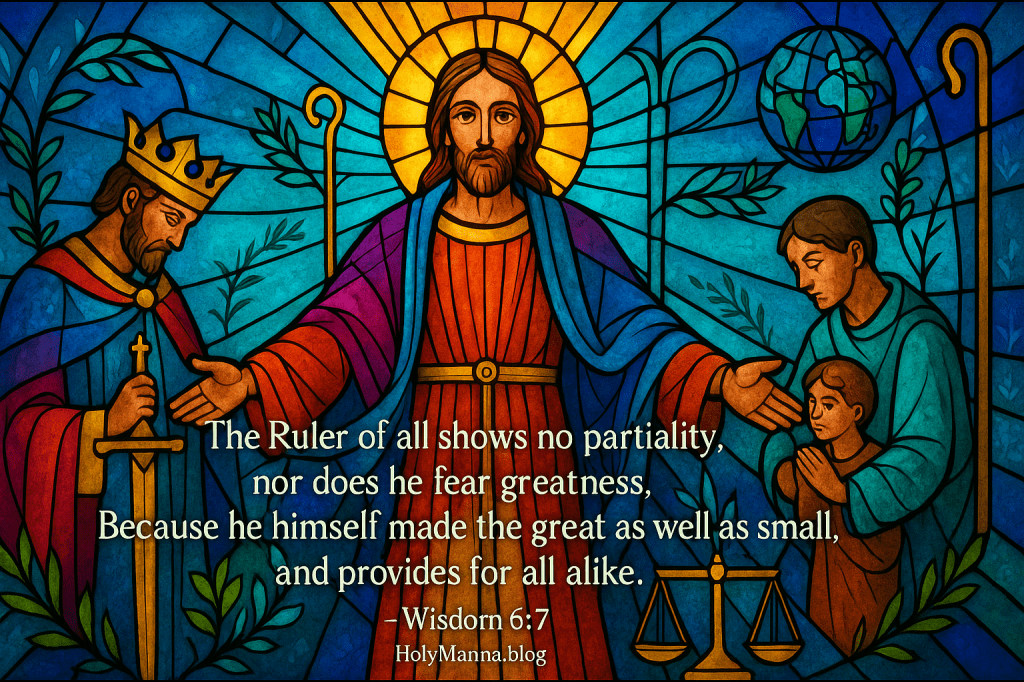
Verse 7 – “For the Ruler of all shows no partiality, nor does he fear greatness, because he himself made the great as well as the small, and provides for all alike;”
Divine justice is impartial. God neither flatters nor fears the powerful. Since God made both small and great, he cares for all without favoritism. This annihilates every excuse that would shield elites from moral responsibility.
Verse 8 – “but for those in power a rigorous scrutiny impends.”
The text repeats and heightens the warning. The phrase “rigorous scrutiny” signals a comprehensive audit of decisions, policies, and the treatment of the vulnerable. It is meant to sober consciences and foster conversion.
Verse 9 – “To you, therefore, O princes, are my words addressed that you may learn wisdom and that you may not fall away.”
Correction is medicinal. The goal is not condemnation but repentance. Wisdom is offered so that leaders will not “fall away” from the covenant path and will instead align governance with God’s justice.
Verse 10 – “For those who keep the holy precepts hallowed will be found holy, and those learned in them will have ready a response.”
Holiness is not accidental. It is formed in obedience to God’s precepts. Those who study and love the law learn how to respond rightly in complex situations. Formation in God’s word equips leaders to answer when trials arrive.
Verse 11 – “Desire therefore my words; long for them and you will be instructed.”
The final appeal moves from duty to desire. Longing for divine wisdom is the doorway to instruction. Leaders are invited to become disciples, and discipleship births the just governance God seeks.
Teachings
The Church teaches that authority exists for service. CCC 2235 states, “Those who exercise authority should do so as a service. ‘Whoever would be great among you must be your servant.’ The exercise of authority is measured morally in terms of its divine origin, its reasonable nature, and its specific object. No one can command or establish what is contrary to the dignity of persons and the natural law.” In harmony with Wisdom 6, this means that political, ecclesial, and domestic leadership must mirror God’s justice and respect for every person.
God’s impartial care demands special love for the poor and vulnerable. CCC 2448 teaches that “In its various forms material deprivation, unjust oppression, physical and psychological illness and death, human misery in general is the obvious sign of the inherited frailty of human nature; it needs the compassion of Christ and of Christians.” The Psalm today calls leaders to defend the lowly, which is precisely the Church’s perennial practice of mercy and justice.
Martyrdom is the high watermark of accountable love. On this Memorial, CCC 2473 teaches, “Martyrdom is the supreme witness given to the truth of the faith: it means bearing witness even unto death. The martyr bears witness to Christ who died and rose, to whom he is united by charity.” Saint Josaphat’s pastoral courage flows from the same well as Wisdom 6: leadership as witness, tested rigorously, consumed in charity for unity.
The saints remind pastors and parents alike of the weight of souls. Saint Gregory the Great writes in his Pastoral Rule, “The care of souls is the art of arts.” Christian authority is not managerial technique but sacrificial love that defends the weak, judges impartially, and desires God’s wisdom above influence.
Reflection
Accountability before God is not meant to crush spirits. It is meant to focus hearts on wisdom, justice, and mercy. Today offers a practical examination. Begin by asking for a teachable spirit and make a concrete plan to learn and live one command of God more faithfully this week. Review any area of influence, including family life, workplace decisions, parish service, or online presence, and identify one way to defend someone who is vulnerable. Practice transparent decision making by inviting counsel and by checking motives in prayer. End the day with thanksgiving to let gratitude purify ambition and keep service rooted in worship. Where is God inviting a change from control to service today? Who is the lowly person that needs advocacy and practical help this week? What would it look like to desire God’s wisdom more than influence and to seek holiness more than success?
Responsorial Psalm – Psalm 82:3–4, 6–8
Justice at the Altar of the King
Psalm 82 places a prophetic spotlight on leaders who hold power over the vulnerable and reminds every believer that God judges without partiality. In Israel’s worship this psalm sounded like a courtroom drama, using the ancient image of God presiding over earthly rulers who were sometimes called “gods” because they exercised judgment. The cultural setting helps the lines make sense. Judges and princes were charged with protecting the poor, the orphan, and the oppressed. When they failed, God Himself rose to judge. This fits today’s theme of accountable shepherds and grateful hearts by calling authority a trust to be used in service and by aiming that service toward the restoration of communion. On the Memorial of Saint Josaphat, Bishop and Martyr, the psalm’s edge becomes pastoral clarity. Shepherds must defend the flock, rulers must safeguard the weakest, and all are invited to return thanks to the Lord whose justice and mercy embrace the nations.
Psalm 82:3-4, 6-8
New American Bible (Revised Edition)
3 “Defend the lowly and fatherless;
render justice to the afflicted and needy.
4 Rescue the lowly and poor;
deliver them from the hand of the wicked.”
6 I declare: “Gods though you be,
offspring of the Most High all of you,
7 Yet like any mortal you shall die;
like any prince you shall fall.”
8 Arise, O God, judge the earth,
for yours are all the nations.
Detailed Exegesis
Verse 3 – “Defend the lowly and fatherless; render justice to the afflicted and needy.”
The psalm opens with the heart of biblical justice. Protection of those without social power is not optional charity. It is covenant duty. The orphan is named because life without a defender becomes a magnet for exploitation. God ties legitimacy of leadership to advocacy for the voiceless.
Verse 4 – “Rescue the lowly and poor; deliver them from the hand of the wicked.”
Justice moves from principle to action. Rescue implies risk and intervention. Deliverance demands courage that confronts predators and systems that trap the poor. The people of God are summoned to become living answers to this prayer.
Verse 6 – “I declare: ‘Gods though you be, offspring of the Most High all of you,’”
The psalmist addresses rulers who judge in God’s name. The term “gods” refers to their delegated role, not to divinity. They bear a filial dignity as “offspring of the Most High,” which heightens responsibility. Authority is a borrowed light that must reflect the Giver.
Verse 7 – “Yet like any mortal you shall die; like any prince you shall fall.”
Memento mori enters the courtroom. Mortality strips away illusion and status, reminding leaders that every decision will meet God’s gaze. The verse punctures pride and invites conversion while there is time.
Verse 8 – “Arise, O God, judge the earth, for yours are all the nations.”
The psalm ends in liturgical hope. God’s rising is a plea for the final setting right of all things. The scope is universal. The nations belong to the Lord. In the light of the Gospel, this cry finds its answer in Christ the King who will judge in justice and mercy and who gathers a grateful people at the Eucharist.
Teachings
The Church anchors authority in service. CCC 2235 teaches, “Those who exercise authority should do so as a service. ‘Whoever would be great among you must be your servant.’ The exercise of authority is measured morally in terms of its divine origin, its reasonable nature, and its specific object. No one can command or establish what is contrary to the dignity of persons and the natural law.” This clarifies why Psalm 82 ties the credibility of rulers to their defense of the weak.
The Eucharist forms a people who live this justice. CCC 1397 states, “The Eucharist commits us to the poor. To receive in truth the Body and Blood of Christ given up for us, we must recognize Christ in the poorest, his brethren.” Gratitude at the altar must become concrete mercy in the street.
Reverence for the image of God grounds social duty. CCC 1931 teaches, “Respect for the human person entails respect for the rights that flow from his dignity as a creature. These rights are prior to society and must be recognized by it. They are the basis of the moral legitimacy of every authority; by flouting them, or refusing to recognize them in its positive legislation, a society undermines its own moral legitimacy.” The psalm’s call to defend the lowly flows directly from this dignity.
Scripture speaks with the same voice. James 1:27 declares, “Religion that is pure and undefiled before God and Father is this: to care for orphans and widows in their affliction and to keep oneself unstained by the world.” And the Lord identifies Himself with the least. Matthew 25:40 records, “Amen, I say to you, whatever you did for one of these least brothers of mine, you did for me.” Saint Josaphat’s pastoral zeal for unity and protection of the flock stands in continuity with these teachings, placing authority at the service of communion.
Reflection
This psalm asks for more than sentiment. It calls for imitation of God’s justice. Begin with prayer that names the vulnerable by name and asks for courage to act. Review the spaces of influence that are already in hand, including the home, parish, workplace, neighborhood, and digital platforms, and identify one burden that can be lifted this week. Seek reconciliation with anyone who has been harmed by haste or indifference, and make a concrete plan to advocate for a person or group who lacks a defender. Let thanksgiving fuel the work by bringing these intentions to the Eucharist and by recognizing Christ in those who suffer. How is God asking for a practical defense of the lowly today? What fear must be surrendered to choose rescue over convenience? Where can gratitude at the altar become justice in action before the next Sunday arrives?
Holy Gospel – Luke 17:11–19
Gratitude That Finishes the Miracle
The Gospel places Jesus on the road to Jerusalem, which means every step is aimed toward the Cross, Resurrection, and the gift of the Spirit. The route through Samaria and Galilee brings the Lord into a borderland where ethnic and religious tensions were real, and where ritual impurity kept the sick at a distance from worship and community. In the Law, priests verified cleansing and authorized a person’s return to covenant life as explained in Leviticus 13–14. Within today’s theme of accountable shepherds and grateful hearts, this scene shows mercy meeting obedience in real time. Ten obey and are cleansed, but only one returns in praise, and he is a Samaritan. Gratitude becomes the door through which healing matures into salvation. The Church reads this on the Memorial of Saint Josaphat, Bishop and Martyr, because unity, thanksgiving, and courageous fidelity belong together when the Lord restores a people for communion.
Luke 17:11-19
New American Bible (Revised Edition)
11 As he continued his journey to Jerusalem, he traveled through Samaria and Galilee. 12 As he was entering a village, ten lepers met [him]. They stood at a distance from him 13 and raised their voice, saying, “Jesus, Master! Have pity on us!” 14 And when he saw them, he said, “Go show yourselves to the priests.” As they were going they were cleansed. 15 And one of them, realizing he had been healed, returned, glorifying God in a loud voice; 16 and he fell at the feet of Jesus and thanked him. He was a Samaritan. 17 Jesus said in reply, “Ten were cleansed, were they not? Where are the other nine? 18 Has none but this foreigner returned to give thanks to God?” 19 Then he said to him, “Stand up and go; your faith has saved you.”
Detailed Exegesis
Verse 11 – “As he continued his journey to Jerusalem, he traveled through Samaria and Galilee.”
Jerusalem signals the climax of the mission. The journey note frames the miracle as part of Jesus’ saving work for all Israel and the nations. Passing through Samaria and Galilee hints that divine mercy crosses boundaries that people often guard.
Verse 12 – “As he was entering a village, ten lepers met [him]. They stood at a distance from him”
Lepers kept their distance because of impurity laws and social fear. The ten stand together in a common suffering that unites beyond ethnicity and status. Their distance underscores the tragedy of sin and sickness, which isolate from worship and community, and prepares for reintegration.
Verse 13 – “and raised their voice, saying, ‘Jesus, Master! Have pity on us!’”
Their cry models humble petition. The title “Master” confesses authority, and “have pity” asks for covenant mercy. The Catechism defines prayer in this key of childlike confidence. CCC 2559 teaches, “Prayer is the raising of one’s mind and heart to God or the requesting of good things from God.”
Verse 14 – “And when he saw them, he said, ‘Go show yourselves to the priests.’ As they were going they were cleansed.”
Jesus sees, commands, and heals. He sends them to the priests because the Law entrusted verification of cleansing to priestly discernment, which restored a person to worship. The cleansing happens as they obey, revealing that faith walks on God’s word before the visible change arrives.
Verse 15 – “And one of them, realizing he had been healed, returned, glorifying God in a loud voice;”
Awareness becomes worship. The healed man interprets the gift correctly and turns back to its Giver. His loud praise reverses the earlier loud plea and teaches that thanksgiving should match the intensity of petition.
Verse 16 – “and he fell at the feet of Jesus and thanked him. He was a Samaritan.”
Prostration at Jesus’ feet is an act of reverence that borders on worship. The Gospel stresses that the grateful disciple is a Samaritan, an outsider who recognizes grace and models the response God desires. Gratitude becomes a bridge to communion where division once stood.
Verse 17 – “Jesus said in reply, ‘Ten were cleansed, were they not? Where are the other nine?’”
The Lord registers the absence. Nine received a gift yet withheld praise. The question exposes the wound of ingratitude, which can halt growth in grace and leave healing unfinished.
Verse 18 – “Has none but this foreigner returned to give thanks to God?”
Jesus names the paradox. The foreigner becomes the true insider by thanksgiving. Gratitude proves that faith has recognized God’s visitation and is ready for deeper communion.
Verse 19 – “Then he said to him, ‘Stand up and go; your faith has saved you.’”
The final word moves from healing to salvation. The verb “saved” signals a graced wholeness that includes body, soul, and belonging to God’s people. Faith expressed through obedient steps and grateful worship receives the fullness God desires to give.
Teachings
The Lord is the physician who heals the whole person. CCC 1505 teaches, “Moved by so much suffering Christ not only allows himself to be touched by the sick, but he makes their miseries his own: ‘He took our infirmities and bore our diseases.’” The cleansing of the ten and the salvation of the one reveal this compassionate power.
Eucharist means thanksgiving and forms the Church’s grateful heart. CCC 1328 states, “The inexhaustible richness of this sacrament is expressed in the different names we give it: Eucharist, because it is an action of thanksgiving to God.” The Samaritan’s return foreshadows the Church gathered around Christ in grateful praise.
Reconciliation restores communion when sin isolates the soul. CCC 1468 explains, “The whole power of the sacrament of Penance consists in restoring us to God’s grace and joining us with him in an intimate friendship.” Just as the priests verified cleansing and readmitted the healed to worship, sacramental confession reintegrates disciples into the life of grace.
Worthy reception of Holy Communion presumes conversion. CCC 1415 teaches, “Anyone who desires to receive Christ in Eucharistic communion must be in the state of grace. Anyone aware of having committed a mortal sin must not receive Communion without having received sacramental absolution.” Gratitude at the altar is inseparable from a life that turns back to the Lord in faith and repentance.
Prayerful petition is the posture of children before the Father. CCC 2559 affirms, “Prayer is the raising of one’s mind and heart to God or the requesting of good things from God.” The ten lepers show that God welcomes bold pleas, and the Samaritan shows that praise should complete what petition begins.
Saints and shepherds witness that gratitude makes the Church one. The martyrdom of Saint Josaphat flows from a heart set on unity at the altar of thanksgiving, where cultural borders yield to the one Body of Christ.
Reflection
Gratitude does not delay. It turns back to God quickly and publicly. Begin and end the day by naming three specific gifts and blessing the Giver. When asking the Lord for help, make a plan for thanksgiving before the answer arrives. Return to the sacraments so that healing matures into communion. Seek out the person on the margins and offer concrete friendship that restores them to community. Let Sunday worship be the loud voice that glorifies God for the week’s mercies. Where is the Lord inviting a return in thanksgiving today that has been postponed? What step of obedience needs to be taken before the visible change appears? Who needs an advocate so that their isolation can give way to communion in Christ?
Justice That Heals
Today’s Word draws a straight line from accountable leadership to grateful worship and lands in a unity that costs everything. Wisdom 6 reminds rulers and anyone with influence that “authority was given you by the Lord” (Wisdom 6:3), that decisions and motives will be examined, and that the path to holiness is obedience to God’s precepts. Psalm 82 turns that accountability into concrete mercy with the command “Defend the lowly and fatherless” (Psalm 82:3), because the Judge of all the earth shows no partiality and claims every nation as His own. Luke 17:11–19 reveals what happens when obedience meets mercy and thanksgiving. Ten are cleansed as they walk in faith, yet only the Samaritan returns to the Giver, and the Lord crowns his gratitude with salvation, “Stand up and go; your faith has saved you.” (Luke 17:19). The Memorial of Saint Josaphat, Bishop and Martyr, gathers these threads into a living icon. His shepherding was tested by conflict, ordered to unity, and sealed with a martyr’s love. The Church teaches that authority exists for service, not privilege, and that thanksgiving is the heart of communion at the altar, as taught in CCC 2235, CCC 813–815, and CCC 1328.
Here is the invitation. Let the Eucharist shape a grateful life that finishes the miracle. Examine any place of influence and choose service over status. Seek reconciliation where division lingers and pray for unity with real hope. Defend someone who is vulnerable and make mercy practical this week. Return to the Lord in thanksgiving and bring that praise to the next Mass with a heart ready to be sent. What decision needs to be made in the fear of God rather than the fear of people? Who is God placing in your path to defend and lift up? Where is the Spirit inviting a quick return in gratitude so that healing can mature into salvation?
Engage with Us!
Share your reflections in the comments below and help build a conversation that strengthens faith and encourages real action.
- In the First Reading from Wisdom 6:1–11, where has God entrusted you with influence, and how can a sincere desire for divine wisdom reshape the decisions that will be made this week?
- In the Responsorial Psalm from Psalm 82:3–4, 6–8, whom is God asking you to defend or rescue, and what specific action will translate prayer into justice for the vulnerable?
- In the Holy Gospel from Luke 17:11–19, where is the Lord inviting a quick return in thanksgiving so that healing matures into salvation rather than stopping at relief?
Keep going with courage and hope. Live a life of faith that chooses service over status, seeks unity over division, and does everything with the love and mercy Jesus taught.
Sacred Heart of Jesus, we trust in You!
Immaculate Heart of Mary, pray for us!
Saint Michael the Archangel, defend us in battle!
Follow us on Instagram and Facebook for more insights and reflections on living a faith-filled life.

 Holy Manna!
Leave a comment