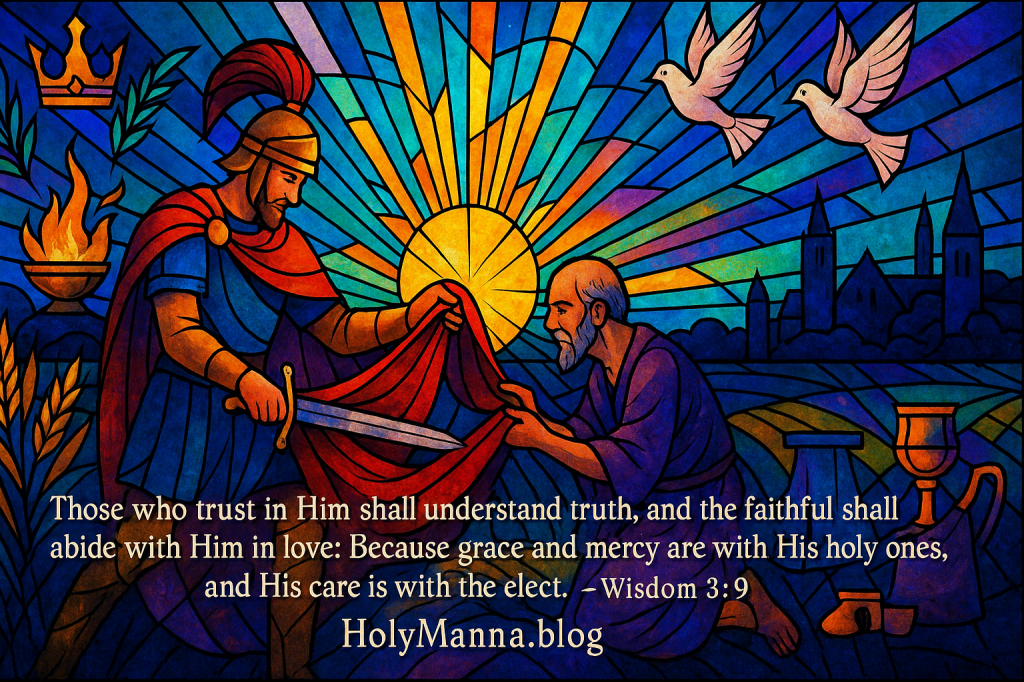
Memorial of Saint Martin of Tours, Bishop – Lectionary: 492
Cloak of Humility, Fire of Hope
The Word today gathers hearts around one clear path: humble service that endures trial because it knows its destiny in God. Wisdom 2:23–3:9 lifts the veil on suffering and reveals that “the souls of the righteous are in the hand of God”, refined like gold and destined for immortality. Psalm 34 answers with a song from the trenches of real life, where the Lord’s eyes are on the just and “the Lord is close to the brokenhearted”, teaching trust when life feels heavy. In the humility catechism of Luke 17:7–10, the Lord forms disciples who serve without entitlement, content to say “we are unprofitable servants; we have done what we were obliged to do.” This is not spiritual minimalism. It is the freedom of children who know that every good work already flows from grace.
This same pattern shines in the Memorial of Saint Martin of Tours, a fourth century soldier turned monk and bishop whose charity was as concrete as a warm cloak cut in two for a shivering beggar. His world knew strict social ranks, military duty, and the honor culture of late Roman Gaul, yet grace rewrote the script. Charity became the true nobility, and pastoral simplicity became real strength. The ancient household image in Luke 17 clarifies the cultural context of duty and service, while Wisdom reveals the hidden dividend of trust under trial, and Psalm 34 trains the tongue to praise in affliction. How does the Lord want humble fidelity to move from duty into love today? The Church teaches in The Catechism that heaven is the blessed communion of all who are perfectly incorporated into Christ (CCC 1024), that our cooperation with God’s initiative is itself grace (CCC 2007–2009), and that the works of mercy express the heart of Christian love (CCC 2447). Saint Martin’s life becomes a living commentary on these pages. He shows that when love serves without seeking credit, the poor are clothed, the crushed are consoled, and hope catches fire because it already breathes the air of eternity.
First Reading – Wisdom 2:23–3:9
Formed for immortality, refined for charity
The Book of Wisdom speaks from the crucible of Hellenistic Alexandria, where faithful Jews wrestled with Greek philosophies about the soul, virtue, and the afterlife. The author writes in Greek and addresses a culture impressed by power, honor, and reputation, yet skeptical about the meaning of suffering and the triumph of the just. Into that world comes the clear claim that God created humanity for immortality and that apparent defeat cannot erase the dignity of the righteous. This reading fits today’s theme by revealing that humble fidelity, even under trial, is not wasted labor but the path into God’s embrace. The Memorial of Saint Martin of Tours shines beside this text because his charity sprang from a hope that death cannot cancel. His famous act of cutting his cloak for a beggar reflected a heart already convinced that the righteous live in God’s hand. The verses here train hearts to serve without entitlement and to endure purification with trust, preparing for the quiet heroism the Gospel commends and for the concrete mercy celebrated in Saint Martin’s life.
Wisdom 2:23-3:9
New American Bible (Revised Edition)
2:23 For God formed us to be imperishable;
the image of his own nature he made us.
24 But by the envy of the devil, death entered the world,
and they who are allied with him experience it.
The Hidden Counsels of God
A. On Suffering
3:1 The souls of the righteous are in the hand of God,
and no torment shall touch them.
2 They seemed, in the view of the foolish, to be dead;
and their passing away was thought an affliction
3 and their going forth from us, utter destruction.
But they are in peace.
4 For if to others, indeed, they seem punished,
yet is their hope full of immortality;
5 Chastised a little, they shall be greatly blessed,
because God tried them
and found them worthy of himself.
6 As gold in the furnace, he proved them,
and as sacrificial offerings he took them to himself.
7 In the time of their judgment they shall shine
and dart about as sparks through stubble;
8 They shall judge nations and rule over peoples,
and the Lord shall be their King forever.
9 Those who trust in him shall understand truth,
and the faithful shall abide with him in love:
Because grace and mercy are with his holy ones,
and his care is with the elect.
Detailed Exegesis
Verse 2:23 — “For God formed us to be imperishable; the image of his own nature he made us.”
Humanity’s origin is not accidental. The language of image points back to creation in Genesis 1:26–27 and forward to participation in divine life. The term imperishable signals that God’s plan is communion beyond decay. This verse undergirds Christian teaching that human dignity is intrinsic and ordered to eternal life, which anchors the call to serve without grasping.
Verse 2:24 — “But by the envy of the devil, death entered the world, and they who are allied with him experience it.”
Here suffering and death are linked to sin and demonic envy, not to God’s purpose. This clarifies that evil is a violation of order, not its source. The verse also implies a moral choice. Alliance with the enemy leads to the taste of death, while friendship with God opens to life. Saint Martin’s break with the military culture of prestige and his embrace of the poor echoes this fundamental realliance.
Verse 3:1 — “The souls of the righteous are in the hand of God, and no torment shall touch them.”
This is the central promise. God’s hand is covenant imagery for power and protection. Even when the body suffers, the just are held in a sphere where torment cannot ultimately conquer. Christian funerals draw hope from this line because it declares a protection more real than pain.
Verse 3:2 — “They seemed, in the view of the foolish, to be dead; and their passing away was thought an affliction”
Perception and reality diverge. The world that measures by visibility judges the righteous as failures. The verse challenges superficial readings of loss and invites a sacramental vision that looks through appearances to God’s fidelity.
Verse 3:3 — “and their going forth from us, utter destruction. But they are in peace.”
The pivot comes with peace. The just do not vanish into nothingness. The phrase affirms rest in God, anticipating the Christian confession that Christ’s Pasch opens the way to peace in him. This peace empowers works of mercy that do not fear loss.
Verse 3:4 — “For if to others, indeed, they seem punished, yet is their hope full of immortality;”
Hope reinterprets the data. What looks like punishment becomes purification when set within God’s promise. The righteous hope not in outcomes they can engineer, but in the Giver who guarantees immortality.
Verse 3:5 — “Chastised a little, they shall be greatly blessed, because God tried them and found them worthy of himself.”
Discipline is temporary and purposeful. God’s testing reveals the worth of the heart. Worthy of himself does not mean self-generated merit. It means a heart conformed to God by grace, ready for communion and responsibility in love.
Verse 3:6 — “As gold in the furnace, he proved them, and as sacrificial offerings he took them to himself.”
Two images meet. The furnace purifies, and the altar consecrates. Suffering, surrendered in love, becomes priestly. Saint Martin’s hidden penitence and public compassion read like commentary on this verse, showing charity born from purification.
Verse 3:7 — “In the time of their judgment they shall shine and dart about as sparks through stubble;”
Vindication is not muted. The just blaze forth as signs that God’s verdict stands. Sparks through stubble suggests swiftness and contagion. Holiness spreads. Authentic service ignites other hearts.
Verse 3:8 — “They shall judge nations and rule over peoples, and the Lord shall be their King forever.”
Participation in judgment reflects shared kingship under the true King. The righteous, configured to charity, receive authority. This is not domination but stewardship that mirrors the Lord’s reign of mercy and truth.
Verse 3:9 — “Those who trust in him shall understand truth, and the faithful shall abide with him in love: Because grace and mercy are with his holy ones, and his care is with the elect.”
Trust unlocks understanding. Abiding love becomes the environment of the righteous. The final line names the source: grace and mercy. Service without entitlement flows from this fountain, which is why the Gospel’s call to identify as unprofitable servants safeguards humility and keeps charity pure.
Teachings
The Church directly names the origin of death in sin, echoing Wisdom 2:24. “Death is a consequence of sin. The Church’s Magisterium, as authentic interpreter of the affirmations of Scripture and Tradition, teaches that death entered the world on account of man’s sin.” CCC 1008.
Charity is defined as concrete mercy that answers real needs, perfectly aligned with Saint Martin’s cloak. “The works of mercy are charitable actions by which we come to the aid of our neighbor in his spiritual and bodily necessities.” “Instructing, advising, consoling, comforting are spiritual works of mercy, as are forgiving and bearing wrongs patiently. The corporal works of mercy consist especially in feeding the hungry, sheltering the homeless, clothing the naked, visiting the sick and imprisoned, and burying the dead.” “Among all these, giving alms to the poor is one of the chief witnesses to fraternal charity; it is also a work of justice pleasing to God.” CCC 2447.
Hope points to communion with Christ as the heart of heaven. “To live in heaven is ‘to be with Christ’.” “By his death and Resurrection, Jesus Christ has opened heaven to us.” CCC 1025.
Humility guards merit and keeps servants grateful. “With regard to God there is no strict right to any merit on the part of man.” CCC 2007. “The merit of man before God in the Christian life arises from the fact that God has freely chosen to associate man with the work of his grace.” CCC 2008. “Filial adoption, in making us partakers by grace in the divine nature, can bestow true merit on us as a consequence of God’s gratuitous justice.” CCC 2009.
Saint Augustine names the rest promised to the righteous. “You have made us for yourself, O Lord, and our heart is restless until it rests in you.” Confessions I, 1. Saint Thomas Aquinas explains charity’s primacy. “Charity is the form of the virtues.” Summa Theologiae II–II, 23, 8 ad 3. Saint Martin of Tours, near death, prayed as a servant ready for more labor if God willed it. “Lord, if your people still need me, I am ready for the task; your will be done.”
Reflection
The reading invites a steady posture. Begin each day convinced that God formed human life for imperishable communion, which means that every act of hidden service matters eternally. Let trials become a furnace rather than a reason to retreat. Choose one corporal or spiritual work of mercy this week and do it quietly for love of God. Offer any resistance or inconvenience as a simple sacrifice, and ask for a heart that abides in love. Pray for the courage to share time, attention, and resources the way Saint Martin shared his cloak, trusting that grace and mercy are with God’s holy ones. Where is the Lord inviting a shift from entitlement to humble service today? Which furnace of trial in life can become an altar of offering this week? How might a concrete act of mercy toward someone who cannot repay become a spark that spreads hope? What truth about God’s care becomes clear when a difficult situation is entrusted to his hand?
Responsorial Psalm – Psalm 34:2–3, 16–19
Praise in the furnace, consolation for the brokenhearted
Psalm 34 rises from a gritty historical moment when David escaped danger by appearing insignificant before a foreign ruler, then turned that humiliation into a hymn of trust. This acrostic thanksgiving psalm became a school of prayer for Israel, teaching hearts to bless God in trouble rather than curse the darkness. In the Church’s worship, these verses form a bridge between the promise of Wisdom 2–3 and the humility lesson of Luke 17:7–10. The theme of humble, faithful service finds oxygen here, because praise under pressure is the posture of servants who know they are held by God. Saint Martin of Tours lived this melody in the streets of late Roman Gaul, where concrete mercy for the poor and quiet confidence in God’s care turned duty into love. This psalm trains the tongue and the heart to move from entitlement to thanksgiving, from fear to fidelity, and from self-assertion to trust that God draws near to the crushed in spirit.
Psalm 34:2-3, 16-19
New American Bible (Revised Edition)
2 I will bless the Lord at all times;
his praise shall be always in my mouth.
3 My soul will glory in the Lord;
let the poor hear and be glad.
16 The eyes of the Lord are directed toward the righteous
and his ears toward their cry.
17 The Lord’s face is against evildoers
to wipe out their memory from the earth.
18 The righteous cry out, the Lord hears
and he rescues them from all their afflictions.
19 The Lord is close to the brokenhearted,
saves those whose spirit is crushed.
Detailed Exegesis
Verse 2: “I will bless the Lord at all times; his praise shall be always in my mouth.”
Blessing God “at all times” rejects a transactional faith. Praise becomes a steady act of adoration that does not depend on favorable outcomes. According to The Catechism, “Praise is the form of prayer which recognizes most immediately that God is God. It lauds God for his own sake, gives him glory for who he is, not for what he does.” CCC 2639. Servants who praise in season and out of season are ready to serve without seeking credit, which aligns the heart with the Gospel’s call to humble duty.
Verse 3: “My soul will glory in the Lord; let the poor hear and be glad.”
Glorying in the Lord redirects honor from self to God. The mention of “the poor” widens the horizon to those who need tangible hope. When praise is genuine, the poor “hear” it as good news because it bears fruit in mercy. CCC 2447 names the works of mercy as the concrete expression of this love, where clothing the naked and consoling the sorrowful become a liturgy lived in the street, just as Saint Martin’s shared cloak became a sermon of joy.
Verse 16: “The eyes of the Lord are directed toward the righteous and his ears toward their cry.”
Divine attention is intimate and active. God’s gaze and God’s listening signal covenant fidelity. The Catechism teaches, “God calls man first… yet the living and true God tirelessly calls each person to that mysterious encounter known as prayer.” CCC 2567. The righteous are not perfect strategists but faithful friends who cry out and continue to serve, certain that heaven’s eyes are not indifferent.
Verse 17: “The Lord’s face is against evildoers to wipe out their memory from the earth.”
The “face” of God symbolizes presence and judgment. Evil is not neutral noise; it has an expiration date under the Lord’s justice. This line harmonizes with Wisdom 3, where the just will share in God’s verdict. The promise strengthens perseverance in humble service, since charity continues even when malice seems loud.
Verse 18: “The righteous cry out, the Lord hears and he rescues them from all their afflictions.”
Hearing and rescue form the heartbeat of salvation history. The verb “rescues” does not promise a frictionless path, but it guarantees that affliction is never final. In the economy of grace, every obedient act, however small, is carried by a God who intervenes with wisdom and timing that serve eternal good.
Verse 19: “The Lord is close to the brokenhearted, saves those whose spirit is crushed.”
Closeness is the answer to brokenness. God’s nearness transforms the crushed spirit from a dead end into holy ground. This proximity dignifies the poor and emboldens disciples to draw near to them. Saint Martin’s charity reflects this verse perfectly, since closeness to the brokenhearted looks like shared warmth, shared resources, and shared hope.
Teachings
The Catechism situates the psalms at the center of the Church’s prayer and identity. “The Psalms constitute the masterwork of prayer in the Old Testament.” CCC 2586. They teach the Church to bless God in every circumstance. Praise is not optional sentiment but a theological act. “Praise is the form of prayer which recognizes most immediately that God is God. It lauds God for his own sake, gives him glory for who he is, not for what he does.” CCC 2639. Authentic praise overflows into mercy. “The works of mercy are charitable actions by which we come to the aid of our neighbor in his spiritual and bodily necessities… Among all these, giving alms to the poor is one of the chief witnesses to fraternal charity; it is also a work of justice pleasing to God.” CCC 2447. Humble service also guards the mystery of merit by keeping the focus on grace. “With regard to God there is no strict right to any merit on the part of man.” “The merit of man before God in the Christian life arises from the fact that God has freely chosen to associate man with the work of his grace.” CCC 2007–2008. In this light, Psalm 34 becomes a school for servants who praise God first, serve the poor next, and leave vindication to the Lord.
Reflection
Begin and end the day with a short act of praise, even when feelings lag, because consistent adoration forms the heart to serve without seeking applause. Choose a simple work of mercy that brings real relief to someone nearby, such as clothing assistance, a meal, or patient listening, and offer it quietly as worship. When affliction weighs heavy, repeat the psalm’s promise aloud and ask for the grace to notice how God draws near to the brokenhearted. Where is praise hardest right now, and how might a small word of blessing shift the heart toward trust? Who nearby needs the kind of closeness that turns theory into warmth and hope? What step today can make prayer spill over into concrete mercy, especially for someone who cannot repay? How does remembering God’s attentive gaze change the way duty is carried out when no one notices?
Holy Gospel – Luke 17:7–10
Servants of grace, not seekers of credit
Luke 17:7–10 speaks from the everyday world of first century households, where a small landholder might have one servant who worked outdoors and indoors. The image does not endorse injustice. It relies on a common social script to teach disciples that duty flows from belonging. In a culture shaped by honor and reciprocity, Jesus breaks the cycle of entitlement by forming hearts that serve because they already live under the Father’s favor. This teaching fits today’s theme by grounding humble service in the certainty of God’s care from Wisdom 3 and the nearness promised in Psalm 34. The Memorial of Saint Martin of Tours places warm flesh on the parable, since his quiet charity toward the poor reveals a servant who did not ask for applause but moved because love had become his duty and his joy.
Luke 17:7-10
New American Bible (Revised Edition)
7 “Who among you would say to your servant who has just come in from plowing or tending sheep in the field, ‘Come here immediately and take your place at table’? 8 Would he not rather say to him, ‘Prepare something for me to eat. Put on your apron and wait on me while I eat and drink. You may eat and drink when I am finished’? 9 Is he grateful to that servant because he did what was commanded? 10 So should it be with you. When you have done all you have been commanded, say, ‘We are unprofitable servants; we have done what we were obliged to do.’”
Detailed Exegesis
Verse 7: “Who among you would say to your servant who has just come in from plowing or tending sheep in the field, ‘Come here immediately and take your place at table’?”
Jesus begins with a rhetorical question that listeners would answer with a clear no. In that world, a single household servant handled fieldwork and table service. The point is not harshness but realism about duty. Discipleship is not an hourly contract. It is a covenant life where service springs from identity as those who belong to the Master.
Verse 8: “Would he not rather say to him, ‘Prepare something for me to eat. Put on your apron and wait on me while I eat and drink. You may eat and drink when I am finished’?”
The Master’s sequence sets priorities. The servant serves first, then eats. Jesus uses the pattern to purify intention. Works of mercy are not leverage for status but love’s ordinary work. In the light of Psalm 34, praise in affliction becomes the inner apron that keeps service warm and steady.
Verse 9: “Is he grateful to that servant because he did what was commanded?”
The question exposes a heart hungry for thanks. Gratitude from others is good, yet disciples are not fueled by human recognition. The Catechism protects this interior freedom by teaching that before God there is no strict claim to merit, since grace always comes first. The Gospel invites servants who are content to be seen by the Father.
Verse 10: “So should it be with you. When you have done all you have been commanded, say, ‘We are unprofitable servants; we have done what we were obliged to do.’”
The conclusion gives the Church a simple rule of humility. Unprofitable does not mean worthless. It means that God owes nothing, while disciples owe everything to grace. The line keeps charity pure, much like Saint Martin’s hidden penances and public compassion, which were offered as duty to Christ rather than a path to applause.
Teachings
The Catechism clarifies merit in a way that perfectly matches this Gospel. “With regard to God there is no strict right to any merit on the part of man.” CCC 2007. “The merit of man before God in the Christian life arises from the fact that God has freely chosen to associate man with the work of his grace.” CCC 2008. “Filial adoption, in making us partakers by grace in the divine nature, can bestow true merit on us as a consequence of God’s gratuitous justice.” CCC 2009.
The Church also describes the shape of love that service aims to embody. “The works of mercy are charitable actions by which we come to the aid of our neighbor in his spiritual and bodily necessities… Among all these, giving alms to the poor is one of the chief witnesses to fraternal charity; it is also a work of justice pleasing to God.” CCC 2447.
Faith supplies the posture of obedience that turns duty into love. “By faith, man completely submits his intellect and his will to God.” CCC 143.
Saint Martin of Tours voices the servant’s heart distilled by this passage. “Lord, if your people still need me, I am ready for the task; your will be done.”
Reflection
Let this teaching give shape to ordinary days. Begin tasks with a quiet acknowledgment that all strength and opportunity come from God, then carry them through without waiting for praise. Choose a concrete work of mercy and offer it anonymously when possible, so the heart learns to rejoice in being seen by the Father. When discouragement rises because efforts go unnoticed, repeat the Gospel’s final sentence and ask for a servant’s joy. Where has entitlement crept in and dulled generosity? What simple service can be offered today for someone who cannot repay? How might praise from Psalm 34 keep the apron of the heart tied when fatigue sets in? In what trial is the Lord inviting a shift from being owed to being offered?
Carry the Cloak, Keep the Fire, Take Your Place at the Table
Wisdom 2:23–3:9 announces the horizon that gives meaning to every act of discipleship. Humanity was formed for imperishable life, and trials become a furnace that prepares the righteous for communion with God. “The souls of the righteous are in the hand of God.” Psalm 34 trains the heart for that pilgrimage with steady praise and tender confidence in divine nearness, because “the Lord is close to the brokenhearted.” Luke 17:7–10 then shapes the interior posture of mature disciples, who serve without entitlement and say with simplicity, “We are unprofitable servants; we have done what we were obliged to do.” The Memorial of Saint Martin of Tours gathers these threads in real history, where a soldier’s cloak became warmth for a beggar and a sign that hope is stronger than death, praise is stronger than fear, and humble duty is stronger than pride.
This is the path offered today. Choose praise in the midst of strain, and let thanksgiving become the breath of every task. Embrace one concrete work of mercy in the spirit of CCC 2447, such as clothing the needy, feeding the hungry, visiting the sick, or consoling the sorrowful, and offer it quietly to the Father who sees in secret. Receive purification without resentment, and remember that any fruit borne in love begins in grace, as CCC 2007–2009 teaches. End the day with a servant’s prayer from Luke 17, and begin the next with the confidence of Wisdom 3.
Which person near at hand needs the warmth of a shared cloak today? Where can humble service be offered without looking for credit? How will praise from Psalm 34 change the tone of ordinary duties this week? What trial can be entrusted to the Lord so that hope burns brighter than fear?
Engage with Us!
Share your reflections in the comments below, and help the community grow in humility, charity, and hope rooted in Christ.
- First Reading — Wisdom 2:23–3:9: How does the promise “the souls of the righteous are in the hand of God” reshape the way trials are carried today? Which specific hardship can become an offering of love this week, trusting that God formed humanity for imperishable life? Where is the Lord inviting a shift from seeking comfort to serving with hopeful perseverance?
- Responsorial Psalm — Psalm 34:2–3, 16–19: What would it look like to bless the Lord at all times in a concrete daily routine, especially when discouragement rises? Who is the brokenhearted neighbor that needs the closeness this psalm describes, and what act of mercy can bring warmth today? How might praise change the tone of a difficult task or conversation before it begins?
- Holy Gospel — Luke 17:7–10: Where has entitlement crept into service, and what hidden work can be offered quietly for love of God? How does praying “We are unprofitable servants; we have done what we were obliged to do” protect the heart from pride and resentment? What simple habit will help keep the apron of the heart tied when fatigue sets in?
May every step be faithful, every word be kind, and every act be offered with the love and mercy Jesus taught, so that a servant’s humility and Saint Martin’s charity become the daily way to holiness.
Sacred Heart of Jesus, we trust in You!
Immaculate Heart of Mary, pray for us!
Saint Michael the Archangel, defend us in battle!
Follow us on Instagram and Facebook for more insights and reflections on living a faith-filled life.

 Holy Manna!
Leave a comment