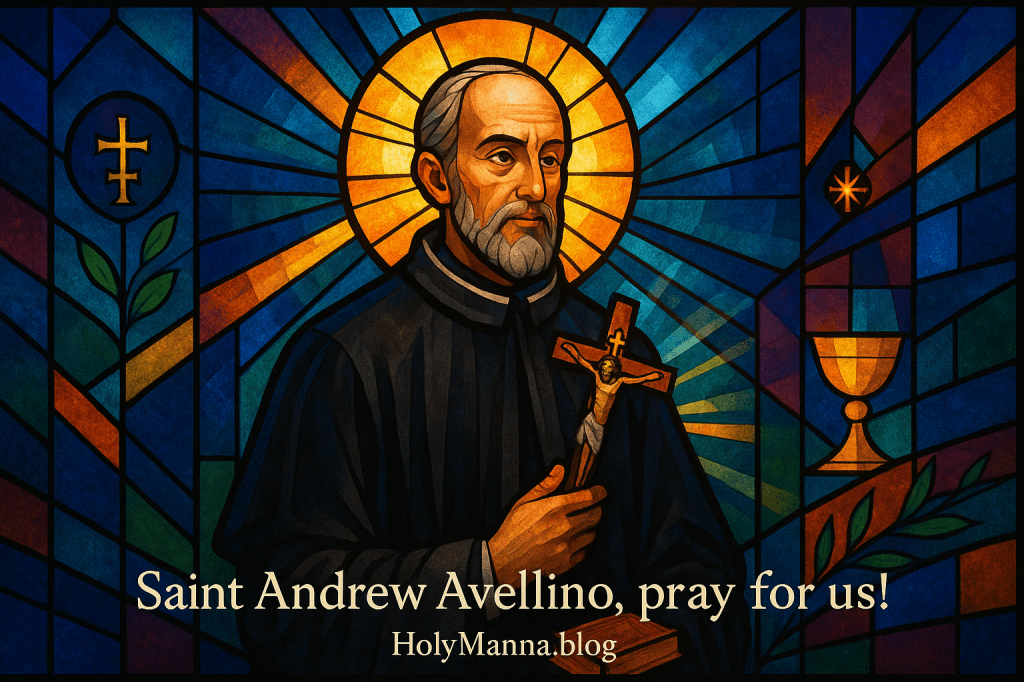
A Shepherd Who Teaches Us How to Die Well
Saint Andrew Avellino, the Theatine priest who reformed hearts by reforming his own first, stands as a quiet giant of Catholic renewal in the wake of the Council of Trent. He served as a trusted spiritual father to clergy and laity, and his counsel was sought by great churchmen like Saint Charles Borromeo. He is invoked as a patron against sudden death and for those who have suffered strokes, because his own passing was a holy one. On November 10, 1608, as he began the Holy Sacrifice of the Mass, he suffered a stroke at the altar, received the sacraments, and died in peace before the Lord he loved. His feast on November 10 invites a sober joy, because he teaches how to live each day in a way that makes one ready to meet Christ at any hour. The Church canonized him in 1712, recognizing a life shaped by prayer, penance, pastoral charity, and a deep love for the Eucharist.
From Lancellotto to Andrew
Born Lancellotto Avellino in 1521 at Castronuovo in Basilicata, in the old Kingdom of Naples, he grew up in a family that prized learning and the faith. Gifted with a sharp mind, he earned a doctorate in civil and canon law at Naples and was ordained around his mid twenties. He began work in the ecclesiastical courts, confident and capable, until a painful moment of conscience changed the whole direction of his life. After uttering an untruth in court, even without malice, he was pierced by the realization that a priest’s tongue must be wholly given to the Truth. That conviction became the seed of his conversion from a careerist path to the narrow road of holiness. With the help of serious spiritual direction and deep prayer, he accepted a difficult assignment to reform a lax convent, where his fidelity sparked fierce resistance and even physical violence. The experience confirmed his desire to belong entirely to Christ. In 1556 he entered the Theatines, took the name Andrew out of love for the Cross, and embraced a disciplined common life ordered to the sanctification of priests and the service of souls. He would become known for steady governance, a warm confessional, and clear guidance rooted in Scripture, tradition, and the sacraments.
A Life Poured Out in Reform, Counsel, and Daily Charity
The shape of Andrew’s vocation was simple and heroic at once. He prayed with perseverance, offered the Mass with profound reverence, visited the sick and the poor, and guided many souls through spiritual letters and personal direction. He helped strengthen Theatine communities and encouraged a faithful observance of their rule so that priests could be living icons of Christ among the people. His influence reached well beyond his own order through friendship with reforming bishops and through the spiritual formation of men who would guide countless others. Among those he counseled was Lorenzo Scupoli, whose classic The Spiritual Combat distilled practical holiness for ordinary Christians. Andrew loved silence and sobriety, but he also loved people. He spoke plainly about the need for ongoing conversion, and he proved by his own life that hard work and hidden sacrifices, joined to Christ, change the Church from within. Few authenticated direct quotations of his words survive in English, yet his letters consistently urge readiness for death, distrust of self will, fidelity to prayer, and tender mercy toward sinners returning to God.
God’s Nearness in the Storm
Andrew never chased wonders, but God occasionally answered his charity with signs that strengthened the faith of those around him. One well loved account tells how, during a violent storm, when the sacred lamps were extinguished as he carried Viaticum to a dying person, a heavenly light surrounded him and guided his steps so the Lord could reach that soul. Such moments were rare, and that is why they stand out. Most of his miracles were the hidden kind that unfold in the confessional and the sickroom when grace moves a heart to repentance, restores hope to a family, or brings peace to a deathbed. He suffered a painful rupture for decades and refused comforts he believed were not necessary, offering his bodily weakness in union with Christ Crucified. The resilience born of suffering made his priestly tenderness even more credible to those who sought his help.
Trial by Fire
Authentic reform attracts opposition. Andrew’s work to restore discipline in religious life led to slander, threats, and a brutal beating at the hands of men angered by his fidelity. He endured humiliation with patience and prayed for his attackers. When tragedy touched his own family through the murder of a relative, he shocked onlookers by urging clemency for the killer. His response flowed from a heart conformed to the Heart of Jesus. Andrew was not a martyr in the strict sense, but his life was profoundly cruciform. He obeyed superiors, embraced correction, persevered through illness, and loved difficult people without giving up the truth. The grace that held him steady through trials prepared him for a holy death that would strengthen the Church’s hope.
After the Altar
With his death at the altar, devotion to Andrew grew quickly in Naples and across southern Italy. The faithful turned to him especially for protection from sudden death and for help with stroke and paralysis, trusting the compassion of a priest who had walked with so many through their final hours. Reports of healings multiplied around his tomb, and pilgrims traveled to venerate his relics and ask for the grace to die in God’s friendship. The memory of his calm, Eucharistic passing gave families comfort in times of danger and taught entire communities to keep their lamps lit. To this day, his relics are honored in Naples, and the faithful who call on him receive the kind of help he offered in life: the courage to repent, the strength to persevere, and the peace that comes from living ready to see the Lord.
Practicing Andrew’s Way of Daily Conversion
Saint Andrew’s path is both demanding and doable. He shows that a serious prayer life, frequent confession, faithful participation at Mass, and concrete love for the poor will slowly convert a stubborn heart. The Catechism describes that ordinary road with beautiful clarity: “Conversion is accomplished in daily life by gestures of reconciliation, concern for the poor, the exercise and defense of justice and right, by the admission of faults to one’s brethren, fraternal correction, revision of life, examination of conscience, spiritual direction, acceptance of suffering, endurance of persecution for the sake of righteousness.” The same Catechism reminds every disciple of the goal and the grace that makes it possible: “Spiritual progress tends toward ever more intimate union with Christ.” Andrew’s holy death also underlines a distinctly Catholic wisdom about the end of life: “The Church encourages us to prepare ourselves for the hour of our death.” The preparation is not morbid at all. It is joyful and practical. It looks like a nightly examen, a good confession each month, a habit of small penances that train the will, a readiness to forgive quickly, and a reverent, attentive participation at Mass. Live that way and there is nothing to fear.
Engage with Us!
Share your thoughts and graces from Saint Andrew Avellino’s witness in the comments below.
- Where is the Lord inviting a concrete act of daily conversion this week, especially in reconciliation, justice, or service to the poor?
- How can spiritual direction, examination of conscience, and regular confession strengthen your resolve to fight self will and grow in virtue, as Saint Andrew did?
- What practices help you live ready to die a holy death, trusting God’s timing and mercy?
- Who in your life needs patient reform rather than harsh correction, and how can you love them with the truth the way Andrew did?
- If you fear sudden death or illness, how might asking Saint Andrew’s intercession bring peace and courage today?
May the example and prayers of Saint Andrew Avellino kindle in every heart a deeper conversion, courageous mercy, and a love for Jesus in the Eucharist. Live the faith boldly and do everything with the love and mercy Jesus taught.
Saint Andrew Avellino, pray for us!
Follow us on Instagram and Facebook for more insights and reflections on living a faith-filled life.

 Holy Manna!
Leave a comment