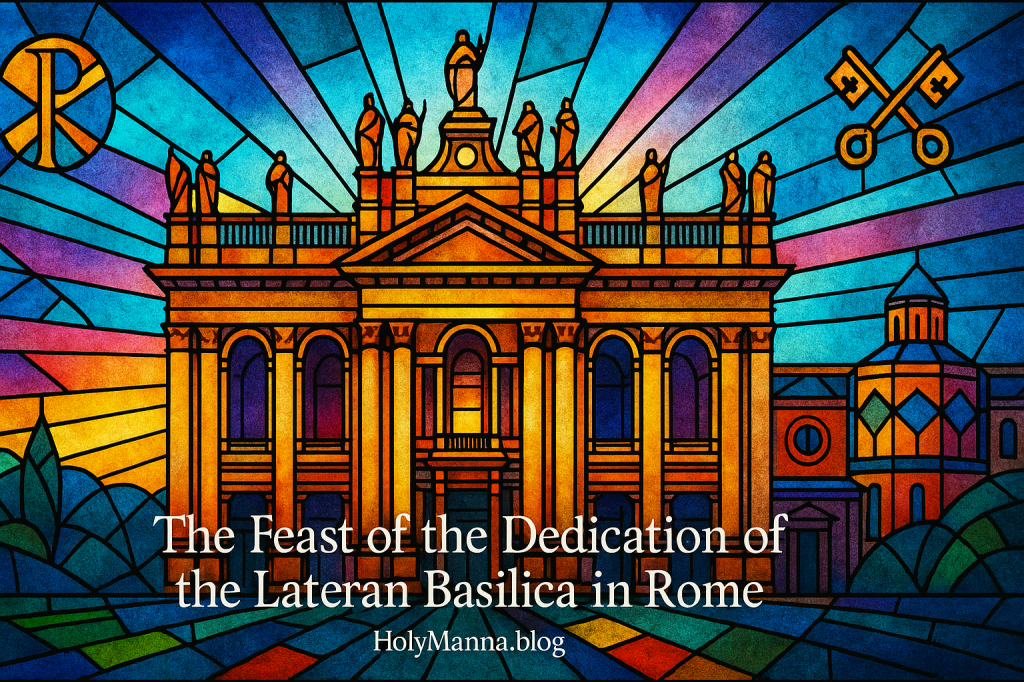
The Mother and Head of All the Churches
Every year on November 9 the Church celebrates the dedication of the Archbasilica of the Most Holy Savior and of Saints John the Baptist and John the Evangelist in the Lateran. This basilica is not simply another historic church in Rome. It is the cathedral of the Bishop of Rome and carries the proud inscription that it is the mother and head of all the churches of the city and of the world. The feast places the spotlight on communion with the successor of Peter and reminds the faithful that the Church is a visible and spiritual reality at the same time. The building points beyond itself to the mystery it shelters. In its walls, altars, and baptistery, the Church sees a sign of the living temple God is raising from the baptized in every age.
From Imperial Gift to Christian Beacon
The story begins in the early fourth century when the Emperor Constantine gave the Lateran palace and its grounds to the Church after the legalization of Christianity. On that site Pope Sylvester I dedicated a basilica around the year 324. For nearly a thousand years the Lateran served as the principal residence of the Popes and as the beating heart of Christian Rome. Through the centuries the complex grew to include the Lateran Baptistery, a model for countless baptisteries in the West, and the nearby Holy Stairs, traditionally identified as the steps Jesus climbed to face Pontius Pilate. Earthquakes, fires, and the long absence of the papacy during the Avignon period inflicted heavy damage, yet each time the basilica rose again with renewed splendor. Baroque renewal reshaped the interior and crowned the church with the grand façade seen today. Over time the commemoration of its dedication moved beyond Rome and became a feast kept throughout the Latin Church, underscoring that this cathedral is a sign of unity for all the faithful.
Where God Dwells With His People
The feast is not only about a famous building. It is a proclamation of what a church is and what the Church is. The Catechism of the Catholic Church teaches that “these visible churches are not simply gathering places but signify and make visible the Church living in this place, the dwelling of God with men reconciled and united in Christ.” It also reminds believers that “in its earthly state the Church needs places where the community can gather… our visible churches, holy places, are images of the holy city, the heavenly Jerusalem.” A parish church is more than a hall for prayer. It is meant to be a sacramental sign of the heavenly homeland and a house where the Eucharist is offered and reserved. For that reason the Catechism calls the church building “the proper place for the liturgical prayer of the parish community” and “the privileged place for adoration of the real presence of Christ in the Blessed Sacrament.” The Lectionary for this day weaves the message together. Ezekiel beholds life giving waters flowing from the temple. Saint Paul tells the Corinthians, “Do you not know that you are God’s temple and that God’s Spirit dwells in you?” The Gospel presents Christ cleansing the temple and speaking of His Body, “Destroy this temple, and in three days I will raise it up.” The stones of the Lateran testify to the deeper truth that Christ builds His Church out of living stones, and that He Himself is the cornerstone.
Pilgrim Steps to the Mother Church
Pilgrims who enter the Lateran find the cathedra, the bishop’s chair of Rome, set in the apse as a sign of pastoral authority ordered toward service and unity. They kneel at the papal altar, traditionally reserved for the Pope, and give thanks for the communion that binds parishes and dioceses to the See of Peter. Many visit the octagonal Lateran Baptistery, where generations of believers were reborn in Christ, and pray for fidelity to their own baptismal promises. Across the street the Scala Sancta invites penitents to climb on their knees in remembrance of the Passion, uniting personal conversion to the mercy that flows from the wounds of the Savior. In Jubilee years the Holy Door of the Lateran opens to welcome those who seek reconciliation and a new beginning. Passing through a Holy Door symbolizes the choice to leave behind sin and walk into the embrace of the Father through Christ, the true Door of the sheepfold. Pilgrimage and devotion at the Lateran are not museum visits. They are encounters with grace that strengthen faith, renew baptismal identity, and deepen love for the Church.
How the World Marks the Day
Because the Lateran is the cathedral of the Pope, this feast is celebrated throughout the world as a sign of universal communion. When it falls on a Sunday in Ordinary Time, the feast replaces the usual Sunday prayers and readings so that parishes everywhere can contemplate the meaning of God’s house. Many communities mark the day with catechesis on the symbolism of church architecture, with processions, and with special times of adoration. Choirs often sing texts long associated with the dedication of a church, such as the ancient antiphon “Locus iste a Deo factus est,” which proclaims that this is a place made by God. Parishioners sometimes reflect on the history of their own church’s dedication and give thanks for the sacrifices that built sanctuaries where the Word is preached and the Sacraments are celebrated. Around the globe, the feast becomes a family reunion in prayer, uniting cathedrals, chapels, missions, and monasteries to the mother church that anchors the visible unity of Catholics.
Living as Temples of the Spirit
The feast presses an important question into daily life. If churches are holy places, what kind of holiness should shine from the people who worship there. Reverence for the house of God should translate into a renewed commitment to the Sunday Eucharist, quiet prayer before the tabernacle, and a life that resembles the liturgy celebrated within those walls. The Catechism insists that the church is the proper place for the prayer of the community and the privileged place for adoration. That conviction takes shape when believers arrive a bit early for Mass to recollect, when they keep a spirit of silence that helps others pray, and when they support beauty in worship through service, generosity, and care for the sanctuary. The feast also calls for interior cleansing. Christ desires to overturn whatever robs the heart of honest worship, which means frequent Confession, reconciliation with those who have been wronged, and a preferential love for the poor. The readings affirm a liberating identity. “You are God’s temple.” Carry that truth into work and family life with integrity, courage, and mercy so that the Church built of living stones looks like what it truly is, a foretaste of the heavenly Jerusalem.
Engage with Us!
We’d love to hear your thoughts, share a grace, a question, or a pilgrimage story in the comments below!
- When you walk into your parish church, what helps you sense that you’re stepping into the “dwelling of God with men”?
- Where is Christ inviting you to let Him “cleanse the temple” of your heart this week (see John 2:13–22)?
- How can you contribute, practically, to the beauty, reverence, and welcome of your parish church?
- If you could make a pilgrimage to the Lateran, what would you bring to the Holy Door as your prayer of conversion?
Go in peace, and live as God’s temple. Do everything with the love and mercy Jesus taught, so that His Church truly shines as a house of prayer for all peoples.
Sacred Heart of Jesus, we trust in You!
Immaculate Heart of Mary, pray for us!
Saint Michael the Archangel, defend us in battle!
Follow us on Instagram and Facebook for more insights and reflections on living a faith-filled life.

 Holy Manna!
Leave a comment