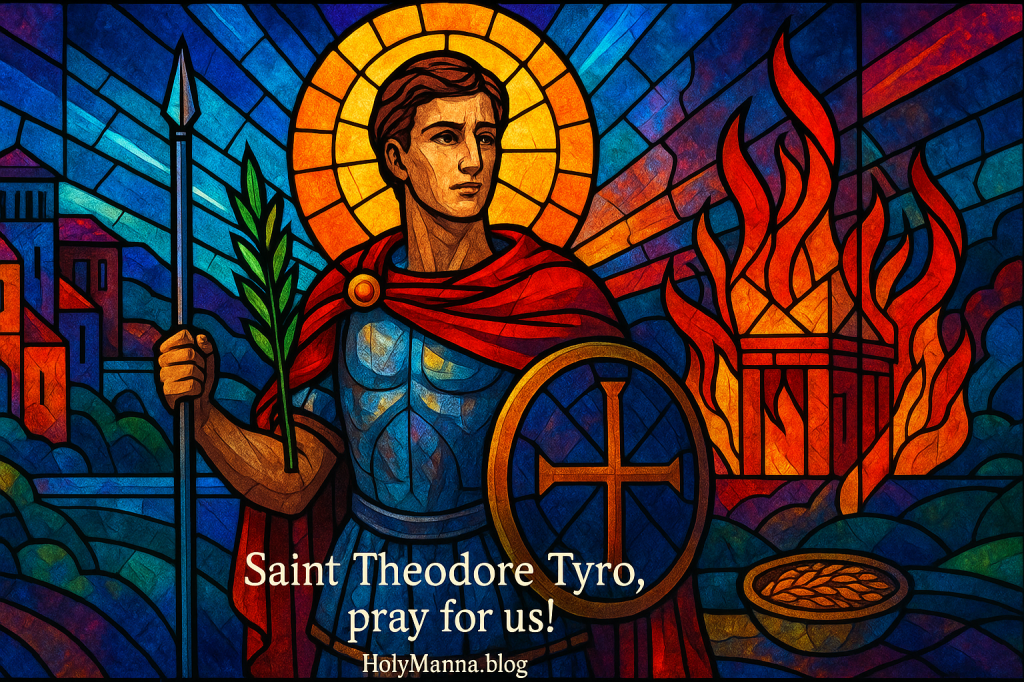
A Banner of Fidelity
Saint Theodore Tyro, known as “the Recruit,” stands among the great soldier martyrs whose steady loyalty to Jesus Christ outshone the glory of Rome. His witness emerges during the Diocletianic persecutions in the early fourth century, when confessing Christ could cost everything. The Church remembers him for a bold refusal to offer sacrifice to pagan gods, a fearless serenity under torture, and a martyrdom by fire that sealed his testimony. In the Latin tradition his memory is kept in November, and in the Christian East he is honored on February 17, with a special commemoration on the first Saturday of Great Lent. The heart of his significance is simple and strong. He shows that real love for Christ produces real choices, even when those choices cut against comfort and power. The Catechism of the Catholic Church calls this kind of witness the summit of Christian truth telling: “Martyrdom is the supreme witness given to the truth of the faith.” (CCC 2473)
From Pontus to Profession
Ancient accounts place Theodore as a young conscript serving with Roman troops in Pontus, near the Black Sea, with the city of Amasea often named in the traditions. The title “Tyro” marks him as a recruit, a soldier early in his service. His family background is not preserved with certainty, which already hints at the kind of sanctity he embodies. Holiness does not always announce itself with famous bloodlines or lengthy biographies. It ripens in hidden fidelity. When orders came to participate in pagan rites, Theodore openly professed his faith in Christ and refused to bend his conscience. Some early narratives add that he set fire to a local temple of Cybele after rejecting idolatry, a detail found in traditional passiones that underscores his uncompromising zeal. What the Church treasures is the interior reality behind the story. He chose the worship of the true God over every competing loyalty. That choice is why he is remembered, sung about, and invoked.
Duty Transformed by Love
Theodore’s daily life looked ordinary from the outside. He trained, kept watch, and lived the rhythm of a military recruit. Inside that ordinary rhythm, grace was working. When the moment came to choose between Roman expectations and the lordship of Jesus, he stood firm. The miracle that shines within his life is the supernatural fortitude that turned a recruit into a confessor of the faith. Ancient Christians did not count miracles only as healings or dramatic signs. They also saw the astonishing stability of a believer who would not deny Christ as a true miracle of grace. Theodore’s quiet steadfastness moved others to courage, and his name quickly spread along pilgrim paths because people sensed the power of God at work in his choices. The Catechism reminds the faithful why saints like Theodore matter for every age: “The saints have always been the source and origin of renewal in the most difficult moments in the Church’s history.” (CCC 828)
The Furnace of Witness
Interrogations followed Theodore’s refusal to sacrifice. Judges hoped that threats, delay, and public pressure would wear down his resolve. He was tortured and finally condemned to death by fire at Amasea, likely around the year 306. Accounts differ on smaller details, as ancient martyr acts often do, but they agree on the essentials. Theodore endured suffering with a calm anchored in Christ, offered his life without bitterness, and died as flames rose around him. The Church venerates him as a Great Martyr because his testimony did not collapse under pain or fear. His death reflects the Church’s faith that God draws saving fruit from such sacrifice. The Catechism teaches that “The blood of martyrs is the seed of Christians.” (cf. CCC 1258, 2473). His execution did not silence his faith. It multiplied it.
Wheat for the Fast
After Theodore’s death, devotion to him spread rapidly, especially in the region of Euchaita, which became the heart of his cult and a destination for pilgrims seeking his intercession. One of the most beloved traditions connected to him comes from the reign of Julian the Apostate. During the first week of Lent, the emperor allegedly ordered that food in the markets of Constantinople be tainted with blood from pagan sacrifices. According to the tradition, Saint Theodore appeared in a dream to the city’s bishop and warned the faithful to avoid the markets and to eat boiled wheat with honey instead, a dish known as koliva. The warning protected Christians from unknowing participation in idolatrous rites, and the Church in the East remembers this mercy on the first Saturday of Great Lent with a special commemoration called Theodore Saturday. Over centuries, churches were dedicated in his honor, and his relics and icons became a source of consolation and healing for the faithful who asked for his prayers. The Catechism explains why this communion with the saints is fruitful for the whole Church: “Being more closely united to Christ, those who dwell in heaven fix the whole Church more firmly in holiness.” (CCC 956)
A Recruit’s Roadmap
Theodore shows that courage begins long before the spotlight. It grows in daily prayer, a well-formed conscience, and the small refusals that train the soul to say yes to God. His story invites believers to reexamine the quiet compromises that creep in when comfort becomes an idol. It encourages an honest return to the sacraments so that grace can rebuild what fear has eroded. The communion of saints is not an abstract idea. It is a family reality. Ask Saint Theodore to steady your heart when conversations get tense or when choices on campus, at work, or at home demand clarity. Renew trust in the Holy Spirit, who gave a young recruit everything needed to face torture with peace. The Church teaches that devotion to the saints flows from and returns to Christ. The Catechism describes this vital exchange with heaven in luminous terms: “Our communion with the saints joins us to Christ, from whom as from its fountain and head issues all grace, and the life of the People of God itself.” (cf. CCC 957). Where is Christ inviting a bolder yes right now? What would it look like to choose Him when it costs something? Which small but concrete step could make faith more visible today?
Engage with Us!
Share your thoughts and reflections in the comments below.
- When have you felt pressure to compromise your faith, and how did you respond?
- What “small incense” might need to be tossed aside so that your daily choices are clearly for Christ?
- How could fasting, confession, or the Eucharist strengthen your courage this week?
- What part of Saint Theodore’s witness most challenges or encourages you right now?
Go forward with confidence in Jesus. Choose the narrow path with love, mercy, and hope, and let every duty, every conversation, and every sacrifice be offered to the Lord who saves.
Saint Theodore Tyro, pray for us!
Follow us on Instagram and Facebook for more insights and reflections on living a faith-filled life.

 Holy Manna!
Leave a comment