A Sweet Voice That Helped Shape a Nation’s Faith
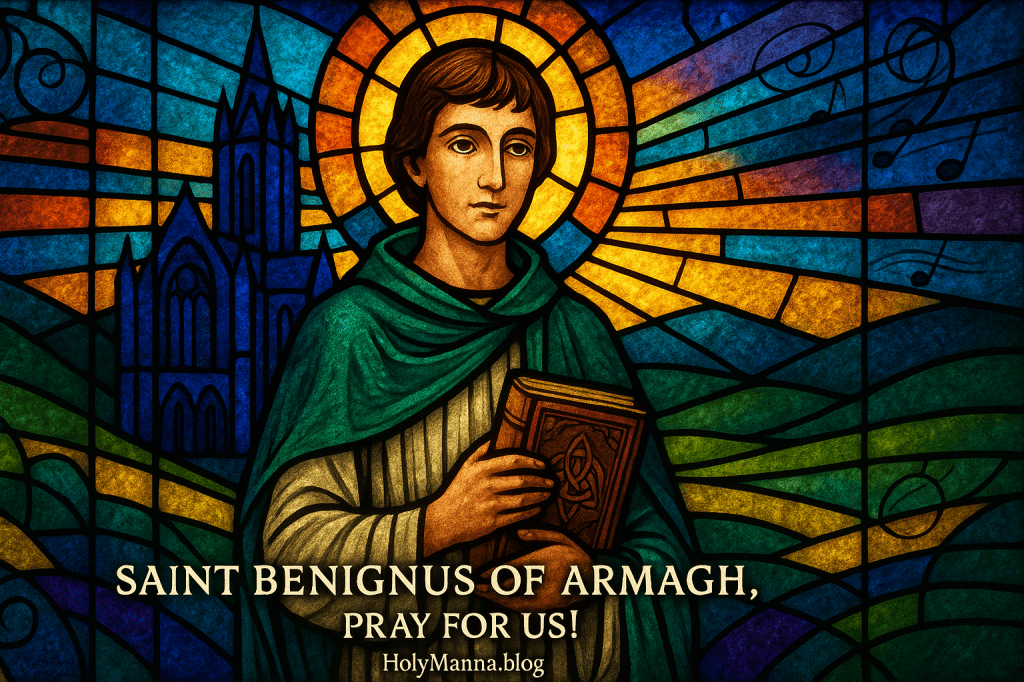
Saint Benignus of Armagh shines in the story of Ireland’s conversion as the gentle disciple whose song carried the Gospel into hearts. Affectionately called Patrick’s psalm singer, he helped give voice to the worship of the infant Irish Church and stood at Patrick’s side as coadjutor in Armagh around the mid fifth century. The Church remembers him on November 9 for fidelity, unity with the See of Peter, and a luminous love for beautiful worship that nourished evangelization. In the spirit of the Church’s teaching on sacred music, “the musical tradition of the universal Church is a treasure of inestimable value” (Catechism of the Catholic Church 1156). Benignus embodied that truth by wedding beauty to doctrine, song to sanctity, and worship to mission.
From a Chieftain’s Home to Saint Patrick’s Side
Benignus was born in what is now County Meath, the son of the chieftain Sesenen. As a boy he encountered Saint Patrick, received baptism, and refused to leave the holy bishop’s side. His mildness earned him the affectionate Irish name Benen, Latinized as Benignus, and his gifts drew him into Patrick’s closest circle. Trained from youth in sacred learning, he became Patrick’s cherished companion and later his coadjutor at Armagh. Tradition notes that his family likely came from the bardic class, which helps explain his role in crafting and leading choral worship for the fledgling Church. Across Ireland he traveled with Patrick, preaching Christ, teaching the newly baptized, and shaping a distinctly Irish expression of liturgical life rooted in Scripture and the sacraments.
Singing the Gospel
Benignus is remembered not only for a beautiful voice but for a mind formed in faith. Sources credit him with assisting in the compilation of the Senchus Mór, the early codification of Irish customary law, which tradition says was reexamined in the light of the Gospel so that civil life would reflect Christian justice. He is also linked with contributions to the Psalter of Cashel and the Book of Rights, showing how evangelization and culture matured together. In all of this, he served as Patrick’s coadjutor, strengthening catechesis and helping to order the life of parishes and monasteries throughout the island. The Church’s teaching on communion and mission illuminates his work: “The Church is universal by reason of the unity of faith, of the sacraments, and of the governance of the Church whose head is the Roman Pontiff” (Catechism 834, see also 830–833). Benignus lived that unity on Irish soil.
Legends That Breathe with Faith
The Irish loved to remember how God sheltered Patrick and his companions through Benignus’s fidelity. One treasured story tells how enemies lying in ambush saw Patrick’s band not as men but as a herd of deer passing by in the half light, with a fawn following and bearing a book on its back. The fawn was said to be the youthful Benignus carrying Patrick’s satchel of sacred books. Another well known tradition recounts a trial by fire at Tara during Easter of 433. A pagan druid and the newly baptized Benignus were bound in a timber structure set ablaze to test whose God would protect his servant. The druid perished while Benignus emerged unharmed, a sign that led many to reverence the God whom Patrick preached. A third beloved tale tells of Earcnat, a noble maiden who fell ill and died after struggling with disordered affection for Benignus. At Patrick’s instruction Benignus brought blessed water, sprinkled it over her, and she returned to life, choosing a life of chastity for Christ. These accounts come to us as hagiographic traditions rather than courtroom records, yet they reveal how Irish Christians experienced the nearness of God in the ministry of Patrick and Benignus, and how grace reorders hearts toward purity and worship.
Trials, Leadership, and Fidelity to Peter
The fifth century Church in Ireland faced hostility, moral upheaval, and the sheer challenge of building Christian life from the ground up. In this, Benignus proved steady as a teacher and judge, helping Patrick shepherd a growing flock. He is remembered as present at a synod that acknowledged the See of the Apostle Peter as the final court of appeal in difficult cases, a witness that shows the early Irish Church’s concrete communion with Rome. Benignus served as Patrick’s coadjutor and later resigned shortly before his death in 467, leaving a memory of pastoral gentleness, liturgical beauty, and ecclesial unity. The Catechism explains why such communion matters for every age: “The Pope, Bishop of Rome and Peter’s successor, is the perpetual and visible source and foundation of the unity both of the bishops and of the whole company of the faithful” (Catechism 882; see also 936). Benignus helped that truth take root in Ireland.
Afterglow of Holiness
After his death the Church continued to honor Benignus with liturgical remembrance. Irish martyrologies keep his name on November 9, and the faithful have long invoked his prayers as the psalm singer who led a nation to praise. Though a long catalog of posthumous miracle reports has not come down to us as it has for some other saints, the enduring veneration of his memory is itself a testimony to his sanctity and intercession. The Catechism states plainly what the Church believes about the saints who have gone before us: “Being more closely united to Christ, those who dwell in heaven fix the whole Church more firmly in holiness” and “They do not cease to intercede for us before the Father” (Catechism 956). Many have turned to Saint Benignus to ask for a heart made gentle by grace and a voice ready to praise.
Let Your Life Become a Psalm
Benignus invites every Christian to let worship form the soul and to let beauty evangelize. Make the psalms the soundtrack of the week and let Scripture shape conversations at home. Choose the parish’s Sunday liturgy as the axis of family life and receive the sacraments with a humble heart. Stay rooted in the Church’s unity by praying for the Holy Father and the local bishop, supporting the parish with time and talent, and choosing gratitude over grumbling. Finally, ask for a gentle spirit that speaks truth without harshness. Ireland was converted through saints who prayed, sang, taught, and loved. The same pattern can convert homes and friendships today.
Engage with Us!
Share your thoughts and experiences in the comments. How has Saint Benignus’ story encouraged you toward deeper faith?
- How does Benignus’ blend of beauty and truth in worship challenge you to pray and sing more intentionally this week?
- Where is the Lord asking you to pair fidelity to Church teaching with a gentleness that invites others in, rather than pushes them away?
- What concrete step can you take to strengthen communion with the wider Church, especially through prayer for the Holy Father and your bishop?
- Which Scripture verses or hymns could become part of your daily routine so that your home sounds a little more like the Church’s song?
Keep going with courage. Live the faith out loud, stay close to Jesus in the sacraments, and do everything with the love and mercy he taught us.
Saint Benignus of Armagh, pray for us!
Follow us on Instagram and Facebook for more insights and reflections on living a faith-filled life.

 Holy Manna!
Leave a comment