Feast of the Dedication of the Lateran Basilica in Rome – Lectionary: 671
Living Waters, Living Temple
Step into today’s feast with a quiet breath and a ready heart, because God is not distant in these readings, He is delightfully near, choosing to dwell with His people and to turn dry ground into living gardens. The Dedication of the Lateran Basilica in Rome celebrates the cathedral church of the Bishop of Rome, the visible sign of unity for the whole Church. Consecrated in the fourth century and honored as the Mother and Head of all churches, the Lateran reminds Christians that bricks and arches matter because they point to a deeper reality. Sacred buildings are not ends in themselves. They are signs that God chooses a people, gathers them, and lives among them.
The central theme tying the Scriptures together is simple and strong: Christ the true Temple purifies and unites His Church so that life giving waters of grace flow from His Body, making the whole Church and each baptized person a holy dwelling of God. In Ezekiel 47:1-12, water flows from the temple and heals everything it touches, a powerful image of sacramental grace that brings life where there was barrenness, “Where these waters flow they refresh; everything lives where the river goes.” In Psalm 46, the city of God is made glad by a river because God is truly in its midst, “God is in its midst; it shall not be shaken.” In 1 Corinthians 3:9-17, the foundation is named clearly, “No one can lay a foundation other than the one that is there, namely, Jesus Christ.” Built on Him, the Church is God’s building, and every believer is a temple where the Spirit dwells, a truth that carries both dignity and responsibility, as taught in CCC 756 and CCC 797-798. In John 2:13-22, Jesus cleanses the temple and points to the definitive sanctuary, “Destroy this temple and in three days I will raise it up,” unveiling His Body as the living Temple whose death and Resurrection unleash the river of grace into the world.
This feast day invites gratitude for the Lateran’s enduring witness and, even more, it invites a renewed reverence for the Church as the living house of God. The Lord still chooses to dwell in the midst of His people, especially in the sacraments, which are the Church’s lifegiving streams. What needs to be cleansed so that the river of grace can flow freely in the heart today? Where has God already turned a barren place into a garden in the home, the parish, or the city? How might today’s worship become a yes that lets the Church be what she is called to be, a living temple that makes God’s nearness unmistakable?
First Reading – Ezekiel 47:1-2, 8-9, 12
From Holy Ground to Healing River
The vision in Ezekiel 47 unfolds during Israel’s exile, when temple worship had been shattered and hope felt thin. Ezekiel, a priest turned prophet in Babylon, is shown a restored temple from which a trickle of water becomes a river that brings life to everything it touches. In the ancient Near Eastern imagination, temples were places where heaven met earth. For Israel, the Jerusalem Temple was the covenant center, the locus of God’s presence and blessing for the nations. This river is not a decorative feature. It is a sacramental sign that God’s indwelling presence overflows into the world as healing and fruitfulness. On the Feast of the Dedication of the Lateran Basilica in Rome, the Mother and Head of all churches, this vision reminds the faithful that consecrated churches are visible signs of an even greater reality. Christ is the true Temple, and from His Body the life of grace flows into the Church and through the Church into the world. Today’s theme comes into focus here. Christ purifies His dwelling and makes His people living temples so that living waters can reach every desert.
Ezekiel 47:1-2, 8-9, 12
New American Bible (Revised Edition)
The Wonderful Stream. 1 Then he brought me back to the entrance of the temple, and there! I saw water flowing out from under the threshold of the temple toward the east, for the front of the temple faced east. The water flowed out toward the right side of the temple to the south of the altar. 2 He brought me by way of the north gate and around the outside to the outer gate facing east; there I saw water trickling from the southern side.
8 He said to me, “This water flows out into the eastern district, runs down into the Arabah and empties into the polluted waters of the sea to freshen them. 9 Wherever it flows, the river teems with every kind of living creature; fish will abound. Where these waters flow they refresh; everything lives where the river goes.
12 Along each bank of the river every kind of fruit tree will grow; their leaves will not wither, nor will their fruit fail. Every month they will bear fresh fruit because the waters of the river flow out from the sanctuary. Their fruit is used for food, and their leaves for healing.”
Detailed Exegesis
Verse 1 – “Then he brought me back to the entrance of the temple, and there! I saw water flowing out from under the threshold of the temple toward the east, for the front of the temple faced east. The water flowed out toward the right side of the temple to the south of the altar.”
The eastward flow signals new creation and sunrise, the biblical direction of origin and hope. The water does not spring from a natural source. It issues from the sanctuary, which means the life given here is divine in origin. The mention of the altar locates the river’s source in worship and sacrifice. Read through the lens of the New Covenant, this anticipates the graces that flow from Christ’s Paschal Mystery and the Church’s sacramental life.
Verse 2 – “He brought me by way of the north gate and around the outside to the outer gate facing east; there I saw water trickling from the southern side.”
The trickle reveals God’s chosen method. Grace often begins small and hidden yet is unstoppable when it is God’s work. The movement around the precincts hints that this blessing is not confined to an inner circle. It will pass beyond the walls and into the world, as the Church’s mission does.
Verse 8 – “He said to me, ‘This water flows out into the eastern district, runs down into the Arabah and empties into the polluted waters of the sea to freshen them.’”
The Arabah and the sea evoke the Dead Sea basin, a symbol of sterility. The river’s power is restorative. God’s presence does not avoid what is polluted. He transforms it. In Christian reading, baptismal grace reaches what is dead through sin and makes it alive.
Verse 9 – “Wherever it flows, the river teems with every kind of living creature; fish will abound. Where these waters flow they refresh; everything lives where the river goes.”
This is the heart of the vision. The effects of God’s life are superabundant fecundity and renewal. The phrase “everything lives where the river goes” anticipates the universality of salvation in Christ. Within the Church, the sacraments are not mere symbols. They are effective signs that communicate the very life they signify.
Verse 12 – “Along each bank of the river every kind of fruit tree will grow; their leaves will not wither, nor will their fruit fail. Every month they will bear fresh fruit because the waters of the river flow out from the sanctuary. Their fruit is used for food, and their leaves for healing.”
Perennial fruitfulness and unwithering leaves echo Eden restored and foretell the healing of nations described again in Revelation 22. The food and healing point to the Eucharist and the anointing presence of the Spirit. Where God dwells, life is nourished and wounds are mended.
Teachings
The Church understands herself as God’s dwelling that extends Christ’s saving presence. As the Catechism teaches in CCC 756, “Often, too, the Church is called the building of God.” This building is alive because the Spirit animates it. In CCC 797, the Catechism gives a luminous key for today’s feast and reading. “What the soul is to the human body, the Holy Spirit is to the Body of Christ.” The Lateran Basilica, as the cathedral of the Bishop of Rome, stands as a sacramental sign of that living Body. From the altar of Christ, grace flows like Ezekiel’s river, healing what is polluted and making barren places fruitful. The temple vision thus prepares hearts to see in Christ the true Temple and in the Church His extended presence, where worship is not an isolated rite but the wellspring of mission. The Fathers often connect sacred water with the pierced side of Christ, from which flowed blood and water, a sign of the sacraments by which the Church is born and sustained. The reading is therefore not a distant dream. It is a map of how God chooses to dwell, to heal, and to send.
Reflection
The river begins as a trickle, yet it transforms a dead sea into a living one. This is how grace often works in the ordinary rhythm of parish life and family life. Begin at the sanctuary, then let the stream reach the places that feel arid or even polluted. Choose concrete practices that keep you near the source. Return to the sacraments, especially Confession and the Eucharist. Set aside time each day to pray with Scripture so the word can take root. Bring the life you receive into the neighborhoods, workplaces, and friendships that need healing. Where is the Lord inviting a small but steady stream of grace to begin today? What desert in the heart or home needs to be reached by the waters that flow from God’s presence? How can today’s worship at church overflow into acts of mercy, patience, and reconciled relationships this week?
Responsorial Psalm – Psalm 46:2-3, 5-6, 8-9
God In Our Midst, The City That Cannot Be Shaken
Prayed in Israel’s worship, Psalm 46 is a song of confident trust from the heart of Zion theology. Ancient Jerusalem was built around life giving water sources like the Gihon spring, yet this psalm points beyond natural streams to the supernatural presence of the Lord who dwells with His people. On the Feast of the Dedication of the Lateran Basilica in Rome, the Church hears these words as a reminder that God’s nearness is the true strength of His city. The Lateran, as the cathedral of the Bishop of Rome, visibly gathers the family of God, but the deeper mystery is this. God Himself is in the midst of His Church. The River that gladdens the city anticipates Ezekiel’s temple stream and is fulfilled in Christ the true Temple, from whom sacramental grace flows to renew the world.
Psalm 46:2-3, 5-6, 8-9
New American Bible (Revised Edition)
2 God is our refuge and our strength,
an ever-present help in distress.
3 Thus we do not fear, though earth be shaken
and mountains quake to the depths of the sea,
5 Streams of the river gladden the city of God,
the holy dwelling of the Most High.
6 God is in its midst; it shall not be shaken;
God will help it at break of day.
8 The Lord of hosts is with us;
our stronghold is the God of Jacob.
Selah
9 Come and see the works of the Lord,
who has done fearsome deeds on earth;
Detailed Exegesis
Verse 2 – “God is our refuge and our strength, an ever-present help in distress.”
The psalm begins with covenant confidence. Refuge and strength name God not as distant power but as immediate protection. For the feast, this line frames the Church’s buildings as signs of a deeper reality. The stability of the people of God rests in the Lord who abides with them.
Verse 3 – “Thus we do not fear, though earth be shaken and mountains quake to the depths of the sea,”
Cosmic chaos imagery evokes uncreation. Even if the most stable features of the world collapse, the faithful answer is fearless trust. Read with the Gospel, this points to Christ who cleanses and reorders His Father’s house so hearts can be steadied in His presence.
Verse 5 – “Streams of the river gladden the city of God, the holy dwelling of the Most High.”
The river is a symbol of God’s lifegiving presence, now read in light of Ezekiel 47 and fulfilled in the sacraments that flow from Christ. The city gladdened by the stream is the people gathered for worship where God makes His home.
Verse 6 – “God is in its midst; it shall not be shaken; God will help it at break of day.”
The center of the city is not stone but Presence. Help at daybreak recalls the Exodus and the dawn of Resurrection. The Church stands firm because Christ is with her, especially in her liturgy and in the Eucharist.
Verse 8 – “The Lord of hosts is with us; our stronghold is the God of Jacob.”
The divine title Lord of hosts proclaims the Lord of angelic armies. The God of Jacob anchors the promise in Israel’s history. The refrain is a communal creed. In every age, the Church’s strength is communion with the God who keeps His covenant.
Verse 9 – “Come and see the works of the Lord, who has done fearsome deeds on earth;”
Worship becomes witness. The faithful are invited to contemplate God’s mighty acts and to proclaim them. On this feast, the visible beauty of a consecrated basilica summons the world to behold the Lord who acts and saves.
Teachings
The Psalm’s claim that God dwells in the midst of His people resonates with the Church’s self understanding. In CCC 756, the Church teaches, “Often, too, the Church is called the building of God.” The Church is not a static structure but a living Body animated by the Spirit. In CCC 797, we learn, “What the soul is to the human body, the Holy Spirit is to the Body of Christ, which is the Church.” This is why the city is unshaken. God Himself indwells His people. The liturgy makes this nearness tangible. As CCC 1090 confesses, “In the earthly liturgy we share in a foretaste of that heavenly liturgy that is celebrated in the Holy City of Jerusalem toward which we journey as pilgrims.” The river that gladdens the city becomes, in Christian worship, the flow of sacramental life. The Fathers loved to connect this river to the water and blood from Christ’s side, the signs of Baptism and the Eucharist, through which the Church is born and sustained. Saint Augustine’s vision of the two cities sharpens the Psalm’s contrast between chaos and communion. In The City of God, he writes, “Two cities have been formed by two loves: the earthly by the love of self, even to the contempt of God; the heavenly by the love of God, even to the contempt of self.” The Psalm teaches the posture of the heavenly city. It stands firm because it stands in God.
Reflection
Pray this Psalm as a declaration over every anxious place. Begin with worship and let confidence grow from God’s nearness. Choose to stand inside the city by living in grace. Return to Confession to clear what clutters the inner temple. Receive the Eucharist with fresh faith that Christ is truly present. Bring this presence into the week through quiet fidelity, works of mercy, and patient peacemaking. Where does the heart need to hear again, “God is our refuge and our strength” today? What would it look like to let the river of grace gladden the home, the parish, and the city? How might Sunday’s worship become a steady source of courage for the responsibilities and relationships entrusted this week?
Second Reading – 1 Corinthians 3:9-11, 16-17
Built On Christ, Indwelt By the Spirit
Written to a divided church in Corinth, this passage speaks into a bustling Greco Roman port city obsessed with status, rhetoric, and competing leaders. Paul corrects the community by shifting attention from personalities to the true project. God Himself is building a living temple on the only foundation that can bear the weight of eternity, Jesus Christ. On the Feast of the Dedication of the Lateran Basilica in Rome, this reading grounds the theme that Christ the true Temple purifies and unites His Church so that the living waters of grace can flow. A consecrated basilica is a visible sign of a deeper mystery. The Church is God’s building, and each baptized believer is a living stone where the Spirit dwells for the life of the world.
1 Corinthians 3:9-11, 16-17
New American Bible (Revised Edition)
9 For we are God’s co-workers; you are God’s field, God’s building.
10 According to the grace of God given to me, like a wise master builder I laid a foundation, and another is building upon it. But each one must be careful how he builds upon it, 11 for no one can lay a foundation other than the one that is there, namely, Jesus Christ.
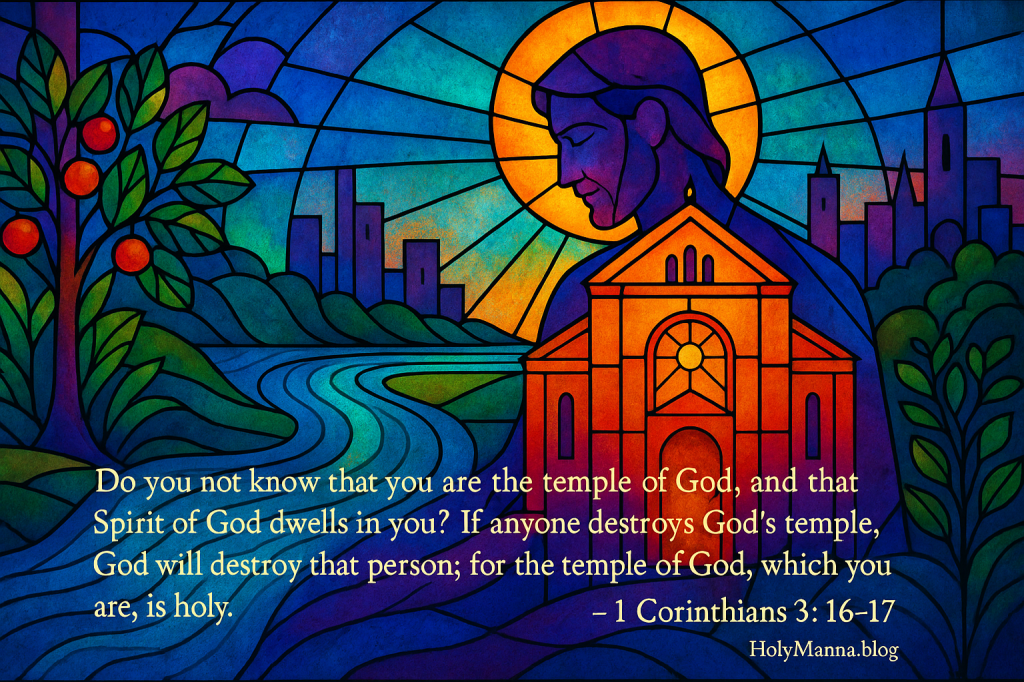
16 Do you not know that you are the temple of God, and that the Spirit of God dwells in you? 17 If anyone destroys God’s temple, God will destroy that person; for the temple of God, which you are, is holy.
Detailed Exegesis
Verse 9 – “For we are God’s co-workers; you are God’s field, God’s building.”
Paul dignifies ministry without allowing cults of personality. Apostles and pastors are co workers with God, not rival contractors. The community is both a field that must be cultivated and a building under construction. The image prepares for the temple language that follows and situates every Christian within God’s ongoing work.
Verse 10 – “According to the grace of God given to me, like a wise master builder I laid a foundation, and another is building upon it. But each one must be careful how he builds upon it,”
Apostolic ministry is a grace, not a personal achievement. Paul laid the foundation through preaching Christ, planting the Church, and handing on sound teaching. Others build by teaching, sanctifying, and governing in continuity with the apostles. The warning introduces moral and doctrinal responsibility. Craft matters when the house is God’s.
Verse 11 – “for no one can lay a foundation other than the one that is there, namely, Jesus Christ.”
Here is the non negotiable center. The Church does not rest on trends, personalities, or human ingenuity. The foundation is a Person. Everything authentic in Christian life and worship stands because it is anchored to Christ. This line illuminates the Lateran’s meaning. The Mother and Head of churches stands as a sign only because it rests on Christ.
Verse 16 – “Do you not know that you are the temple of God, and that the Spirit of God dwells in you?”
The “you” is plural. Paul speaks to the whole Church gathered. Together the baptized form God’s temple because the Holy Spirit truly dwells in the community. This is not metaphorical sentiment. It is a revealed reality that flows from Baptism and is nourished in the Eucharist.
Verse 17 – “If anyone destroys God’s temple, God will destroy that person; for the temple of God, which you are, is holy.”
Division, false teaching, and grave scandal are not minor faults when the community is God’s dwelling. The strong warning protects the sanctity of the Church and the dignity of every member. Holiness is not optional because God is present. The community must reflect the character of its divine Guest.
Teachings
The Church reads this passage as a charter for her identity as God’s building. In CCC 756, the Church teaches, “Often, too, the Church is called the building of God.” This building stands because the Spirit is its life. In CCC 797, we receive the classic summary, “What the soul is to the human body, the Holy Spirit is to the Body of Christ, which is the Church.” The consequence is ecclesial and personal. United to Christ the cornerstone, believers become living stones who offer spiritual worship. As 1 Peter 2:5 proclaims, “Like living stones, let yourselves be built into a spiritual house to be a holy priesthood, to offer spiritual sacrifices acceptable to God through Jesus Christ.” The dedication of the Lateran Basilica fits here as a historical and sacramental sign. Consecrated in antiquity as the cathedral church of the Bishop of Rome, the Lateran has long been honored as Mother and Head of all churches. Its sacred walls proclaim that the visible house of prayer points to the living house God is building in His people. That house rests on one foundation only, “Jesus Christ.” The saints echo the urgency of rightly ordered love within this city of God. Saint Augustine writes in The City of God, “Two cities have been formed by two loves. The earthly by the love of self, even to the contempt of God. The heavenly by the love of God, even to the contempt of self.” Built on Christ and animated by the Spirit, the Church belongs to the heavenly city and must be recognizable by that love.
Reflection
Let this reading reframe identity and purpose. Begin at the foundation. Choose practices that anchor daily life to Christ. Pray with Scripture each day so the mind and heart are formed by the Word. Return to Confession to clear what threatens the integrity of the inner temple. Participate in the Eucharist with attentive faith, since the Spirit builds up the Church each time the Body of Christ is received. Build carefully in relationships. Speak truth with charity. Refuse gossip and division. Encourage vocations and support pastors whose work is to build on the foundation with care. Where has another foundation tried to slip under the feet this week? What beams in character or habits need repairing so that the Spirit’s dwelling is honored? How might today’s worship at church inspire one concrete act of unity, mercy, or witness that helps build up the household of God?
Holy Gospel – John 2:13-22
Zeal For The Father’s House, The Body That Rises
Celebrated near the feast of Passover, this scene unfolds in the heart of Israel’s worship. Pilgrims streamed into Jerusalem to offer sacrifice in the Temple, and practical needs gave rise to a market in the outer courts for animals and the exchange of currency for the temple tax. Commerce crowded the place meant to welcome the nations into prayer. Into this setting the Messiah steps with prophetic clarity. Jesus cleanses the courts in a sign of judgment and renewal, then declares the definitive truth about the Temple. His own Body is the true sanctuary that will be destroyed and raised. On the Feast of the Dedication of the Lateran Basilica in Rome, the Mother and Head of all churches, this Gospel reveals why sacred buildings matter and why they point beyond themselves. Christ is the living Temple, the Church is His Body, and the worship that begins at the altar must flow outward like Ezekiel’s river to heal a thirsty world.
John 2:13-22
New American Bible (Revised Edition)
Cleansing of the Temple. 13 Since the Passover of the Jews was near, Jesus went up to Jerusalem. 14 He found in the temple area those who sold oxen, sheep, and doves, as well as the money-changers seated there. 15 He made a whip out of cords and drove them all out of the temple area, with the sheep and oxen, and spilled the coins of the money-changers and overturned their tables, 16 and to those who sold doves he said, “Take these out of here, and stop making my Father’s house a marketplace.” 17 His disciples recalled the words of scripture, “Zeal for your house will consume me.” 18 At this the Jews answered and said to him, “What sign can you show us for doing this?” 19 Jesus answered and said to them, “Destroy this temple and in three days I will raise it up.” 20 The Jews said, “This temple has been under construction for forty-six years, and you will raise it up in three days?” 21 But he was speaking about the temple of his body. 22 Therefore, when he was raised from the dead, his disciples remembered that he had said this, and they came to believe the scripture and the word Jesus had spoken.
Detailed Exegesis
Verse 13 – “Since the Passover of the Jews was near, Jesus went up to Jerusalem.”
Passover sets a context of liberation and covenant. Going up to Jerusalem places Jesus at the liturgical center of Israel’s life. The timing hints that a new Exodus is at hand, accomplished through the Paschal Mystery.
Verse 14 – “He found in the temple area those who sold oxen, sheep, and doves, as well as the money-changers seated there.”
The merchants and money changers served sacrificial needs, but their presence in the court of the Gentiles turned prayer-space into traffic and profit. The sign exposes disorder. Worship must not be reduced to transaction.
Verse 15 – “He made a whip out of cords and drove them all out of the temple area, with the sheep and oxen, and spilled the coins of the money-changers and overturned their tables,”
The action is forceful and symbolic rather than violent against persons. Jesus enacts prophetic purification, recalling texts like Malachi 3, where the Lord comes to refine His house. The overturning of tables overturns a mindset that treats the holy as ordinary.
Verse 16 – “and to those who sold doves he said, ‘Take these out of here, and stop making my Father’s house a marketplace.’”
“Father’s house” reveals Jesus’ unique sonship and the true purpose of the Temple. The issue is not sacrifice itself but the profanation of prayer. The command restores right order. The Temple is for communion with God.
Verse 17 – “His disciples recalled the words of scripture, ‘Zeal for your house will consume me.’”
The citation from Psalm 69:10 frames Jesus as the righteous sufferer whose zeal brings opposition. His passion for the Father’s glory points toward His Passion, where love for the Father and for the world consumes Him on the cross.
Verse 18 – “At this the Jews answered and said to him, ‘What sign can you show us for doing this?’”
Leaders ask for authorization. In the Gospel of John, signs reveal identity. Jesus will answer with the sign that interprets all others, His death and Resurrection.
Verse 19 – “Jesus answered and said to them, ‘Destroy this temple and in three days I will raise it up.’”
The riddle makes sense only after Easter. Jesus identifies Himself as the true Temple. If the old house’s purpose was to mediate God’s presence, Jesus now embodies that presence in person.
Verse 20 – “The Jews said, ‘This temple has been under construction for forty-six years, and you will raise it up in three days?’”
They hear in earthly terms and miss the sign’s depth. Forty six years refers to the Second Temple renovations under Herod. The contrast between years of stonework and three days of divine power highlights who Jesus is.
Verse 21 – “But he was speaking about the temple of his body.”
John gives the key. The Temple is fulfilled in the crucified and risen Body of Christ. Through Him, access to the Father is no longer tied to one building, yet sacred places still matter as signs that gather and form the people.
Verse 22 – “Therefore, when he was raised from the dead, his disciples remembered that he had said this, and they came to believe the scripture and the word Jesus had spoken.”
Resurrection unlocks memory. The Church’s faith grows as the Spirit brings to mind the Lord’s words in light of Easter. Belief in Scripture and in Jesus’ word is one act of faith because He fulfills the Scriptures.
Teachings
The Church treasures this passage as a revelation of Christ and of worship. The Catechism affirms the Temple’s significance while showing its fulfillment in Jesus. In CCC 584 we read, “Jesus went up to the Temple as the privileged place of encounter with God.” This zeal explains His cleansing of the outer court and prepares the declaration that His Body is the definitive sanctuary. The Spirit makes that Body present in the Church. In CCC 797 the Church teaches, “What the soul is to the human body, the Holy Spirit is to the Body of Christ, which is the Church.” Because the New Covenant centers on the living Temple, Christian worship is universal and not confined to a single locale. In CCC 1179 we are taught, “The worship ‘in spirit and truth’ of the New Covenant is not tied exclusively to any one place.” Yet consecrated churches still matter as signs that gather the family of God and train hearts for heaven. The vision reaches its horizon in the promise of glory, where, as Revelation 21:22 proclaims, “I saw no temple in the city, for its temple is the Lord God almighty and the Lamb.” The dedication of the Lateran Basilica serves this mystery. The Mother and Head of all churches on earth points to Christ the true Temple and forms the people who are His Body, so that the lifegiving river of grace can flow into the world.
Reflection
Pray to receive the Lord’s zeal for the Father’s house. Let Him cleanse what has turned prayer into mere transaction. Set aside time each day to adore, to listen, and to intercede for others. Return to Confession with honesty and hope, since the Spirit restores the inner temple and clears the clutter that crowds out grace. Approach the Eucharist with grateful reverence, trusting that communion unites hearts to the living Temple. Bring this presence into daily work through integrity, patient love, and generosity that refuses to treat people like projects. What table in the heart needs overturning so that prayer can take first place again? Where is Jesus inviting a clean beginning in the habits of worship, speech, and stewardship? How will today’s liturgy at church become a yes that lets His risen life flow through the home, the parish, and the city this week?
Let the River Flow
Today’s Word gathers like a cathedral of light. From Ezekiel 47 the stream slips out from the sanctuary and turns death into life, “everything lives where the river goes.” Psalm 46 answers with steady confidence that the city stands because “God is in its midst; it shall not be shaken.” 1 Corinthians 3 sets the footing, “No one can lay a foundation other than the one that is there, namely, Jesus Christ.” Then John 2:13-22 reveals the heart of it all as Jesus cleanses the courts and names His own Body the definitive dwelling of God, “Destroy this temple and in three days I will raise it up.” The Feast of the Dedication of the Lateran Basilica in Rome brings these voices together. The Lateran, honored as Mother and Head of all churches, stands as a visible sign that the Church is God’s living house, built on Christ and animated by the Holy Spirit, where worship at the altar becomes a river of grace for the world.
Let this feast renew a love for the places where God gathers His people, and let it stir a deeper reverence for the living temple God is building in the baptized. The Lord’s zeal is not harsh. It is healing. He clears what clutters the inner courts so that grace can flow freely again. Choose to stay close to the source. Pray with Scripture each day. Return to Confession with hope. Receive the Eucharist with faith that communion strengthens the whole Body. Bring that presence into work, family, and friendships through mercy, patience, and truth spoken with love. What needs cleansing so the Father’s house in the heart can be a place of real prayer again? Where is the Lord asking for one concrete yes that lets His river reach a dry place this week? How will today’s worship become the foundation for a life that gladdens the city of God?
Engage with Us!
Share your reflections in the comments below and be part of a conversation that strengthens faith and builds up the Church.
- Ezekiel 47:1-2, 8-9, 12: Where is the Lord inviting the river of grace to flow in life right now, and what barren or polluted place needs His healing waters? How can worship at the altar overflow into concrete mercy at home and in the city this week?
- Psalm 46:2-3, 5-6, 8-9: What fear needs to hear again, “God is our refuge and our strength,” so that the heart stands firm? How might the Lord’s presence gladden the home and parish through habits of prayer, patience, and praise?
- 1 Corinthians 3:9-11, 16-17: What practical step today will help build on the one foundation, Jesus Christ, rather than on convenience or opinion? How can the dignity of being a temple of the Holy Spirit reshape speech, choices, and relationships?
- John 2:13-22: What “tables” of distraction or compromise need overturning so that the Father’s house in the heart is truly a place of prayer? How is Jesus inviting holy zeal that is firm, charitable, and ordered toward worship and mission?
Choose faith that is steady and generous, protect the temple of the heart, and let grace flow outward in word and deed. Live a life of faith and do everything with the love and mercy Jesus taught.
Sacred Heart of Jesus, we trust in You!
Immaculate Heart of Mary, pray for us!
Saint Michael the Archangel, defend us in battle!
Follow us on Instagram and Facebook for more insights and reflections on living a faith-filled life.

 Holy Manna!
Leave a comment