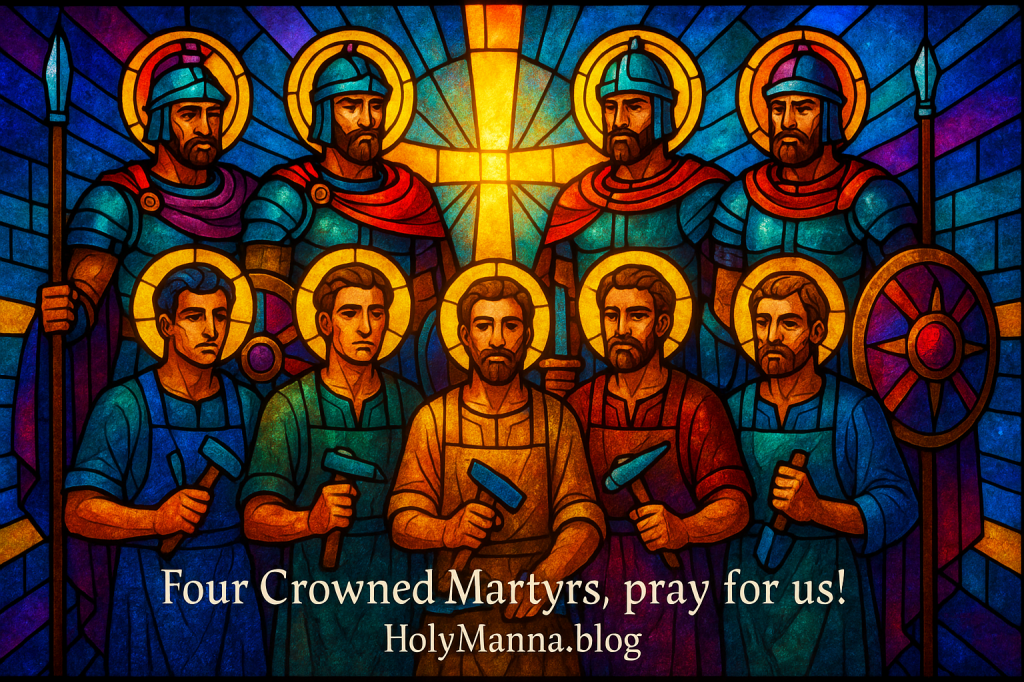
Crowned In Stone And Spirit
The Four Crowned Martyrs, known in Latin as Sancti Quattuor Coronati, are a singular company of early Christian witnesses whose story joins two groups of confessors into one luminous memory of fidelity. Venerated since antiquity and honored on November 8, they are celebrated as patrons of sculptors, stonemasons, and stonecutters. Their lives proclaim that labor is not merely a way to make a living but a path to holiness when offered to God. Their courage under pressure reveals how the first commandment shapes every other choice, since “Idolatry not only refers to false pagan worship. It remains a constant temptation to faith.” (Catechism of the Catholic Church, 2113). They stand as a reminder that excellence in craft and purity of conscience can harmonize into a powerful act of worship.
Ordinary Lives, Extraordinary Resolve
The Church’s memory preserves two linked stories. One group names four Roman soldiers, traditionally Severus, Severianus, Carpophorus, and Victorinus, officials who handled records and administration. The other group names five master carvers from Sirmium in Pannonia, remembered as Claudius, Nicostratus, Symphorian, Castorius, and Simplicius. The early sources are sparse about their families and hometown details, but the portrait is clear enough to inspire. These were ordinary professionals living under the long shadow of Diocletian’s reign. Their defining moment arrived when their roles were conscripted for idolatry. The soldiers were commanded to offer sacrifice before an image of the healing god Aesculapius. The craftsmen were ordered to carve a pagan statue for imperial honor. Both groups refused. Their no to false worship flowed from a deeper yes to the true God. In them the Church recognizes the quiet heroism taught by the first commandment and the dignity of work celebrated in the Catechism: “Human work proceeds directly from persons created in the image of God… Work honors the Creator’s gifts and the talents received from him.” (Catechism of the Catholic Church, 2427).
The Workshop As A Chapel
The saints did not seek celebrity or controversy. They served faithfully in the stations where Providence placed them, sanctifying the routine of ledgers and chisels. The Christian imagination learned from their story that a ledger can become an altar when the truth is kept, and a chisel can become a psalm when the heart refuses to shape an idol. No early sources record spectacular public miracles during their lifetimes. Instead, their daily integrity was their sign. They practiced the supernatural courage the Catechism calls fortitude, “the moral virtue that ensures firmness in difficulties and constancy in the pursuit of the good.” (1808). Their example urges a different kind of wonder: a conscience that cannot be bought, a craft that cannot be bent toward false gods, and a loyalty to Christ that quietly transforms the ordinary into something radiant.
Leaded Whips And Unbroken Hearts
The path of discipleship eventually led them to suffering. Ancient passion narratives recount that the four soldiers were scourged to death with whips weighted with lead after refusing to offer sacrifice to Aesculapius. The five craftsmen, renowned for their skill, declined to fashion a pagan statue for imperial honor and met execution for their fidelity. Some traditions place the soldiers’ death near Albano outside Rome and the artisans’ martyrdom near the Sava River in Pannonia, with their bodies later honored by the faithful in Rome. Details vary among the oldest accounts, but the Church’s judgment about their witness is consistent and clear: “Martyrdom is the supreme witness given to the truth of the faith.” (Catechism of the Catholic Church, 2473). Their deaths also illustrate the duty laid upon every Christian conscience: “The citizen is obliged in conscience not to follow the directives of civil authorities when they are contrary to the demands of the moral order.” (Catechism of the Catholic Church, 2242).
Afterglow Of A Living Cult
After their martyrdom, devotion to the Four Crowned Martyrs blossomed in Rome. The faithful visited their tomb and prayed for courage to resist the idols of every age. A great church arose on the Caelian Hill bearing their name, and across centuries builders, stonecutters, and sculptors entrusted their safety and skill to these patrons. Guilds adopted them as heavenly protectors, and Christian artists carved their likenesses to teach future generations what courage looks like when it stands upright in a public square. Medieval and Renaissance Christians testified to favors received through their intercession, especially protection from danger at work and the steadying grace to speak the truth without bitterness. While the historical record preserves fewer specific miracle stories than some other saints, the enduring breadth of their cult and the constancy of devotion among artisans speak to the quiet stream of graces the Lord poured out through them.
How Their Witness Meets Today
The Four Crowned Martyrs offer a bracing word for a culture that prizes applause over integrity. Their story teaches that holiness begins where duty meets love. A paycheck is good, but a pure heart is better. A finished project is satisfying, but a soul at peace with God is priceless. Their example invites a practical rule of life. Begin the day with prayer. Offer the work of mind and hands to the Lord. Refuse tasks that warp truth or worship success as an idol. Speak clearly and charitably when a boundary must be set. Ask for fortitude when fear knocks. Encourage colleagues by choosing excellence and humility at the same time. Their patronage is especially fitting for anyone who shapes the material world, from architects and engineers to artisans and tradespeople. In their company, the workshop becomes a chapel and the timeclock becomes a summons to praise.
Engage with Us!
Share your thoughts and reflections in the comments below. Your story may encourage someone who is discerning how to live the faith at work today.
- Where is the pressure strongest to “go along” with something that does not honor God, and how can fortitude help you stand firm this week?
- How can daily work become an offering to God rather than a race for approval or applause?
- What practical step could sanctify your craft today, such as a prayer before starting, an act of charity for a colleague, or a renewed commitment to excellence?
- Which of the Catechism’s teachings quoted above speaks most to your present season, and why?
Keep moving forward in faith, anchored in the grace of Jesus Christ. Offer every moment to God, do the next good thing with love, and let mercy mark your words and your work.
Four Crowned Martyrs, pray for us!
Follow us on Instagram and Facebook for more insights and reflections on living a faith-filled life.

 Holy Manna!
Leave a comment