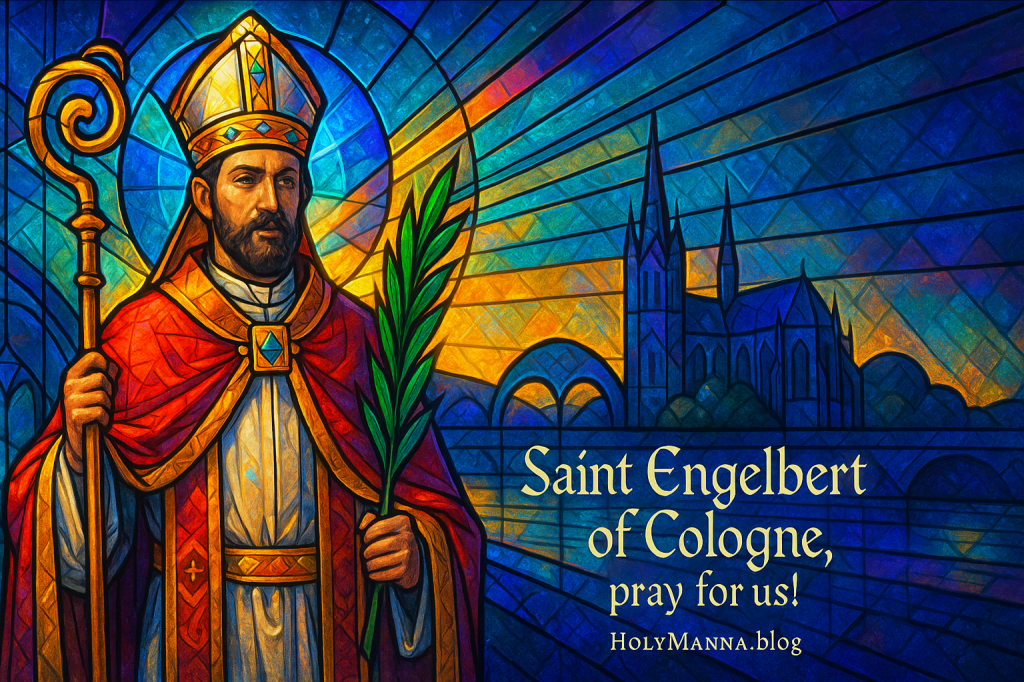
Shepherd of Justice
Saint Engelbert of Cologne (c. 1185 to 1225) rose to leadership at a time when the Church and the Holy Roman Empire were tangled in fierce rivalries. As Archbishop of Cologne and one of the seven imperial electors, he carried both spiritual authority and serious political weight. His legacy rests on the way he used that authority for the good of souls, the protection of consecrated religious, and the pursuit of peace in a violent age. He welcomed renewal, strengthened religious life, and defended the freedom of the Church with a courage that cost him his life. The Church venerates him as a martyr whose feast is kept on November 7. “Martyrdom is the supreme witness given to the truth of the faith.” The Catechism of the Catholic Church expresses the meaning of his death with clarity, because Engelbert sealed this witness with his blood.
Born to Rule, Called to Repent
Engelbert was born into the noble House of Berg at the family stronghold of Burg an der Wupper in the Rhineland. His parents, Count Engelbert of Berg and Margaret of Gelderland, placed him into the Church’s care at a young age, and he was educated at the cathedral school in Cologne. Like many noble sons of the period, he advanced quickly, holding important prebends before he had fully reached maturity. That early privilege did not prevent real conversion. In his youth he aligned with the wrong side of a bitter regional power struggle and incurred excommunication, which shook him to the core. He sought reconciliation with the Church, publicly amended his life, and accepted penance. Tradition records that he took the cross in 1212 as part of that penance. The experience humbled him and forged a shepherd’s heart. When he was unanimously elected Archbishop of Cologne in 1216, he brought with him not only noble skill but a chastened zeal for the Gospel and a determination to govern as a pastor who had learned through failure.
A Bishop With a Backbone
Engelbert’s episcopate shows how sanctity often looks like steady work rather than spectacle. He invited the mendicant revival into Cologne, welcoming the Franciscans in 1219 and the Dominicans in 1221, because he recognized their power to renew preaching, penance, and care for the poor. He promoted discipline and restored order in monasteries and collegiate churches, insisting that property and privileges serve the mission of the Church. His charity reached the poor through almsgiving and legal protections, and his justice reached the powerful through firm oversight. His influence extended to the empire itself when he became guardian and tutor of the young King Henry VII. He crowned Henry at Aachen on May 8, 1222, and governed in his name with an eye to peace and lawful order. Chroniclers praise his fairness in arbitration, his courage in curbing abuses, and his readiness to defend women religious whose rights and lands were threatened. When others treated church property as a family purse, Engelbert acted as a true steward who understood that the things of the Church belonged to God.
Signs of Grace While He Lived
No famous collection of spectacular miracles is tied to Engelbert’s public ministry in the way of wonder-working friars or hermit saints. His graces often took the shape of righteous decisions, reconciled enemies, and protected communities. He stood up for the abbey of Essen and its nuns when local nobles sought to strip them of their goods. He strengthened religious life by backing communities that fed the hungry and taught the faith. He promoted preachers whose words moved hearts to repentance. In an age that craved marvels, his lasting sign was holiness lived in office. The fruit of his labor looked like repaired altars, safer roads for pilgrims, reformed houses of prayer, and a people newly confident that their shepherd would stand between them and injustice. “By their fruits you will know them.” Those fruits become the clearest testimony to the grace at work in him.
Greater Love Than This
Engelbert’s courage put him on a collision course with men who treated consecrated goods as spoils. His investigation into abuses tied to the abbey of Essen hardened the opposition of powerful relatives, including his cousin, Count Frederick of Isenberg. On the evening of November 7, 1225, while returning from official business near Soest, Engelbert’s small escort was ambushed at Gevelsberg. He was cut down and left with many wounds. The young King Henry reportedly wept for the loss of his guardian, and the faithful of Cologne mourned a father. The Church recognized that he died in odium iustitiae, out of hatred for justice, and honored him as a martyr who shed blood for the freedom of the Church and the protection of consecrated women. “He endures death through an act of fortitude.” The Catechism of the Catholic Church describes the spirit that animated Engelbert’s final stand, because he met violence with fidelity and entrusted himself to Christ.
A Saint’s Intercession
Engelbert’s body was carried with reverence to Cologne. His burial in the cathedral on February 24, 1226, opened a new chapter marked by favors and healings reported at his tomb. His life, passion, and miracles were soon recorded by the Cistercian writer Caesarius of Heisterbach, which indicates how swiftly devotion grew. Engelbert’s relics were enshrined with honor in Cologne Cathedral, where a splendid shrine kept his memory alive for pilgrims. His heart was preserved at Altenberg, a sign of the love that bound him to his people and to the consecrated religious he defended. Over time his name entered the Church’s martyrologies, and the faithful learned to ask his intercession for upright governance, for courageous bishops, and for the protection of those who have vowed their lives to God. “Being more closely united to Christ, those who dwell in heaven do not cease to intercede with the Father for us. So by their fraternal concern is our weakness greatly helped.” The Catechism of the Catholic Church describes why devotion to a martyr like Engelbert is a wise and hopeful practice. “Besides sacramental liturgy and sacramentals, catechesis must take into account the forms of piety of the faithful, especially veneration of relics, visits to sanctuaries, and pilgrimages.” The Catechism of the Catholic Church situates these devotions within a healthy Christian life that leads to the sacraments and to deeper conversion.
Walking With a Martyr-Bishop
Saint Engelbert teaches that holiness can wear the garments of public responsibility. He reminds every disciple that love sometimes demands the hard work of reform, the risk of speaking uncomfortable truth, and the patience to defend the vulnerable when it is costly. His stewardship of power was not a personal project. It was a form of charity toward the people God entrusted to him. Ask his intercession for bishops and pastors to be brave, for religious communities to flourish, and for civil order that protects the weak. Make room for the communion of saints in daily prayer, and let their friendship draw the heart closer to Jesus. “The saints do not cease to intercede for us.” That is not poetry. It is a promise rooted in the Body of Christ, and it bears real fruit in lives that ask and receive.
Engage with Us!
Share your thoughts and what struck you about Saint Engelbert’s courage and charity in the comments below.
- Where is God inviting a bolder defense of the vulnerable in your daily responsibilities?
- How can prayer for our bishops deepen unity in your parish and diocese this week?
- What concrete step will you take to weave devotion to the saints into your family’s prayer life?
- If you face pushback for doing what is right, how does Engelbert’s martyrdom strengthen your resolve?
Keep going with courage and mercy. Live the faith fully, love the Church deeply, and do everything with the love and mercy Jesus taught us.
Saint Engelbert of Cologne, pray for us!
Follow us on Instagram and Facebook for more insights and reflections on living a faith-filled life.

 Holy Manna!
Leave a comment