Friday of the Thirty-first Week in Ordinary Time – Lectionary: 489
Spirit-Led Mission and Stewardship
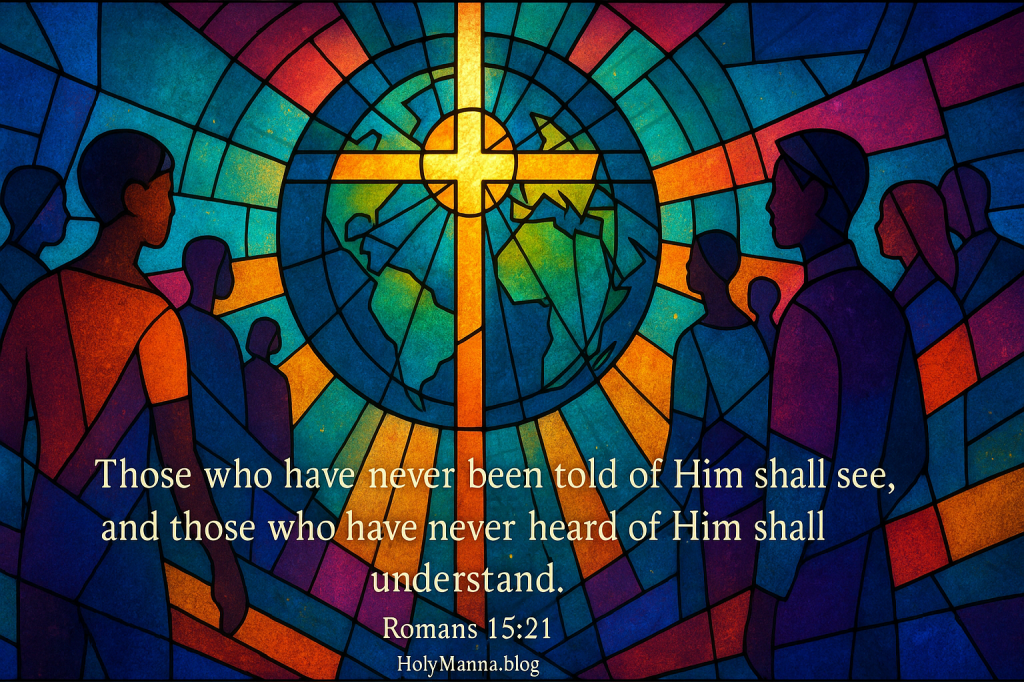
Hearts wake up when the Gospel calls not only for zeal but also for wisdom. In Romans 15:14–21, St. Paul speaks as a priestly missionary to the nations, letting the Holy Spirit make his life an offering so that those who never knew the Name might believe. He cites Isaiah’s vision, “Those who have never been told of him shall see, and those who have never heard of him shall understand.” That same horizon bursts into song in Psalm 98:1–4, where all peoples witness the Lord’s saving victory and are invited to praise, “Sing a new song to the Lord.” Then Luke 16:1–8 brings the focus down to the street level of daily choices, where a household steward navigates debt notes and social obligations in a first-century economy. In that world, stewards managed a lord’s goods, negotiated accounts, and lived by their resourcefulness, and Jesus highlights that kind of practical savvy as a wake-up call for disciples pursuing eternal ends. The master commends prudence, not dishonesty, and the lesson lands squarely on the virtue that orders means to the highest good, as taught in CCC 1806. Taken together, these readings sketch a single path: the Church lives a bold, outward-facing mission to those who have not heard, as taught in CCC 851, and that mission thrives when disciples steward time, relationships, and resources for God’s glory, as taught in CCC 2404–2405. The geography stretches from Jerusalem to Illyricum in Romans 15, a arc reaching toward the Adriatic, and the praise of Psalm 98 echoes across every shore, yet the conversion Jesus seeks happens right where decisions are made and accounts are settled. Where is the Lord inviting brave zeal and prudent creativity in the way the Gospel is shared this week?
First Reading – Romans 15:14–21
Apostolic Fire, Priestly Service, and the Reach of the Spirit
The letter to the Romans arrives from the mid first century, likely near the end of Paul’s third missionary journey, when the Apostle looked toward Rome and beyond, eager to carry the Gospel into fresh territory and to strengthen communion between Jewish and Gentile believers. In the Roman world, cities were hubs of culture, commerce, and competing loyalties, and Paul writes as a seasoned missionary who has seen the Holy Spirit bring diverse peoples into one worshiping body. The language of “priestly service” frames his mission as liturgy, where the nations themselves become an offering sanctified by the Spirit. This reading fits today’s theme by showing how Spirit-led stewardship and shrewd planning serve a single end, which is the worship of God among those who have not yet heard the Name of Jesus. The scope reaches from Jerusalem to Illyricum, yet the heart of it is an obedient faith that bears fruit in word and deed.
Romans 15:14-21
New American Bible (Revised Edition)
Apostle to the Gentiles. 14 I myself am convinced about you, my brothers, that you yourselves are full of goodness, filled with all knowledge, and able to admonish one another. 15 But I have written to you rather boldly in some respects to remind you, because of the grace given me by God 16 to be a minister of Christ Jesus to the Gentiles in performing the priestly service of the gospel of God, so that the offering up of the Gentiles may be acceptable, sanctified by the holy Spirit. 17 In Christ Jesus, then, I have reason to boast in what pertains to God. 18 For I will not dare to speak of anything except what Christ has accomplished through me to lead the Gentiles to obedience by word and deed, 19 by the power of signs and wonders, by the power of the Spirit [of God], so that from Jerusalem all the way around to Illyricum I have finished preaching the gospel of Christ. 20 Thus I aspire to proclaim the gospel not where Christ has already been named, so that I do not build on another’s foundation, 21 but as it is written:
“Those who have never been told of him shall see,
and those who have never heard of him shall understand.”
Detailed Exegesis
Verse 14 – “I myself am convinced about you, my brothers, that you yourselves are full of goodness, filled with all knowledge, and able to admonish one another.”
Paul begins with affirmation, not flattery. He recognizes a community formed by moral goodness and doctrinal understanding, mature enough for mutual correction. Admonishing one another is an act of charity ordered to salvation, a family duty within the Body of Christ. This anticipates the reading’s missionary thrust, since a community that corrects in love becomes credible in witness and resilient under pressure.
Verse 15 – “But I have written to you rather boldly in some respects to remind you, because of the grace given me by God”
His boldness rests on grace, not personality. Apostolic authority is a gift received, which keeps the messenger humble and the message pure. The reminder function shows that evangelization renews what is known while opening new horizons. The community needs both encouragement and correction for mission to flourish.
Verse 16 – “to be a minister of Christ Jesus to the Gentiles in performing the priestly service of the gospel of God, so that the offering up of the Gentiles may be acceptable, sanctified by the holy Spirit.”
Here Paul describes mission as liturgy. He serves as a minister so that the Gentiles themselves, gathered by faith, become a living offering. The sanctifying agent is the Holy Spirit, who consecrates a people for God. This verse grounds the baptismal priesthood and shows that evangelization culminates in worship. The goal is not mere information but transformation into a holy people.
Verse 17 – “In Christ Jesus, then, I have reason to boast in what pertains to God.”
Any boasting is “in Christ Jesus,” which redirects honor to God. Missionary success is measured by fidelity and grace, not by self-promotion. The right kind of glorying safeguards the Church from pride and keeps attention on what God accomplishes through frail instruments.
Verse 18 – “For I will not dare to speak of anything except what Christ has accomplished through me to lead the Gentiles to obedience by word and deed,”
Paul refuses to center his own achievements. Christ acts through the Apostle, producing the “obedience of faith” that Romans emphasizes from the opening chapter. Word and deed go together, which means preaching is authenticated by a way of life. Evangelization is holistic witness that engages mind, heart, and action.
Verse 19 – “by the power of signs and wonders, by the power of the Spirit [of God], so that from Jerusalem all the way around to Illyricum I have finished preaching the gospel of Christ.”
The advance of the Gospel is a work of the Spirit, confirmed at times by signs and wonders, and stretched across a vast arc from Jerusalem to the Balkan region of Illyricum. Geography here is theology in motion. The promise to Israel is spilling outward to the nations, showing that mission is both supernatural and strategically itinerant.
Verse 20 – “Thus I aspire to proclaim the gospel not where Christ has already been named, so that I do not build on another’s foundation,”
Paul’s aim is pioneer evangelization. He seeks places with no Christian foundation, which prevents rivalry and models generous collaboration. The Church grows best when ministers honor each other’s labors and focus on the un-evangelized rather than competing for the already convinced.
Verse 21 – “but as it is written: ‘Those who have never been told of him shall see, and those who have never heard of him shall understand.’”
Isaiah’s prophecy frames Paul’s strategy. Mission fulfills Scripture and reveals God’s plan for the nations. The seeing and understanding promised by Isaiah are the fruit of Spirit-empowered proclamation that invites real conversion and worship.
Teachings
Paul’s “priestly service of the gospel” reflects the baptismal priesthood and the Church’s missionary identity. Catechism of the Catholic Church 1546 teaches: “Christ, high priest and unique mediator, has made of the Church ‘a kingdom, priests for his God and Father.’ The whole community of believers is, as such, priestly. The faithful exercise their baptismal priesthood through their participation, each according to his own vocation, in Christ’s mission as priest, prophet, and king. Through the sacraments of Baptism and Confirmation the faithful are ‘consecrated to be a holy priesthood.’” This clarifies why Paul uses liturgical language for his Gentile mission. Evangelization is ordered to worship because the Gospel gathers a people into priestly service.
The same priestly mission belongs to the entire Church. CCC 863 states: “The whole Church is apostolic in that she remains, through the successors of Saint Peter and the other apostles, in communion of faith and life with her origin and in that she is sent out into the whole world. All members of the Church share in this mission, though in various ways.” Paul’s personal call shows the pattern for every disciple according to vocation and state of life.
Paul attributes the spread of the Gospel to the Spirit’s power, sometimes manifested in signs and wonders. CCC 799 explains charisms in this key: “Whether extraordinary or simple and humble, charisms are graces of the Holy Spirit which directly or indirectly benefit the Church, ordered to her building up, to the good of men, and to the needs of the world.” This safeguards discernment. Charisms serve mission and communion, never personal prestige.
Evangelization demands prudence without compromise. While this reading highlights mission rather than moral casuistry, today’s Gospel underscores strategic savvy. CCC 1806 defines prudence in a way that illuminates missionary judgment: “Prudence is the virtue that disposes practical reason to discern our true good in every circumstance and to choose the right means of achieving it; it is not to be confused with timidity or fear, nor with duplicity or dissimulation. It is called the charioteer of the virtues; it guides the other virtues by setting rule and measure.” Paul’s choice to preach where Christ is not yet named is a prudent allocation of limited time and strength for maximal evangelical fruit.
Saint John Paul II, reading the same apostolic horizon, urged renewed zeal in Redemptoris Missio: “The mission of Christ the Redeemer, which is entrusted to the Church, is still very far from completion. An overall view of the human race shows that this mission is still only beginning and that we must commit ourselves wholeheartedly to its service.” This echoes Paul’s holy ambition and situates today’s reading within the ongoing life of the Church.
Reflection
Paul’s example invites a missionary mindset that worships first and plans second. The Gentiles becoming an offering suggests that every relationship, workplace, and neighborhood can be placed on the altar through prayer, presence, and honest witness. Strategic choices matter. It helps to identify one or two circles of influence where Christ is not yet named clearly and to devote steady attention there through intercession, friendship, and patient explanation of the hope of the Gospel. Gratitude keeps the heart right. Boasting in what pertains to God disarms pride and keeps the focus on Christ’s work. Dependence on the Holy Spirit is nonnegotiable. Daily prayer for charisms that truly build up others and for prudence that knows when to speak and when to wait will shape fruitful mission. Which names and places is the Lord placing on the heart for intentional prayer and outreach this week? Where can creative prudence open a door for a conversation or an invitation to prayer or Mass? What would it look like to offer daily work, family life, and friendships as a spiritual sacrifice, sanctified by the Holy Spirit, for those who have not yet heard the Name of Jesus?
Responsorial Psalm – Psalm 98:1–4
The New Song That Echoes to the Nations
Israel sang Psalm 98 as a victory hymn of the Lord’s kingship, likely in a post exilic setting when God’s faithfulness had been freshly remembered and publicly celebrated. In ancient Israel, public worship gathered the whole people to proclaim that God’s mighty deeds were not private experiences but world changing acts that revealed his reign. The psalm’s call to a “new song” signal not a novelty for its own sake but a renewed act of praise that flows from God’s saving work. This dovetails with today’s theme of Spirit led, mission minded stewardship. As Romans 15:14–21 shows the Gospel moving from Jerusalem toward the nations and Luke 16:1–8 urges prudent and creative fidelity, Psalm 98 supplies the soundtrack. God’s victory is revealed “in the sight of the nations,” and the whole earth is summoned to praise. The Church’s mission draws strength from worship, and worship overflows into witness.
Psalm 98:1-4
New American Bible (Revised Edition)
The Coming of God
1 A psalm.
Sing a new song to the Lord,
for he has done marvelous deeds.
His right hand and holy arm
have won the victory.
2 The Lord has made his victory known;
has revealed his triumph in the sight of the nations,
3 He has remembered his mercy and faithfulness
toward the house of Israel.
All the ends of the earth have seen
the victory of our God.
4 Shout with joy to the Lord, all the earth;
break into song; sing praise.
Detailed Exegesis
Verse 1 – “Sing a new song to the Lord, for he has done marvelous deeds. His right hand and holy arm have won the victory.”
The “new song” is covenant language for fresh praise after a fresh saving act. The “right hand” and “holy arm” personify God’s effective power in history. Praise is not vague optimism. It is the fitting response to concrete deliverance that renews a people’s identity. The verse trains the heart to see salvation as God’s work and to answer with grateful worship that fuels evangelization.
Verse 2 – “The Lord has made his victory known; has revealed his triumph in the sight of the nations,”
Revelation is public. God’s saving justice is not hidden within one tribe. The nations are meant to perceive it. This anticipates the Church’s universal mission, where the Good News is announced with clarity and beauty so that all may understand. Mission is the natural outward movement of praise that cannot remain silent.
Verse 3 – “He has remembered his mercy and faithfulness toward the house of Israel. All the ends of the earth have seen the victory of our God.”
“Remembered” does not imply God forgets. It declares the covenant mercy that acts again in history. Israel’s experience of fidelity becomes the sign that invites the whole world. When God keeps promises in Israel, the nations receive hope. The second line echoes Isaiah’s vision, where salvation is visible to the ends of the earth. Evangelization flows from God’s remembered mercy into a global horizon.
Verse 4 – “Shout with joy to the Lord, all the earth; break into song; sing praise.”
The summons includes everyone. Joy is commanded because God is objectively worthy and has objectively acted. The verbs pile up to portray an overflowing liturgy. This is not entertainment. It is the rightful response of creation to its Redeemer. Such praise gives courage and creativity to disciples who must be prudent and bold in sharing the Gospel.
Teachings
CCC 2639 defines the very heart of this psalm’s prayer of praise: “Praise is the form of prayer which recognizes most immediately that God is God. It lauds God for his own sake, gives him glory for his own sake, quite beyond what he does, but simply because HE IS.” Psalm praise begins in who God is and then names what God has done.
CCC 2587 situates the Psalter within the Church’s prayer: “The Psalter is the book in which the Word of God becomes man’s prayer.” This means the Church does not merely quote ancient poetry. The Holy Spirit teaches the Church to pray God’s own words back to him.
CCC 1156 highlights the fitting place of song in worship that this psalm commands: “The musical tradition of the universal Church is a treasure of inestimable value, greater even than that of any other art.” Sacred song is not decoration. It is an ordered means by which hearts are lifted to God and the Gospel is made resound.
CCC 849 keeps the global scope in view that Psalm 98 announces: “The missionary mandate. ‘Having been divinely sent to the nations that she might be the universal sacrament of salvation,’ the Church, in obedience to the command of her founder and because it is demanded by her own essential universality, strives to preach the Gospel to all men.” What the psalm proclaims, the Church lives.
Saint Augustine captures the interior renewal behind the “new song.” In his preaching on the psalms he taught, “To sing a new song is to live a new life.” The song God wants is the converted heart that becomes a living hymn through holiness and charity.
Reflection
This psalm invites a practical rhythm that begins with praise and ends in mission. Begin each day by naming aloud two or three “marvelous deeds” God has done recently and thank him for each one in simple, heartfelt words. Allow gratitude to reshape speech, work, and relationships so that conversations carry a tone of hope and a readiness to bless. Consider how music can become a form of stewardship. Sacred playlists during commutes, a sung psalm at home prayer, or learning a simple chant can train the heart to rejoice in God’s presence. Let worship lead to witness. Share one concrete testimony this week about God’s faithfulness, not to impress but to invite. Ask the Holy Spirit for prudence to know when to speak and when to listen so that praise becomes fruitful for someone who has not yet heard the Name. What “new song” is God asking for today in thought, word, and habit? Where has God’s remembered mercy been most visible, and who needs to hear that story? How can joyful praise this week strengthen courage to evangelize with clarity, charity, and creative prudence?
Holy Gospel – Luke 16:1–8
Prudent With What Passes, Faithful For What Lasts
In Luke 16:1–8, Jesus addresses disciples within the daily economy of first century households, where a steward managed a wealthy master’s accounts, negotiated debts, and brokered relationships that could make or break a household’s future. Debts were often recorded on promissory notes, and stewards received commissions that encouraged shrewd bargaining. Jesus does not praise dishonesty. He highlights prudence, the practical wisdom that chooses fitting means for a true good in real circumstances. This fits today’s theme because the same Spirit who drives mission also trains disciples to steward time, money, and influence toward eternal ends. The parable calls for clear sight, quick repentance where needed, and creative generosity that turns worldly leverage into lasting mercy.
Luke 16:1-8
New American Bible (Revised Edition)
The Parable of the Dishonest Steward. 1 Then he also said to his disciples, “A rich man had a steward who was reported to him for squandering his property. 2 He summoned him and said, ‘What is this I hear about you? Prepare a full account of your stewardship, because you can no longer be my steward.’ 3 The steward said to himself, ‘What shall I do, now that my master is taking the position of steward away from me? I am not strong enough to dig and I am ashamed to beg. 4 I know what I shall do so that, when I am removed from the stewardship, they may welcome me into their homes.’ 5 He called in his master’s debtors one by one. To the first he said, ‘How much do you owe my master?’ 6 He replied, ‘One hundred measures of olive oil.’ He said to him, ‘Here is your promissory note. Sit down and quickly write one for fifty.’ 7 Then to another he said, ‘And you, how much do you owe?’ He replied, ‘One hundred kors of wheat.’ He said to him, ‘Here is your promissory note; write one for eighty.’ 8 And the master commended that dishonest steward for acting prudently.
Application of the Parable. “For the children of this world are more prudent in dealing with their own generation than are the children of light.
Detailed Exegesis
Verse 1 – “Then he also said to his disciples, ‘A rich man had a steward who was reported to him for squandering his property.’”
Jesus speaks to disciples, not outsiders, which places accountability at the heart of Christian life. The charge of squandering signals waste, the opposite of stewardship. Every gift, from money to influence, is entrusted for a purpose that serves God and neighbor.
Verse 2 – “He summoned him and said, ‘What is this I hear about you? Prepare a full account of your stewardship, because you can no longer be my steward.’”
A reckoning arrives. The scene mirrors final judgment in miniature, where accounts are rendered. The steward’s role is ending, which forces urgency. Grace often arrives as a summons to clarity about how goods have been handled.
Verse 3 – “The steward said to himself, ‘What shall I do, now that my master is taking the position of steward away from me? I am not strong enough to dig and I am ashamed to beg.’”
The inner monologue reveals self knowledge. He admits limits and refuses despair. Honest assessment of weakness can become the doorway to conversion and wise action.
Verse 4 – “I know what I shall do so that, when I am removed from the stewardship, they may welcome me into their homes.’”
A plan emerges with future oriented logic. The steward aims at welcome, a social capital that will outlast his job. Jesus will later redirect this logic toward eternal welcome, where mercy shown on earth opens doors in heaven.
Verse 5 – “He called in his master’s debtors one by one.”
One by one indicates deliberation and personal engagement. Evangelical prudence is not sloppy. It pays attention to real people and concrete circumstances.
Verse 6 – “He replied, ‘One hundred measures of olive oil.’ He said to him, ‘Here is your promissory note. Sit down and quickly write one for fifty.’”
The reduction is dramatic, likely removing the steward’s own commission or unlawful interest. The point is not fraud but decisive action that turns resources into relationships. Mercy takes form in specific, measurable choices.
Verse 7 – “Then to another he said, ‘And you, how much do you owe?’ He replied, ‘One hundred kors of wheat.’ He said to him, ‘Here is your promissory note; write one for eighty.’”
Again the steward acts swiftly. The differing reductions suggest negotiation and realism. Wisdom does not treat every case the same, yet aims at the same good, which is reconciliation that bears fruit.
Verse 8 – “And the master commended that dishonest steward for acting prudently. For the children of this world are more prudent in dealing with their own generation than are the children of light.”
The master praises prudence, not dishonesty. Jesus contrasts worldly sharpness with spiritual sluggishness. Disciples must be at least as intentional, strategic, and timely in the service of the Kingdom as worldly agents are in serving lesser ends.
Teachings
CCC 1806 defines the very virtue Jesus commends: “Prudence is the virtue that disposes practical reason to discern our true good in every circumstance and to choose the right means of achieving it; the prudent man looks where he is going. Prudence is not to be confused with timidity or fear, nor with duplicity or dissimulation. It is called the charioteer of the virtues; it guides the other virtues by setting rule and measure.” Prudence turns conviction into concrete action that fits the moment and aims at God.
Stewardship carries a social responsibility. CCC 2404 teaches: “In his use of things man should regard the external goods he legitimately owns not merely as exclusive to himself, but common to others also, in the sense that they can benefit others as well.” The steward’s recalculations hint at this truth. Possessions are entrusted for the good of many.
Mercy toward the poor is not optional philanthropy but justice shaped by charity. CCC 2446 cites Saint John Chrysostom: “Not to enable the poor to share in our goods is to steal from them and deprive them of life. The goods we possess are not ours, but theirs.” Jesus’ parable nudges disciples to convert assets into mercy that becomes treasure before God.
The Lord aims this prudence at eternal welcome. Later in the chapter, Jesus will say that earthly wealth can be used to make friends who will receive you into eternal dwellings, which is the Gospel horizon of this passage. The teaching is simple and searching. Use what passes to serve what lasts.
Reflection
This Gospel invites a weekly examen of stewardship that is concrete and hopeful. Begin by naming where time, money, and attention have been squandered, then ask for prudence to redirect them toward God and neighbor. Identify one financial habit to adjust this week, such as setting aside a small, steady gift for someone in need or simplifying a purchase in order to fund an act of mercy. Consider relationships like promissory notes of trust and gratitude. Make one reconciliatory phone call, forgive one old debt of resentment, or write one note of encouragement that restores a strained tie. Pray for the courage to act quickly when grace prompts, because delay often becomes disobedience in slow motion. Where is the Lord asking for decisive generosity today, not tomorrow? What resources can be converted into mercy that blesses a real person by name? How might prudent planning this month open doors for someone to experience the welcome of God’s house?
New Song, New Nerve, New Mission
Today’s Word paints one horizon and one path. In Romans 15:14–21, the Apostle reveals a priestly mission that offers the nations to God, trusting the Holy Spirit to make the sacrifice holy and acceptable. In Psalm 98:1–4, the whole earth is summoned to praise, because God’s victory is public and universal, “Sing a new song to the Lord.” In Luke 16:1–8, Jesus insists on holy sharpness, where disciples handle passing goods with prudence for eternal gain, so that mercy becomes the kind of treasure that welcomes into the Father’s house. Put together, the picture is simple and strong. Bold evangelization, joyful worship, and creative stewardship belong together. The Church moves outward with the courage of CCC 851, sings upward with the gratitude of the psalms, and plans forward with the prudence described in CCC 1806. Isaiah’s promise, echoed by Paul, still drives the day: “Those who have never been told of him shall see, and those who have never heard of him shall understand.”
Here is the invitation. Let praise become the engine. Name God’s marvelous deeds and give thanks. Let prudence become the steering wheel. Make one concrete decision that turns time, money, or attention into mercy for a real person. Let mission become the destination. Look for a conversation, a prayer, or an invitation that opens a door for someone who has not heard the Name of Jesus clearly. The Kingdom advances when hearts sing, hands give, and plans serve what lasts forever. Where can a new song rise today? What single prudent step will turn resources into mercy this week? Who is the Lord placing in front of you to love, invite, and bless in his Name?
Engage with Us!
Please share reflections in the comments below and encourage one another in faith.
- First Reading – Romans 15:14–21: Where is the Holy Spirit inviting courageous, humble mission in daily life right now? How can the “priestly service” of the Gospel shape work, family, and friendships this week? What would it look like to boast only in what Christ has accomplished, not in personal achievements?
- Responsorial Psalm – Psalm 98:1–4: What “new song” of gratitude needs to be sung today, and what concrete deed of God does it celebrate? How can worship become a visible witness so that others see God’s mercy and faithfulness? Where has God’s remembered mercy been most evident, and who needs to hear that story?
- Holy Gospel – Luke 16:1–8: Which resources need to be redirected with prudent, timely generosity for the sake of the Kingdom? What relationship calls for swift reconciliation or practical mercy this week? How can planning and budgeting become acts of love that serve eternal ends?
Stay encouraged, keep the faith, and let every word and work be done with the love and mercy Jesus taught.
Sacred Heart of Jesus, we trust in You!
Immaculate Heart of Mary, pray for us!
Saint Michael the Archangel, defend us in battle!
Follow us on Instagram and Facebook for more insights and reflections on living a faith-filled life.

 Holy Manna!
Leave a comment