Chains Broken, Hearts Freed
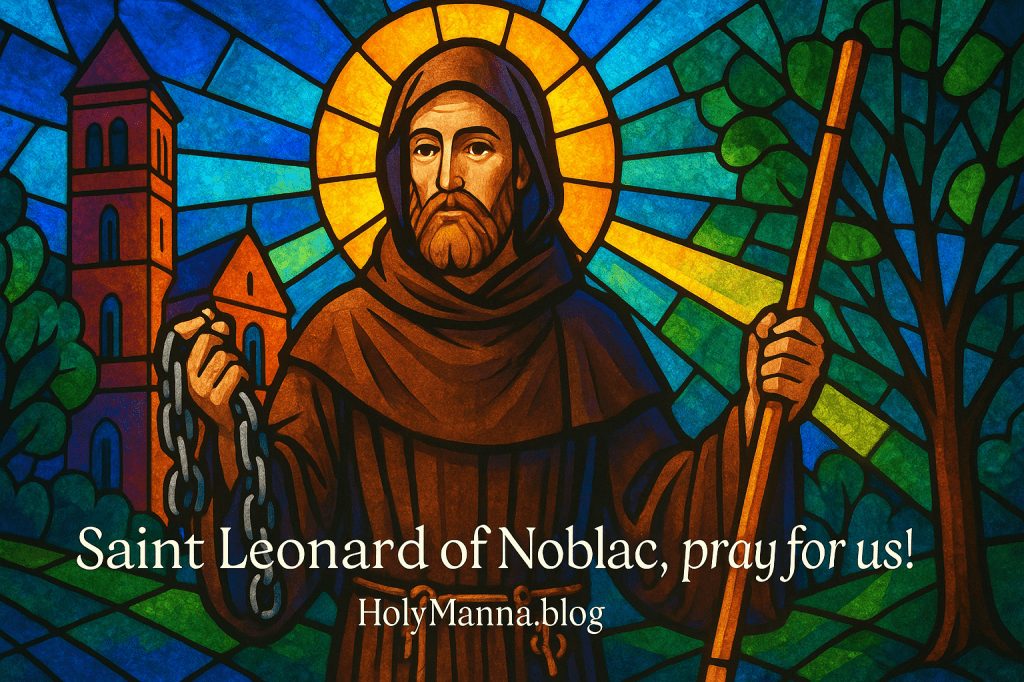
Saint Leonard of Noblac shines in Christian memory as a sixth century confessor whose prayer and mercy brought freedom to captives, hope to the poor, and protection for women in labor. His feast is kept on November 6, and his common attributes are chains and fetters because so many Christians experienced liberation through his intercession. The Church venerates saints not as distant legends but as living models who draw believers closer to Christ. As the Catechism of the Catholic Church teaches, “by canonizing some of the faithful… the Church… proposes the saints to [believers] as models and intercessors” (CCC 828). Saint Leonard’s life is a living commentary on that teaching because his holiness took flesh in concrete works of mercy and a bold trust that God breaks every chain.
From Courtly Halls to a Forest Hermitage
Tradition places Leonard among the Frankish nobility in the days after the baptism of King Clovis. He is linked to Saint Remigius of Reims and is often described as a court companion who tasted privilege but hungered for holiness. Drawn by the Gospel and the witness of monastic life, Leonard spent time at the monastery of Micy near Orléans, where a love for prayer, Scripture, and manual labor matured into a clear call to solitude with God. Refusing titles and honors that would have secured his comfort, he journeyed south into the Limousin, near present day Saint Léonard de Noblat, and embraced the simple rhythm of a hermit who welcomed strangers, fed the hungry, and prayed for those who suffered. He is remembered most of all as a patron of prisoners, a protector of mothers and infants during childbirth, and a defender of the poor who saw Christ in every wounded face. In a culture still learning the Gospel’s demands, his quiet fidelity preached more powerfully than any royal decree.
Mercy in Action
The Catechism describes the works of mercy with clarity: “The works of mercy are charitable actions by which we come to the aid of our neighbor in his spiritual and bodily necessities… visiting the sick and imprisoned” (CCC 2447). That is the pattern of Leonard’s life. Accounts from his earliest biography say that he asked for the grace to visit and advocate for prisoners, and that he obtained releases for many who had been harshly condemned. Tradition also preserves a beloved story about a royal mother who experienced a difficult labor that turned to joy after Leonard prayed for her safe delivery. Local memory in the Limousin tells of captives who invoked Leonard’s name, found their chains loosened, and brought their shackles to his church as a thanksgiving offering. These episodes communicate a consistent portrait of the saint. He was a man whose union with God poured out in mercy, whose intercession made the Gospel feel near, and whose hospitality transformed his hermitage into a refuge for the desperate. There are no reliably preserved personal sayings from Leonard, but his eloquence is the witness of a life that made people freer, safer, and holier.
Hidden Battles of a Confessor
Leonard did not die by the sword. His martyrdom was the daily surrender of a monk and hermit who chose poverty over prestige, prayer over power, and charity over comfort. He bore the ordinary trials of the ascetic life: fasting, sleepless nights in prayer, service to those in need, and spiritual warfare that tests every disciple who says yes to Christ. The Catechism helps believers recognize that the heart of such a life is intercession: “Intercession… has been characteristic of a heart attuned to God’s mercy” (CCC 2635). Leonard’s strength was not in worldly influence but in hidden fidelity, and that fidelity became a shelter for countless souls. In his story, God teaches that the cross carried in obscurity can shake empires more than a throne carried in triumph.
After Glory
After Leonard’s death in the sixth century, devotion to him spread widely across France and far beyond. Pilgrims journeyed to his tomb, and the town that grew around his shrine became a way station for travelers on the Camino routes toward Santiago de Compostela. The church dedicated to him displayed ex voto chains, a physical sign of thanksgiving from people who experienced freedom through his intercession. Across the centuries his patronage touched new corners of Christian life. Farmers and families entrusted their animals and livelihoods to his prayers, and parts of Bavaria developed vibrant Leonhardi horse processions that express gratitude to God and honor the saint’s protection. The Catechism explains why such devotion bears fruit: “The witnesses who have preceded us into the kingdom… constantly care for those whom they have left on earth. Their intercession is their most exalted service to God’s plan” (CCC 2683). Leonard’s name became a quiet watchword for those seeking deliverance, and his shrine a place where the weary learned to hope again.
Living Leonard’s Legacy Today
Saint Leonard invites every Christian to become a liberator in Christ. Some chains are iron, others are fear, addiction, shame, or isolation. The communion of saints means that grace moves through the whole Body of Christ. “A perennial link of charity exists between the faithful who have already reached their heavenly home, those who are expiating their sins, and those who are still pilgrims on earth” (CCC 1475). The Lord’s own mission defines the standard: “I was in prison and you visited me” and “He has sent me to proclaim liberty to captives”. In Leonard’s spirit, that looks like writing to someone behind bars, supporting ministries that serve the incarcerated and their families, praying by name for a friend who feels trapped, and practicing holy hospitality with people who carry invisible chains. Leonard shows that when a disciple prays and acts in mercy, Christ’s freedom arrives with power.
Engage with Us!
Start by sharing your thoughts and reflections in the comments below.
- Where do “chains” show up in your life or community, and how is Christ asking you to bring freedom there today?
- How can prayerful intercession become a concrete work of mercy for those in prison, detention, or trapped by addiction or fear?
- What step could you take this week to honor the communion of saints by asking Saint Leonard to intercede for someone who feels forgotten?
- Which corporal or spiritual work of mercy will you practice intentionally in the spirit of Saint Leonard?
May every reader choose courage, compassion, and faith. Live a life of prayer and service, love the poor and the imprisoned, and do everything with the love and mercy Jesus taught.
Saint Leonard of Noblac, pray for us!
Follow us on Instagram and Facebook for more insights and reflections on living a faith-filled life.

 Holy Manna!
Leave a comment