Thursday of the Thirty-first Week in Ordinary Time – Lectionary: 488
Found, Accountable, and Joyfully Sought
Today, contemplate this consoling truth: belonging to the Lord changes how fear is faced, how others are seen, and how repentance is celebrated. In Romans 14:7-12, the early Roman church wrestled with tensions between Jewish and Gentile believers over food and sacred days, yet Saint Paul lifts their eyes to a higher allegiance, teaching that “whether we live or die, we are the Lord’s” and that each person will give an account before God’s judgment seat. That sober certainty does not crush hope. It frees hearts from rivalry and contempt, because the Lord who judges is the same Lord who saves. Psalm 27 then supplies the interior posture of discipleship amid confusion and pressure, confessing with courage, “The Lord is my light and my salvation; whom should I fear?” and longing to dwell in His presence while waiting on His timing. Into that atmosphere of trust, Luke 15:1-10 reveals the beating heart of God in first century Galilee, where tax collectors and other public sinners gathered around Jesus and the Pharisees questioned His table fellowship. Jesus answers with two homey parables that everyone in that culture would recognize: a shepherd who refuses to cut losses and a homemaker who scours every corner for a missing coin. Both search until they find, and both throw a party, because “there will be more joy in heaven over one sinner who repents” and “there will be rejoicing among the angels of God”. Read together, the readings proclaim a single theme: God’s merciful lordship claims every moment of life and death, moves the community beyond judgment, and fills heaven and earth with joy when the lost are found. This is the Gospel the Church safeguards and preaches, that Christ is both merciful Savior and true Judge, as taught in The Catechism (CCC 545; CCC 678–679; CCC 1038–1041). What would change today if the heart truly trusted His light, treated every neighbor as someone who belongs to the Lord, and shared in heaven’s joy whenever a sinner turns back?
First Reading – Romans 14:7-12
Belonging to the Lord Ends Rivalry and Fuels Mercy
The church in Rome held a mix of Jewish and Gentile disciples wrestling with food laws, festival days, and the temptations of mutual suspicion. Into that tension, Romans 14:7-12 announces that identity and destiny are not self made, because “whether we live or die, we are the Lord’s”. This short passage reframes the whole dispute. Christ’s lordship reaches into every moment of life and the hour of death, which dissolves contempt and replaces it with reverent accountability before God. Read within today’s theme, this text anchors bold trust from Psalm 27 and the joyful searching of Luke 15, because the One who will judge is the same Shepherd who carries the lost and the same Light who casts out fear. The result is a community that resists rash judgment, awaits the Lord with courage, and rejoices whenever a sinner comes home.
Romans 14:7-12
New American Bible (Revised Edition)
7 None of us lives for oneself, and no one dies for oneself. 8 For if we live, we live for the Lord, and if we die, we die for the Lord; so then, whether we live or die, we are the Lord’s. 9 For this is why Christ died and came to life, that he might be Lord of both the dead and the living. 10 Why then do you judge your brother? Or you, why do you look down on your brother? For we shall all stand before the judgment seat of God; 11 for it is written:
“As I live, says the Lord, every knee shall bend before me,
and every tongue shall give praise to God.”
12 So [then] each of us shall give an account of himself [to God].
Detailed Exegesis
Verse 7 – “None of us lives for oneself, and no one dies for oneself.”
Paul denies the myth of isolation. Baptism grafts believers into Christ’s Body, which means life and death are never private projects. The Christian vocation is fundamentally relational, oriented to God and to the communion of the Church. This line also counters the pride that fuels quarrels. If life is not self possessed, then preferences cannot become weapons.
Verse 8 – “For if we live, we live for the Lord, and if we die, we die for the Lord; so then, whether we live or die, we are the Lord’s.”
Here is the center of gravity. Christ’s lordship embraces ordinary days and final breaths. Living for the Lord means worship, moral obedience, and charity in the concrete. Dying for the Lord means hope that outlasts fear. The verse harmonizes with Psalm 27 in which the heart learns to say, “The Lord is my light and my salvation; whom should I fear?” Confidence in belonging to Christ unseats anxiety and frees love.
Verse 9 – “For this is why Christ died and came to life, that he might be Lord of both the dead and the living.”
The Paschal Mystery is not a footnote. By death and resurrection, Jesus does not simply inspire. He truly becomes Lord over the entire human condition, including the realm of the dead. Paul roots unity in this cosmic lordship. When believers remember who rules, they stop policing one another’s status and start honoring one another as those for whom Christ died and rose.
Verse 10 – “Why then do you judge your brother? Or you, why do you look down on your brother? For we shall all stand before the judgment seat of God.”
Judgment belongs to God. Paul targets two corrosive habits, condemnation and contempt. Both divide the Church and both forget that every disciple will appear before God’s tribunal. The remedy is humility, patience, and charity that interprets a neighbor’s actions in the best light possible. Accountability is real, yet it is God’s to execute.
Verse 11 – “As I live, says the Lord, every knee shall bend before me, and every tongue shall give praise to God.”
Quoting Isaiah 45:23, Paul widens the horizon to the universal confession of God’s sovereignty. Worship is the truth of things made visible. Bending the knee and praising God is not theatrics. It is the proper posture of creatures redeemed by Christ. Remembering this future scene heals the urge to dominate the present.
Verse 12 – “So then each of us shall give an account of himself to God.”
Personal responsibility is not erased by belonging to the Lord. It is intensified. The final line invites a daily examen, honest confession, and steady conversion. Because the Judge is also the Shepherd who searches until He finds, accountability becomes the doorway to mercy and to joy that fills heaven when repentance happens.
Teachings
The Church teaches that Christ’s mission is directed precisely to sinners and that heaven rejoices when they turn back. The Catechism states, “Jesus invites sinners to the table of the kingdom: ‘I came not to call the righteous, but sinners.’ He invites them to that conversion without which one cannot enter the kingdom, but shows them in word and deed his Father’s boundless mercy for them and the vast ‘joy in heaven over one sinner who repents’.” (CCC 545). This explains why a community that belongs to the Lord refuses contempt and welcomes conversion.
At the same time, the Church affirms that Christ will judge every human being and manifest the truth of each life. The Catechism teaches, “Following in the steps of the prophets and John the Baptist, Jesus announced the judgment of the Last Day in his preaching. Then will the conduct of each one and the secrets of hearts be brought to light. Then will the culpable unbelief that counted the offer of God’s grace as nothing be condemned. Our attitude to our neighbor will disclose acceptance or refusal of grace and divine love.” (CCC 678). In the same article, it adds, “Christ is Lord of eternal life. Full right to pass definitive judgment on the works and hearts of men belongs to him as redeemer of the world. He ‘acquired’ this right by his cross. The Father has given ‘all judgment to the Son’. Yet the Son did not come to judge, but to save and to give the life he has in himself.” (CCC 679). Paul’s reminder about the judgment seat of God is therefore not a threat tossed into the debate. It is a promise that justice and mercy will prevail in Christ.
Regarding personal accountability and conversion, The Catechism proclaims, “The message of the Last Judgment calls men to conversion while God is still giving them ‘the acceptable time, the day of salvation.’ It inspires a holy fear of God and commits them to the justice of the Kingdom of God.” (CCC 1041). Because the Judge is merciful, this summons is hopeful rather than paralyzing.
Finally, charity governs how believers view one another before that day arrives. The Catechism instructs, “To avoid rash judgment, everyone should be careful to interpret insofar as possible his neighbor’s thoughts, words, and deeds in a favorable way.” (CCC 2478). This pastoral directive applies directly to the community tensions behind Romans 14 and safeguards unity while the Lord shepherds each heart toward maturity.
Reflection
This reading asks for a new way to stand before God and neighbor. Belonging to the Lord means beginning and ending the day with the confession that every choice, every conversation, and every sacrifice is offered to Jesus who died and rose. It means practicing a daily examen, telling the truth about sins without excuses, and seeking the Sacrament of Reconciliation with confidence in mercy. It means refusing contempt in conversation, choosing to interpret a brother or sister generously, and gently correcting only with love and humility. It means waiting on the Lord with the courage of Psalm 27, praying for those who have wandered, and sharing in heaven’s joy when they return. What changes today when the heart remembers that Christ is Lord in life and in death? Whose reputation needs to be protected by charity rather than pierced by suspicion? What concrete step of repentance would bring real joy to heaven and fresh peace to the soul this week?
Responsorial Psalm – Psalm 27:1, 4, 13-14
Fearless Trust That Waits To See God’s Goodness
Ancient Israel prayed Psalm 27 in a world of real threats and real worship. Enemies pressed in, yet the temple drew hearts with the promise of God’s nearness. The psalmist holds both together, naming fear honestly while anchoring courage in the Lord’s presence. This prayer fits today’s theme because it teaches a community that belongs to the Lord how to live between assurance and longing. In Romans 14, belonging to Christ ends rivalry and invites accountability before His judgment seat. In Luke 15, the Shepherd searches until the lost are found and heaven rejoices at repentance. Psalm 27 supplies the interior stance for that life together: the Lord is light when shadows gather, the one thing worth seeking is communion with Him, and the way forward is patient courage that waits to see His goodness in the land of the living.
Psalm 27:1, 4, 13-14
New American Bible (Revised Edition)
Trust in God
1 Of David.
The Lord is my light and my salvation;
whom should I fear?
The Lord is my life’s refuge;
of whom should I be afraid?
4 One thing I ask of the Lord;
this I seek:
To dwell in the Lord’s house
all the days of my life,
To gaze on the Lord’s beauty,
to visit his temple.
13 I believe I shall see the Lord’s goodness
in the land of the living.
14 Wait for the Lord, take courage;
be stouthearted, wait for the Lord!
Detailed Exegesis
Verse 1 – “The Lord is my light and my salvation; whom should I fear? The Lord is my life’s refuge; of whom should I be afraid?”
Israel knew darkness as danger, confusion, and the threat of enemies, but also as a symbol for sin and death. Naming the Lord as light and salvation is more than positive thinking. It is a confession that God Himself guides, protects, and delivers. The rhetorical questions train the heart to answer fear with faith. This accords with the Church’s insistence that hope leans on God’s promise rather than human strength, and it matches Paul’s claim that whether in life or death, believers belong to the Lord.
Verse 4 – “One thing I ask of the Lord; this I seek: To dwell in the Lord’s house all the days of my life, To gaze on the Lord’s beauty, to visit his temple.”
Desire narrows to one thing. The temple was the meeting place of God and His people, the site of sacrifice and praise. To dwell there signifies a life ordered around worship, contemplation, and holiness. The verbs ask, seek, dwell, gaze, and visit reveal a rhythm of prayer that moves from petition to loving attention. The psalmist wants not only protection from danger but the joy of beholding God’s beauty, which anticipates the Church’s hope for the vision of God.
Verse 13 – “I believe I shall see the Lord’s goodness in the land of the living.”
Faith expects God’s goodness to appear within history, not only in eternity. The line holds together resurrection hope and present perseverance. Assurance here does not deny suffering. It declares that God’s covenant love will break in with real help and real joy. The Church teaches that such confidence is the fruit of theological hope and the action of the Holy Spirit.
Verse 14 – “Wait for the Lord, take courage; be stouthearted, wait for the Lord!”
Waiting in Scripture is not passive. It is steadfast fidelity, prayer, and obedience while God acts in His timing. Courage here is not bravado. It is the strength that comes from trusting the Lord’s presence and promises. Repetition drives the point home because hearts need to hear it twice. For a Church called to stop judging, to welcome sinners, and to rejoice at repentance, this kind of waiting keeps love steady and hope bright.
Teachings
The psalm’s confidence is rooted in the virtue of hope. The Catechism teaches, “Hope is the theological virtue by which we desire the kingdom of heaven and eternal life as our happiness, placing our trust in Christ’s promises and relying not on our own strength, but on the help of the grace of the Holy Spirit.” (CCC 1817). This explains the psalmist’s fearless questions and steady waiting.
The longing to gaze on the Lord’s beauty points toward the Church’s teaching on heaven. The Catechism proclaims, “This perfect life with the Most Holy Trinity, this communion of life and love with the Trinity, with the Virgin Mary, the angels and all the blessed is called ‘heaven.’ Heaven is the ultimate end and fulfillment of the deepest human longings, the state of supreme, definitive happiness.” (CCC 1024). The desire to dwell in the Lord’s house is a seed of this destiny.
Contemplation is at the heart of verse 4’s gaze. The Catechism states, “Contemplation is a gaze of faith, fixed on Jesus.” (CCC 2715). The psalmist models this gaze by seeking the Lord’s beauty more than any earthly security.
Praise is the fitting response to God who is light and salvation. The Catechism explains, “Praise is the form of prayer which recognizes most immediately that God is God. It lauds God for his own sake and gives him glory, quite beyond what he does, but simply because HE IS.” (CCC 2639). The psalm’s language of adoration trains the soul to honor God before asking for His gifts.
The saints echo the psalm’s interior movement. Saint Augustine confesses, “You have made us for yourself, O Lord, and our heart is restless until it rests in you.” (Confessions I.1.1). That restlessness becomes focused desire in verse 4. Saint Teresa of Ávila gives courage for verse 14’s waiting: “Let nothing disturb you, let nothing frighten you. All things are passing away. God never changes. Patience obtains all things. Whoever has God lacks nothing. God alone suffices.”
Reflection
This psalm teaches a way to live when fears are loud and answers seem slow. Begin the day by proclaiming with the psalmist that the Lord is light and salvation, then name the specific fear that needs to bow to that truth. Choose one concrete practice that expresses the desire to dwell with God, such as a short visit to the church, a quiet moment before a crucifix, or a slow reading of Scripture that lingers on a single verse. Practice the gaze of faith by letting attention rest on Jesus without hurry. When discouragement rises, repeat the final verse aloud until courage returns. What would change this week if the heart truly sought one thing above all, the Lord’s presence and beauty? Where does waiting need to become an act of trust rather than a spiral of anxiety? Who needs the witness of a hopeful word that expects to see the Lord’s goodness in the land of the living?
Holy Gospel – Luke 15:1-10
The God Who Searches Until He Finds
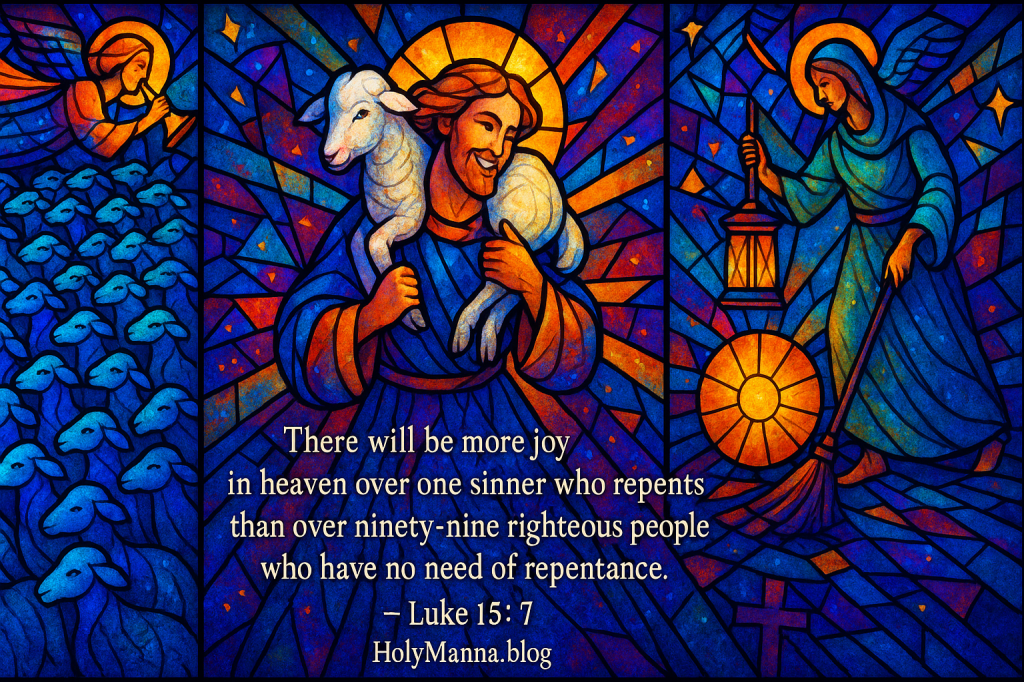
First century Galilee knew who mattered and who did not. Tax collectors were seen as collaborators with an occupying empire, and public sinners were treated as spiritual liabilities. Table fellowship signaled acceptance, so when Jesus welcomed such people to His meals, it challenged religious expectations and exposed the heart of God. Luke 15:1-10 opens with grumbling Pharisees and scribes, but it ends with a party in heaven. The shift happens because Jesus reveals a Father who refuses to cut losses, a Shepherd who shoulders the weak, and a Woman who scours every corner for what belongs to her. This fits today’s theme by showing that God’s merciful lordship claims every life, silences rash judgment, and fills the Church with joy whenever repentance breaks through. The community taught in Romans 14 to leave judgment to God and the heart trained by Psalm 27 to wait with courage both find their reason here. Heaven’s joy is not cheap sentiment. It is the triumph of mercy over lostness.
Luke 15:1-10
New American Bible (Revised Edition)
The Parable of the Lost Sheep. 1 The tax collectors and sinners were all drawing near to listen to him, 2 but the Pharisees and scribes began to complain, saying, “This man welcomes sinners and eats with them.” 3 So to them he addressed this parable. 4 “What man among you having a hundred sheep and losing one of them would not leave the ninety-nine in the desert and go after the lost one until he finds it? 5 And when he does find it, he sets it on his shoulders with great joy 6 and, upon his arrival home, he calls together his friends and neighbors and says to them, ‘Rejoice with me because I have found my lost sheep.’ 7 I tell you, in just the same way there will be more joy in heaven over one sinner who repents than over ninety-nine righteous people who have no need of repentance.
The Parable of the Lost Coin. 8 “Or what woman having ten coins and losing one would not light a lamp and sweep the house, searching carefully until she finds it? 9 And when she does find it, she calls together her friends and neighbors and says to them, ‘Rejoice with me because I have found the coin that I lost.’ 10 In just the same way, I tell you, there will be rejoicing among the angels of God over one sinner who repents.”
Detailed Exegesis
Verse 1 – “The tax collectors and sinners were all drawing near to listen to him,”
The marginalized are not peripheral to Jesus. They are His audience. Listening marks the first step of conversion. The Gospel underlines that grace attracts hearts that know their need.
Verse 2 – “but the Pharisees and scribes began to complain, saying, ‘This man welcomes sinners and eats with them.’”
The complaint recognizes the scandal of mercy. To welcome and to eat with someone signaled covenant closeness. Jesus embodies God’s initiative. The holy God draws near precisely to heal and restore.
Verse 3 – “So to them he addressed this parable.”
Jesus speaks directly to the critics. Parables are invitations that bypass defensiveness and search the conscience. Mercy does not ignore the hard heart. It reasons with it.
Verse 4 – “What man among you having a hundred sheep and losing one of them would not leave the ninety-nine in the desert and go after the lost one until he finds it?”
The shepherd is ordinary, yet his persistence is remarkable. “Until” reveals the tempo of divine love. God’s search does not time out. The risk to the ninety nine highlights the worth of the one.
Verse 5 – “And when he does find it, he sets it on his shoulders with great joy”
Restoration begins with lifting. The shoulders bear the weight the sheep cannot carry. Joy, not scolding, frames the return. Grace precedes and empowers repentance.
Verse 6 – “and, upon his arrival home, he calls together his friends and neighbors and says to them, ‘Rejoice with me because I have found my lost sheep.’”
Mercy is communal. Finding triggers celebration, not suspicion. The Church is taught to throw parties for conversions, because salvation is never a private victory.
Verse 7 – “I tell you, in just the same way there will be more joy in heaven over one sinner who repents than over ninety-nine righteous people who have no need of repentance.”
Heaven’s arithmetic differs from ours. The point is not that God loves the ninety nine less, but that rescuing the endangered brings a surge of shared joy. True righteousness rejoices when mercy triumphs.
Verse 8 – “Or what woman having ten coins and losing one would not light a lamp and sweep the house, searching carefully until she finds it?”
A single drachma mattered in a peasant home. The woman’s diligence mirrors divine wisdom. Light and careful searching evoke God’s penetrating charity that illuminates hidden places.
Verse 9 – “And when she does find it, she calls together her friends and neighbors and says to them, ‘Rejoice with me because I have found the coin that I lost.’”
Again the refrain is joy shared. What was lost retains its value. The finder’s gladness becomes the neighborhood’s song, which models the Church’s liturgy of thanksgiving for every reconciled soul.
Verse 10 – “In just the same way, I tell you, there will be rejoicing among the angels of God over one sinner who repents.”
Jesus lifts the veil on heaven. Angels rejoice because God’s will is being done on earth as in heaven. Repentance is not merely moral improvement. It is communion restored, and it delights the courts of God.
Teachings
The Catechism gathers this Gospel into a single affirmation of Christ’s mission: “Jesus invites sinners to the table of the kingdom: ‘I came not to call the righteous, but sinners.’ He invites them to that conversion without which one cannot enter the kingdom, but shows them in word and deed his Father’s boundless mercy for them and the vast ‘joy in heaven over one sinner who repents’.” (CCC 545). The scandal the Pharisees feel is answered by the revelation of a Father who rejoices to recover His own.
The Church professes that the forgiveness Jesus offers is carried through time in a sacrament. The Catechism teaches, “Those who approach the sacrament of Penance obtain pardon from God’s mercy for the offense committed against him, and are at the same time reconciled with the Church which they have wounded by their sins and which by charity, by example, and by prayer seeks their conversion.” (CCC 1422). The shoulder of the Shepherd is made tangible in confession, where the sinner is lifted and brought home.
Hope must never be surrendered, because no sin exhausts the mercy of God. The Catechism states, “There is no offense, however serious, that the Church cannot forgive. There is no one, however wicked and guilty, who may not confidently hope for forgiveness, provided his repentance is honest. Christ who died for all men desires that in his Church the gates of forgiveness should always be open to anyone who turns away from sin.” (CCC 982). The parables of the lost sheep and the lost coin are the narrative form of this doctrine.
The joy of heaven is meant to shape the joy of the Church on earth. Praise is the proper response to God who saves. The Catechism teaches, “Praise is the form of prayer which recognizes most immediately that God is God. It lauds God for his own sake and gives him glory, quite beyond what he does, but simply because HE IS.” (CCC 2639). Celebration after repentance is not indulgent. It is worship.
Reflection
This Gospel calls for a new way to see God, a new way to see neighbors, and a new way to see sin. Choose to believe that the Lord is searching with patient love, not hovering with condemnation. Make room for that search by scheduling a quiet examination of conscience and planning to receive the Sacrament of Reconciliation, especially if it has been a while. Cultivate the culture of heaven by celebrating even small steps of repentance in family life and parish life, with encouragement that heals shame and strengthens resolve. Pray for specific people who feel far from God and be ready to welcome them without lectures when grace begins its work. Where has the heart grown used to being lost and settled for distance instead of letting the Shepherd lift and carry? Who needs a simple invitation to listen to Jesus again, perhaps over a meal that communicates welcome and hope? What concrete act of repentance would make the angels rejoice today and begin a new story of freedom?
Belonging, Courage, and the Joy of Coming Home
Today’s Word draws a single line from identity to hope to celebration. Romans 14:7-12 announces that “whether we live or die, we are the Lord’s”, which ends rivalry, silences contempt, and fixes every life on the day when each soul will give an account to God. Psalm 27 then trains the heart for that journey with fearless trust, confessing “The Lord is my light and my salvation; whom should I fear?” while seeking one thing above all, to dwell in the Lord’s presence and to gaze on His beauty. Luke 15:1-10 unveils the pulse of heaven itself, where “there will be rejoicing among the angels of God over one sinner who repents.” Taken together, the readings reveal God’s merciful lordship over life and death, the courage that springs from His nearness, and the gladness that erupts whenever the lost are carried home.
Step into this grace with concrete faith. Begin and end the day by declaring belonging to Christ and by practicing a brief examen that tells the truth before the Lord. Seek the presence of God each day with Scripture, quiet prayer, and time before the Blessed Sacrament. Trade rash judgment for patient charity, interpreting a neighbor’s actions in the best light and encouraging every small step toward holiness. Prepare to receive the Sacrament of Reconciliation with confidence in mercy, then celebrate God’s work in family and parish with grateful praise. What fear needs to bow before the Lord’s light today? Who can be welcomed with the hospitality of Jesus so that repentance feels possible and hope feels near? What single act of trust will open the door to heaven’s joy right now?
Engage with Us!
Share your reflections in the comments below and help build a conversation that strengthens hearts in Christ.
- First Reading – Romans 14:7-12: Which habit of judging or looking down on others needs to be surrendered to the Lord today? How would a nightly examen change if it began with the confession “whether we live or die, we are the Lord’s” and ended by remembering that each person will give an account to God?
- Responsorial Psalm – Psalm 27:1, 4, 13-14: What fear must bow before the truth that “The Lord is my light and my salvation”? What is one concrete way to seek the Lord’s presence this week, such as a brief visit to the church or a quiet time of Scripture and prayer? Where is the Lord inviting patient courage to wait for His timing with trust?
- Holy Gospel – Luke 15:1-10: Where might the heart have settled for distance instead of letting the Shepherd find and lift? Who needs a simple invitation to come closer to Jesus, perhaps through a meal or a kind word that communicates welcome and hope? How will repentance be celebrated at home or in the parish so that joy in heaven also becomes joy on earth?
Walk in faith with courage, choose mercy in every conversation, and do everything with the love and compassion Jesus teaches, so that His joy can be seen and shared.
Sacred Heart of Jesus, we trust in You!
Immaculate Heart of Mary, pray for us!
Saint Michael the Archangel, defend us in battle!
Follow us on Instagram and Facebook for more insights and reflections on living a faith-filled life.

 Holy Manna!
Leave a comment