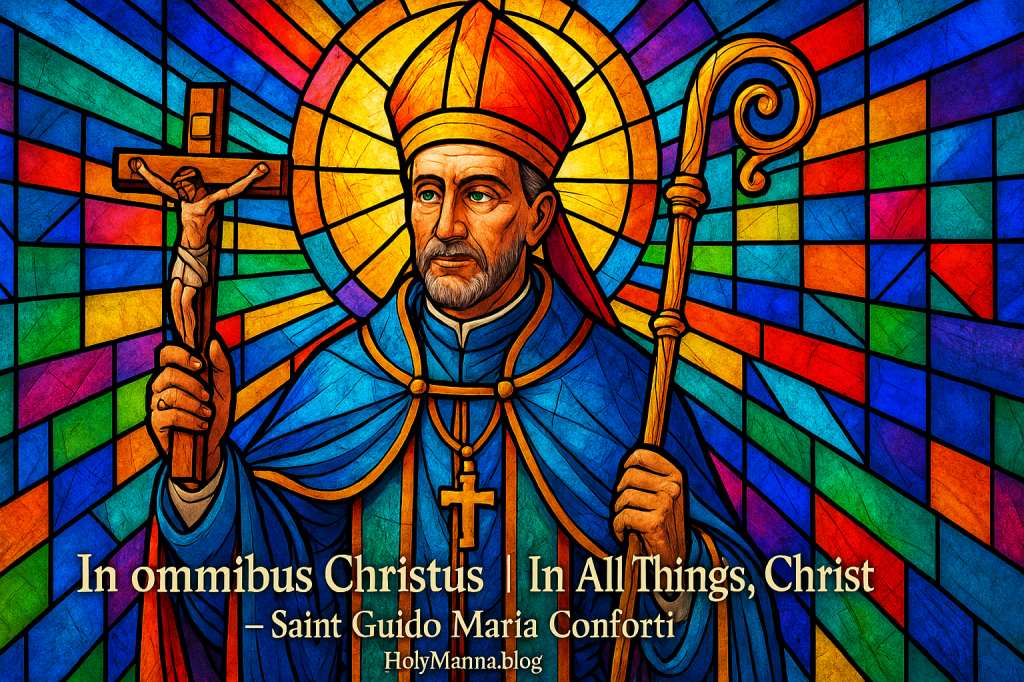
A Heart for the Whole World
Saint Guido Maria Conforti, Bishop of Parma and founder of the Xaverian Missionaries, stands out as a gentle shepherd with a global vision. His life radiated a love for the Crucified Christ that overflowed into bold missionary action. He formed and sent men to the far reaches of the world, encouraged clergy everywhere to think with a missionary heart, and reminded the faithful that holiness and evangelization belong together. Canonized on October 23, 2011, and commemorated on November 5, he is revered for igniting missionary zeal in modern times, not through noise, but through fidelity, humility, and a contagious passion for Christ. His lifelong motto captured his soul’s horizon: “In omnibus Christus.” (“In All Things, Christ) He often summed up his dream in a single family phrase: “To make of the world one family.”
Formed Before the Crucifix
Guido was born on March 30, 1865, in Casalora di Ravadese near Parma, the eighth of ten children in a hardworking farming family. As a boy studying with the De La Salle Brothers, he developed the habit of stopping in a Parma church before a large Crucifix on his way to class. In that silent encounter, grace did its patient work. He later recalled the moment that set his course in life: “I looked at Him, and He looked at me, and it seemed He was telling me many things.” Those “many things” took shape as a burning desire for the missions, especially after reading about Saint Francis Xavier. Although poor health kept him from joining missionary congregations he admired, the Lord redirected his zeal. He entered the diocesan seminary, matured in prayer, and was ordained a priest on September 22, 1888. Rising quickly to serve as vicar general, he never let administrative responsibilities dampen the missionary fire that God had placed in his heart.
A Founder With a Vision and a Father’s Heart
On December 3, 1895, the feast of Saint Francis Xavier, Father Conforti founded the Pious Society of Saint Francis Xavier for Foreign Missions, known today as the Xaverian Missionaries. The rallying cry that animated the first community came straight from Saint Paul and from Conforti’s own heart: “Caritas Christi urget nos.” (“The Love of Christ compels us”) He formed his men with a spirituality that was simple and demanding. Keep your gaze fixed on the Crucified. Live fraternal charity with joy. Learn the language and culture of the people you serve. Seek nothing but the glory of Christ and the salvation of souls. The first Xaverians left for China in 1899, and Conforti accompanied them as a father in the Spirit, writing, visiting, encouraging, and building structures that would outlast him. He accepted appointment as Archbishop of Ravenna in 1902, resigned in 1904 due to serious health problems, and then became Bishop of Parma in 1907, where he poured himself into pastoral renewal. His governance was marked by catechetical reform, care for clergy and religious life, support for Catholic Action, and a practical, tender concern for the poor. In 1928, after years of dreaming, he finally visited his missionaries in China, strengthening them with the same steady directive he lived by: “In all things, Christ.”
The Everyday Miracle of Pastoral Love
Guido Maria Conforti is not remembered for spectacular wonders during his lifetime. His “miracles” wore the face of daily fidelity. He listened to his people with patience, reconciled enemies, encouraged fainthearted priests, and inspired young men to lay down their lives for the Gospel. He taught that the truest sign of God’s power is a heart transformed by the Cross and poured out in charity. His life was a living homily that holiness is missionary, and mission is the overflow of holiness. The fruit speaks for itself. Vocations flourished. Parishes came alive. The Xaverian family took root on new soil. Quiet endurance, pastoral creativity, and fatherly tenderness became the ordinary road by which God did extraordinary things.
Suffering, Surrender, and the Calvary Path of a Bishop
The path of this saintly bishop ran straight through weakness and contradiction. Fragile health forced him to step down from a prestigious archdiocese and embrace a humbler assignment in Parma. Social tensions and political turmoil brought unrest to his city, and he worked tirelessly to foster peace, protect the vulnerable, and keep the Church focused on Christ rather than factions. He accepted illness not with bitterness, but as a place to love God more. He taught his missionaries that the Cross is not a detour for disciples but the royal road. His counsel remained consistent and clear: “Fix your eyes on Christ and do His will.” He did not shed his blood in martyrdom, yet his life was martyr-like in its daily surrender, its calm perseverance, and its courageous charity.
Signs From Heaven After His Passing
Guido Maria Conforti died in Parma on November 5, 1931. After his death, the Lord confirmed his servant’s holiness with striking favors. A young girl in Burundi named Sabina Kamariza was healed of pancreatic cancer following prayers through his intercession, a grace later recognized in the process that led to his beatification. Years afterward in Brazil, a very premature newborn named Thiago João dos Apóstolos Souza suffered a prolonged cardiopulmonary arrest and grave complications, yet recovered in a way that medical experts judged inexplicable. That healing was accepted for his canonization. These signs do not draw attention to the saint as a wonderworker for his own sake. They point to Christ the healer, who delights to glorify Himself in His friends and to strengthen the faith of the Church.
Where His Memory Endures and His Family Grows
Saint Guido’s remains rest in Parma, at the motherhouse church of the Xaverian Missionaries, a place of prayer that continues to radiate his spirit. The religious family he founded now serves across continents, especially in places where the name of Jesus is not yet known or is scarcely heard. Their charism remains clear. They seek to announce Christ with respect and love, to promote dialogue, to form local leaders, and to build communities that look like a single household under the Father. The dream that guided their founder still breathes through their work: “To make of the world one family.”
The Church’s Voice on Mission
Saint Guido’s life harmonizes perfectly with what the Church teaches in the Catechism of the Catholic Church. “The missionary mandate… the Church… strives to preach the Gospel to all.” (CCC 849) “It is from God’s love for all men that the Church in every age receives the vigor of her missionary dynamism.” (CCC 851) “The Holy Spirit is the principal agent of the whole of the Church’s mission.” (CCC 852) The Catechism makes it unmistakable that evangelization is not only the work of missionaries ad gentes. “Lay people… evangelize by the proclamation of Christ by word and the testimony of life… in the ordinary circumstances of the world.” (CCC 905) Saint Guido shows how bishops, priests, religious, and lay faithful each have a part to play. When Christ fills everything, everything becomes mission.
Walking With Saint Guido Today
Saint Guido Maria Conforti teaches that missionary fire begins at the foot of the Cross and grows in the quiet choices of daily life. The invitation is as clear now as it was in his day. Spend a set time each week in Eucharistic adoration and look upon Jesus with love. Whisper his own line as a prayer, “In omnibus Christus.” Ask for the grace to see every meeting, every task, and every irritation through the eyes of Christ. Support the missions with intercession and concrete almsgiving, even if small. Share the Gospel naturally and respectfully in conversations at home, at work, and online. When faced with weakness, make an act of surrender and keep going. What one step can you take today to keep your eyes fixed on Christ and to love your neighbor with missionary charity?
Engage with Us!
Readers are invited to share thoughts and testimonies in the comments below. What part of Saint Guido’s story moved your heart? How is Jesus calling you to a deeper missionary spirit right where you live?
- When you picture Saint Guido as a young student before the Crucifix, what does that scene stir up in your own prayer life?
- Where is Christ inviting you to practice “In omnibus Christus” this week at home, in your parish, or at work?
- How can you support the Church’s mission more concretely through prayer, fasting, giving, or a simple conversation about Jesus?
- Which line from the Catechism about mission challenges you the most, and why?
- What practical step will you take today to keep your eyes fixed on Christ and to love your neighbor with missionary charity?
Keep going with courage. Live a life of faith that breathes love for Jesus Christ into every action, choosing mercy in small things and big things, so that the world truly becomes one family in Him.
Saint Guido Maria Conforti, pray for us!
Follow us on Instagram and Facebook for more insights and reflections on living a faith-filled life.

 Holy Manna!
Leave a comment