Wednesday of the Thirty-first Week in Ordinary Time – Lectionary: 487
Love That Carries the Cross
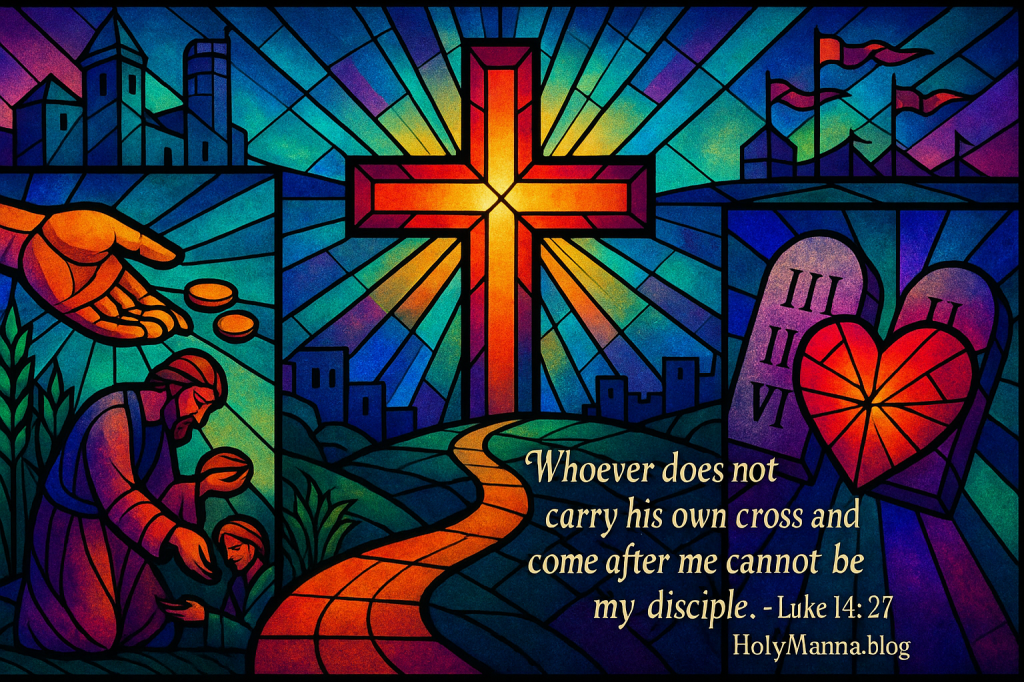
Longing for a faith that is more than slogans, today’s readings unveil love as both the heart of the law and the path of the cross. In Romans 13:8-10, Saint Paul insists that disciples “owe nothing” but charity because “love is the fulfillment of the law”. That claim reaches back to Leviticus 19:18 and is ratified in the Church’s teaching that all the commandments converge in love of God and neighbor, as taught in CCC 2055 and deepened in the virtues of charity described in CCC 1822-1829. Psalm 112 paints the living portrait of this love in action. The just person is steady in darkness, generous with resources, and deals with others in integrity. Scripture even spotlights the generosity that marks authentic righteousness: “Lavishly he gives to the poor” (Psalm 112:9), echoing the Church’s constant witness that almsgiving is a work of mercy (CCC 2447). Then Luke 14:25-33 lays down the price tag of such love. Jesus speaks in the Semitic idiom of preference when he says to “hate” family and life, meaning every attachment must take second place to him. He calls for sober calculation before discipleship, like a builder or a king who counts the cost, culminating in the uncompromising summons: “Whoever does not carry his own cross and come after me cannot be my disciple”, and “everyone of you who does not renounce all his possessions cannot be my disciple”. This is not contempt for good things. It is detachment for the sake of the Greatest Good, a freedom the Church names as essential to following Christ (CCC 2544-2547). The combined witness is clear. Love fulfills the law when it is poured out in concrete mercy, ordered by prudence, purified by detachment, and sealed by the cross. What would charity look like today if nothing stood between your heart and Christ’s call to give?
First Reading – Romans 13:8-10
Love Is the Only Debt That Grows as It Is Paid
Paul writes to a mixed community of Jewish and Gentile believers living in the shadow of imperial Rome, where social obligations, patronage, and legal codes shaped daily life. Into that world of competing loyalties, this short paragraph reframes the entire moral landscape. The decisive obligation is not a civic favor or a ceremonial observance. It is charity. Rooted in Israel’s law from Leviticus 19:18 and fulfilled in Christ, Paul announces that the disciple’s permanent liability is love. This love is not sentiment or mere restraint. It is an active choosing of the neighbor’s good that brings the commandments to their fullness. Read alongside Psalm 112, which celebrates the just person’s generosity, and the Gospel’s summons to costly discipleship in Luke 14:25-33, the message is clear. The law is fulfilled when charity becomes concrete, prudent, and sacrificial. Detachment and the cross do not cancel love. They clear the heart so that love can be total.
Romans 13:8-10
New American Bible (Revised Edition)
8 Owe nothing to anyone, except to love one another; for the one who loves another has fulfilled the law. 9 The commandments, “You shall not commit adultery; you shall not kill; you shall not steal; you shall not covet,” and whatever other commandment there may be, are summed up in this saying, [namely] “You shall love your neighbor as yourself.” 10 Love does no evil to the neighbor; hence, love is the fulfillment of the law.
Detailed Exegesis
Verse 8 – “Owe nothing to anyone, except to love one another; for the one who loves another has fulfilled the law.”
Paul does not forbid legitimate financial obligations. He relativizes every debt under a singular, lifelong obligation that never expires. Charity is both duty and delight. In Christ, the law’s purpose reaches its goal. The commandments are no longer external demands but an interiorized way of life animated by grace, as taught in the New Covenant. The believer who truly wills the good of the other already lives the law’s heart.
Verse 9 – “The commandments, ‘You shall not commit adultery; you shall not kill; you shall not steal; you shall not covet,’ and whatever other commandment there may be, are summed up in this saying, [namely] ‘You shall love your neighbor as yourself.’”
Paul lists representative prohibitions from the Decalogue to show that love is not vague. Love orders desire and action. Adultery, murder, theft, and coveting fracture communion because they contradict the neighbor’s good. When charity governs the heart, the negative precepts are not burdensome. They become the guardrails of authentic freedom that keeps communion intact.
Verse 10 – “Love does no evil to the neighbor; hence, love is the fulfillment of the law.”
This is Paul’s conclusion and his definition. Love never treats a person as a means. Love chooses the true good of the other, in truth and mercy. Because the law aimed to form a people capable of communion, charity is its perfect realization. Where charity rules, the law’s purpose stands complete.
Teachings
The Church defines charity with clarity and precision. CCC 1822 states, “Charity is the theological virtue by which we love God above all things for his own sake, and our neighbor as ourselves for the love of God.” This virtue is infused by God and becomes the form of all Christian moral life. Works of mercy flow necessarily from this interior gift. CCC 2447 teaches, “The works of mercy are charitable actions by which we come to the aid of our neighbor in his spiritual and bodily necessities.” Paul’s summary of the law aligns with the apostolic witness elsewhere. In Galatians 5:14 Scripture declares, “For the whole law is fulfilled in one statement, namely, You shall love your neighbor as yourself.” The saints echo this same center. Saint Augustine famously writes, “Love, and do what you will.” This is not permission for license. It is a demand for transformation. When charity governs thought, word, and deed, the commandments are kept in their deepest intention. The historical context of Rome adds weight to Paul’s words. Surrounded by civic cults, stratified classes, and transactional relationships, the Christian community was marked by a new economy where the only nonnegotiable debt was generous, truthful love.
Reflection
Charity is not a feeling that visits occasionally. It is a decision, sustained by grace, to will and work the neighbor’s good. That means speaking truth without cruelty, giving without counting the cost, and refusing any advantage that harms another. Begin by praying for the person who is hardest to love. Choose one concrete act of mercy today that no one will see. Set aside time to examine whether entertainment, speech, or spending patterns ever injure another’s dignity. Seek reconciliation where harm has been done. What attachment keeps the heart from choosing another’s good? Where can a quiet act of generosity repair a fracture today? How might a simple habit of intercession change the way people are treated in ordinary conversations?
Responsorial Psalm – Psalm 112:1-2, 4-5, 9
Steady Light and Open Hands
This wisdom psalm rises from Israel’s worshiping life as a portrait of the just person whose reverent fear of the Lord orders every choice. In ancient Israel, righteousness carried a social dimension. Acts of generosity were not optional extras but tangible signs that covenant faith had taken root. Psalm 112 mirrors Psalm 111 in structure, pairing God’s faithful works with the believer’s faithful response. Read within today’s theme of costly charity, the psalm shows how delight in God’s commands blossoms into concrete mercy, prudent stewardship, and resilient hope. The just person’s generosity is not a performance. It is the overflow of a heart anchored in God, the same interior freedom that Jesus demands in Luke 14:25-33 and that Paul sums up in love fulfilling the law in Romans 13:8-10.
Psalm 112:1-2, 4-5, 9
New American Bible (Revised Edition)
The Blessings of the Just
1 Hallelujah!
Blessed the man who fears the Lord,
who greatly delights in his commands.
2 His descendants shall be mighty in the land,
a generation of the upright will be blessed.
4 Light shines through the darkness for the upright;
gracious, compassionate, and righteous.
5 It is good for the man gracious in lending,
who conducts his affairs with justice.
9 Lavishly he gives to the poor;
his righteousness shall endure forever;
his horn shall be exalted in honor.
Detailed Exegesis
Verse 1 – “Hallelujah! Blessed the man who fears the Lord, who greatly delights in his commands.”
Beatitude begins with worship. Fear of the Lord is filial awe, not cringing terror. Delight in God’s commands reveals that obedience is relational, springing from trust in the Lawgiver. The psalm establishes that happiness is not found in having more but in loving God more, which prepares the heart for generous love of neighbor.
Verse 2 – “His descendants shall be mighty in the land, a generation of the upright will be blessed.”
Righteousness bears generational fruit. Integrity forms a culture within the family where courage and virtue can grow. The blessing described is not merely material. It is the strength that comes from stability in God, a legacy of justice that outlives the one who practices it.
Verse 4 – “Light shines through the darkness for the upright; gracious, compassionate, and righteous.”
Three words sketch the just person’s character: gracious, compassionate, righteous. The image of light dawning in darkness evokes God’s own action in salvation history and signals that those who share God’s heart become channels of his light. Mercy does not deny truth. Mercy puts truth into motion for the neighbor’s good.
Verse 5 – “It is good for the man gracious in lending, who conducts his affairs with justice.”
Generosity is paired with prudence. Lending here is not predatory but restorative, expressing solidarity with the vulnerable. Justice governs business, contracts, and daily decisions. Charity without justice becomes sentimentality. Justice without charity becomes cold. The psalm holds them together in a single life.
Verse 9 – “Lavishly he gives to the poor; his righteousness shall endure forever; his horn shall be exalted in honor.”
Almsgiving crowns the portrait. The just person gives with breadth and freedom, trusting God to sustain what endures. The “horn” symbolizes strength and dignity. Honor here is not applause but the divine recognition that accompanies a life poured out for others.
Teachings
The Church names charity as the heart of Christian living. CCC 1822 teaches, “Charity is the theological virtue by which we love God above all things for his own sake, and our neighbor as ourselves for the love of God.” This interior virtue necessarily becomes outward mercy. CCC 2447 states, “The works of mercy are charitable actions by which we come to the aid of our neighbor in his spiritual and bodily necessities.” In the same spirit, CCC 2462 affirms, “Almsgiving is a witness to fraternal charity: it is also a work of justice pleasing to God.” Such generosity flows from detachment for Christ. CCC 2544 teaches, “Jesus enjoins his disciples to prefer him to everything and everyone, and bids them renounce all that they have for his sake and that of the Gospel.” The psalm’s portrait aligns perfectly with the New Covenant vision in which love fulfills the law by becoming concrete in justice, mercy, and a steadfast preference for God’s will.
Reflection
This psalm invites a reordering of desires so that generosity becomes as natural as breathing. Consider setting aside a regular portion of income for hidden alms, not as leftover change but as a first-fruits habit of worship. Review financial and professional decisions through the lens of justice. Ask whether any choice, however small, quietly harms a neighbor’s dignity. Pray this psalm for light in dark places and then look for a practical way to be that light for someone in need. Where could a gracious loan or a quiet gift restore hope this week? What habit of spending or speaking needs to be brought under the fear of the Lord? How might delight in God’s commands free the heart to give with joy and without anxiety?
Holy Gospel – Luke 14:25-33
No Half Measures
The scene unfolds along the road to Jerusalem, the climactic arc of Luke in which Jesus steadily moves toward the cross and teaches the crowds what it truly costs to follow him. In a culture where family loyalty, honor, and property anchored identity, Jesus speaks with Semitic intensity to clarify priorities. The word “hate” is a comparative idiom that demands total preference for Christ over every attachment, not contempt for family or life. His images are concrete and familiar. Builders in first century Palestine planned carefully before raising towers, and kings weighed forces before risking battle. Jesus uses these everyday reckonings to unveil the seriousness of discipleship. In light of today’s theme of costly charity from Romans 13:8-10 and the generous righteousness of Psalm 112, this Gospel insists that love reaches its fulfillment only when the heart is detached enough to carry the cross with Christ. Detachment is not disdain for good gifts. It is freedom to love God and neighbor without reserve.
Luke 14:25-33
New American Bible (Revised Edition)
25 Great crowds were traveling with him, and he turned and addressed them, 26 “If any one comes to me without hating his father and mother, wife and children, brothers and sisters, and even his own life, he cannot be my disciple. 27 Whoever does not carry his own cross and come after me cannot be my disciple. 28 Which of you wishing to construct a tower does not first sit down and calculate the cost to see if there is enough for its completion? 29 Otherwise, after laying the foundation and finding himself unable to finish the work the onlookers should laugh at him 30 and say, ‘This one began to build but did not have the resources to finish.’ 31 Or what king marching into battle would not first sit down and decide whether with ten thousand troops he can successfully oppose another king advancing upon him with twenty thousand troops? 32 But if not, while he is still far away, he will send a delegation to ask for peace terms. 33 In the same way, everyone of you who does not renounce all his possessions cannot be my disciple.
Detailed Exegesis
Verse 25 – “Great crowds were traveling with him, and he turned and addressed them,”
Popularity is not the same as discipleship. Jesus turns to sift motives. The journey setting signals that following him is dynamic and demanding, not a brief enthusiasm.
Verse 26 – “If any one comes to me without hating his father[a] and mother, wife and children, brothers and sisters, and even his own life, he cannot be my disciple.”
The shocking language is a Semitic way of insisting on ultimate allegiance. Christ does not abolish the fourth commandment. He reorders it under the first. When loyalties compete, the disciple chooses Christ. Even self-preservation yields to fidelity. This is the interior freedom that allows charity to be total.
Verse 27 – “Whoever does not carry his own cross and come after me cannot be my disciple.”
The cross was a Roman instrument of execution and a public sign of shame. Jesus claims it as the badge of belonging. To carry the cross is to accept sacrificial love as the pattern of life, not as an exception, and to walk behind the Master where he leads.
Verse 28 – “Which of you wishing to construct a tower does not first sit down and calculate the cost to see if there is enough for its completion?”
Discipleship requires prudence. Sitting down to count the cost means choosing practices and renunciations that can be sustained by grace. The image guards against impulsive starts that ignore perseverance.
Verse 29 – “Otherwise, after laying the foundation and finding himself unable to finish the work the onlookers should laugh at him”
An unfinished tower becomes a monument to half-heartedness. The warning is pastoral. Begin with intention to finish, trusting grace while acknowledging weakness.
Verse 30 – “and say, ‘This one began to build but did not have the resources to finish.’”
Public failure exposes the danger of shallow commitment. Jesus invites sober realism so that the foundation of faith is matched by a lifetime of endurance.
Verse 31 – “Or what king marching into battle would not first sit down and decide whether with ten thousand troops he can successfully oppose another king advancing upon him with twenty thousand troops?”
The second image shifts from construction to conflict. The Christian life includes real opposition, both exterior and interior. Counting the cost means acknowledging the gravity of spiritual combat and the need for divine aid.
Verse 32 – “But if not, while he is still far away, he will send a delegation to ask for peace terms.”
Prudence seeks peace when victory is impossible. Spiritually this suggests humility. Seek reconciliation with God and others rather than persisting in pride. Renunciation is the path to peace.
Verse 33 – “In the same way, everyone of you who does not renounce all his possessions cannot be my disciple.”
Jesus states the principle plainly. Possessions are not evil in themselves, but attachment is lethal to love. Renunciation creates room for the radical charity that fulfills the law and frees the heart for generous mercy.
Teachings
The Church speaks clearly about the priority of Christ and the necessity of the cross. CCC 2544 teaches, “Jesus enjoins his disciples to prefer him to everything and everyone, and bids them renounce all that they have for his sake and that of the Gospel.” Detachment is ordered to love, not to stoic indifference. The path is cruciform. CCC 2015 states, “The way of perfection passes by way of the Cross. There is no holiness without renunciation and spiritual battle.” This renunciation does not negate the goodness of creation or family bonds. It subordinates them to the Kingdom so that charity may be unhindered. The saints echo this evangelical logic. Saint Ignatius of Loyola prays in the Suscipe, “Take, Lord, and receive all my liberty, my memory, my understanding, and my entire will, all I have and call my own. You have given all to me. To you, Lord, I return it. Everything is yours. Do with it what you will. Give me only your love and your grace. That is enough for me.” Such surrender names the interior act that Jesus demands. In the Roman world where crosses lined the roads as warnings, Christ reframed the cross as the narrow gate into life. The Church reads this passage as a constant call to count the cost so that love can reach its full stature in generous self-gift.
Reflection
This Gospel invites a candid inventory of attachments and a concrete plan for faithful endurance. Consider a simple practice of renunciation that touches real comfort, like regular fasting, intentional limits on entertainment, or a weekly act of hidden almsgiving, all chosen as an offering of love. Order relationships by choosing Christ first, which paradoxically makes love for family more honest and more patient. End each day with a brief examen that asks where the cross was embraced or avoided, then ask for grace to begin again with courage. What possession or preference most competes with love for Christ today? Where might a freely chosen sacrifice open space for generous charity toward a specific person? How can a clear plan for prayer, penance, and mercy help finish the tower rather than leaving a foundation exposed to the weather of distraction?
Built to Last
Today’s Word sketches one coherent path. Romans 13:8-10 declares that “love does no evil to the neighbor” and so brings the commandments to their goal. Psalm 112 shows what that love looks like in real time as light in darkness, integrity in decisions, and generous almsgiving that does not flinch. Luke 14:25-33 names the price of that kind of love with startling clarity, reminding that “whoever does not carry his own cross and come after me cannot be my disciple” and that detachment from possessions frees the heart to love without reserve. Taken together, the readings call for charity that is not a feeling but a cruciform decision, steady enough to endure and generous enough to bless.
Here is the invitation. Count the cost with Christ, then choose concrete love. Name one attachment that competes with fidelity and set it down before God. Plan a hidden act of mercy that no one will notice and offer it with joy. Order daily choices around prayer, repentance, and generosity so that love does not start and stall but actually finishes the work. What step will make room for grace to move today? Where can costly love repair a relationship, restore hope, or bring light into a quiet corner of darkness? The Lord’s grace is sufficient. The tower can be completed when the heart prefers Christ first and pours itself out for the neighbor.
Engage with Us!
Share your reflections in the comments below and help the community grow in wisdom, courage, and charity.
- First Reading – Romans 13:8-10: Where is love being withheld in a concrete relationship today, and what specific step can restore communion this week? How could a chosen act of mercy become a steady habit that fulfills the law rather than a one time gesture?
- Responsorial Psalm – Psalm 112:1-2, 4-5, 9: What practical change in work, budgeting, or lending would make your affairs more just and more gracious? Where is God inviting you to be light for someone walking through darkness, and what will that look like in the next seven days?
- Holy Gospel – Luke 14:25-33: Which attachment, possession, or preference most competes with following Christ, and how will you renounce it in a realistic and sustainable way? What plan for prayer, penance, and mercy will help you carry the cross with consistency rather than bursts of enthusiasm?
Keep moving forward in hope. Choose concrete love, practice generous mercy, and let every word and action reflect the heart of Jesus who teaches how to live a life of faith that endures.
Sacred Heart of Jesus, we trust in You!
Immaculate Heart of Mary, pray for us!
Saint Michael the Archangel, defend us in battle!
Follow us on Instagram and Facebook for more insights and reflections on living a faith-filled life.

 Holy Manna!
Leave a comment